TL;DR
- Binaural beats work through a specific auditory processing mechanism: When a slightly different frequency is presented to each ear, the auditory cortex generates a perceived beat at the difference frequency. This perceived beat can drive neural oscillation toward the target frequency through entrainment — but only while wearing stereo headphones. The effect disappears without them.
- 40Hz gamma binaural beats have the most mechanistic coherence for ADHD focus: ADHD is associated with reduced gamma power in prefrontal cortical networks. Gamma (40Hz) neural oscillation supports the binding of distributed neural activity into coherent attention and working memory function. 40Hz auditory entrainment may support prefrontal gamma activity, producing modest improvements in attentional focus.
- 40Hz gamma and delta serve completely different purposes: 40Hz gamma supports alertness, attentional focus, and working memory. Delta (0.5–4Hz) supports deep sleep and is broadly inhibitory during waking. Mixing them up is one of the most common errors in binaural beats self-application.
- The headache problem is real and preventable: Binaural beat-related headaches typically come from extended use at high volume, inappropriate frequency selection for the task (e.g., using delta frequencies during waking), or underlying sensory sensitivities. Protocol adjustments resolve the majority of cases.
- The evidence is promising but modest: Research supports meaningful — if not dramatic — effects of binaural beats on sustained attention, working memory, and anxiety in healthy adults. The ADHD-specific evidence is preliminary. Binaural beats are a useful adjunct, not a treatment.
Introduction: Does Frequency Actually Work, or Is It Noise Science?
If you have ADHD, chances are you’ve experimented with at least one audio-based focus hack. Maybe it was brown noise. Maybe lo-fi music. Maybe a YouTube video promising that 40Hz gamma frequencies would help you “unlock your brain.”
And if you’ve found yourself wondering whether any of this is actually backed by science, you’re not alone.
The binaural beats industry generates enormous enthusiasm and significant scepticism in equal measure. On one side: a community of people who swear by 40Hz gamma tracks for focus, theta for creativity, and alpha for calm. On the other: it is dismissed as another wellness trend built on placebo and anecdotal success stories.
As is often the case, the truth lies somewhere in the middle.
Binaural beats are based on a real and measurable neurological phenomenon called neural entrainment. When two slightly different frequencies are played into each ear, the brain perceives a third “beat” equal to the difference between them. EEG studies suggest that this perceived beat can influence brainwave activity while you are listening. That said, the effects are generally modest. For some people, binaural beats create a noticeable shift in focus or calm. For others, they feel distracted or do very little at all.
So the most useful question is not whether binaural beats “work” in a universal sense, but:
- What do they actually do?
- Who are they most helpful for?
- Under what conditions do they seem to work best?
- And how much of a difference can you realistically expect?
For ADHD, the question becomes especially interesting because neuroscience is more specific than it first appears. ADHD is associated with differences in the brain networks involved in sustained attention, working memory, and executive functioning. Some of these networks also rely on gamma-band activity, which is why 40Hz stimulation has attracted particular attention.
The research is still emerging, but the theoretical connection is strong enough to make 40Hz gamma binaural beats worth exploring as a potential focus aid. At the same time, tools like binaural beats are just one small part of the picture.
At Coach for Mind, we often work with adults who have tried every productivity strategy they can find like Pomodoro timers, apps, body doubling, supplements, and endless “focus hacks.” Sometimes these tools help. But many clients discover that their biggest struggle is not a lack of productivity techniques. It is the shame, self-criticism, emotional overwhelm, and nervous system dysregulation that make it difficult to access focus in the first place.
When that is the case, therapy can help address the underlying patterns while tools like binaural beats serve as useful supports along the way.
What Is the Best Sound Frequency for ADHD Focus?
Of all the frequencies commonly recommended for ADHD, 40Hz gamma has the strongest scientific rationale. Gamma brainwaves are associated with sustained attention, working memory, and the brain’s ability to integrate information into a coherent stream of thought. In simpler terms, they are linked to the mental processes that help us stay focused, hold information in mind, and think clearly.
| f=40 Hz |
This is particularly relevant because ADHD is associated with differences in the prefrontal cortex, the part of the brain involved in planning, prioritising, impulse control, and attention regulation. EEG studies have found that many people with ADHD show relatively lower fast-wave activity (such as beta and gamma) and higher slow-wave activity (particularly theta), especially during tasks that require sustained concentration. This does not mean every person with ADHD has the same brainwave pattern, but it does provide a plausible explanation for why some people find 40Hz stimulation helpful.
The idea is that listening to 40Hz binaural beats may gently encourage the brain toward the kind of activity associated with focused attention. Some research suggests this can lead to small but meaningful improvements in concentration and cognitive performance. The key word here is small.
Binaural beats are not comparable to stimulant medication, which acts directly on dopamine and norepinephrine systems involved in attention and executive functioning. The effects are subtler and far more variable from person to person. For some people, 40Hz binaural beats make it easier to settle into a task and reduce the friction of getting started. Others notice no difference, or even find the sound distracting.
One Reddit user on the ADHD forum described it this way: “They don’t help me focus for hours, but they do help me get into focus mode.”
For many adults with ADHD, the hardest part is not staying focused once momentum builds, it is getting past the mental resistance and overwhelm that comes before starting. If a 30-minute 40Hz session helps you cross that threshold, it can be a useful tool.
At Coach for Mind, we encourage clients to treat strategies like binaural beats as experiments rather than solutions. If they help you initiate work, reduce distractions, or feel more mentally organised, they may deserve a place in your toolkit. But if attention difficulties are tied to chronic stress, perfectionism, emotional dysregulation, or years of feeling “not good enough,” the deeper work often involves understanding and supporting the nervous system as a whole.
How Do Binaural Beats Work Without Giving You a Headache?
Binaural beats are created when two slightly different tones are played into each ear through headphones. Your brain processes the difference between the two tones as a rhythmic “beat,” which may gently influence brainwave activity while you listen. For many people, this feels calming or focusing. But for others, especially those with sensory sensitivities, binaural beats can lead to headaches, mental fatigue, or a feeling of irritation. The good news is that this is usually preventable.
If you have a history of epilepsy, seizures, or severe migraines, it is best to speak with your doctor before using binaural beats. At Coach for Mind, we often remind clients that if a “focus tool” leaves you feeling worse, it is not the right tool for your nervous system. Attention support should feel supportive, not overwhelming.
Volume Matters More Than You Think
The most common cause of binaural beat-related headaches is simply listening at too high a volume. The entertainment effect does not become stronger when the sound is louder. In fact, higher volume usually just increases auditory fatigue. A moderate listening level is more than enough. A good rule of thumb: if the sound feels intrusive or tiring after a few minutes, turn it down.
Using the Wrong Frequency for the Task
Different frequencies are associated with different mental states.
- 40Hz gamma: focus and alertness
- Alpha (8–12Hz): relaxed attention
- Theta (4–8Hz): meditation and creativity
- Delta (0.5–4Hz): deep sleep
Using sleep-related frequencies like delta during the day can leave you feeling groggy, foggy, or headachy. This is one of the most common mistakes people make when experimenting with binaural beats.
Longer Is Not Necessarily Better
More listening does not always mean better results. For most people, 20–40 minutes is the sweet spot. Beyond that, the benefits often plateau and fatigue can start to build.
Sensory Sensitivities Are Real
Many neurodivergent individuals, including those with ADHD, are especially sensitive to repetitive sounds.
If binaural beats feel irritating, overwhelming, or exhausting even at low volume, that does not mean you are “doing it wrong.” It may simply mean your nervous system does not respond well to this type of auditory input.
In these cases, alternatives like brown noise or pink noise are often easier to tolerate while still helping to mask distracting background sounds.
A Gentle Trial-and-Error Approach
Like many ADHD tools, binaural beats are highly individual. Some people find them genuinely helpful for getting into a focused state. Others notice no effect, or decide they prefer simpler options like instrumental music or brown noise. At Coach for Mind, we encourage clients to approach these tools with curiosity rather than pressure. If it helps you start a task with a little less resistance, that is meaningful. And if it gives you a headache, your nervous system is giving you useful feedback. The goal is not to force yourself to use what works for someone else. It is to discover what helps your own mind feel more supported and regulated.
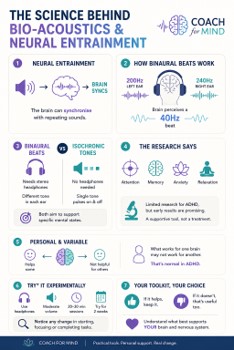
What Is the Science Behind Bio-Acoustics and Neural Entrainment?
Binaural beats are based on a real neurological phenomenon called neural entrainment. This simply means that the brain can temporarily synchronise its activity with a repeating external stimulus, such as sound.
When two slightly different tones are played into each ear, your brain perceives a third rhythmic beat equal to the difference between them. For example, if one ear hears 200Hz and the other hears 240Hz, the brain detects a 40Hz beat.
EEG studies suggest that this perceived beat can influence brainwave activity while you are listening. Once the sound stops, the brain returns to its usual baseline state.
Binaural Beats vs Isochronic Tones
Binaural beats require stereo headphones, because each ear must receive a different tone.
Isochronic tones work differently: they use a single tone that pulses on and off at a set rhythm. They do not require headphones and may produce stronger effects for some people.
Both aim to encourage specific mental states, but neither works equally well for everyone.
What Does the Research Say?
The evidence suggests that binaural beats can have small to moderate effects on:
- Sustained attention
- Working memory
- Anxiety
- Relaxation
The research specific to ADHD is still limited, but early findings are promising enough to make them worth trying as a focus aid. The key point: binaural beats are best thought of as a supportive tool, not a treatment in themselves.
Some people with ADHD find 40Hz binaural beats genuinely helpful for getting into a focused state. Others find them distracting or notice no difference at all. This variability is very typical of ADHD. The same tool can feel transformative for one person and irrelevant for another.
At Coach for Mind, we encourage clients to approach focus tools experimentally. Try using 40Hz binaural beats with headphones, moderate volume, and 20–30 minute sessions for two weeks. Notice whether your ability to start tasks, sustain attention, or complete work actually improves.
If it helps, it can become part of your toolkit. If it does not, that is useful information too. The goal is not to find a universal solution, but to understand what best supports your particular brain and nervous system.
How Does Therapy Help with ADHD-Related Focus and Regulation?
When people think about ADHD treatment, they often think of medication, productivity apps, or practical tools like planners and timers. These can be incredibly helpful. But for many adults with ADHD, the struggle goes far beyond attention. Over time, ADHD can shape how you see yourself.
You may have spent years being told that you are lazy, careless, inconsistent, “full of potential,” or not trying hard enough. Many adults come to therapy carrying deep shame, chronic self-criticism, and a sense that they cannot trust themselves to follow through. This is where therapy can be transformative.
Therapy helps address not only the symptoms of ADHD, but also the emotional wounds and nervous system patterns that often develop around it. If you are unsure of how to get started, book your free discovery call with Coach For Mind today.
ADHD Is More Than a Focus Problem
ADHD is not simply about being distracted. It affects:
- Task initiation
- Time management
- Emotional regulation
- Impulse control
- Self-esteem
- Relationships
- Burnout and stress tolerance
Many people with ADHD can focus intensely on things that are interesting or urgent, while feeling almost physically unable to start tasks that feel boring, ambiguous, or overwhelming. This inconsistency can be deeply frustrating, both for the person with ADHD and for the people around them. You can click here to read more about it.
CBT for ADHD: Building Practical Skills
Cognitive Behavioural Therapy (CBT) adapted for ADHD focuses on the everyday challenges that often cause the most distress. This includes:
- Breaking large tasks into manageable steps
- Improving time estimation
- Creating realistic routines
- Developing systems for organisation
- Challenging self-critical thoughts such as “I always mess things up”
CBT helps clients move from “I’m lazy” to “My brain needs a different strategy.”
DBT Skills for Emotional Dysregulation and Rejection Sensitivity
Many adults with ADHD experience intense emotional reactions, including what is often referred to as Rejection Sensitive Dysphoria (RSD). A small criticism, delayed text, or perceived disappointment can trigger feelings of shame, panic, or anger that feel disproportionate but very real. DBT-informed skills can help with:
- Distress tolerance
- Emotional regulation
- Impulse control
- Communicating needs effectively
These skills help create more space between the emotional trigger and the response.
Somatic Therapy and Nervous System Regulation
Focus depends heavily on nervous system state. When your body is in chronic fight-or-flight mode, or collapses into shutdown, it becomes much harder to access attention, planning, and decision-making. Somatic approaches help clients notice and regulate bodily states through:
- Breathwork
- Grounding techniques
- Interoceptive awareness
- Movement-based regulation
For many ADHD clients, improving focus begins with helping the body feel safer and more settled.
Attachment and Self-Worth Work
Some adults with ADHD carry longstanding beliefs such as:
- “I’m unreliable.”
- “I disappoint people.”
- “Something is wrong with me.”
Therapy can help explore where these beliefs came from and gradually build a more compassionate and accurate understanding of oneself. This often includes elements of:
- Attachment-based therapy
- Inner child work
- Compassion-focused therapy
- Psychodynamic exploration
Medication and Therapy Work Best Together for Many People
Medication can make it easier to access focus and reduce mental noise.
Therapy helps you build the skills, self-understanding, and emotional resilience needed to use that focus effectively.
For many adults, the combination is more powerful than either approach alone.
How Binaural Beats Can Be Paired with Therapy
Binaural beats are not a substitute for therapy, but they can be a useful complement. For example, you might use 40Hz gamma binaural beats:
- Before a therapy homework session
- While working on a difficult task
- During structured work blocks
- To reduce distractions when practising new routines
One client described it as “a helpful bridge” between intention and action. The audio did not solve her executive dysfunction, but it made it easier to begin. That distinction matters. Tools like binaural beats can support focus in the moment. Therapy helps you understand why focus feels difficult in the first place and builds sustainable strategies for change.
At Coach for Mind, we understand that ADHD affects much more than productivity. Our ADHD assessments use the DIVA-5 (Diagnostic Interview for ADHD in Adults) and include a comprehensive understanding of cognitive, emotional, and relational patterns. Our therapy approach may integrate:
- CBT for ADHD
- DBT-informed emotional regulation skills
- Somatic and nervous system regulation
- Attachment-focused therapy
- Inner child work
- Psychoeducation
- Coordination with psychiatrists when medication is indicated
We work with adults across India and internationally who want not only to “get more done,” but to develop a more compassionate and sustainable relationship with their minds. Because ADHD treatment is not just about learning to focus better. It is also about learning to live with less shame, more self-understanding, and a nervous system that feels supported rather than constantly overwhelmed.
Support at Coach For Mind
At Coach for Mind, we understand that stress, trauma, anxiety, and emotional overwhelm are not experienced only in the mind. They are often carried through the body as chronic tension, hypervigilance, emotional numbness, fatigue, shallow breathing, or a persistent sense of being “on edge.” Our approach integrates evidence-based psychotherapy with a trauma-informed understanding of the nervous system, helping clients explore both emotional patterns and embodied stress responses in a safe, regulated, and compassionate way.
We work with concerns such as anxiety, burnout, trauma, relationship difficulties, emotional dysregulation, overthinking, self-esteem issues, chronic stress, and psychosomatic distress. Rather than focusing on quick catharsis or wellness trends, we prioritise long-term nervous system safety, emotional insight, and sustainable healing. Depending on the individual’s needs, therapy may include cognitive, relational, somatic, mindfulness-based, or trauma-informed approaches that help clients reconnect with themselves gradually and safely.
If you have been feeling emotionally overwhelmed, physically tense all the time, disconnected from your body, or stuck in survival mode, support is available. Healing does not require forcing emotional release or pushing yourself beyond your limits. Sometimes it begins with learning how to feel safe in your own body again. You can reach out to Coach for Mind to explore therapy and trauma-informed mental health support in a space that is thoughtful, non-judgmental, and grounded in both science and compassion.
Sessions available online across India and internationally for NRI clients, and in-person in Gurgaon.
References
Oster, G. (1973). Auditory beats in the brain. Scientific American, 229(4), 94–102.
Garcia-Argibay, M. et al. (2019). Efficacy of binaural auditory beats in cognition, anxiety, and pain perception. Psychological Research, 83(2), 357–372.
Adaikkan, C. et al. (2019). Gamma entrainment binds higher-order brain regions and offers neuroprotection. Neuron, 102(5), 929–943.
Barkley, R.A. (2015). Attention-Deficit Hyperactivity Disorder: A Handbook for Diagnosis and Treatment (4th ed.). Guilford Press.
For informational purposes only. Not clinical advice. iCall (India): 9152987821.
Frequently Asked Questions
For some people, yes. Many adults with ADHD describe 40Hz gamma binaural beats as helping them “settle into” focus or reduce the mental friction of starting tasks. The effects are usually subtle rather than dramatic, and not everyone responds the same way. At Coach for Mind, we encourage clients to treat focus tools as experiments and notice what genuinely supports their nervous system and attention.
Generally, yes. 40Hz gamma frequencies are associated with alertness, sustained attention, and working memory, which is why they are often explored for ADHD focus. Delta frequencies are linked to deep sleep and can make people feel foggy or tired during the day. We help clients understand which tools match the state they are trying to create rather than using random frequencies without context.
This is more common than people think, especially in neurodivergent individuals with sensory sensitivities. Headaches usually happen because the volume is too high, the session is too long, or the frequency is not suited to the task. At Coach for Mind, we encourage a gentler approach: low volume, shorter sessions, and stopping if your nervous system feels overwhelmed rather than pushing through discomfort.
No. Brown noise works mainly by masking distracting environmental sounds with a steady, low-frequency sound profile. Binaural beats aim to influence brainwave activity through neural entrainment. Some ADHD individuals find binaural beats more activating and useful for task initiation, while others prefer the softer and more regulating feel of brown noise. We help clients identify what their own nervous system responds to best.
No. Binaural beats may support focus temporarily, but they do not address the underlying attentional, emotional, or executive functioning difficulties associated with ADHD. Medication works through different neurological mechanisms, and therapy helps build long-term regulation, self-understanding, and coping skills. At Coach for Mind, we often integrate practical tools alongside therapy rather than treating them as replacements for deeper support.
Many adults with ADHD struggle not only with focus, but also with shame, overwhelm, emotional reactivity, burnout, and chronic self-criticism. Years of feeling “behind” or misunderstood can deeply affect self-esteem and nervous system regulation. Our therapy approach looks beyond productivity and supports the emotional and relational impact ADHD can have over time.
Our work is tailored to the individual rather than using a one-size-fits-all approach. Depending on the client’s needs, therapy may include CBT for ADHD, DBT-informed emotional regulation skills, somatic and nervous system regulation work, attachment-focused therapy, psychoeducation, and coordination with psychiatrists when medication support is needed. The goal is not just better productivity, but a more compassionate and sustainable relationship with yourself.