
TL;DR
- Your phone is not a neutral tool — it is a nervous system intervention: Every notification, scroll, and alert is a sensory event that registers in the autonomic nervous system. The cumulative effect of hundreds of these micro-activations per day is a specific form of chronic low-grade sympathetic activation that research increasingly links to anxiety, attention dysregulation, and sleep disruption.
- Doomscrolling is not a willpower failure — it is an autonomic loop: The doomscrolling cycle exploits specific features of the human threat detection system. Threat-relevant content activates the orienting response and the amygdala. The activation produces arousal. The arousal triggers a search for more information. The information activates more arousal. The loop is neurobiological, not motivational.
- The 'Visual Fight-or-Flight' response is real: The visual cortex is directly connected to the superior colliculus and the amygdala through pathways that can trigger sympathetic activation from visual input alone — particularly from content depicting threat, conflict, or distressing social dynamics. Threat content on a screen produces genuine physiological threat responses.
- Social comparison on social media activates the same neural circuitry as social threat: Status threat — perceiving oneself as lower in social hierarchy — activates the sympathetic nervous system through the same pathways as physical threat. The continuous status comparison that social media enables maintains a low-grade social threat state that is neurobiologically costly.
- You can use your phone to regulate — but it requires deliberate protocol: Specific applications, frequencies, and content types produce vagal activation rather than sympathetic activation. Brown noise, slow video, binaural beats, guided breath practice, and low-stimulation nature content each produce measurably different autonomic effects than threat-adjacent social media content.
Introduction: The Device in Your Pocket Is Quietly Shaping Your Nervous System
In 2024, the average person unlocked their smartphone 96 times per day. At first glance, that might just sound like a habit. But when we slow it down, each of those unlocks is a micro-shift, a small reorientation of attention toward a stream of content designed to capture and hold you.
From a nervous system perspective, each of these moments is not neutral. It is a sensory event that your brain and body have to register, interpret, and respond to. As these sensory events get registered in the threat detection and reward systems of the brain, they produce neurochemical and autonomic responses. Over time, these micro-activations add up.
What many people don’t realise is this: when you bought a smartphone, you didn’t just buy a communication tool. You also picked up a device that can continuously influence your autonomic state: sometimes in ways that support you, but very often in ways that leave your system more dysregulated than you realise.
This is not about blaming the phone. And it’s not about blaming you either. Because what we see in therapy, again and again, is that people are not “failing to control” their screen use. They are responding to a system that is designed to engage their attention and their nervous system
The clinical pattern of digital dysregulation
Over time, this can begin to show up in very specific ways:
- Anxiety that feels real in the body, but doesn’t seem tied to a clear external cause
- Difficulty sustaining attention, even when motivation is present
- Sleep that doesn’t feel restorative, despite “doing all the right things”
- And the very familiar loop of doomscrolling, or engaging with content that feels distressing, noticing it’s making things worse, and still finding it hard to stop
A client described it in therapy saying “My chest gets tighter as I know I should sleep… still I keep scrolling. It doesn’t even feel like a choice after a point.” That last line is important. Because this is where many people start to feel confused, or even ashamed: “Why can’t I just stop?” From a therapeutic lens, this is not a failure of willpower. It is a loop your nervous system has learned.
This article looks at how social media and digital content interact with your threat and reward systems. It also explains the polyvagal and neurobiological mechanisms, and — because this is a problem with practical solutions — provides specific protocols for using devices in ways that support rather than undermine autonomic regulation.
How Does Social Media Affect the Nervous System?
Let’s find out what is actually happening inside the body when we scroll? At a broad level, social media tends to engage the nervous system through three core pathways:
- Threat detection activation: Your brain is constantly scanning for threat, not just through thoughts, but through sensory input, especially visual information. The superior colliculus, a midbrain structure that processes visual input for rapid threat detection, receives direct projections from the retina and sends direct projections to the amygdala, bypassing the visual cortex's conscious processing. Essentially, there is a fast pathway
This means that when you come across:
- Distressing news
- Conflict-heavy content
- Emotionally charged social interactions
Your body may already be responding before you’ve had time to think, “This is upsetting.” You might notice slight tightening in your chest, or change in your breathing, with a subtle sense of alertness or unease. Individually, these responses are small. But repeated dozens of times a day, they begin to shape your baseline state.
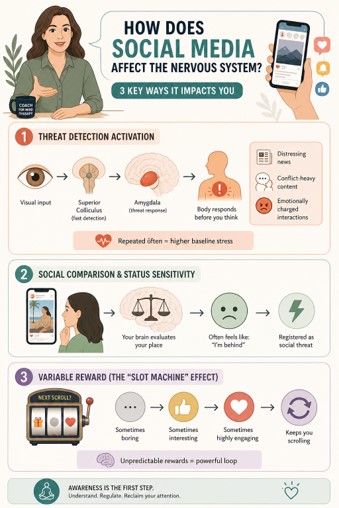
- Social comparison and status sensitivity: As humans, we are wired to track our place in the social world. So when you scroll through images of other people’s achievements, relationships, lifestyles, and appearances - your brain is not just “observing.” It is often evaluating, sometimes very quickly and outside conscious awareness. And that evaluation often lands are “I’m behind” or “I am not doing enough,” our bodies often register this as a part of social threat. One client put it this way: “It’s not like I think anything specific… I just feel worse about my life after being on my phone.” That “just feeling worse” is often your nervous system responding to repeated micro-comparisons.
- Variable reward (the “slot machine” effect): The third mechanism is what keeps the loop going. Social media doesn’t give you consistent rewards. Instead, it gives you unpredictable ones: something interesting, then something boring, then something highly engaging again. This unpredictability is exactly what makes behaviours more persistent. It’s the same reinforcement pattern used in slot machines: you keep going because the next scroll might be the one that feels good, informative, or relieving. Scrolling is not just a habit. It is a neurobiological loop involving arousal, anticipation, and temporary relief.
"I know the doomscrolling is making me feel worse. I can feel it while I'm doing it. My chest gets tighter, I start holding my breath, I get more anxious with every story I read. And I cannot stop. I try to put the phone down and I pick it back up within three minutes. It is not a choice at that point."
— A Reddit User, R/getdisciplined.
Bringing it together
When these three processes combine:-
- subtle threat activation,
- ongoing social comparison,
- and intermittent reward
The nervous system can end up spending large parts of the day in a mild but persistent state of activation. Not overwhelmed. But not fully settled either. You are not “too dependent” on your phone. Your nervous system has simply learned a pattern that makes sense given the environment it’s in. And the good news is, patterns like this can be understood, worked with, and gradually reshaped.
The Visual Fight-or-Flight Response
The visual fight-or-flight response refers to how your brain reacts to threatening or distressing images, often before you’re even aware of it. There’s a fast pathway from the eyes to the amygdala (your threat detection system) that bypasses conscious processing. So when you see content involving violence, conflict, or distress, your body can already be responding.
You might notice:
- a slight increase in heart rate
- shallow breathing
- a sense of alertness or unease
Importantly, this response does not require the threat to be real or happening to you.
This system evolved for a very different environment, one where visual threats were:
- immediate
- real
- and required action
Today, your brain is exposed to continuous streams of threat-relevant content like news, conflict, distressing social situations, without any way to respond physically. So the sequence becomes:
- your body activates
- the response has nowhere to go
- the activation stays in the system
Over time, this can build into a higher baseline of anxiety, difficulty switching off, sleep disruption, and more threat-sensitive thinking.
Clinical note: The visual fight-or-flight response partially explains why media consumption before sleep is so consistently disruptive to sleep quality. The content produces sympathetic activation that the circadian system cannot override with melatonin. The person who stops screen use 90 minutes before sleep and replaces it with low-stimulation, non-threat content (slow-paced video, audio narrative, or no screen) typically shows measurable sleep architecture improvement within two weeks.
Using Your Phone as a Regulation Tool
Your phone is not just a source of stress, it can also become a tool for regulation, depending on how you use it.
Certain types of content tend to calm the nervous system rather than activate it. Steady background sounds like brown or pink noise, slow and repetitive visuals like rain or flowing water, and guided breathing practices all give the body a different kind of input like one that signals safety instead of urgency. Over time, these can help your system settle rather than stay on alert.
The important shift here is this: it’s not about how long you’re on your phone, but what your nervous system is experiencing while you use it. A few minutes of slow breathing can bring the system down. An extended scroll through stimulating or distressing content can keep it activated. The device is the same, but the effect is very different.
In practice, small structural changes tend to work better than drastic ones. Starting your day with a few minutes of something regulating, before checking messages or news, can help your system begin from a more settled place. Interrupting doomscrolling by adding small barriers, like app timers, creates a pause where stepping away becomes possible. Giving your body some buffer time before sleep, with lower-stimulation input, allows it to shift more easily into rest. Even using social media in more defined windows, rather than continuously, can reduce how often your system is getting activated.
At Coach for Mind, we often see clients who are doing meaningful work in therapy but still feel like something isn’t fully shifting. When we look more closely, their nervous system is being re-activated throughout the day through constant digital input. It’s not that therapy isn’t working, it’s that the system isn’t getting enough time to settle in between.
So we don’t approach this as a simple “reduce screen time” problem. We look at what your phone use is doing for you, whether it’s helping you regulate, avoid, or cope, and then build small, practical shifts alongside deeper therapeutic work. If this is something you’re noticing in your own life, you’re welcome to explore it with us. We offer a free 15-minute discovery call to help you understand what might be going on and how therapy can support you.
How Does Therapy Help with Digital Dysregulation?
Therapy helps with digital dysregulation by looking beyond the behaviour itself and understanding what the screen use is doing for you.
For many people, it serves a function. Doomscrolling can feel like a way to manage anxiety by “staying informed.” Social media can soften loneliness through a sense of connection. Passive scrolling can help avoid the discomfort of being alone with one’s thoughts or body.
So the focus in therapy is not just on reducing screen time. It is on understanding the need underneath it and finding more sustainable ways to meet that need. This is often where a shift happens.
Because the compulsive feeling - “I know this isn’t helping, but I can’t stop,” is rarely about a lack of discipline. It is usually a sign that something important is being regulated, soothed, or avoided through the behaviour.
In therapy, we work with this at multiple levels.
- From a CBT lens, we look at the thought patterns that keep the cycle going, like the fear of missing out on important information, or the tendency to compare and feel “behind.” Gently questioning and restructuring these patterns can reduce the urgency to keep checking.
- From an ACT perspective, the work often involves building the capacity to sit with discomfort, whether that’s anxiety, boredom, or restlessness, without immediately escaping into the phone. Over time, this increases psychological flexibility and reduces reliance on avoidance.
- At a nervous system level, we focus on regulation. If scrolling has become your most accessible way to manage internal states, then removing it without alternatives can feel destabilising. So we build other ways for your system to settle, through breath, body awareness, pacing, and sensory grounding. This reduces the need for the behaviour, rather than just trying to control it.
We may also draw from attachment and relational work, especially when social media is meeting needs for connection or validation. Here, therapy becomes a space to explore those needs more directly and build more fulfilling ways of experiencing connection.
At Coach for Mind, we don’t treat digital dysregulation as an isolated habit to “fix.” We look at it as part of a larger pattern, involving your nervous system, your emotional world, and your environment. In practice, this means we might:
- map your screen use alongside your emotional states
- identify what each pattern is helping you cope with
- introduce small, realistic shifts rather than rigid rules
- and support you in building regulation and connection outside the screen
Over time, the goal is not just to reduce screen use, but to help you feel more in control, more settled, and less dependent on it to cope.
At Coach For Mind, digital dysregulation is assessed as part of a comprehensive clinical picture rather than as an isolated behaviour problem. We are interested in what the screen use is doing for the person's nervous system and what needs it is serving, because that analysis directs the treatment toward the underlying issue rather than the surface behaviour
Support at Coach For Mind
At Coach for Mind, we understand that stress, trauma, anxiety, and emotional overwhelm are not experienced only in the mind. They are often carried through the body as chronic tension, hypervigilance, emotional numbness, fatigue, shallow breathing, or a persistent sense of being “on edge.” Our approach integrates evidence-based psychotherapy with a trauma-informed understanding of the nervous system, helping clients explore both emotional patterns and embodied stress responses in a safe, regulated, and compassionate way.
We work with concerns such as anxiety, burnout, trauma, relationship difficulties, emotional dysregulation, overthinking, self-esteem issues, chronic stress, and psychosomatic distress. Rather than focusing on quick catharsis or wellness trends, we prioritise long-term nervous system safety, emotional insight, and sustainable healing. Depending on the individual’s needs, therapy may include cognitive, relational, somatic, mindfulness-based, or trauma-informed approaches that help clients reconnect with themselves gradually and safely.
If you have been feeling emotionally overwhelmed, physically tense all the time, disconnected from your body, or stuck in survival mode, support is available. Healing does not require forcing emotional release or pushing yourself beyond your limits. Sometimes it begins with learning how to feel safe in your own body again. You can reach out to Coach for Mind to explore therapy and trauma-informed mental health support in a space that is thoughtful, non-judgmental, and grounded in both science and compassion.
Sessions available online across India and internationally for NRI clients, and in-person in Gurgaon.
Conclusion
Your phone is not the problem. But the way it interacts with your nervous system matters more than most of us realise.
If you’ve found yourself stuck in patterns like constant scrolling, difficulty switching off, or feeling on edge without a clear reason, it’s not a personal failure. It’s often a nervous system that has adapted to a high-stimulation environment.
The good news is that these patterns are not fixed. With awareness, small shifts, and the right support, your relationship with your phone and with your own internal state, can begin to change.
And often, that change doesn’t come from trying harder. It comes from understanding what your system needs, and learning how to meet it differently.
References
Montag, C. & Reuter, M. (Eds.). (2017). Internet Addiction: Neuroscientific Approaches and Therapeutical Interventions. Springer.
Twenge, J.M. & Campbell, W.K. (2019). Media use is linked to lower psychological well-being. Preventive Medicine Reports, 13, 271–278.
Porges, S.W. (2011). The Polyvagal Theory. Norton.
Anderson, C.A. et al. (2010). Violent video game effects on aggression, empathy, and prosocial behavior in Eastern and Western countries. Psychological Bulletin, 136(2), 151–173.
For informational purposes only. Not clinical advice. iCall (India): 9152987821.
Frequently Asked Questions
For many people, the anxiety of being away from the phone is not actually about the device itself. It is often about what the phone has come to regulate. If your nervous system has learned that checking your phone helps reduce uncertainty, avoid boredom, soften loneliness, or manage anxious anticipation, then being without it can create genuine dysregulation. What people often call “phone anxiety” is frequently a nervous system response to losing a primary coping tool.
At Coach For Mind, we work to understand what internal state the phone is helping you manage, because reducing dependence becomes far easier when alternative forms of regulation and emotional support are built alongside behavioural change.
Automatic phone checking is often less a conscious decision and more a conditioned regulatory behaviour. Over time, the brain learns to pair moments of discomfort, boredom, uncertainty, or emotional activation with the relief or stimulation of checking the device. Eventually the behaviour becomes procedural and reflexive, occurring before conscious thought has fully registered the urge. In therapy, we often help clients slow this process down enough to notice the trigger state underneath the impulse. Once the sequence becomes visible, “I feel discomfort, then I reach,” it becomes possible to intervene more effectively.
Yes. Many people do not realise how much chronic digital overstimulation can resemble primary anxiety, burnout, or attentional exhaustion. Persistent low-grade sympathetic activation from constant notifications, threat-based content, and cognitive switching can produce symptoms such as restlessness, irritability, sleep disturbance, mental fatigue, and a sense of being perpetually “on edge.” This does not mean digital input is always the sole cause, but it can significantly amplify existing vulnerabilities.
At Coach For Mind, we assess digital patterns as part of the broader clinical picture because untreated environmental overstimulation can maintain symptoms even when deeper therapeutic work is progressing.
Screen use often intensifies during periods of emotional strain because the phone offers immediate modulation of internal state. It can distract from distress, provide stimulation when one feels flat, create pseudo-connection when lonely, or offer a temporary sense of control when life feels uncertain. In this way, increased phone use is often less about poor discipline and more about adaptive coping that has become over-relied upon.
Therapy focuses not simply on removing the coping mechanism, but on understanding what emotional function it is serving and building more sustainable alternatives.
Yes. For most people, the goal is not total abstinence but more intentional and regulated use. Social media itself is not inherently harmful; the clinical issue is the relationship between the person, the platform, and the nervous system. Some individuals can engage without significant dysregulation, while others find that even moderate exposure produces substantial activation.
At Coach For Mind, we help clients move away from rigid all-or-nothing approaches and instead identify what forms of digital engagement are regulating, dysregulating, avoidant, connective, or compulsive. The aim is not simply less use, but healthier use.
Extended passive scrolling can produce a kind of dissociative or hyperarised state in some individuals. When the nervous system is repeatedly overstimulated, particularly by rapid emotional shifts, novelty, or conflicting information, it may eventually shift from activation into a flattened or numbed state as a protective response. Many people describe this as feeling “fried,” emotionally detached, or mentally foggy after prolonged screen exposure. In therapy, we may conceptualise this not simply as overstimulation but as the nervous system cycling between sympathetic activation and dorsal withdrawal. Understanding that pattern helps guide more nuanced intervention.
Because if the phone has become intertwined with regulation, avoidance, reward, connection, and habit, reducing use is not merely removing a pastime—it is disrupting an entire psychological system. People often judge themselves harshly because they assume the issue is simple discipline. Clinically, however, compulsive digital use is usually multiply determined: part nervous system regulation, part behavioural reinforcement, part emotional avoidance, and part environmental conditioning. This is why insight alone often does not resolve it.
At Coach For Mind, we approach the issue systemically, helping clients understand and address the full network maintaining the behaviour.
The question is less about hours and more about function and consequence. Screen use becomes clinically relevant when it persistently leaves you more dysregulated, interferes with sleep, concentration, work, relationships, or emotional wellbeing, feels compulsive despite attempts to reduce it, or serves as a primary way of avoiding internal distress. Many people have high screen time without significant impairment; others may have moderate use that nonetheless plays a major dysregulating role. In our work, we assess not just quantity but what the screen use is doing psychologically and physiologically.
Treatment typically involves more than behavioural advice. At Coach For Mind, we begin by mapping the function of the digital behaviour: what emotional states precede it, what needs it serves, what autonomic shifts occur during and after it, and what beliefs or relational dynamics maintain it. From there, treatment may integrate CBT for unhelpful cognitions, ACT for avoidance and distress tolerance, somatic work for nervous system regulation, and deeper relational or attachment-based exploration where screen use is compensating for unmet emotional needs. The focus is not simply on reducing symptoms, but on changing the underlying system that makes the behaviour necessary.