TL;DR
- Regulation Is Not Calm — It Is Flexibility: A regulated nervous system is not one that never experiences strong emotion or activation. It can move fluidly through different states and return to baseline.
- You Do Not Have to Revisit Trauma to Heal Your Nervous System: The nervous system can be retrained through present-moment experience without requiring excavation of the past. For many people, stabilisation through body-based work is both the first phase and sufficient in itself.
- CBT Cannot Reason a Physiological State Away: Physical anxiety symptoms arise from subcortical, automatic processes that are initiated before conscious awareness. Reasoning about them does not reliably resolve them — the body must be part of the intervention.
- Polyvagal Theory Has Reframed What Regulation Means Clinically: Three distinct nervous system states — ventral vagal, sympathetic, and dorsal vagal — each have distinct physiology and distinct clinical implications. Effective treatment requires understanding which state the person is in.
- The Most Evidence-Backed Path Is Integrative: CBT, somatic approaches, EMDR, mindfulness, and relational co-regulation each reach different dimensions of the nervous system. The clinical question is which combination, in what sequence, for this specific person.
- The Body Is the Primary Site of Nervous System Change: Whether healing from trauma, resolving anxiety, or building sustainable capacity for regulation, the evidence increasingly points in the same direction: the body must be part of the work.
Introduction: The Myths That Delay Healing
In the last decade, nervous system regulation has moved from the edges of psychotherapy into mainstream clinical and popular conversation. Polyvagal Theory, somatic experiencing, window of tolerance, vagal tone — concepts once confined to specialist trauma literature are now part of the vocabulary of millions of people trying to understand their own stress responses, their anxiety, their difficulty sleeping, or their chronic sense of threat in environments that should feel safe.
This is largely a positive development. The growing understanding that psychological symptoms are not only cognitive events — that they are physiological states, embodied processes, neurobiological realities — has opened clinical doors that purely cognitive models kept shut. It has permitted people to take their physical symptoms seriously, to understand their emotional volatility as a nervous system response rather than a character failing, and to seek approaches that work at the level of the body rather than only the mind.
But with the mainstreaming of nervous system language has come a set of assumptions — some from partial understandings of clinical science, some from popular wellness culture — that actively interfere with people's ability to engage with their own healing. Three of these assumptions are particularly prevalent, particularly misleading, and worth examining with the care the science deserves. This matters most for people actively working through PTSD or trauma, where misapplied ideas about regulation can genuinely slow recovery — something we unpack further in what emotional trauma really means.
MYTH 1: Regulation Means Being Calm and Serene All the Time
Part One: Regulation Means Being Calm and Serene All the Time — Debunked
Where This Myth Comes From
The conflation of regulation with calm is understandable. For many people, the felt experience of nervous system dysregulation is one of chronic hyperactivation — the racing heart, the shallow breathing, the perpetual low-level vigilance, the inability to rest even when rest is possible. When relief from this state finally arrives, the experience of comparative calm can feel so extraordinary that calm itself becomes the goal.
Meditation communities, mindfulness apps, and wellness culture broadly reinforce this framing. The image of regulation is typically a person in stillness — relaxed, peaceful, unhurried. By implicit contrast, any experience of strong emotion, high arousal, or physiological activation becomes evidence that regulation has failed. This framing is clinically incorrect — and actively harmful for many people trying to heal.
What Regulation Actually Means
In the clinical science of nervous system function, regulation does not mean the absence of activation. It means the presence of flexibility.
A regulated nervous system can:
- Move into states of high arousal — anger, excitement, urgency — when those states are appropriate and useful
- Return to baseline when the demand that generated the arousal has passed
- Access the full range of human emotional and physiological experience without becoming chronically stuck in any single state.
- Respond proportionately to actual present-moment demands rather than to historical threat signals that the current environment does not contain
Dr Stephen Porges' Polyvagal Theory — the most influential neurobiological framework for understanding nervous system states — describes three distinct states:
Ventral Vagal (Social Engagement): The state of genuine safety and social connection. Heart rate is flexible and responsive. Breathing is full. Facial expressiveness and vocal prosody are online. This is what most people mean by 'regulated', but it is not the only regulated state.
Sympathetic Mobilisation (Fight or Flight): The state of physiological activation in response to challenge or threat. Heart rate increases. Cortisol and adrenaline mobilise resources. This state is not dysregulation — it is an entirely appropriate, life-serving response to genuine demand.
Dorsal Vagal (Freeze/Shutdown): The state of physiological collapse in response to perceived inescapable threat. Heart rate drops. The person feels numb, heavy, disconnected. This state — like the sympathetic state — is not inherently pathological. It is a biological last-resort protection mechanism.
Dysregulation does not mean being in the sympathetic or dorsal vagal state. It means being unable to move fluidly between states — being stuck in chronic sympathetic hyperactivation, unable to down-regulate even when safe, or stuck in chronic dorsal vagal shutdown, unable to mobilise even when action is warranted.
"Regulation is not the absence of waves. It is the capacity to surf them."

The Clinical Implication
A person who experiences intense anger is not necessarily dysregulated. They may be in an appropriate sympathetic response to a real injustice, and the clinical task is not to eliminate that response but to ensure they can express it proportionately and return to baseline afterwards.
Many people come to therapy believing that the goal is to feel calm all the time. It often comes from years of trying to manage overwhelming emotions by suppressing them or avoiding situations that might trigger them. This makes sense as a coping strategy, but it is not the same as regulation.
From a clinical perspective, emotions like anger or activation are not the problem in themselves. A strong response can be appropriate to what is happening. The difficulty arises when there is either suppression or a lack of flexibility, when the system cannot return to baseline or moves into extremes too quickly. Over time, suppressing emotions can actually narrow the window of tolerance and increase sensitivity.
At Coach for Mind, the focus is not on eliminating emotional responses but on building capacity to experience them safely. This involves helping individuals recognise their nervous system states, understand what their responses are trying to do, and develop ways to move between states more fluidly. The work often includes body-based awareness, emotional processing, and practical tools for expression that feel proportionate and contained.
The aim is to move away from a life organised around avoiding feelings, toward one where emotions can be experienced, understood, and integrated without overwhelming the system.
MYTH 2: You Must Dig Into Your Trauma Memories to Fix Your Nervous System
Part Two: You Must Dig Into Your Trauma Memories — Debunked
Where This Myth Comes From
The idea that healing requires revisiting the traumatic past has deep roots in the psychotherapeutic tradition. The intuition is comprehensible: if something from the past is causing present distress, surely addressing it directly is the path to resolution. This intuition is not wrong — in some contexts and for some people, direct trauma memory processing is genuinely the most efficient and effective therapeutic pathway. EMDR and Prolonged Exposure Therapy, which involve working directly with traumatic memory content, have strong evidence bases for PTSD specifically.
The myth is not that memory processing is useless. The myth is that it is the only pathway, the primary pathway, or the pathway that should occur first, regardless of a person's current nervous system state and capacity for stabilisation.
The Phase-Based Model: Stabilisation Before Processing
The most influential contemporary frameworks for trauma treatment — including the Phase-Based model endorsed by the International Society for Traumatic Stress Studies (ISTSS) — make a critical distinction between stabilisation and processing. These are not two names for the same thing. They are sequential phases that should occur in order.
Phase One — Stabilisation: Before any direct engagement with traumatic memory content, the therapeutic task is building the nervous system's capacity to approach and tolerate difficult material without being overwhelmed. This involves: developing present-moment regulation skills; expanding the window of tolerance; establishing genuine safety in the therapeutic relationship; and ensuring the person has reliable access to a ventral vagal state before being asked to approach material that will temporarily move them out of it.
Attempting trauma memory processing in a person whose nervous system is still in a chronic survival state — whose window of tolerance is too narrow to approach traumatic content without being flooded — does not process the trauma. It reactivates it. The nervous system is not in a physiological condition to integrate the experience; it can only re-experience it. This is not a theoretical concern. It is one of the most common reasons that therapy makes people worse without the 'getting better' part.
At Coach For Mind, we ensure the process is paced to your needs. The initial focus is on building safety, stabilisation, and widening the window of tolerance before any trauma processing begins. This includes developing awareness of nervous system states, strengthening grounding skills, and creating a sense of internal and external safety. Only when the system shows readiness does deeper processing begin, and even then, it proceeds gradually with continuous regulatory support.
The Body Processes What the Mind Cannot Always Access.
Research by Bessel van der Kolk, Peter Levine, and others has consistently demonstrated that traumatic experience is encoded not only as explicit, narrative memory but as sensorimotor and physiological patterns — body postures, breath patterns, muscular tension, autonomic states — that persist below the level of conscious memory and narrative access.
For many trauma survivors, particularly those with early childhood or pre-verbal trauma, there is no coherent narrative to access and process. The trauma does not exist as a story. It exists as a sensation, a physiological response, a survival pattern that fires without the person being able to identify the memory that installed it. For these individuals, asking them to 'dig into' their trauma memories is asking them to access something that is not organised as accessible memory in the first place.
Neuroplasticity: Healing Through New Experience
The nervous system learns through experience. It was dysregulated through experience — the repeated experiences of threat, overwhelm, or absence of adequate safety that shaped its current default states. It heals through experience — the repeated experience of states it has not had sufficient access to, particularly genuine safety, genuine connection, and the completion of stress response cycles that were previously interrupted.
A person can substantially shift their nervous system's default state — expanding their window of tolerance, reducing their hypervigilance baseline, improving their capacity for co-regulation — through present-moment therapeutic experience without ever directly engaging with the content of specific traumatic memories. Present-moment work is not preparation for the 'real' healing work. For many people, it is the healing work.
At Coach For Mind, we assess the nervous system's readiness before any processing work begins. Stabilisation is not a preliminary stage to rush through. For many clients, it is where the most important change happens.
MYTH 3: CBT Is the Best Way to Reason Your Way Out of Physical Anxiety Symptoms
Part Three: CBT Can Reason Away Physical Anxiety Symptoms — Debunked
Where This Myth Comes From
Cognitive Behavioural Therapy (CBT) is the most extensively researched psychological treatment in existence. Its evidence base for anxiety disorders is genuinely impressive — decades of randomised controlled trials demonstrating meaningful, durable reductions in anxiety symptoms. Its techniques — identifying and challenging cognitive distortions, behavioural exposure, and developing adaptive thinking patterns — have helped millions of people.
The myth is not that CBT is ineffective. The myth is that CBT's mechanism of action is reasoning — that it works by the person thinking their way out of anxiety. And the corollary is that physical anxiety symptoms, because they are experienced in the body, should respond to the same cognitive intervention that addresses anxious thoughts. This misunderstands both how CBT actually works and how the body's threat response system operates.
The Neuroscience: Why Reasoning Cannot Reach Physical Anxiety
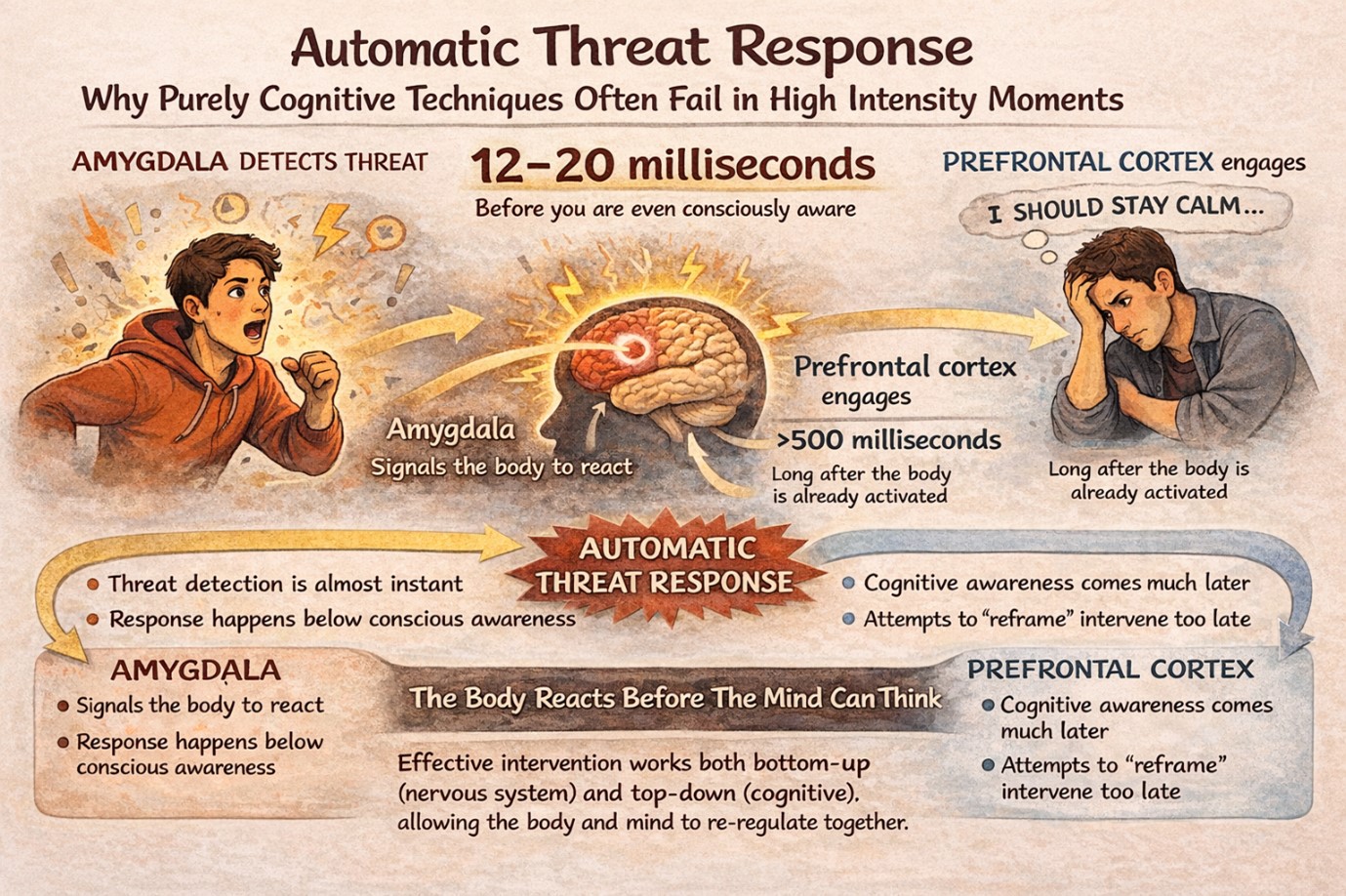
Physical anxiety symptoms — the racing heart, the chest tightness, the muscle tension, the shallow breathing, the nausea, the dizziness — arise from the activation of the autonomic nervous system's sympathetic branch. Specifically, they are the physiological expression of the amygdala-driven threat response: the body mobilising its resources to deal with perceived danger.
The critical neurological fact is this: the amygdala processes threat signals and generates a response in approximately 12–20 milliseconds — before conscious awareness and before the prefrontal cortex (the seat of reasoning and deliberate thought) has even had time to engage. This is not a design flaw. It is a survival feature. By the time you are consciously aware that you are anxious, the physiological response has already been initiated. Applying a cognitive reframing technique to a response generated below conscious awareness is an attempt to intervene at the wrong level.
"I know I am being irrational, but it does not help." — The knowing is entirely real. Knowing occurs at the cortical level. But the anxiety is occurring at a subcortical level that the knowing does not directly access.
What CBT Actually Does — and What It Does Not Do
This needs to be stated precisely, because the research evidence for CBT in anxiety disorders is real and should not be overstated in the opposite direction.
CBT works effectively at several levels:
Cognitive restructuring reduces the frequency and intensity of threat appraisals — the habitual thought patterns that amplify or perpetuate anxiety. By changing the interpretation of ambiguous situations, CBT reduces the frequency of amygdala activation. This is a genuine and valuable mechanism.
Behavioural exposure works through a different mechanism entirely: by providing repeated, safe contact with feared stimuli in the absence of the feared outcome, it gradually retrains the amygdala's associative learning — reducing the conditioned fear response at a neurological level. This is not reasoning. This is learning through direct experience.
What CBT does not do is directly regulate an already-activated physiological threat response through reasoning. If a person is currently in full sympathetic activation — flooded, physically overwhelmed, unable to access the prefrontal cortex that CBT's cognitive techniques require — applying cognitive restructuring in that moment is asking them to use a tool that requires the very system that the anxiety has temporarily taken offline.
What Does Work for Physical Anxiety Symptoms
The clinical approaches with the most direct evidence for physical anxiety symptoms — those that work at the level of the body where symptoms are generated — include:
Breathwork and physiological regulation: Extended exhalation breathing (exhaling for longer than the inhale) directly activates the vagal brake — the parasympathetic mechanism that down-regulates sympathetic activation. This is not a soft relaxation technique. It is a physiological intervention that measurably reduces heart rate within minutes because it speaks the body's own language.
Cold water stimulation: The dive reflex — triggered by cold water on the face — is one of the most potent, rapid-acting vagal activations available, producing immediate, measurable reductions in heart rate through direct parasympathetic activation.
Somatic Experiencing: Peter Levine's approach works with the body's incomplete stress response cycles — the physiological activation that was mobilised in response to threat and never discharged. By gently attending to physical sensations and allowing natural discharge processes to complete, SE resolves stored physiological charge without requiring narrative engagement with trauma content.
EMDR: The bilateral stimulation of EMDR appears to work partly through the orienting response and partly through its effect on the Default Mode Network — reducing the amygdala's associative charge around traumatic material while the prefrontal cortex remains online. It is not a cognitive technique. It works at a level that cognitive techniques cannot directly access.
Co-regulation: The presence of a regulated nervous system — a genuinely safe, attuned other person — directly reduces autonomic arousal through the polyvagal social engagement system. This is not metaphorical. It is a physiological reality: another person's nervous system co-regulates ours through the ventral vagal pathways that govern facial expression, vocal prosody, and social cue processing.
Where CBT Fits — The Integrated Picture
CBT is most powerful in combination with somatic approaches — not as a standalone intervention for physical anxiety symptoms, but as a critical component of a comprehensive approach. The sequencing matters: first, physiological down-regulation to bring the person into their window of tolerance; then, cognitive and behavioural work while the prefrontal cortex is accessible. This is why effective therapists — even those working primarily within a CBT framework — often begin sessions with grounding and regulation practices before engaging in cognitive work.
The problem is not CBT. The problem is the assumption that CBT is sufficient on its own for physical anxiety symptoms, and the corollary that if CBT is not fully working, the person is not applying it correctly. Neither is true.
What Genuine Nervous System Regulation Actually Requires
Safety Is the Prerequisite, Not the Outcome
The nervous system cannot regulate in the absence of sufficient safety, and safety, in the polyvagal sense, is not a cognitive assessment ('I know I'm safe') but a physiological state ('my nervous system is registering safety signals'). Building genuine safety — in the therapeutic relationship, in the body, in the daily environment — is the foundation on which everything else rests.
The Window of Tolerance Is the Clinical Target
Dr Dan Siegel's window of tolerance describes the zone of physiological arousal within which a person can process experience, access their full cognitive and emotional capacities, and engage meaningfully with therapeutic work. Too far above the window (hyperarousal) and the prefrontal cortex is offline — flooded, reactive, unable to reason. Too far below (hypoarousal) and the system has shut down — numb, disconnected, unable to engage.
Expanding this window — gradually, through titrated exposure to challenge and return to safety — is the core project of nervous system regulation work. Not achieving a specific state. Not processing a specific memory. Building the capacity to move through a wider range of experience without becoming stranded outside the window.
Bottom-Up and Top-Down Work Together
The most effective nervous system regulation approaches combine bottom-up interventions (working with the body directly — breathwork, movement, somatic practices, EMDR) with top-down interventions (working with thoughts, meaning, narrative, and behavioural patterns). Neither alone is sufficient:
- Bottom-up approaches reach the subcortical, autonomic processes that top-down approaches cannot directly access
- Top-down approaches address the cognitive and narrative architecture that maintains dysregulation patterns between physiological activations.
The clinical question is not which approach is superior. It is which approach, in what combination, and in what sequence, that will work for this specific person's nervous system profile and presentation.
Co-Regulation Is Not a Supplement — It Is Medicine
One of the most important and most undervalued insights of contemporary nervous system science is that regulation is fundamentally a relational phenomenon. The nervous system developed in a social context. It is calibrated by social signals. And it regulates — or fails to regulate — in significant part through its contact with other nervous systems.
The quality of the therapeutic relationship is not a background variable in nervous system work. It is the primary medium through which co-regulation occurs. A consistently safe, attuned, non-threatening therapeutic relationship provides repeated experiences of ventral vagal activation that the nervous system needs to expand its default range.
At Coach For Mind, the therapeutic relationship is understood as a nervous system intervention in its own right — not the container for the 'real' work, but one of the primary vehicles of change. You can book your free discovery call here!
Conclusion: A More Honest Account of Healing
The three myths addressed in this article share a common structure: they each describe a simplified version of how healing works that sounds plausible and is easier to communicate than the clinical reality, but that, when taken as the whole story, leaves people feeling that they are failing at something they are doing correctly.
The person who has been trying to maintain perpetual calm and feels like a failure every time strong emotion arises is not failing at regulation. They are working toward the wrong target.
The person who has been told they need to access and process their traumatic memories but whose nervous system collapses into overwhelm every time they approach that material is not lacking courage. They are working in the wrong phase.
The person who knows exactly why they are anxious, can identify every cognitive distortion, and still cannot make the physical symptoms stop, is not being irrational. They are applying a tool at the wrong level.
The more accurate account of nervous system healing is less simple but also considerably more hopeful: the nervous system is not fixed. It changes through experience. The right experiences — of safety, of co-regulation, of complete stress-response cycles, of physiological flexibility — produce genuine, durable, measurable change at the level where symptoms are generated. This work is available. It takes time. And it works.
Nervous System Support at Coach For Mind
At Coach For Mind, our work with nervous system dysregulation integrates all of the approaches the clinical evidence supports — not as competing schools, but as complementary tools that reach different dimensions of the same system.
Our approach includes:
- Somatic and body-based regulation work — breathwork, grounding, movement, and autonomic regulation practices integrated from the first session
- Trauma-informed therapy — working with developmental and relational history that shaped the nervous system's current defaults, without forcing processing before stabilisation is established
- EMDR — for processing specific traumatic material once sufficient stabilisation has been achieved
- Adapted CBT — for cognitive and behavioural dimensions of anxiety and dysregulation, sequenced appropriately within a somatic foundation
- Window of tolerance expansion — the core clinical project, built through titrated, relational, and somatic experience over time
- Psychoeducation — giving you an accurate, clinically grounded understanding of your own nervous system, which is itself a regulatory experience
Sessions available online across India and internationally for NRI clients, and in-person in Gurgaon.
www.coachformind.com | [email protected]
Begin with a free 15-minute discovery call. RCI-registered clinical psychologists. Somatic and Trauma-informed counselling psychologists. Evidence-based.
References
Porges, S.W. (2011). The Polyvagal Theory: Neurophysiological Foundations of Emotions, Attachment, Communication, and Self-Regulation. Norton.
van der Kolk, B. (2014). The Body Keeps the Score: Brain, Mind, and Body in the Healing of Trauma. Viking.
Levine, P.A. (1997). Waking the Tiger: Healing Trauma. North Atlantic Books.
Siegel, D.J. (2012). The Developing Mind: How Relationships and the Brain Interact to Shape Who We Are. Guilford Press.
Foa, E.B., et al. (Eds.). (2009). Effective Treatments for PTSD: Practice Guidelines from the International Society for Traumatic Stress Studies. Guilford Press.
LeDoux, J. (1996). The Emotional Brain: The Mysterious Underpinnings of Emotional Life. Simon & Schuster.
Hofmann, S.G., et al. (2012). The efficacy of cognitive behavioral therapy: A review of meta-analyses. Cognitive Therapy and Research, 36(5), 427–440.
Ogden, P., Minton, K., & Pain, C. (2006). Trauma and the Body: A Sensorimotor Approach to Psychotherapy. Norton.
Shapiro, F. (2018). Eye Movement Desensitization and Reprocessing (EMDR) Therapy: Basic Principles, Protocols, and Procedures (3rd ed.). Guilford Press.
This article is for informational purposes only and does not constitute medical advice. If you are experiencing significant anxiety, trauma symptoms, or chronic stress, please seek assessment from a qualified mental health professional.
By Ms Bhavya Sekhri | Psychotherapist at Coach For Mind
Frequently Asked Questions
A regulated nervous system is not one that never experiences strong emotion or physiological activation. It is one that can move fluidly through different autonomic states — mobilising when genuine demand requires it, accessing genuine rest and connection when safety is present, and returning to baseline after activation rather than remaining chronically stuck in threat states. The technical definition is flexibility across the autonomic range. The felt definition is being able to experience the full range of human experience without being trapped in any single state indefinitely.
At Coach for Mind, the work focuses on building this flexibility in real life. This includes helping individuals recognise their states, understand transitions between them, and develop practical ways to return to baseline without forcing calm.
Short answer- yes. While processing traumatic memory content can be a valuable and sometimes essential therapeutic component, it is not the only pathway to nervous system change — and for many people, it is not the appropriate starting point. The nervous system learns through present-moment experience. Somatic practices, breathwork, movement, and co-regulation through safe relationships all produce measurable changes in autonomic function without requiring excavation of traumatic memory content. For those with pre-verbal, relational, or diffuse trauma where no coherent narrative memory exists, these bottom-up approaches may be the primary vehicle of healing.
At Coach for Mind, therapy does not begin with pushing into trauma. The focus is on stabilisation, safety, and present-moment regulation so that the nervous system can change without being overwhelmed.
Because physical anxiety symptoms are generated by subcortical, automatic processes — specifically, amygdala-driven threat responses initiated in approximately 12–20 milliseconds, before conscious awareness. By the time you are aware of physical anxiety symptoms, the physiological response that produced them has already been running for some time. Cognitive reframing operates at the cortical level and cannot directly interrupt a physiological process already underway beneath cortical access. This is not a failure of technique or the person applying it. It is a neurobiological reality. Somatic and physiological approaches — breathwork, movement, cold water, body-based grounding — work at the level where the symptoms are generated.
At Coach for Mind, cognitive tools are not used in isolation. The work integrates body-based regulation first, making cognitive strategies more accessible and effective.
The window of tolerance is the zone of physiological arousal within which you have full access to your cognitive and emotional capacities. Inside the window, you can think clearly, feel proportionately, and engage with experience without being overwhelmed. Above the window (hyperarousal), you may be flooded, reactive, unable to reason — heart racing, breathing shallow, thoughts fragmented, unable to listen or reflect. Below the window (hypoarousal), you may feel numb, heavy, disconnected, and unable to access emotion or motivation. Common signs of being outside the window include inability to track a conversation, dissociation, either excessive emotional reactivity or complete emotional flatness, and difficulty with basic executive function.
At Coach for Mind, individuals are supported in identifying their personal signs of being inside and outside the window. The work then focuses on building skills to return to the window in a way that feels manageable and repeatable.
No. CBT is one of the most evidence-based psychological treatments available and is a genuinely valuable component of comprehensive nervous system work. The problem is not CBT itself — it is the assumption that cognitive techniques are the primary or sufficient tool for physical anxiety symptoms and nervous system dysregulation. CBT's cognitive components work most effectively when the person is within their window of tolerance and can access the prefrontal cortex that cognitive restructuring requires. When combined with somatic regulation practices that first bring the person into their window, CBT becomes significantly more accessible and more effective.
At Coach for Mind, CBT is used as part of a layered approach. The nervous system is supported first, so that cognitive work can actually land and create change.
Polyvagal Theory, developed by Dr Stephen Porges, describes the autonomic nervous system as having three distinct response systems, each associated with a different physiological state: the ventral vagal system (safety, social engagement, genuine rest), the sympathetic system (mobilisation, fight or flight), and the dorsal vagal system (shutdown, freeze, conservation). The theory matters for regulation because it explains why 'just calm down' does not work as a therapeutic instruction — different autonomic states require different interventions, and understanding which state a person is in is the prerequisite for knowing which approach is clinically appropriate.
At Coach for Mind, this framework is applied in practice. Individuals are helped to recognise their current state and learn specific tools that match it, rather than applying the same strategy to every situation.
There is no universal timeline. The evidence consistently shows that nervous system change is possible across the lifespan — neuroplasticity does not have an expiration date. Modest, consistent regulation practice — daily breathwork, regular movement, somatic grounding — produces measurable changes in autonomic markers (particularly Heart Rate Variability) within weeks to months. Bigger changes to the default autonomic state typically require sustained therapeutic engagement over a longer period. The pace depends on the severity and chronicity of the dysregulation, the presence of underlying trauma, and the quality of the therapeutic relationship and social support available.
At Coach for Mind, the focus is on consistency rather than speed. The process is structured to support sustainable change, with an emphasis on integrating practices into everyday life.
Hyperarousal is nervous system activation above the window of tolerance — the sympathetic system is running too hot, generating anxiety, reactivity, inability to rest, physical tension, racing thoughts, and difficulty regulating emotional responses. Hypoarousal is activation below the window of tolerance — the dorsal vagal system has produced a shutdown or collapse state, generating numbness, disconnection, fatigue, emotional flatness, and difficulty mobilising. Both are outside the window. Both are forms of dysregulation. And importantly, both require different interventions — attempting to 'calm down' someone in a hypoarousal state, or attempting to 'energise' someone in a hyperarousal state, can worsen the dysregulation.
At Coach for Mind, the work involves helping individuals differentiate between these states in real time. This allows for more accurate and effective responses, rather than relying on generic coping strategies that may not align with the state.