
TL;DR
- Healing from PTSD and C-PTSD is a structured process, not a quick fix.
- Phase 1: Stabilize your nervous system first using grounding, breathwork, and sensory tools.
- Phase 2: Build safety and coping skills through trauma-informed therapy before deep trauma work.
- Phase 3: Process trauma safely with evidence-based therapies like CPT, PE, EMDR, or gentler options like Somatic Experiencing and IFS.
- Phase 4: Use medication strategically to manage symptoms, but not as a standalone solution.
- Phase 5: Integrate resilience by practicing self-care, learning new skills, and making healthy lifestyle changes to rewire your brain for long-term recovery.
- Coach For Mind offers a personalized, trauma-informed roadmap, from stabilization to resilience, with therapists trained in EMDR, CBT, IFS, and somatic approaches.
- Healing is non-linear; setbacks are normal, prioritize safety, self-compassion, and steady progress.
OVERCOMING POST TRAUMATIC STRESS DISORDER (PTSD)

Note: If you are currently unsafe, thinking about harming yourself, or at risk from others, contact local emergency services or a crisis line immediately. If you are experiencing new or severe physical symptoms (chest pain, fainting, severe shortness of breath), seek emergency medical evaluation first , some medical problems can mimic or trigger PTSD symptoms. If you are on medications, do not change or stop them without discussing with your prescriber.
If you are living with Post Traumatic Stress Disorder (PTSD) or Complex PTSD (C-PTSD), your nervous system is trapped in a loop. The world doesn't feel safe, and symptoms like intrusive flashbacks, hyperarousal, and emotional numbness make every waking moment feel like a high-stakes survival exercise.
You are not alone if you feel despair, overwhelmed by the sheer number of treatment options, or exhausted by years of ineffective therapy. As one survivor powerfully stated:
"People suffering from PTSD and CPTSD are desperate for ANY kind of relief. It literally impacts every single waking moment of your entire life."
The truth is, healing is not a single event or a magic pill. It is a structured, phased roadmap. This guide, built on the consensus of trauma experts, breaks down how to overcome PTSD by prioritizing nervous system stabilization before attempting deep trauma processing.This is your roadmap from survival to resilience.
Phase 1: Stabilize the Nervous System (The Body-First Approach)
For too long, trauma treatment focused solely on changing thoughts (a top-down approach). However, trauma is fundamentally stored in the body and the limbic system, it is a nervous system injury. The critical first step in overcoming PTSD is learning to regulate this dysregulated system.
The primary goal of Phase 1 is to widen your Window of Tolerance, the optimal zone where you can manage emotions without becoming hyper-aroused (anxious, panicked) or hypo-aroused (dissociated, numb).
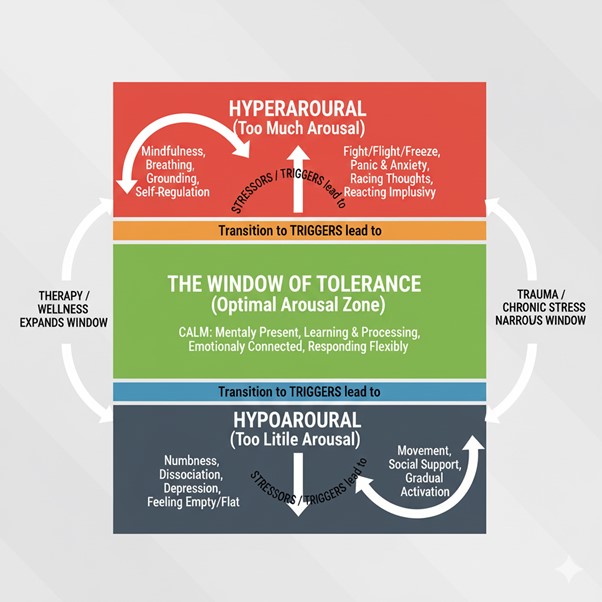
Your PTSD Emergency Toolkit
When flashbacks, dissociation, or hyperarousal strike, you need immediate, discreet tools to pull you back into the present moment. These sensory-based techniques work because they engage the prefrontal cortex, overriding the fear response managed by the amygdala.
| Technique | Purpose | How to Implement |
|---|---|---|
| Temperature Change (TIPP) | Interrupts the physiological panic response by triggering the dive reflex. | Splash ice-cold water on your face (especially around eyes/cheeks) or hold an ice cube in your hand for ~60 seconds. A cold pack across the upper face works as well. |
| Intense Exercise | Burns off adrenaline rapidly and completes the fight/flight motor program. | Do ~1 minute of vigorous activity (running in place, jumping jacks, wall sits). If mobility is |
| limited, do fast foot tapping or strong seated punches. | ||
| Sensory Grounding (5 4 3 2 1) | Pulls the mind out of catastrophic spirals and into the present moment. | Name 5 things you see, 4 things you can touch, 3 things you hear, 2 you smell, 1 you taste. Say them out loud for stronger effect. |
| Intense Flavor Input | Disrupts internal overfocus by forcing sensory redirection. | Chew strong peppermint gum or suck on sour candy. Pay attention to the intensity and sensory detail. |
| Paced Breathing (4 7 8 or 4 6) | Activates the parasympathetic nervous system and counters hyperventilation. | Inhale 4 seconds → hold 7 → exhale 8. If holding feels triggering, use 4 in / 6 out. Focus on lengthening the exhale. |
| Hand-on-Lap Grounding | Reconnects the nervous system to predictable, stable sensory input; gently lowers arousal without overwhelming the body. | Sit comfortably. Place both hands palms down on your thighs. Notice the weight, temperature, and texture of clothing. Slowly turn palms up and feel the shift in sensation. Repeat 2–3 times while breathing naturally. |
| Gentle Rocking | Uses rhythmic vestibular movement to settle the autonomic nervous system; helpful when the body feels frozen or agitated. | Sit with feet grounded. Gently rock your pelvis forward and backward 8–10 times. Keep the movement small and slow. Focus on the feeling of the seat supporting you and the rhythm of the movement. |
| Heart-Hand Pause | Activates parasympathetic soothing through warmth and pressure; helps re-establish a sense of safety and belonging in the body. | Place one or both hands over your heart. Breathe slowly. Notice the warmth, pressure, and slight movement under your hand as you breathe. Stay here for 15–30 seconds, letting your body settle. |
When PTSD coexists with other conditions, PTSD commonly co-occurs with depression, substance use, traumatic brain injury, bipolar disorder, and severe medical illness. These conditions can change treatment priorities. For example, if substance use is active or withdrawal is possible, treat stabilization and SUD first (or simultaneously), because active SUD increases risks during trauma processing. Always coordinate care across providers.
Expert Insight: For those struggling with dissociation, grounding is non-negotiable. Somatic (body-first) techniques are crucial for connecting the mind and body, proving that you are present and safe.
At Coach For Mind we begin with body-first stabilisation, our therapists teach and coach the emergency grounding and vagal tools above so you can widen your Window of Tolerance before moving deeper.
Phase 2: Build the Foundation with Trauma-Informed Care
Before engaging in deep trauma work, you must establish safety, reliable support, and a robust set of coping skills. This involves finding the right therapeutic fit and strengthening your social support network.
Navigating the Therapy Maze: A C-PTSD Warning
Traditional talk therapy can be ineffective or even re-traumatizing if the therapist lacks trauma expertise. If you have Complex PTSD (C-PTSD) resulting from chronic, prolonged trauma (like childhood abuse), you must prioritize stabilization skills before exposure therapy.
The Non-Negotiable Skills Phase
- Validate Your Experience: If you feel like therapy isn't working, trust your gut. As one survivor noted: "I went through around 10 years of various therapists before I found one who was actually well-informed in trauma... the difference is really clear."
Prioritize Skill-Building: For C-PTSD, the first phase of therapy must focus on emotional regulation, distress tolerance, and interpersonal effectiveness, skills often taught in Dialectical Behavior Therapy (DBT).
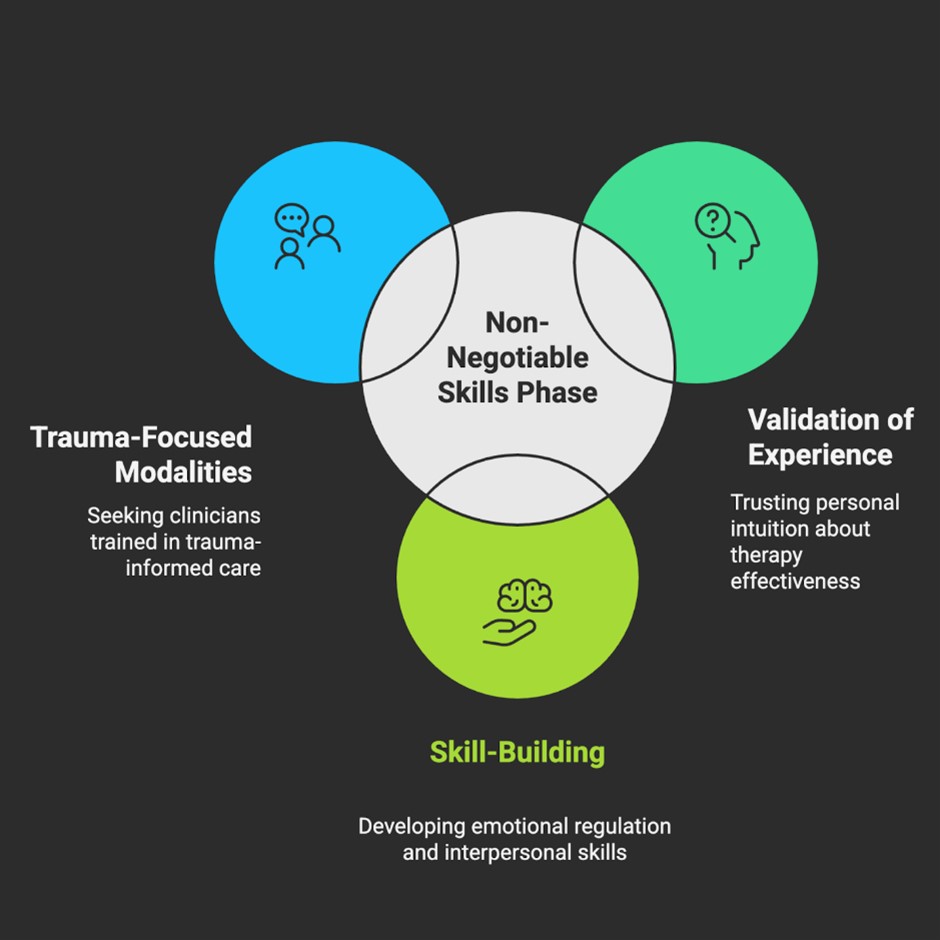
- Avoid intensive trauma processing until you have reliable stabilization skills and a support plan; for many people this means weeks to months of Phase 1–2 work. Seek Trauma-Focused Modalities: Look for clinicians trained specifically in trauma-informed care, not just general Cognitive Behavioral Therapy (CBT).
How to choose a trauma-competent provider, ask:
- What trauma-focused modalities are you trained in (CPT, PE, EMDR, SE, IFS)?
- How do you manage dissociation or worsening symptoms during exposure?
- What is your policy on medications and coordination with prescribers?
- Can you provide a written safety and relapse plan?
If you’re unsure where to start, Coach For Mind offers an initial, trauma-focused consultation free of cost, where we map your current stabilization, list clinician training (EMDR, SE, IFS, CPT), and co-create a safety plan before any trauma processing begins. Book your free discovery call now.
C-PTSD Priority Box: For complex trauma, stabilization is often the longest phase.Focus on mastering skills like setting boundaries, managing the relentless inner critic, and developing genuine self-compassion before moving to Phase 3.
Phase 3: Process Trauma Safely with Gold-Standard Therapies
Once you have established safety and grounding skills (Phases 1 and 2), you are ready to address the traumatic memories themselves. Trauma-focused psychotherapies (TFP) are the most effective way to extinguish the conditioned fear response associated with PTSD.
Large meta-analyses and practice guidelines generally support trauma-focused psychotherapies (TFP) , like CPT, PE, and EMDR , as first-line psychological treatments for PTSD in many populations. Medication can reduce symptoms and support engagement in therapy; the best approach is coordinated, individualized care.
The Core Trauma-Focused Modalities
- Cognitive Processing Therapy (CPT): A specific type of CBT that helps you challenge and modify the unhelpful beliefs (maladaptive cognitions) you developed as a result of the trauma (e.g., "I am incompetent," "The world is entirely unsafe").CPT helps you rewrite the narrative.
- Prolonged Exposure (PE): This involves safely and repeatedly confronting trauma-related memories, feelings, and situations. By doing this in a controlled environment, the brain learns that the memory is no longer a threat, allowing the fear response to diminish.
- Eye Movement Desensitization and Reprocessing (EMDR): EMDR uses dual attention stimuli (like following a therapist’s hand or alternating tones) while recalling traumatic memories. This process is thought to mimic REM sleep, helping the brain process and reorganize the memory so it loses its emotional charge.
Alternative & Adjunctive Trauma-Processing Modalities
While EMDR, Prolonged Exposure, and Cognitive Processing Therapy (CPT) are the traditional gold-standard, research-backed approaches, many trauma survivors, especially those with C-PTSD, dissociation, or chronic hyperarousal, benefit from gentler, body-based or parts-based modalities. These therapies work differently from exposure-based approaches and can be used instead of or in combination with EMDR, PE, or CPT.
Somatic Experiencing (SE): Body-First Trauma Resolution
Somatic Experiencing focuses on completing the body’s interrupted fight/flight/freeze responses, which are often left “stuck” in the nervous system after trauma. Instead of diving into the narrative of the trauma, SE guides you to track subtle internal sensations (tightness, heat, pressure, impulses to move) and gently discharge stored survival energy.
Best for:
- C-PTSD
- Freeze responses, shutdown, dissociation
- People overwhelmed by exposure therapies
- Individuals whose trauma is felt more in the body than in thoughts
Why it matters:
SE is one of the safest ways to work with a sensitized nervous system because it helps rebuild regulation without forcing traumatic memory recall. It’s a powerful bridge between Phase 1 stabilization and deeper trauma processing.
Internal Family Systems (IFS): Healing Trauma Through Parts Work
Internal Family Systems (IFS) views the psyche as a system of “parts,” each carrying different roles and burdens:
- Managers: Keep life controlled
- Firefighters: Block pain through extreme reactions (panic, addiction, rage)
- Exiles: Hold the raw, unbearable emotions from trauma
IFS does not require reliving trauma in vivid detail. Instead, it teaches you to access your Self, a calm, compassionate inner state,and help your parts unburden the trauma they have been carrying.
Best for:
- Emotional flashbacks and shame
- Attachment trauma
- Inner critic, self-blame, toxic guilt
- Survivors who disconnect or numb under exposure therapy
Why it matters:
IFS is often better tolerated than exposure methods, especially for C-PTSD, because it focuses on internal safety and compassion rather than revisiting traumatic events directly.
How These Compare to EMDR, CPT, and PE
EMDR is fast and effective for clear, discrete traumas and intrusive memories. It uses bilateral stimulation to help the brain reprocess traumatic material. However, it can be too activating for people with high dissociation or very poor nervous system stability. SE and IFS pair extremely well with EMDR because they strengthen the nervous system beforehand.
Prolonged Exposure (PE) involves repeatedly accessing traumatic memories or avoided situations until the brain learns the memory is no longer dangerous. It works, but it is the most intense modality and has the highest dropout rate, especially for people with fragmented memories or chronic trauma. SE and IFS serve as safer alternatives for those who cannot tolerate exposure.
Cognitive Processing Therapy (CPT) centrally targets trauma-related beliefs (“I am unsafe,” “It was my fault”). It’s excellent for cognitive distortions but less effective for pre-verbal trauma, somatic trauma, or survivors who struggle with dissociation. SE and IFS complement CPT by helping process the body-level and emotional aspects that thoughts cannot reach.
The Psychotherapists at Coach For Mind are trained across EMDR, CPT, PE, IFS and somatic approaches, we tailor the pathway (gentle → intermediate → exposure) to suit your nervous system, not the other way round.
When Exposure is Too Much: Mindfulness and Alternatives
While TFP is the gold standard, it requires active participation and can be highly distressing, leading to high dropout rates. If actively re-living the trauma feels overwhelming,"I find that re-living the trauma can make me worse for days",alternative approaches offer a gentler path.
Mindfulness-Based Therapies such as Mindfulness-Based Stress Reduction (MBSR), focus on nonjudgmental acceptance of thoughts and emotions in the present moment. Studies show MBTshave significantly lower drop-out rates and offer medium to large effect sizes in symptom reduction.
Phase 4: Utilize Medication Strategically (Symptom Management)
Medication can be a powerful ally in healing, but at Coach for Mind, we frame it as support, not a standalone cure. For many of our clients, medication reduces the intensity of symptoms enough for them to meaningfully engage in the deeper psychological work of Phases 2 and 3. When your nervous system is calmer, therapy becomes safer, more accessible, and more effective.
The Medication Hierarchy
- First-Line Options
Prescribers typically begin with SSRIs (such as sertraline / Zoloft, paroxetine / Paxil) or the SNRI venlafaxine (Effexor). These medications are FDA-approved for PTSD and often help reduce persistent anxiety, hyperarousal, intrusive thoughts, and depressive symptoms. When these symptoms settle, clients often say: “I finally have enough space in my mind to do the work.” - Nightmares
Trauma-related nightmares can be exhausting and destabilizing. There is medication prescribed that is often used to reduce their frequency and emotional intensity. Better sleep directly improves emotional regulation and daytime functioning.
CRITICAL CAUTION: Why We Avoid Benzodiazepines for Long-Term PTSD Care
We know how tempting fast relief can feel when anxiety is overwhelming. But for long-term recovery, benzodiazepines often do more harm than good. They may offer short-term calm, but they can:
- Create tolerance and dependence, requiring higher doses over time
- Disrupt exposure-based learning, making trauma therapy less effective
- Increase dissociation and worsen intrusive symptoms for many clients
Under careful medical supervision, they may be used briefly in acute emergencies, but they do not address the neurobiological roots of PTSD. At Coach for Mind, we focus on medications that expand your capacity to heal, not ones that pull you away from the deeper work required for long-term recovery.
Phase 5: Integrate Resilience Through Lifestyle
This phase is where many clients experience the most profound change. After surviving for so long in a state of hypervigilance, the body often needs time to relearn safety. Phase 5 is about building a life that consistently supports your nervous system, not through intensity or hustle, but through gentle, daily anti-neglect practices.
These practices don’t just “maintain progress.” They reshape your brain, your beliefs, and your relationship with yourself.
Neuroplasticity: Rewiring the Brain After Trauma
PTSD is not a life sentence, it reflects a brain that learned to survive overwhelming experiences by rewiring itself around danger. The good news is that the brain is plastic: it can form new neural pathways throughout life. Phase 5 is not just about “maintenance”; it is about intentionally using neuroplasticity to reshape the nervous system toward safety, resilience, and emotional flexibility.
Trauma wires the brain for hypervigilance. Recovery wires it for stability.
Here are the five neuroplasticity principles that matter most for PTSD and C-PTSD recovery:
- Learning New Skills (Cognitive Enrichment)
Nothing drives neuroplastic change more powerfully than learning something genuinely new. Trauma narrows your world; learning widens it. This can include:
- learning a musical instrument
- a new language
- painting, drawing, pottery
- coding or any new technical skill
These activities strengthen the prefrontal cortex, the very area that trauma tends to suppress, supporting better emotional regulation and reducing reactivity.
- Novelty (Breaking the Trauma Loop)
Trauma teaches your nervous system to expect the same danger repeatedly. Novel experiences remind your brain that life contains new, safe possibilities.
Small acts of novelty can be transformative:
- taking a different walking route
- trying a new cuisine
- changing your evening routine
- picking up a new sensory or creative hobby
Each new experience says: “The present is not the past.” And it disrupts trauma-driven prediction loops and supports new emotional associations.
- Complexity (Challenging the Brain Enough to Grow)
For neuroplasticity, the task must be challenging enough to stretch cognitive capacity without overwhelming it. Activities with layered complexity, like dance choreography, chess, knitting patterns, martial arts, or learning an instrument, stimulate:
- working memory
- spatial reasoning
- motor coordination
This strengthens large-scale brain networks that trauma often suppresses.
- Bilateral Physical Movement (Neurobiological Reset)
Bilateral rhythmic movement (left-right-left-right) naturally engages the brain’s integrative systems and supports emotional regulation.
Examples:
- walking or running
- swimming
- rowing
- dancing
- drumming
This type of movement also improves vagal tone and reduces sympathetic overactivation, key for long-term stabilization.
- Meditation & Mindfulness-Based Practices
Meditation is one of the few tools proven to directly increase gray matter density in areas affected by PTSD (like the hippocampus).
Especially helpful forms include:
- breath-focused meditation
- body scans
- loving-kindness practices
- slow, mindful yoga
Meditation doesn’t erase trauma, it trains the brain to notice sensations without being hijacked by them, transforming reactivity into resilience.
Why This Matters
Phase 5 is often misunderstood as a “maintenance stage,” but it is actually the phase where the most profound brain changes occur. Neuroplastic activities shift the system from merely coping to genuinely healing, creating new neural circuits that support safety, self-trust, and emotional regulation.
Lifestyle Changes for Neurobiological Health
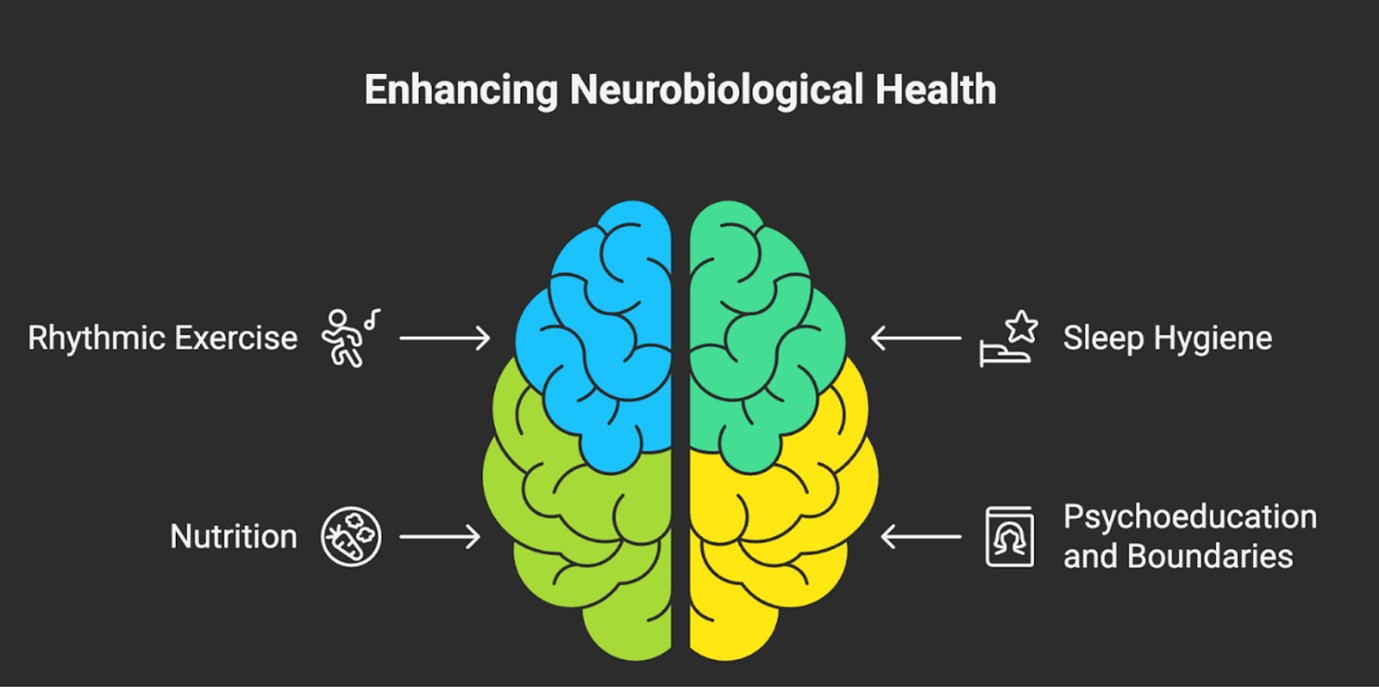
Chronic stress from PTSD leads to HPA axis dysregulation, which impacts everything from inflammation to sleep. You can actively modulate this through consistent habits:
- Rhythmic Exercise: Activities like walking, running, swimming, or cycling are particularly beneficial. Rhythmic, bilateral movement helps regulate the nervous system and reduce high levels of hyperarousal.
- Sleep Hygiene: Adequate sleep is essential for the brain to process memories and regulate mood. Maintaining a strict, dark, cool sleep routine is vital.
- Nutrition: Focus on anti-inflammatory foods rich in Omega-3 fatty acids, which support brain health and neuroplasticity,the brain’s ability to reorganize circuits necessary for healing.
- Psychoeducation and Boundaries: Continue learning about trauma and setting firm boundaries in your life. This reinforces the internal message that you are worthy of safety and respect.
The Lasting Impression
Healing is non-linear, and setbacks are a normal, expected part of the process.
By committing to this phased roadmap,starting with stabilization and moving carefully toward trauma processing, you regain control over your body and your life. You are not destined to remain "stuck" in the past.
You have the power to move beyond mere survival and into true resilience.
Why Choose CoachForMind for Your Healing Journey?
At CoachForMind, we understand the unique experiences and how easily deep wounds can be misunderstood.
Experienced and Licensed Psychologists: We are a team of licensed RCI-registered (Rehabilitation Council of India) mental health counselors. Our team is well-experienced in various forms of therapies such as CBT, IFS, DBT, EMDR therapy for trauma, Somatic and Narrative Therapy. Our expertise is verifiable, and our commitment to ongoing training ensures we deliver the most current and effective treatments.
Personalized, Client-Centered Approach
We are dedicated to treating our clients in the best-suited way, carefully curated as per the client's needs, and adhering to one-on-one, client-centered therapy. Every individual is different and every story is unique. We move beyond a one-size-fits-all model to create a safe, non-judgmental space where genuine healing can occur.
Scientific, Evidence-Based Techniques
Our treatment plans and therapeutic methods are based on highly researched scientific findings such as Cognitive Behaviour Therapy, Narrative Therapy, and Dialectical Behaviour Therapy. We believe in transparency and utilizing methods that have been proven effective in treating trauma. Our goal is to empower our clients, making them the authors of their own stories rather than passive recipients of a diagnosis.
Quality Service Grounded in Empathy
We at CoachForMind ensure quality services in our treatment regime and therapeutic approaches. Our clients hold most value to us, so we ground our techniques in empathy while maintaining the highest level of professionalism and confidentiality. We help you slow down the inner chaos so you can finally listen to what the masked trauma has been trying to tell you.
Explore our trauma treatment in India services, or begin with a free 15-minute discovery call For more information, please visit our website or contact us directly at [email protected]
Written by Ms Akshita: Psychotherapist at Coach For Mind
FAQs
Firstly, this is very common and completely normal. Many trauma survivors worry that therapy won’t “work” unless they can recall everything clearly, but fragmented memory is actually one of the most common signs of traumatic stress. During overwhelming events, the brain shifts into survival mode, shutting down the systems responsible for coherent storytelling. What gets stored instead are sensations, flashes, emotions, and body states, not a neat, chronological narrative. Trauma therapy doesn’t require perfect memory. We work with what’s available, your present reactions, body cues, relational patterns, and emotional triggers. These hold just as much therapeutic information as explicit memories.
What you’re likely experiencing
- Memory gaps, sensory flashes, or intense feelings with no clear story.
- Fragments triggered by smells, sounds, or body sensations (the “feels like” without the “remembers”).
- Confusion, shame, or fear about whether what you remember is true.
At Coach For Mind, we treat the nervous system and the fragments first, stability before story. We don’t need a complete narrative to get started. We use body-first and parts-based approaches that don’t demand a linear memory to be effective. Some of the modalities that we use:
- Somatic Experiencing (SE): Tracks bodily sensations and allows the nervous system to complete interrupted survival responses.
- Internal Family Systems (IFS): Helps parts carry emotions and memories gently, allowing “exiles” to be heard without forced recall. Works well with shame, internal confusion, and childhood wounds.
- EMDR: EMDR can be applied to image fragments, body sensations, or the worst sensory moment, not only full narratives. A trauma-informed clinician will titrate the intensity.
- Sensorimotor Psychotherapy / Body-Centered Therapies: Integrate body awareness with gentle processing of what can be tolerated.
Trauma-Informed CBT / CPT: Useful later for cognitive patterns that arise from fragmented memories (self-blame, “I’m broken”).
Nervous system dysregulation is far more common than people realize, especially for anyone with a trauma history. Dysregulation doesn’t always look dramatic, it often shows up as subtle patterns in energy, emotions, and behavior. When the nervous system has been exposed to chronic stress or threat, it can get “stuck” in survival states: hypervigilance, shutdown, emotional reactivity, or numbness. This isn’t a personality flaw; it’s a physiological imprint of past overwhelm. The goal is not to eliminate dysregulation but to learn how to notice it, soothe it, and return to safety more consistently.
What you’re likely experiencing
- Feeling “on edge,” restless, or overstimulated for no clear reason
- Difficulty calming down after small stressors
- Emotional swings, shutdown, numbness, or feeling disconnected from your body
- Trouble sleeping, concentration issues, chronic tension, or digestive changes
At Coach For Mind, we focus on nervous system literacy, helping you understand what state you’re in, how you got there, and how to shift gently. Instead of forcing calm, we teach you how to recognize your survival patterns with curiosity rather than shame. Once you learn the signals of fight, flight, freeze, and fawn, therapy becomes less about “fixing yourself” and more about building nervous system safety and flexibility. Some of the modalities we use:
- Somatic Experiencing (SE): Helps track activation and settle the body through small, manageable steps.
- Polyvagal-Informed Therapy: Teaches how your body signals safety, danger, or shutdown and how to move between states.
- Internal Family Systems (IFS): Helps understand the parts that get activated when your system feels unsafe.
- DBT / Emotional Regulation Skills: Provides grounding, distress tolerance, and present-moment tools for day-to-day stability.
Practical tools to try now
- Paced breathing: 4 in / 6 out for a few minutes when anxious.
- Temperature change (cold splash): Quick way to interrupt panic.
- Bilateral movement: Walk with steady left-right rhythm or gentle alternating tapping.
Micro-check-ins: Place a hand on your belly, breathe, and name one small thing that’s okay right now.
Absolutely and this is often the healthiest and most sustainable place to start. Many people assume trauma therapy must begin with diving into the past, but the truth is that present-day skills like boundaries and regulation set the stage for deeper healing. Without them, trauma processing can feel destabilizing. Working on boundaries isn’t “avoiding the real issue”, it is trauma work, because boundaries were often violated, blurred, or unsafe in the original environment.
What you’re likely experiencing
- Difficulty saying no or feeling guilty after asserting your needs
- Feeling overwhelmed, reactive, or shut down in daily relationships
- Knowing what is healthy but struggling to apply it in the moment
At Coach For Mind, we emphasize boundaries and regulation early on because they give you choice, agency, and emotional clarity, skills that make trauma processing safer, faster, and more effective later. When your system feels more stable, you’re no longer re-enacting old patterns in current relationships, and you become better equipped to revisit the past with resilience rather than collapse. Some of the modalities we use:
- DBT: DBT provides structured, practical skills for people whose emotions feel too intense or too shut down. Instead of trying to “think” your way out of emotional overwhelm, DBT teaches how to regulate your physiology, use grounding techniques, and build distress tolerance. For boundaries, DBT gives clients real scripts and behavioral tools, how to say no, how to hold a limit, and how to navigate guilt or fear that arises afterward. DBTbecomes the emotional stabilizer that makes deeper trauma work possible.
- Internal Family Systems: IFS views boundary struggles as the result of different internal “parts” trying to keep you safe.
- One part might be terrified of conflict.
- Another might fawn or people-please.
- Another might shut down or avoid.
Protector work helps these parts feel understood rather than forced. When protectors trust you more, you naturally begin asserting boundaries without panic or guilt. IFS builds a sense of internal leadership, you decide how to respond, rather than old patterns taking over automatically.
- Somatic Experiencing (SE): For many clients, boundary problems are body-based, not cognitive. The body freezes, collapses, or fawns before the mind has time to think. SE helps you learn the early signals of activation: tightness, breath changes, shrinking posture and gently expand your tolerance for discomfort. Boundary-setting becomes a felt experience: your body learns it is safe to hold your ground, speak up, or step back. Over time, SE helps you move from survival responses to grounded responses.
There is no single “best” trauma therapy, because trauma impacts each person differently. The right modality depends on your symptoms, your nervous system style, and how your trauma shows up today. What matters most is finding an approach that meets your system where it is, not where it “should” be. Some people benefit from body-first work; others from thought-based restructuring; others from parts-based inner work. Many clients thrive with a blend.
At Coach For Mind, we use an integrative model, your therapist will recommend modalities based on your nervous system’s needs, not a one-size-fits-all protocol. We reassess continuously because what you need in month one may be different from what helps you in month six. The goal is not to fit you into a modality - it’s to build a healing process that fits you.
A quick guide to what each modality supports:
- EMDR: Useful when memories (even fragments or sensations) hold emotional charge.
- Somatic Experiencing (SE): Best for body-based trauma, chronic tension, shutdown, or sensory overwhelm.
- Internal Family Systems (IFS): Ideal for shame, inner conflict, self-blame, or complex trauma.
- CPT / Trauma-Focused CBT: Helpful for stuck trauma thoughts, self-blame, or meaning-making.
- Prolonged Exposure (PE): Effective for avoidance patterns when used gently and collaboratively.
Therapy costs at Coach For Mind vary depending on the therapist’s experience, specialization, and training, and typically range from ₹1500 to ₹4500 per session. We believe mental health care should feel accessible, not overwhelming, so we offer therapists across different pricing tiers, from early-career clinicians who are deeply trained and closely supervised, to senior therapists with advanced expertise in trauma, panic disorder, EMDR, and somatic therapies.
A higher fee doesn’t necessarily mean a “better” therapist, it just reflects different levels of experience and specialization. What matters most is fit, safety, and how understood you feel. Your needs, not your budget, define the match.
How Coach For Mind helps you choose
During your discovery call, we talk about your symptoms, history, goals, and preferences, and then match you with someone whose style, modalities, and training fit best. If you need EMDR, somatic therapy, or advanced trauma work, we pair you with a specialist. If you prefer a gentler, skills-focused approach, we have therapists for that too. The aim is simple: you get the right care, with the right therapist, at the right pace and price point for you.


