
What is emotional trauma? Emotional trauma is a deeply distressing psychological response to an overwhelming, harmful or life-threatening event that shatters your fundamental sense of safety. It alters nervous system regulation, and can show up long after the event as chronic anxiety, emotional numbness, flashbacks or dysregulation.
Unexplained Body Aches? Here’s How Your Body Might Be Asking for Help
You've been to the doctors, tried the treatments, and still, those persistent headaches, chronic fatigue, digestive issues, or unexplained body aches refuse to budge. Maybe sleep feels impossible or you tense up when someone touches you, even from loved ones - without actually knowing why.
If you’ve ever shared these worries and heard, “It’s all in your head,” you are not imagining things. Your body may be carrying unhealed stress or past hurt. This is in fact your body asking for help, a quiet signal that something inside needs care.
As a therapist, I often see how the body keeps stories we have not been able to tell. Sometimes a persistent symptom is your system’s way of asking for a different kind of attention. When you pause and notice sensations, for example tight shoulders, a fluttering stomach, a heaviness in your chest, you may discover emotions you never had words for.
This article is an invitation to listen with curiosity rather than fear. It explores how emotional trauma and chronic stress can leave physical fingerprints and why noticing your body’s cues can be a first step toward relief. We will also cover some simple, grounding practices you can start today. And of course, how therapy can help you release what you’ve been carrying. Healing often means working gently with both mind and body. At Coach for Mind, therapists use approaches like somatic therapy or trauma-focused CBT, guiding you to track sensations, build safety, and gradually loosen the hold of old stress.
What Is Emotional Trauma? Meaning and Definition
Emotional trauma is a deeply distressing psychological response to an overwhelming, harmful, or life-threatening event that shatters an individual's fundamental sense of safety. It alters nervous system regulation, manifesting long after the initial event as chronic anxiety, emotional numbness, flashbacks, or dysregulation.
What matters most is the impact on your system, not just the event. Trauma disrupts the nervous system and leaves it dysregulated. When you sense danger, your body’s fight-or-flight alarm takes over. If escape or defense isn’t possible, a “freeze” response can set in, leaving you numb or disconnected (what therapists call dissociation). There’s also a lesser-known fawn response, a reflex to appease the source of threat to stay safe. While these survival mechanisms are vital in the moment, they can become unhelpful when they persist long after the actual threat has passed. Your body might remain stuck in a state of alert, impacting every single system within you.

Trauma lives not only in memory but also in sensations, posture, and breath. And therapeutic approaches that include the body, known as somatic work can help you notice and gently release stored tension. Coach For Mind therapists guide you to track physical sensations and allow the nervous system to complete the “fight, flight, freeze, or fawn” cycle safely. Trauma-focused therapy works alongside somatic work to reprocess painful memories so the body no longer reacts as if the threat is still present.
Many clients describe a subtle but powerful shift: shoulders that drop for the first time in years, deeper breaths, fewer unexplained aches. Healing emotional trauma is rarely quick, but with a therapist trained in both mind and body approaches, your system can learn slowly and compassionately that it’s safe to stand down.
How Trauma Manifests as Physical Symptoms
Sometimes the body remembers what your mind might try to forget or suppress. As a therapist, I often meet people who have “moved on” mentally from a painful event but still wake with headaches, tense shoulders, or a heart that races without warning. These physical reactions aren’t “just in your head.” They are real signals from a nervous system still protecting you.
Physical manifestations of trauma can vary person to person. Sometimes they are described as “my muscles are always tense.” or “Trying to fall asleep feels unsafe.” Here are some of the most common physical symptoms of emotional trauma that might be silently impacting your life. This body-held pattern is exactly why somatic therapy can be so effective, working directly with the nervous system rather than only the narrative:
- Chronic Pain & Tension: Ongoing headaches, migraines, muscle aches (especially in the neck, shoulders, and back) are frequently reported by trauma survivors . This tension is often a physical manifestation of constant vigilance or a 'bracing' against perceived threats. Pain can sometimes be more than just “physical.” The body may hold on to unspoken hurts or conflicts, carrying them in tight muscles or constant aches. For some people, back or shoulder pain feels like carrying a weight they never asked for. The body becomes a way of “speaking” when words were never allowed.
- Fatigue & Sleep Disturbances: Persistent exhaustion, insomnia, difficulty falling or staying asleep, vivid nightmares, night terrors, or conversely, sleeping excessively, are signs of a dysregulated nervous system struggling to find rest.
- Digestive Issues: Through the gut–brain connection, trauma can trigger IBS, nausea, or alternating constipation and diarrhea. Stomach pain, nausea, or bowel problems can carry emotional meaning. The gut is closely tied to feelings, that’s why we talk about having “a gut feeling.” Sometimes, the body struggles to “digest” life experiences that felt too unfair, overwhelming, or confusing. What cannot be processed emotionally may show up in the belly.
- Heart and breathing changes: Racing heart, shallow breathing, or sudden palpitations can mimic anxiety attacks. A racing heart or shortness of breath can reflect more than anxiety. For many, it is the body remembering moments of fear, when survival meant being hyper-alert. Even if the mind has “moved on,” the body may still react as if the threat is happening now.
- Skin Conditions: Stress hormones can significantly impact skin health, leading to flare-ups of acne, eczema, psoriasis, or other dermatological issues.
- Physical Reactions to Touch & Proximity: Flinching, tightening with discomfort, and defensive responses even when a trusted partner initiates touch, can be a powerful physical symptom, particularly in survivors of physical or sexual abuse.
- Sensory Sensitivities: Lights, sounds, or smells (or lack of) can feel overwhelming when the nervous system is hyper-alert.
- Unusual Physical Manifestations: In some cases, emotional distress can manifest as neurological symptoms without a clear medical cause, such as temporary paralysis, blindness, or speech difficulties.
These symptoms often linger even after standard medical care, leaving many people feeling frustrated, isolated, and unseen. That’s where therapy can help. Trauma can keep the nervous system on constant alert, flooding it with stress hormones long after the danger has passed. Psychiatrist Bessel van der Kolk calls this “the body keeping the score,” where memories live not only in the mind but in muscles and even cells
When seen this way, symptoms are not just problems to get rid of they are signals, carrying clues about what your inner world has been through. Your body may be speaking for you, holding stories or emotions that were never given a voice.
Client’s lived example: I started working with Maya (name changed) a year ago. She came in with complaints of waking up with a heaviness in her chest. She said “I feel like I can’t breathe. I’ve gone to doctors, done scans, and blood tests. They keep telling me nothing is wrong. But somehow this tightness in my chest doesn’t end.” WAs she spoke, I noticed how her body tensed in sessions whenever we approached this topic. One day, I invited her to pause and stay with the heaviness for a moment, simply noticing it. Almost instantly, her eyes filled with tears and she whispered, “It feels like I’m being told to shut up again.”
Over the weeks that followed, pieces of her story came out. Maya had grown up in a home where emotions were accepted conditionally. A lot of times negative emotions were silenced with phrases like, “Stop overreacting,” or, “Don’t make a scene.” Whenever she had tried to cry or speak up, she was told to hold it in.
We worked slowly, with both words and body-based grounding to build insight into how the heaviness might be related to her voice being pushed down. I encouraged her to place her hand on her chest and gently soothe the heaviness. I encouraged her to place her hand on her chest, to soothe the heaviness with a gesture of care, and to notice the imagery, memories, or automatic thoughts that surfaced alongside it. With soothing behaviours like rocking herself, she started to connect the sensation of weight with the story of her silenced voice.
As she experimented with small acts of self-soothing like rocking herself, Maya began to explore the weight of her silenced emotions that she was carrying. Slowly, the heaviness transformed into feeling lighter. By approaching it with curiosity and care, Maya reclaimed her voice, giving shape to emotions that had previously been shut down.
Therapy offers a safe space to listen to these signals gently, without judgment. Together with a therapist, you can explore what your body might be carrying, slowly put words to it, and find new ways to release the tension. This process helps both mind and body learn that it is safe to rest, safe to breathe, and safe to live in the present.
Trauma is stored in the body, effective treatment blends talk therapy with body-based work. Somatic approaches help you slow down and notice sensations or tremors that signal release. EMDR and trauma-focused CBT reprocess painful memories so the body no longer reacts as if threat is present. Mindfulness practices such as breathwork, gentle yoga, meditation offer the nervous system a felt sense of safety and bring you back to the present.
The Science Behind the Symptoms
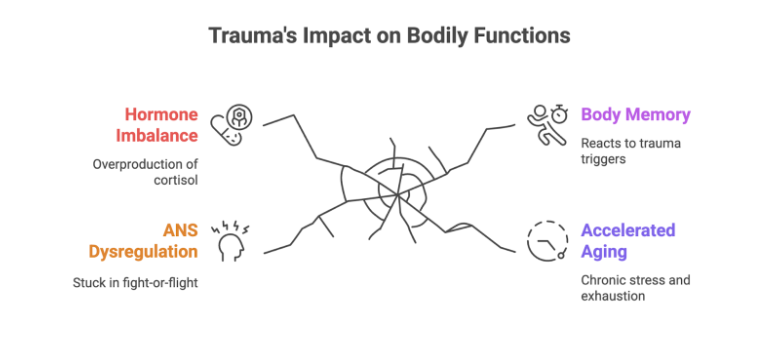
Trauma's impact goes far beyond the mind, deeply affecting your physical body. It’s not just an emotional state; it’s a biological response that can persist long after the event is over.
- Your Body's "Alarm System" Gets Stuck: Your body has an automatic system called the autonomic nervous system (ANS) that controls involuntary functions like your breathing and heart rate. When you face danger, this system helps you react by going into "fight, flight, or freeze" mode. But for people who’ve experienced trauma, this system can get stuck. It either stays on high alert all the time, making you feel anxious and tense, or stays in "freeze" mode, making you feel numb and exhausted.
- Overproduction of Stress Hormones: Your body’s central stress response system is called the HPA axis or the Hypothalamic-Pituitary-Adrenal axis. Normally, this system helps you respond to stress and then calms down by producing hormones like cortisol. The HPA axis can overproduce cortisol with experiences of long-standing trauma, which has damaging effects. It can lead to fatigue, widespread inflammation, a weakened immune system, and can be a significant factor in chronic pain.
- Your Body Remembers: Trauma isn't just stored in your brain as a memory; it's also stored in your muscles and tissues. It's like your body has its own memory bank of the experience. When you encounter something that reminds your body of the trauma, it can react as if the past is happening right now. This can cause sudden physical symptoms like a racing heart, muscle tension, or nausea, even if you're not consciously thinking about the traumatic event. Your body reacts as if the past is happening now.
- Accelerated Aging: The constant stress from being in a state of chronic fight-or-flight, along with elevated cortisol levels, takes a significant toll on your body. This continuous wear and tear is similar to putting a car through a rapid, intense use. This accelerated biological aging can make you feel "older than your age," with a sense of physical and mental exhaustion that goes beyond what would be expected for your chronological age.
Coach for Mind therapists use a trauma-focused approach, integrating somatic and mindfulness-based techniques to support deep healing. Somatic work helps release trauma by bringing attention to the body’s sensations, allowing stored tension and stress to surface and be safely processed. This happens with safety and gentle care, along with the therapist to ensure your well-being. This helps individuals reconnect with their body, release physical blockages, and restore a sense of safety, balance, and control.
Wondering If Your Symptoms are Signs of Trauma?
Determining if your physical symptoms are related to trauma requires a careful and cautious approach. It's not about self-diagnosing but rather about exploring the powerful connection between your mind and body. The process involves two key steps.
Step 1: Prioritize Medical Consultation
Before you consider trauma as a cause, it is essential to consult with a medical doctor. Your physician can perform a thorough examination and run tests to rule out any underlying physical illnesses. You must be open and honest with your doctor about all of your symptoms. This crucial step ensures you receive the proper medical care and prevents any potential misdiagnosis.
Step 2: Observe Your Body’s Patterns
After you have a clean bill of health from your doctor, you can begin to explore whether your symptoms might be connected to past trauma. Consider some of these key indicators:
- Do your symptoms persist despite medical treatment? If you have tried various treatments for physical ailments without success, it could be a sign that there's more to your symptoms than a simple physical explanation.
- Is there an emotional connection? Pay attention to whether your symptoms worsen during periods of stress, when you recall difficult memories, or in specific situations. For example, do you feel an increase in physical distress when you're in a crowded place or hear a certain sound?
- Are your physical symptoms accompanied by emotional distress? Physical symptoms linked to trauma often co-occur with emotional distress like anxiety, depression, irritability, or a sense of dread. You may also feel emotionally numb or detached.
- Do you have a history of difficult or overwhelming experiences? Even if you've tried to bury these memories, they can profoundly shape your adult reactions and lead to chronic physical issues.
- Do you feel "stuck"? A persistent feeling of being unable to move forward, even when you know you should, can be a clue that your body and mind are caught in a trauma response.
Step 3: Seek Professional Guidance for Uncovering Connections
Exploring the link between your physical symptoms and trauma can be intense and emotionally overwhelming to do alone. This journey is most safely and effectively undertaken with a qualified trauma-informed professional, such as a therapist or counselor. Reach out to Coach For Mind and book a free discovery call for 15 minutes to discuss your concerns.
A trauma-informed therapist provides a safe, structured space to explore these experiences, pace the process, and integrate mind-body awareness. They can help you develop tools to cope with it. For example, a therapist might use techniques like Somatic Experiencing, which focuses on releasing trauma from the body by tracking physical sensations and helping you complete the "fight or flight" responses that were interrupted during the traumatic event. This approach helps the nervous system return to a state of calm and balance, addressing the root cause of your physical symptoms.
Self-Regulation Strategies for Your Body
Feeling overwhelmed by the physical symptoms of trauma can be a daunting experience. The good news is that you can actively work to calm your body in the moment. These self-regulation strategies are not quick fixes, but consistent practices that can help you build resilience and a sense of safety. Before diving in, it's worth clearing up three common myths about nervous system regulation that can quietly derail this work.
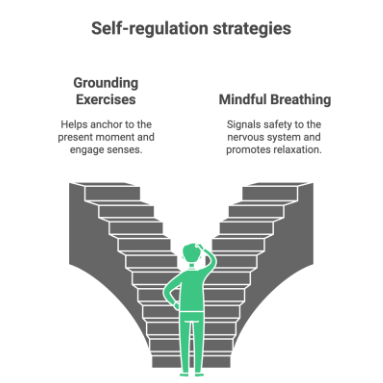
- Grounding Exercises: When you feel overwhelmed, grounding brings you back to the safety of the present moment. It is an easy way to anchor yourself to reality.
- 5-4-3-2-1 Technique: Engage your senses to shift your focus. Name 5 things you can see, 4 things you can touch, 3 things you can hear, 2 things you can smell, and 1 thing you can taste. A Reddit thread also found this technique helpful in reducing stress.
- Physical Grounding: Press your feet firmly into the floor, notice the weight of your body in your chair, or hold a tangible object, focusing intently on its texture and temperature.
- Mindful Breathing: Slow, deep breathing is a powerful way to signal safety to your nervous system, shifting you out of fight/flight/freeze. You can try Diaphragmatic Breathing by placing one hand on your chest and one on your belly. Inhale slowly through your nose, feeling your belly gently rise. Focus on making your exhales longer than your inhale
- Tense and Release (Muscle Scan): Sometimes our muscles hold on to stress long after the moment has passed. This gentle exercise helps your body notice where it’s tight and then let that tension go.
Step 1: Find a cozy spot and get comfortable
Step 2: Curl your toes or tense the muscles in your feet. Hold for a slow count of 3 and then release. Notice how they feel when the tension melts away.
Step 3: Move upward through your body: - Calves: Tighten, hold for 3, and release.
- Thighs & buttocks: Gently squeeze, hold, and let go.
- Belly: Pull in your stomach muscles, hold, and release.
- Arms & hands: Make fists or press your arms slightly, hold, and then let them soften.
- Shoulders: Shrug them up toward your ears, hold, then drop them down with an exhale.
- Face: Scrunch your face (wrinkle your nose, tighten your jaw), hold, then relax completely.
- Gentle Movement: Movement can be incredibly effective for releasing pent-up energy and stored tension. Gentle, intuitive stretches can help release muscle tension that often accompanies chronic stress.Another helpful way is to take a slow, mindful walk, focusing on the rhythm of your steps, the sensation of your feet on the ground, and your surroundings.
- Vagal Nerve Regulation: Simple practices can stimulate your vagus nerve, a key player in calming your nervous system. Humming or Chanting create vibrations that can gently stimulate the vagus nerve - promoting a sense of calm. Also, splashing cold water on your face or holding ice cubes in your hands can trigger the "mammalian dive reflex," which rapidly calms the nervous system.
- Titration: Strong emotions can be overwhelming if you face them all at once. Titration lets you “dip a toe” in safely.
How to Practice: - Bring to mind a mildly upsetting memory (not the most painful).
- Notice how your body responds for about 30 seconds - tight chest, racing heart, clenched jaw.
- Shift focus to something calming: a cozy memory, a favorite place, or the feeling of your feet on the ground.
- Gently move back and forth between the upsetting memory and the calming image.
- This exercise can get a little overwhelming and is usually done under supervision of a trained professional.
- Establish Routine & Foundational Self-Care: Consistency in basic self-care creates a sense of predictability and safety.
- Sleep Hygiene: Prioritize consistent sleep schedules, create a relaxing bedtime routine, and ensure your sleep environment is dark, quiet, and cool.
- Nourishing Nutrition: A balanced, whole-foods diet supports overall physical and mental health, reducing inflammation and supporting brain function.
- Consistent Hydration: Dehydration can exacerbate fatigue, headaches, and brain fog. Keep a water bottle handy.
Remember to breathe with each release. Each time you let go, exhale like a soft sigh. Imagine the stress leaving your body as your breath flows out. Feel free to skip any area that feels painful or unsafe. Or cover even a few areas (like just shoulders and hands) if you don’t have time for a full body scan.
When to Seek Professional Help (And What to Expect)
Recognizing the physical signs of emotional trauma is a powerful first step, but lasting healing often requires compassionate guidance from a trauma-informed professional. You don’t have to navigate this journey alone.
Consider seeking professional support if:
- If your symptoms are interfering with your work, relationships, or your ability to care for yourself, it's a sign that you need support. When trauma affects a relationship, couples therapy can help both partners understand what's happening. If your trauma stems from a violation of consent or boundaries, our guide on healing from sexual trauma speaks directly to that experience.
- If you have thoughts of harming yourself, it is crucial to seek immediate help. (Please call a crisis hotline right away.)
- You feel consistently overwhelmed or hopeless. If you feel utterly unable to cope, professional help can provide the support and tools you need.
- Your physical symptoms are persistent. If self-care strategies are not enough and your physical symptoms continue, it may indicate a deeper, trauma-related issue.
- You suspect your pain has deep emotional roots that feel impossible to manage on your own.
A trauma-informed therapist understands the powerful mind-body connection. They will never dismiss your physical symptoms as "all in your head." Their goal is to help you process trauma safely, without re-traumatizing you.
Look for therapists specializing in modalities like:
- Somatic Work: This therapy modality focuses on releasing trauma stored in the body by gently bringing awareness to your physical sensations.
- EMDR therapy in India (Eye Movement Desensitization and Reprocessing): This method helps your brain reprocess distressing memories to reduce their emotional impact.
- Trauma-Focused Cognitive Behavioral Therapy (TF-CBT): This type of therapy helps you identify and transform the negative thought patterns and behaviors related to your trauma.
Navigating Your Healing Journey:
Healing from trauma is rarely a straight line; it's a journey that requires immense patience and courage. Remember to be your own advocate and ask questions. Finding the right fit for a therapist can be challenging at times. Learn about our trauma treatment in India, or reach out to Coach For Mind to book a 15-minute discovery call for free. Connect with trusted friends, family, or support groups. You are not meant to heal in isolation, but with support. Lastly, practice compassion and kindness towards yourself. Your symptoms are a sign of a deeply wounded nervous system doing its best to cope.
At Coach For Mind, our therapists are trained in trauma-informed approaches like Somatic Therapy, EMDR, and Trauma-Focused CBT. These methods allow us to work with both the body and the mind, so that healing can happen even if words feel out of reach.
Why CoachForMind?
Experienced Psychologists: We are a team of licensed RCI-registered clinical psychologists. Our team is well-experienced in various forms of therapy such as CBT, DBT, EMDR, and Narrative Therapy.
Personalized Approach: We are dedicated to treating our clients in the best-suited way, carefully curated as per the client's needs, and adhering to one-on-one, client-centered therapy.
Scientific Techniques: Our treatment plans and therapeutic methods are based on highly researched scientific findings such as CBT, DBT, EMDR and Narrative Therapy.
Quality service: We at CoachForMind ensure quality services in our treatment regime and therapeutic approaches. Our clients hold the most value to us, so we ground our techniques in empathy while maintaining professionalism.
Begin with a free 15-minute discovery call For more information, please visit our website or contact us directly at [email protected]
Written by Ms Akshita - Psychotherapist at Coach For Mind
FAQs
Understanding trauma, your nervous system, and how healing can begin — gently and at your pace
Yes — and you are not alone in this. Many people living with unresolved stress or trauma describe exactly what you’re feeling: constant tiredness, muscle tension, restlessness, or even a sense of being “wound up and drained” at the same time. Here’s why it happens: when the nervous system has been stuck in survival mode for too long, it keeps your body “on guard,” as if danger could arrive at any moment. Your muscles stay braced, your heart rate and breathing may stay slightly elevated, and your body never fully gets the signal to relax.
This constant vigilance takes a huge toll:
- Physically: heaviness, body aches, headaches, or exhaustion.
- Emotionally: irritability, restlessness, or difficulty concentrating.
- Relationally: feeling too tired to connect, even with people you love.
It’s not that you’re lazy or weak. It’s that your nervous system is doing its best to keep you safe, but in doing so, it’s draining your energy reserves.
At Coach For Mind, our therapists help you:
- Track the signals your body is giving you, so you can begin to understand the patterns.
- Build safety in the present moment using grounding, mindful breathing, and gentle somatic practices.
- Release chronic tension in small, manageable ways, teaching your body that it no longer has to brace all the time.
- Reconnect with energy and rest by gradually guiding your nervous system into a state of balance.
This is something many people struggle with. You may have already tried all the “right” things — going to bed on time, exercising regularly, eating healthier — and still, the headaches, fatigue, or restless nights don’t go away. That can feel frustrating, even hopeless, like nothing will ever work. Here’s the thing: healthy habits are important, but if trauma is involved, they may not be enough on their own.
When trauma is stored in the body, your nervous system can get “stuck” in survival mode — fight, flight, freeze, or fawn. In that state, your body doesn’t fully register safety, even when life around you is calm. This is why:
- Sleep feels impossible, because the nervous system refuses to let its guard down.
- Exercise sometimes helps temporarily, but the tension comes back.
- No amount of “positive thinking” can fully reset a body that still believes it’s in danger.
This is where trauma-informed therapy makes the difference. At Coach For Mind (CFM), our therapists combine mind and body approaches so you can finally learn to stand down.
This is such an important question, and the honest answer is, you may not know right away. Trauma and medical conditions can look very similar in the body: headaches, fatigue, digestive problems, chest tightness, or trouble sleeping can all have both physical and emotional causes.
The first step is always medical. It’s essential to consult a doctor and rule out underlying conditions. Blood tests, scans, and check-ups are important not only for your health but also for your peace of mind. Sometimes the body is asking for medical attention, and we never want to overlook that.
But what if the tests come back “normal”? This is where many people feel stuck and unheard. The symptoms are still there — the pain, the tension, the racing heart — but no clear explanation is found. This does not mean you’re imagining it. What it can mean is that your body is carrying unresolved trauma.
Here are a few clues that symptoms may be trauma-related:
- They flare up or worsen during times of stress.
- They appear when you recall difficult memories, or in situations that feel similar to past hurts.
- They don’t fully respond to medical treatment.
- They come with emotional patterns — anxiety, dread, irritability, or a sense of going numb.
- You notice a “stuck” feeling, as though your body can’t fully relax or let go.
Bottom line: Only a doctor can rule out medical causes. But if your symptoms linger, follow emotional patterns, or don’t make sense medically, it may be your body’s way of telling its trauma story. And therapy can help you finally listen to that story with compassion.
It’s very natural to wonder about this. Many people living with trauma symptoms have already tried to manage things on their own — through exercise, meditation, journaling, or simply telling themselves to “move on.” And some of these self-care practices really do help. Grounding, mindful breathing, gentle stretching, humming, or splashing cold water on your face can calm the nervous system in the moment. These strategies are valuable tools, and you can absolutely begin using them right away.
But here’s what many clients discover: self-regulation can ease the storm, but it doesn’t always reach the root. Trauma is often held not just in the mind, but in the body and in younger “parts” of us that still carry fear, shame, or grief. On your own, it can be hard to meet those places fully, because they often feel overwhelming, confusing, or even hidden.
That’s where therapy makes a difference. At Coach For Mind, our therapists don’t just hand you coping skills — we walk with you as you learn them, so you don’t feel alone in the process. We go at your pace, never rushing, helping you:
- Build safety in your body with somatic practices that teach your nervous system it’s okay to rest again.
- Work with younger parts of you (IFS) that may still feel scared, silenced, or stuck — and give them the care they never received.
- Reprocess painful memories (EMDR, Trauma-Focused CBT) so they stop intruding into the present.
- Learn to regulate emotions in a relationship — not only calming yourself, but also experiencing what it feels like to be truly seen and supported by another.
So the answer is: yes, you can start feeling better on your own, and we encourage you to try. But if the symptoms feel stuck, too heavy, or keep coming back, therapy offers something self-help cannot: a safe, supportive relationship where you don’t have to carry the healing process alone.
This is one of the most common and frustrating experiences people bring to therapy: “The tests are normal, but my body still hurts. Am I imagining this?” The answer is no — you are not imagining it. The pain is real. What’s happening is that trauma can leave the body’s survival system “stuck on,” which keeps sending signals of tension and pain even when the danger has passed.
Here’s how it works in the body:
The Alarm System: When you perceive a threat, your amygdala (the brain’s alarm center) instantly signals danger.
Fight-or-Flight Activation: The hypothalamus switches on the HPA axis (hypothalamic–pituitary–adrenal system). This releases stress hormones — cortisol and adrenaline.
Your Body Prepares to Survive:
- Heart rate and blood pressure rise.
- Muscles tighten, ready to fight or run.
- Blood flow is pulled away from digestion toward the big muscle groups.
- Higher brain functions (like long-term planning) go offline so you can focus only on immediate survival.
The Recovery Phase: Normally, once the danger passes, the parasympathetic nervous system — especially the vagus nerve — brings the body back into balance. Your muscles relax, digestion returns, and hormones settle down.
But when trauma is chronic or overwhelming, this recovery phase may not happen properly. The alarm system gets “stuck,” leaving your body in a constant state of tension and hyper-alertness. Over time, this can create muscle pain, tension, digestive issues, and widespread inflammation that fuels chronic pain and fatigue, among others. So when your doctor says you’re “fine,” they may mean there’s no structural damage or disease. But that doesn’t mean your body isn’t suffering. The pain is your nervous system’s way of saying: “I’m still protecting you.”
In therapy we will together:
- Calm the overactive alarm system.
- Release the muscle tension your body has been holding.
- Rebuild balance between the fight/flight system and the calming parasympathetic system.
- Teach your body that it is finally safe to rest.
In short: your pain is real. It’s not “all in your head.” It’s your body’s survival wisdom — and with the right support, that survival system can learn how to stand down.
It is never too late.
Trauma is not just about what happened — it’s about how the body and mind adapted to survive. Those adaptations (hypervigilance, numbness, muscle tension, sleeplessness) can linger for years, even when life on the outside has moved on. But the very same nervous system that once learned survival can also learn safety again. This is possible because of neuroplasticity — the brain and body’s lifelong ability to change and rewire.
At Coach For Mind, we often work with people who believe they are “stuck for good.” What unfolds in therapy shows otherwise:
- In somatic work, clients learn to gently notice where their body still holds the past — the clenched jaw, the heavy chest, the guarded posture — and slowly release it.
- Through EMDR, painful memories that once felt unbearable can lose their charge. A client may say, “It’s still there, but it no longer runs my life.”
- With Trauma-Focused CBT, long-held beliefs like “I’m broken” or “It was my fault” can soften into more compassionate truths.
- Using IFS (Internal Family Systems), many clients meet the “parts” of themselves that froze in time — the frightened child, the vigilant protector, the shamed inner critic. By building a caring relationship with these parts, healing becomes about integration, not erasure.
Healing doesn’t mean erasing the past. It means your body no longer reacts as if the past is happening right now. It is never too late because the self inside you — the part that longs for freedom, connection, and peace — does not disappear with time. Therapy is about helping that part come forward, patiently and gently, at whatever age you are now. At CFM, we walk this path with you, whether your trauma happened last year or fifty years ago. Healing is not about rushing or forcing — it is about slowly reclaiming your body, your voice, and your right to feel whole.
Unlike general talk therapy, trauma-focused therapy doesn’t just explore your thoughts and feelings — it also pays close attention to how trauma lives in the body. Many people find that even when they “understand” their past, their body still reacts as if the danger is happening now. Trauma-focused therapy helps with both: calming the body and reshaping the mind.
At Coach For Mind, our therapists are trained in several specialized approaches:
- Somatic Work: Trauma often gets “stored” in the body as muscle tension, shallow breathing, or a sense of being on guard. Somatic techniques gently guide you to notice these sensations and slowly release them, so your body can learn it is safe again.
- EMDR (Eye Movement Desensitization and Reprocessing): This method helps your brain reprocess painful memories in a way that takes the emotional charge out of them. Many clients describe feeling less triggered or haunted by the past after EMDR sessions.
- Trauma-Focused CBT: Trauma can create negative thought patterns like “I’m not safe” or “It was my fault.” Trauma-focused CBT helps you challenge and transform these beliefs into healthier, more compassionate ones.
What makes trauma-focused therapy unique is its integrative approach. Instead of just talking, you’re also learning how to:
- Calm your nervous system.
- Release stored tension from the body.
- Rewire old thought patterns that keep you stuck.
Clients often tell us that the biggest difference they feel is this: “I’m not just talking about my trauma — my body actually feels different.” Shoulders drop, breaths come easier, and sleep slowly improves.
At Coach For Mind, we believe healing needs to happen on every level — body, mind, and emotions. Trauma-focused therapy offers that deeper, whole-person healing, at your pace, with support every step of the way.
That’s completely okay. Many people feel worried about having to “tell everything” when they come to therapy. At Coach For Mind, we want you to know: you do not have to share your whole story right away — or at all — for healing to begin.
Trauma-focused therapy is first and foremost about safety and trust. Our therapists understand that for many survivors, words can feel overwhelming, or even impossible, in the beginning. That’s why we don’t push you to revisit painful memories before you’re ready. Instead, we start with building stability in the present.
In practice, this often looks like:
- Body awareness: Learning to gently notice where stress shows up in your body (like tight shoulders, a racing heart, or an uneasy stomach). This helps you build a language of sensations before diving into memories.
- Grounding and nervous system regulation: Simple practices like mindful breathing, grounding through your senses, or gentle movement to help you feel more in control and less overwhelmed.
- Small steps at your pace: CFM therapists will always check in with you before moving into deeper territory. You set the pace, and you decide what feels safe to share.
Many clients discover that they can feel real relief just from these early steps, even before talking about their trauma directly. Over time, as trust grows, you may feel ready to share parts of your story — but it will always be your choice.


