
TL;DR
- Dysregulation Is Physiological, Not Psychological: A dysregulated nervous system is a measurable biological state,a chronic imbalance between the sympathetic (mobilisation) and parasympathetic (restoration) branches of the Autonomic Nervous System,not simply "being anxious" or "overthinking."
- Symptoms Are a Constellation, Not a Checklist: Research confirms that dysregulation manifests simultaneously across six domains: physical pain, digestion, sleep, emotional regulation, cognitive function, and autonomic reactivity. If doctors cannot explain your symptoms, the nervous system deserves investigation.
- Four Survival States: The body does not only fight or flee. It also freezes and fawns. Understanding which state your nervous system is stuck in is the essential first step toward targeted recovery.
- Your Heart Rate Tells the Story: Heart Rate Variability (HRV) is an objective, measurable indicator of nervous system health. A healthy nervous system is flexible and irregular. A dysregulated one is rigid,beating like a metronome, unable to adapt to changing demands.
- You Cannot Think Your Way Out: Cognitive approaches alone cannot resolve a physiologically stuck nervous system. Bottom-up, somatic interventions,working with the body first,are often the missing link for people who have "done the talk work" and still feel unwell.
- Calm Can Feel Dangerous: For people in severe dysregulation, standard relaxation techniques can paradoxically increase distress. This is not a sign of being broken. It is a known neurological response,and it requires a slower, titrated approach.
- The Fawn Response Is Under-Recognised: People-pleasing, chronic compliance, and the inability to set limits in professional or personal settings are not personality traits. They are survival mechanisms,symptoms of a nervous system that learned to manage threat through social appeasement.
- Dysregulation Predicts Future Physical Disease: Longitudinal research links chronic ANS imbalance to metabolic syndrome, cardiovascular disease, and type 2 diabetes,sometimes two years before clinical symptoms emerge. The cost of leaving a dysregulated nervous system unaddressed is not only psychological.
Introduction:
I feel like I can't trust my body at all.
That sentence, shared in a community forum by someone who had visited the emergency room eight times in two months without a single confirmed diagnosis, captures something that millions of people experience and almost nobody names accurately.
The racing heart that arrives without warning. The digestive system that stops working when stress accumulates. The brain that goes offline at precisely the moment you need it most. The chronic exhaustion that never resolves with sleep.
Some people describe it as feeling strangely disconnected from themselves like being lifeless, monotone, or emotionally flat. Others say they need the shower to be extremely hot just to feel something.
These are not imaginary symptoms. They are not signs of hypochondria, weakness, or excessive emotional sensitivity. They are the recognisable, well-documented, and clinically measurable signs of a dysregulated autonomic nervous system, a body that has been running its emergency response programme for so long that it no longer knows how to turn it off.
This article explains what is actually happening when the nervous system dysregulates, what the full spectrum of symptoms looks like across every domain of health, why standard medical tests frequently return normal results despite genuine suffering, and what the science says about the path back to a body you can inhabit without fear.
If you have been told that your symptoms are "just stress," "just anxiety," or "all in your head",this article is for you. Not as reassurance. As evidence.
Part One: What the Autonomic Nervous System Actually Does?
The System That Runs in the Background
The Autonomic Nervous System (ANS) is the branch of the nervous system responsible for regulating the body's involuntary functions,heart rate, breathing, digestion, immune response, body temperature, blood pressure, and the fundamental switching mechanism between states of safety and states of threat.
It operates below conscious awareness, continuously and automatically adjusting the body's internal environment in response to signals from both the external world and the body's own interior. You do not decide to increase your heart rate when you are startled. You do not choose to suppress digestion when you are under sustained pressure. These are ANS functions, running their programme whether you are paying attention or not.
Under healthy conditions, the ANS is flexible, moving fluidly between states of mobilisation (when activation is needed) and restoration (when recovery is needed), responding proportionately to real demands and returning to baseline when those demands pass. This flexibility is not merely a comfort. It is a core indicator of physiological health.
When the system loses this flexibility,when it becomes chronically tilted toward one state, stuck in survival mode and unable to return to genuine rest,the consequences extend across every system in the body. This is dysregulation.
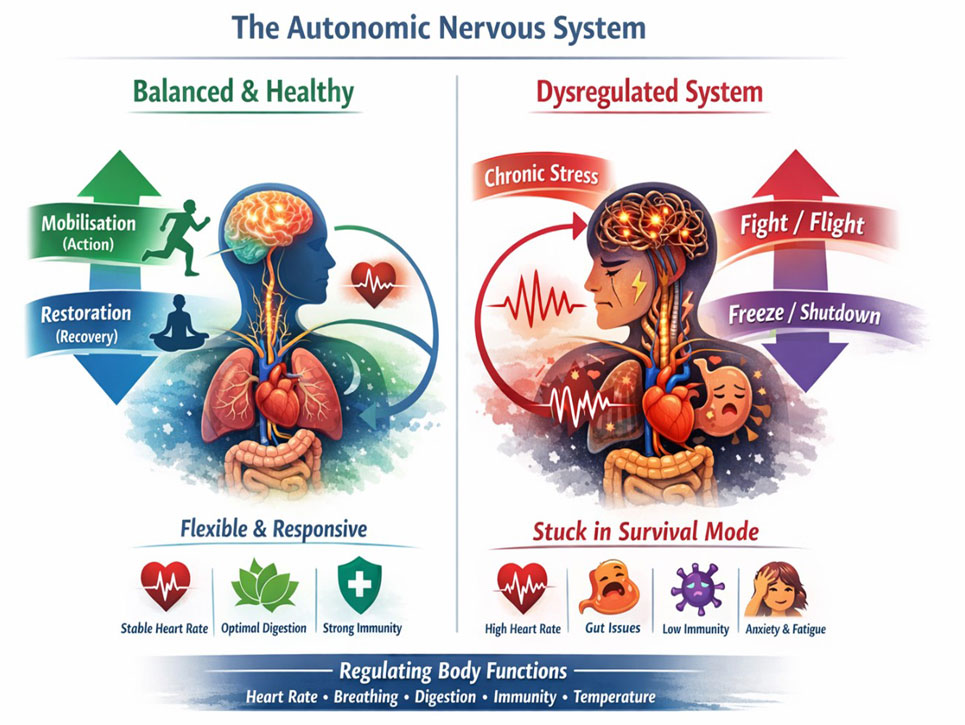
The Polyvagal Framework: Three States That Govern Everything
To understand dysregulation, it helps to understand the framework that has most significantly advanced the clinical understanding of nervous system function: Polyvagal Theory, developed by neuroscientist Dr Stephen Porges.
Polyvagal Theory describes the ANS not as a simple two-state system (on/off, stressed/relaxed) but as a three-tiered hierarchy of response states, each with a distinct neurological character and a distinct set of symptoms:
Ventral Vagal State: Safety and Social Engagement
This is the state of genuine physiological safety. When the ventral vagal branch is active, the heart rate is regulated and flexible, digestion functions normally, breathing is full and effortless, and the social engagement system,facial expression, vocal tone, and the capacity to connect with others, is online. This is what regulation looks and feels like.
Sympathetic State, Fight or Flight
When the nervous system detects a threat, whether real, anticipated, or residually stored from past experience, it mobilises. Heart rate increases. Blood flow redirects to the limbs. Digestion slows. The immune system is temporarily suppressed. Cortisol and adrenaline flood the system. Attention narrows to the perceived threat.
This state is not inherently harmful. It is essential. The problem arises when it becomes the default, when the system cannot shift back to the ventral vagal once the threat has passed, and instead treats the resting state as dangerous.
Dorsal Vagal State, Freeze and Shutdown
When threat is perceived as inescapable,when fight and flight are not viable options,the nervous system may drop into the oldest, most primitive response state: shutdown. Heart rate drops. The body becomes heavy and still. Cognitive function narrows. The person feels detached, numb, lifeless, unreachable. This is the biological basis of the "freeze" response,and it is frequently misdiagnosed as depression.
"I feel lifeless and monotone... like a disconnect that's happening.",A person describing dorsal vagal shutdown, captured in community discussion
These three states are not chosen. They are triggered automatically by the nervous system's continuous, below-conscious process of environmental scanning, which Polyvagal Theory calls neuroception, the body's built-in threat-detection system, operating beneath the level of conscious perception. When neuroception is calibrated accurately, the responses it triggers are proportionate to the real environment. When it has been shaped by chronic stress or unresolved traumatic experience, it begins generating survival responses in response to cues that are associated with past danger,even when the present environment is objectively safe.
Part Two: What Causes Nervous System Dysregulation?
The Body Learns to Stay Alert
Nervous system dysregulation is not a single event. It is a pattern that develops,usually gradually, often imperceptibly,through the nervous system's remarkable capacity for experience-dependent plasticity: its ability to reorganise itself based on repeated experience.
Research on 80 children presenting with unexplained symptoms at a paediatric neurology clinic found that 65% had experienced adverse childhood experiences,and that in every single case, symptoms appeared simultaneously across multiple domains: physical, emotional, cognitive, and autonomic. The nervous system had, in effect, learned to stay in threat mode, wiring itself for hypervigilance because hypervigilance had been the most adaptive response available.
This learning is not a character flaw. It is a design feature. An organism that grows up in a chronically threatening environment should maintain elevated vigilance. The tragedy is that the same wiring that was adaptive in the original environment becomes profoundly costly when the environment changes,when the threat has objectively passed, but the nervous system's learning has not been updated.
The Causes Are Multiple and Cumulative
The triggers for nervous system dysregulation are not limited to dramatic traumatic events. They include:
Early adverse experiences: Emotional neglect, inconsistent caregiving, household instability, chronic criticism, parentification, or growing up in an environment where safety was not reliably provided. To read more, click here.
Chronic adult stressors: Sustained workplace pressure, financial precarity, caregiving demands, relationship conflict, or discrimination,particularly when these stressors are ongoing and there is no genuine recovery period.
Single traumatic events: Accidents, assaults, sudden bereavements, medical emergencies, or any experience that overwhelmed the nervous system's capacity to process and complete the stress response.
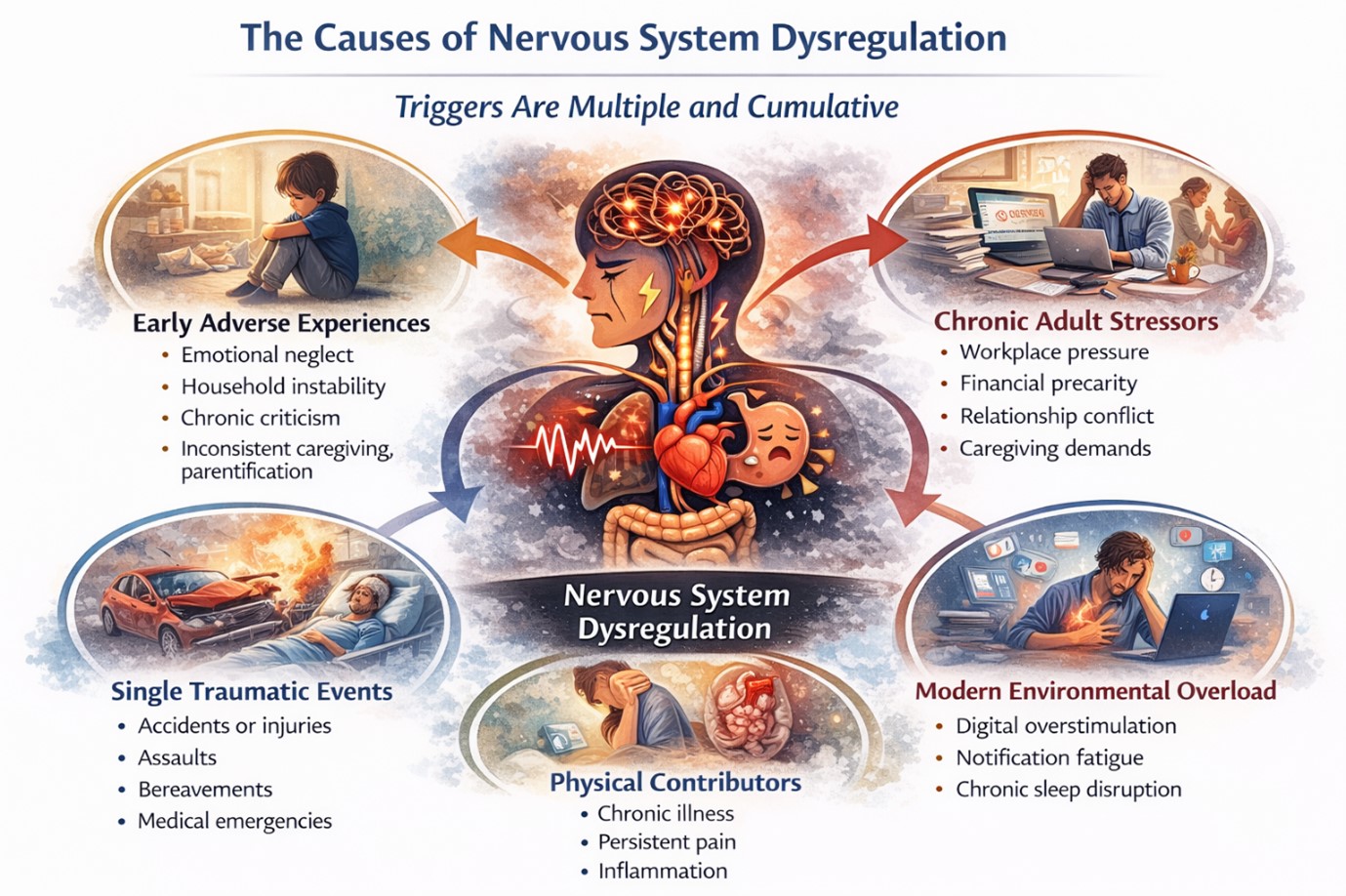
Modern environmental overload: Notification fatigue, chronic digital overstimulation, blue light disruption of circadian rhythms, the "always-on" professional culture that eliminates the parasympathetic recovery time the nervous system requires to maintain balance.
Physical contributors: Chronic illness, persistent pain, inflammatory conditions, gut dysbiosis, and thyroid dysregulation can all directly influence ANS function through the bidirectional gut-brain axis and the systemic inflammation pathways that link physical and neurological health.
These causes are rarely singular. More often, what clinicians see is a cumulative burden, a combination of early nervous system learning, sustained adult stressors, and physical contributors that together tip the system beyond its threshold for self-regulation.
Part Three: The Physical Symptoms: What the Body Is Trying to Say
When the Body Becomes the Messenger
One of the most significant and least understood aspects of nervous system dysregulation is the degree to which it manifests as physical symptoms that have no identifiable structural cause, symptoms that return normal results on standard medical investigations, leading many sufferers through years of inconclusive appointments and the quietly devastating experience of being told that nothing is wrong.
The research is unambiguous on this point: dysregulation is a "maladaptive neurophysiology", a genuine, measurable physical state that produces real physiological changes throughout the body. The fact that a blood test or an MRI cannot locate a structural cause does not mean the suffering is imaginary. It means the cause is systemic and neurological rather than structural.
Research examining children with dysregulation found that 100% showed simultaneous somatic and emotional symptoms,and that physical symptoms were as universal as psychological ones. This is not a coincidence. It is the body faithfully reflecting the state of the nervous system that governs it.
Cardiovascular and Respiratory Symptoms
- Palpitations and irregular heart rate, the sympathetically activated heart beats faster and less variably; a racing, pounding, or irregular heartbeat in the absence of cardiac pathology is a classic dysregulation signal
- Chest tightness and shortness of breath,the respiratory muscles are influenced directly by ANS state; sympathetic activation produces shallow, upper-chest breathing that can sustain the very state of alarm it is responding to
- Dizziness and presyncope,dysregulation of blood pressure regulation can produce intermittent lightheadedness, particularly on standing
- Temperature dysregulation, hot flushes, cold extremities, excessive sweating, or the inability to feel adequately warm are all expressions of autonomic dysregulation in the thermoregulatory system
"Needing my shower to be HOT... or needing more blankets just to feel something." - A person in dorsal vagal shutdown, describing the sensory numbing associated with the freeze state
Digestive and Gut Symptoms
The digestive system is almost entirely governed by the Enteric Nervous System,sometimes called the "second brain",which operates in intimate, bidirectional communication with the ANS. When the sympathetic system activates, it diverts blood flow and neural resources away from digestion as a matter of physiological priority: the body is not concerned with processing lunch when it believes it is running from a predator.
Research documented that 66% of children with nervous system dysregulation suffered from digestive problems,not as a comorbid condition separate from their neurological state, but as a direct and predictable expression of it. In adults, the digestive manifestations of dysregulation include:
- Irritable Bowel Syndrome (IBS),the gut's contractility patterns are directly modulated by ANS state; chronic sympathetic activation disrupts the normal peristaltic rhythm
- Nausea and appetite loss,particularly under acute stress, as the body suppresses digestive processes to redirect energy to the perceived emergency
- Food sensitivities and bloating,chronic autonomic imbalance impairs the gut's ability to regulate inflammation and permeability
- Constipation or diarrhoea,reflecting the erratic switching between sympathetic suppression and parasympathetic acceleration of gut motility
For many people, the gut is the first and loudest reporter of nervous system distress,long before cognitive or emotional symptoms become identifiable.
Sleep Disruption
Sleep requires the nervous system to genuinely surrender its vigilance. For a dysregulated system calibrated to detect threat, this surrender is not safe,and the body responds accordingly.
Research linked dysregulation to sleep disruption in 92.5% of cases,making it the most reliably co-occurring symptom in the dataset. The specific mechanisms include:
- Difficulty falling asleep: The sympathetically activated system cannot shift into the parasympathetic dominance that sleep onset requires; racing thoughts and physical tension keep the system mobilised
- Nocturnal hypervigilance: Waking repeatedly through the night, often with a jolt of alertness disproportionate to any real stimulus
- Unrefreshing sleep: Spending hours in bed but cycling through sleep stages too shallowly to achieve genuine restoration
- Nightmare and night terror patterns: The sleeping brain continuing to process unresolved threat material
"I often go to sleep TERRIFIED if I'll wake up at all."- A person with severe sympathetic dysregulation, describing nocturnal hypervigilance
Chronic sleep disruption then worsens every dimension of dysregulation through a straightforward physiological mechanism: sleep deprivation elevates cortisol, reduces prefrontal cortex function, and sensitises the amygdala,amplifying the very threat responses that are disrupting sleep in the first place.
Chronic Pain, Muscle Tension, and Somatic Symptoms
The dysregulated nervous system holds its vigilance in the body's tissues as well as in its neurological circuitry. Sustained sympathetic activation maintains the muscular and fascial system in a state of protective bracing,tension that serves a real purpose in acute threat but becomes profoundly costly when sustained chronically.
Common physical expressions include:
- Chronic neck, shoulder, and jaw tension,the muscles most associated with the protective bracing posture of sympathetic activation
- Tension headaches and migraines,driven in part by sustained vascular and muscular changes associated with chronic sympathetic dominance
- Unexplained widespread pain,particularly relevant in conditions like fibromyalgia, which has a documented neurological substrate in sensitised pain-processing circuits
- Tinnitus, increasingly recognised as having a significant neurological component, with ANS dysregulation disrupting the auditory processing system's capacity to filter and modulate sound
- Skin conditions like psoriasis, eczema, and urticaria all have documented stress-sensitivity pathways through the ANS-immune axis
- Sensory amplification like the experience of ordinary sensory input (ambient noise, bright light, crowd environments) as overwhelming or physically painful, reflecting the failure of the brain's inhibitory filtering mechanisms
A client described it this way: “Small things, like loud noises or unexpected events, suddenly seem magnified.” In neuroscience terms, this reflects difficulty in the brain’s sensory gating system, which normally filters out irrelevant stimuli.
In therapy, these symptoms often appear long before clients recognize them as nervous system patterns.One client I worked with, a 29-year-old professional, initially came to therapy because of persistent digestive issues and heart palpitations. Medical tests had repeatedly come back normal, and she had begun to worry something serious had been missed.
Over time, we noticed a pattern: her symptoms consistently worsened during periods of interpersonal stress at work. Her nervous system was remaining in a state of chronic activation. As therapy progressed and we began incorporating regulation practices, including breathwork, pacing strategies, and trauma-informed processing, the physical symptoms gradually reduced. Nothing structural in her body had changed. What changed was the state of her nervous system. To book your free discovery call, contact us today!
Part Four: The Emotional Symptoms: What Dysregulation Feels Like
Emotional Volatility Without a Proportionate Cause
A regulated nervous system allows emotions to move through the body, even intense emotions like grief, anger, or excitement, and then gradually settle. Emotional regulation does not mean the absence of strong feelings. It means the ability to experience them without becoming stuck inside them.
Nervous system dysregulation disrupts this process. Emotions may activate quickly, intensify rapidly, and take much longer to settle. Many people describe feeling as though their emotional responses are disproportionate to the situation, even when they cannot fully explain why.
Common emotional expressions of dysregulation include:
- Anxiety without identifiable cause: A persistent, diffuse sense of threat that does not attach to a specific, manageable worry; this is the experiential signature of neuroception calibrated for danger in a present-day safe environment.
- Sudden anger or irritability,particularly in response to sensory triggers, unexpected changes, or perceived demands; in sympathetic dysregulation, the threshold for defensive mobilisation is chronically lowered.
- Emotional numbness and disconnection,the dorsal vagal shutdown state is frequently experienced not as acute distress but as an absence of feeling; a flatness, a distance from experience, a sense of watching one's own life from behind glass.
- Shame and self-blame,many people with dysregulation have spent years receiving the message that their responses are excessive, inappropriate, or evidence of weakness, producing a secondary layer of shame around the symptoms themselves that significantly compounds the suffering.
- The inability to feel positive emotions,particularly in chronic dorsal vagal states; the system is not simply suppressing distress. It is suppressing the full range of affect, including pleasure, joy, and connection.
Rejection Sensitivity and Relational Hypervigilance
When the nervous system's threat-detection system has been shaped by relational experiences,by environments where the behaviour of caregivers or important figures was unpredictable, critical, or dangerous,the social environment becomes a primary source of neuroceptive threat signals.
The result is a pattern of relational hypervigilance: a continuous, exhausting monitoring of others' facial expressions, vocal tones, and behavioural signals for any indication of displeasure, withdrawal, or rejection. Minor shifts that a regulated nervous system would barely register,a slightly cooler message, an ambiguous pause, an unanticipated change in plan,are processed as significant threat signals, producing emotional responses that can feel bewildering in their intensity.
This is not sensitivity in the ordinary sense. It is the nervous system doing its job,scanning for the specific categories of social threat that it learned to monitor in earlier, more dangerous relational environments.
Part Five: The Four Survival States: Which One Are You Stuck In?
Understanding which survival state your nervous system tends to default to can be a powerful first step toward learning how to regulate it. Each state has a distinct symptom profile, a distinct neurological character, and a distinct set of interventions that are most likely to be effective.
In therapy, we often see that people are not stuck in just one state. Most nervous systems move between several patterns, but one response tends to become the default under stress.
Fight Response
The fight response is sympathetic activation oriented toward confrontation. It is not limited to physical aggression. In adult life, it manifests as:
- Persistent irritability, impatience, and a short fuse
- A sense of being under constant attack,defensiveness as a default relational stance
- Difficulty receiving feedback without experiencing it as threatening
- Controlling behaviour, the attempt to manage the environment to reduce unpredictability
- Chronic muscle tension, jaw clenching, and a braced physical posture
In professional environments, the fight response can sometimes look like high performance: driven, decisive, demanding, productive. The cost is the internal environment,and eventually the physical health,of the person maintaining it.
Flight Response
The flight response is sympathetic activation oriented toward escape. In adult life, chronic flight manifests as:
- Chronic busyness and workaholism,the inability to stop, rest, or sit with stillness; productivity as a form of outrunning internal distress
- Restlessness and difficulty with unstructured time
- Difficulty completing tasks,moving rapidly from one thing to the next without settling
- Chronic anxiety and anticipatory worry,the mind projecting forward to the next threat
- Digestive disruption, particularly before anticipated challenges
- An inner sense of urgency that does not resolve with achievement
At Coach For Mind, we regularly see high-functioning professionals who have built entire careers on a flight nervous system,and who arrive in our rooms when the engine finally stalls. In some cases, productivity becomes less about ambition and more about staying ahead of uncomfortable internal states.
Many clients who seek therapy for burnout or chronic anxiety eventually discover that their nervous system has been operating in a prolonged flight state.
Freeze Response
The freeze response is the dorsal vagal shutdown,the ancient biological response to inescapable threat. It manifests as:
- Profound fatigue and low energy that does not respond to rest
- Emotional numbness, flatness, and disconnection
- Difficulty making decisions,cognitive paralysis
- The sense of being invisible, absent, or not quite present in one's own life
- Physical heaviness,the sense of moving through treacle
- Dissociation: moments of depersonalisation or derealisation, a dreamlike quality to experience
- Significantly reduced motivation,not laziness, but a nervous system that has powered down non-essential functions
The freeze state is frequently misdiagnosed as depression,and treated with approaches that target the wrong neurological mechanism. In some cases, treatments that focus only on mood may not fully address what is happening physiologically in a shutdown state. In therapy, people often describe this state not as sadness, but as disconnection from life itself.
Fawn Response
The fawn response is the least recognised and most clinically underserved of the four survival states. It emerges when the nervous system learns that social appeasement,making oneself agreeable, accommodating, and non-threatening,is the most effective strategy for managing a threatening environment.
In adult life, chronic fawn dysregulation manifests as:
- Compulsive people-pleasing,an inability to decline requests, express disagreement, or prioritise one's own needs without acute anxiety
- Chronic overextension in professional settings,taking on more than is sustainable because saying no feels dangerous
- Difficulty identifying one's own feelings, needs, or preferences,having subordinated them for so long that they are no longer legible
- A persistent internal vigilance for signs of others' displeasure,monitoring and managing others' emotional states as a primary activity
- A deep sense of inauthenticity,the feeling of performing a version of oneself rather than inhabiting it
- Post-social exhaustion,profound depletion after social interactions where the fawn response was continuously active
The fawn response often looks, from the outside, like exceptional interpersonal skill, extraordinary professionalism, and remarkable selflessness. From the inside, however, it can feel deeply exhausting and unsafe. It is characteristic of a nervous system that believes that being truly seen and genuinely disagreed with carries catastrophic risk.
"The loneliness of these cycles is the worst; not a lot of empathy for a grown man crying." A person describing the isolation of living inside a survival response that the outside world cannot see
Part Six: The Cognitive Symptoms: When the Brain Goes Offline
Brain Fog Is Not Laziness
Executive dysfunction, what many people describe as "brain fog",is one of the most disabling and least understood cognitive expressions of nervous system dysregulation. Research examining dysregulation across multiple domains found it present as a consistent, co-occurring feature across all cases studied.
The mechanism is straightforward: sustained sympathetic activation and elevated stress hormones can interfere with the functioning of the prefrontal cortex, the brain region responsible for planning, decision-making, and emotional regulation. When the PFC is inhibited by chronic stress, the brain's threat circuits run without adequate top-down modulation. In these moments, thinking clearly becomes difficult not because intelligence has changed, but because the brain is prioritising survival.
The cognitive symptoms include:
- Working memory impairment,difficulty holding multiple pieces of information in mind simultaneously; the experience of starting a sentence and losing it before reaching the end
- Concentration and task initiation failure,the inability to begin or sustain cognitive effort on tasks that feel neutral or low-priority
- Word-finding difficulty,the specific experience of knowing what you mean but being unable to locate the word; language production is one of the first higher functions to be degraded under sustained sympathetic activation
- Slowed processing speed,the sense that the mind is working through fog or treacle, that responses and decisions take longer than they should
- Time perception distortion,losing track of time, being surprised by how much or how little has passed; this is a direct expression of ANS dysregulation affecting the brain's temporal processing
Many clients describe this experience with frustration: “I know I’m capable of thinking clearly, but my brain just won’t cooperate.” From a nervous system perspective, this is not a personal failure, it is a system temporarily prioritising safety over cognition.
Hypervigilance and Sensory Gating Failure
A healthy, regulated nervous system maintains a continuous filtering process,prioritising relevant stimuli and suppressing irrelevant background noise. This is called sensory gating: the brain's inhibitory control system allows us to attend to what matters without being overwhelmed by the full sensory environment.
In a dysregulated system, this gating function is compromised. Every stimulus competes for attention at roughly equal volume. The hum of the air conditioning is as loud as the voice of the person speaking. The ambient light feels intrusive. The texture of clothing is distracting. Sudden sounds produce a startle response that is physiologically indistinguishable from a genuine threat response.
This is not sensory sensitivity in the ordinary sense. It is the loss of the brain's capacity to filter,a direct consequence of the threat circuits running without adequate modulation from the inhibited prefrontal cortex.
Part Seven: How Dysregulation Predicts Future Physical Disease
The Bodily Cost of Staying in Survival Mode
The physical health consequences of chronic nervous system dysregulation extend well beyond the symptom domains already described. Longitudinal research has made increasingly clear that a persistently dysregulated ANS is not only a source of present suffering,it is a predictor of future systemic disease.
Cardiovascular and Metabolic Consequences
A two-year longitudinal study of nearly 2,000 participants found that elevated sympathetic activity,measured through heart rate and cardiac autonomic balance,predicted the development of metabolic syndrome: elevated blood pressure, unfavourable lipid profiles, and impaired blood sugar regulation. The dysregulated nervous system was literally changing how the body handles fat and sugar metabolism,and it was doing so measurably, two years before clinical symptoms emerged.
The mechanism involves the sustained elevation of cortisol and adrenaline associated with chronic sympathetic activation. These hormones are catabolic and inflammatory in their chronic effects: they raise blood pressure, dysregulate lipid metabolism, impair insulin sensitivity, and promote visceral fat accumulation. The body's stress response is designed for short-term survival. When it remains chronically activated, it can begin to affect multiple body systems over time.
Heart Rate Variability as the Objective Measure
Heart Rate Variability (HRV),the degree of variation in the time interval between consecutive heartbeats,has emerged as one of the most powerful and accessible objective indicators of nervous system health. A meta-analysis of 37 studies confirmed that stress is characterised by low HRV: a heart that beats too predictably, like a metronome, without the natural, healthy irregularity of a flexible, responsive autonomic system.
Many modern fitness trackers now estimate HRV, giving people a rough window into how their nervous system is responding to stress and recovery.
The vmPFC,the brain's regulatory brake,normally acts to maintain HRV by modulating the amygdala's threat responses. When chronic stress inhibits the vmPFC, the amygdala runs unchecked, cortisol remains elevated, and HRV drops. The heart becomes rigid. The body loses its capacity to respond fluidly to changing demands.
A healthy heart is slightly irregular. A stressed heart is too regular. This single insight,available through widely accessible wearable technology,gives people a window into their nervous system's actual state, beyond subjective reports.
Diabetes Distress and Autonomic Reactivity
Research examining 855 adults with diabetes found that higher emotional distress around their condition directly predicted higher levels of nervous system reactivity,measured both above the diaphragm (palpitations, breathing changes) and below it (gut reactivity, digestive disruption). This bidirectional relationship between emotional state and physical ANS symptoms is not metaphorical. It is a measurable physiological reality.
Part Eight: Why Standard Relaxation Doesn't Always Work
The Relaxation-Induced Anxiety Paradox
One of the most disorienting experiences for someone with severe nervous system dysregulation is the discovery that standard relaxation techniques,deep breathing, body scans, meditation, progressive muscle relaxation,can produce the opposite of the intended effect. Rather than calming, these practices generate increased anxiety, panic, or a profound sense of danger.
This is not a failure of technique, and it is not evidence that the person is beyond help. It is a specific, neurologically explicable phenomenon.
For a nervous system that has been chronically dysregulated, the activation state,the vigilance, the tension, the constant monitoring,is what feels like safety. It is the state the system knows. It is the state that has been associated with survival. For some nervous systems, relaxing vigilance does not initially feel like rest, it can feel like losing protection. The amygdala, scanning continuously for threat, registers the unfamiliarity of a quieter internal state as a potential danger signal.
This is why a titrated, gradual approach to regulation is essential for people with significant or longstanding dysregulation. The goal is not to force the system from one extreme to the other in a single session. The goal is to expand the window of tolerance,gradually, incrementally, in doses the nervous system can integrate,until the state of relative calm becomes increasingly familiar and therefore increasingly safe.
At Coach For Mind, we work with this reality directly. For clients whose nervous systems register stillness as threatening, we begin regulation work with active, movement-based, and sensory-grounded practices rather than stillness-based ones. Regulation often begins with the body. As the nervous system gradually learns safety again, emotional calm tends to follow.
One client we worked with, a senior consultant in her mid thirties, described feeling unable to stop working even when she was exhausted. Weekends made her anxious. Quiet moments felt uncomfortable.
Over time, it became clear that productivity had become her nervous system’s primary coping strategy. When we began working on nervous system regulation, the goal was not to reduce ambition but to help her body rediscover the ability to rest without feeling unsafe
Part Nine: Treatment: What Actually Helps
The Bottom-Up Principle
The foundational principle of effective nervous system treatment is this: you cannot think your way out of a physiological state. Cognitive approaches,reasoning, reframing, analysing,operate through the prefrontal cortex. But in active dysregulation, the prefrontal cortex is precisely the system that has been inhibited by the stress-hormone cascade. You are attempting to use the tool that the dysregulation has disabled.
This is why somatic, bottom-up approaches are not complementary add-ons to trauma and dysregulation treatment. For many people, they are the primary mechanism of change,the intervention that finally reaches where the problem actually lives.
In therapy, many people initially find this idea surprising. They are used to trying to solve distress by thinking harder about it, analysing the problem, understanding their triggers, or reasoning with their thoughts. While insight can be helpful, a dysregulated nervous system often requires something more fundamental: a change in the body’s state. When the nervous system begins to feel safe again physiologically, cognitive clarity often returns naturally.
Somatic Approaches
Somatic Experiencing (SE)
Developed by Dr Peter Levine, Somatic Experiencing works directly with the body's incomplete stress responses,the physiological energy that was mobilised in response to threat and never discharged. SE guides the client's attention to present-moment physical sensations in a carefully titrated way, facilitating the gradual completion of stress cycles that the body has been holding in suspension.
SE does not require the client to narrate traumatic events in detail. It works at the level of sensation,tracking the body's moment-to-moment responses, allowing the nervous system to move through the activation it has been carrying, and gradually expanding the window of tolerance through direct physiological experience rather than cognitive processing.
For example, a therapist might guide a client to notice subtle shifts in the body, warmth in the chest, tension in the shoulders, changes in breathing and to move attention slowly between sensations of activation and sensations of safety. This gentle oscillation allows the nervous system to process activation without becoming overwhelmed. Over time, the body learns that it can experience stress responses without remaining trapped inside them.
At Coach For Mind, somatic work forms a central pillar of our approach to nervous system dysregulation,both in our in-person sessions in Gurgaon and through our online therapy platform. For clients who have spent years in talk therapy without reaching the physical dimension of their symptoms, somatic work is frequently the intervention that changes everything.
Vagal Toning Practices
The vagus nerve,the primary pathway of the parasympathetic nervous system,is directly accessible through several evidence-informed practices. The vagus nerve plays a central role in regulating the parasympathetic nervous system, the branch responsible for rest, digestion, and recovery. While we cannot directly control the vagus nerve, certain behaviours can stimulate pathways associated with vagal activation. These practices are sometimes referred to as vagal toning because they strengthen the nervous system’s ability to shift out of survival states.
- Slow, extended exhalation breathing,extending the exhale to twice the length of the inhale directly activates the parasympathetic brake; this is one of the few top-down interventions that can reliably shift ANS state
- Humming, singing, and vocal resonance,the vagus nerve innervates the larynx and pharynx; vocal vibration directly stimulates vagal tone
- Cold water exposure,brief cold water on the face or neck activates the dive reflex, a vagally mediated parasympathetic response
- Body doubling and co-regulation,the regulated nervous system of another person can directly co-regulate a dysregulated one through the social engagement system; this is somatic medicine in its most relational form.
Importantly, these practices are most effective when done consistently and gently rather than as emergency interventions. The goal is not to force the nervous system into calm, but to gradually increase its familiarity with states of safety and restoration.
Movement and Somatic Discharge
Drawing on the observation that mammals naturally discharge acute stress through physical trembling and movement, somatic practices that facilitate this neurological completion,gentle shaking, rhythmic movement, TRE (Tension and Trauma Releasing Exercises),can reduce the stored physiological activation that sustains chronic dysregulation.
In nature, animals often shake or tremble after escaping a threat — a process that helps discharge the activation built up in the nervous system. Humans have largely lost this instinctive mechanism, often suppressing physical stress responses instead. Somatic movement practices aim to recreate this discharge process in a controlled and safe way.
Yoga, when practised with an emphasis on interoceptive awareness rather than performance, has documented evidence for increasing HRV and reducing sympathetic dominance over time.
EMDR and Trauma-Focused Processing
For dysregulation rooted in specific traumatic experiences, EMDR (Eye Movement Desensitisation and Reprocessing)addresses the source material directly,facilitating the brain's reprocessing of traumatic memories in a way that reduces their ongoing contribution to ANS sensitisation. EMDR is available at Coach For Mind both in-person and online, and does not require detailed verbal narration of the traumatic content.
EMDR works by activating the brain’s natural information-processing system while the person remains grounded in the present moment. Through bilateral stimulation, typically guided eye movements, the brain is able to reprocess traumatic memories in a way that reduces their emotional intensity and their ongoing impact on the nervous system.
Cognitive and Behavioural Approaches: With a Critical Qualifier
Trauma-Focused CBT and related cognitive approaches have documented effectiveness,but the sequence matters. Cognitive interventions are most effective after sufficient somatic stabilisation has been established. Attempting cognitive restructuring before the nervous system has enough regulation capacity to access the prefrontal cortex is, at best, ineffective,and at worst, an additional source of shame when it does not work.
For people with dysregulation who have "tried CBT and it didn't help," the question worth asking is not whether CBT can be effective,but whether the foundation of nervous system safety was established before the cognitive work began.
In practice, effective therapy for nervous system dysregulation often integrates both approaches. Somatic techniques help restore physiological safety, while cognitive work helps the person make sense of their experiences and build new behavioural patterns. When these two layers work together, change tends to be deeper and more sustainable.
Building a Nervous-System-First Life
Beyond acute therapeutic interventions, long-term resilience requires structural changes,what might be called lifestyle architecture designed with the nervous system's actual needs in mind. Regulation does not happen only inside therapy sessions. The nervous system is shaped by the structure of daily life, the rhythms, environments, and relationships we move through every day. Small but consistent changes in these areas can significantly support long-term nervous system stability.
Sleep prioritisation as a non-negotiable: Given that sleep disruption is the most universally co-occurring symptom of dysregulation, and that it worsens every other dimension of the condition, protecting sleep architecture is not a lifestyle preference. It is a therapeutic intervention.
Rhythmic, predictable daily structure: The dysregulated nervous system is hypersensitive to unpredictability. Consistent daily rhythms,meals, movement, sleep, transition rituals,reduce the neuroceptive load by making the environment more legible and less threatening.
Digital environment curation: Notification fatigue, infinite scrolling, and chronic blue light exposure generate continuous low-level sympathetic activation. Managing the digital environment,not as a productivity strategy, but as nervous system hygiene,is increasingly clinically relevant.
Social connection as medicine: Across every domain of research, social support emerges as the most potent protective factor for nervous system health. Co-regulation,the direct physiological effect of safe, attuned human contact,is not metaphorical. It is the nervous system's primary resource for returning to the ventral vagal.
Gentle nervous system pacing: Learning to pace work, social commitments, and stimulation levels helps prevent the nervous system from repeatedly exceeding its regulation capacity. For many people recovering from chronic dysregulation, periods of intentional rest and recovery become essential rather than optional.
Part Ten: The Window of Tolerance: Understanding Your Capacity
The Framework That Changes Everything
The window of tolerance, a concept developed by Dr Dan Siegel and widely applied in trauma and dysregulation treatment, describes the optimal zone of physiological arousal within which a person can function effectively,present, responsive, and capable of integrating experience.
Inside this window, emotions may still be intense, but they remain manageable. The person can reflect on what they are feeling, communicate with others, and make decisions without becoming overwhelmed or shutting down. In this state, the brain’s emotional and cognitive systems are working together rather than competing.
Within the window, the nervous system is regulated: emotion is accessible without being overwhelming, thinking and feeling operate in coordination, and the person has the full capacity of their cognitive and relational resources.
Above the window,in hyperarousal,the sympathetic system has overwhelmed the regulatory capacity: anxiety, panic, rage, impulsivity, sensory overwhelm, and the inability to think clearly.
Below the window,in hypoarousal,the dorsal vagal shutdown has taken over: numbness, disconnection, cognitive flatness, physical heaviness, the inability to feel or respond.
Many people living with chronic stress or trauma notice that their window of tolerance has become very narrow. Small stressors may quickly push them into anxiety or overwhelm, while exhaustion or emotional shutdown may follow shortly afterwards. Understanding this pattern can be deeply validating, because it reframes these experiences as nervous system responses rather than personal failures.
Recovery from nervous system dysregulation is, at its core, the process of expanding this window,gradually increasing the range of experience, sensation, and stress that can be met and metabolised without the system being pushed outside its tolerance into survival responses. This expansion does not happen through willpower or through cognitively "deciding" to be more regulated. It happens through repeated, titrated experiences of approaching the edge of the window,in safety, with support,and returning to the centre.
In therapy, much of the work involves helping clients recognise when they are approaching the edges of their window of tolerance. By learning to notice early signals, changes in breathing, muscle tension, emotional intensity, people can begin to intervene before the nervous system becomes fully overwhelmed.
Each return builds capacity. Each successful navigation of activation and recovery teaches the nervous system that it can move through difficult states without catastrophe. Over time, the window widens. More of life becomes accessible. More experience can be met.
Conclusion: From Survival to a Body You Can Trust Again
A dysregulated nervous system is not a character flaw. It is not evidence that you are too sensitive, too weak, or fundamentally unable to cope. It is a physiological state,a pattern of ANS function that developed in response to real experiences, that made real sense in its original context, and that has persisted past the point where it continues to serve you.
The body is not betraying you. It is doing precisely what it learned to do. The suffering is real. The biology is real. And the capacity for change is real.
Neuroplasticity,the nervous system's lifelong ability to reorganise itself through new experience,means that the patterns of dysregulation described throughout this article are not permanently fixed. A nervous system that has learned to stay in threat mode can learn, gradually and with appropriate support, to recognise safety. A window of tolerance that has narrowed to a sliver can widen. A body that has been running on emergency power for years can learn to rest.
This does not happen through willpower. It does not happen through reasoning or positive thinking. It happens through the body,through consistent, titrated, somatically grounded experiences of safety; through the co-regulation offered by attuned therapeutic relationships; through the slow, patient work of teaching the nervous system something it may have never had the chance to learn.
The goal is not to become a different person. The goal is to come home to the one you already are,underneath the survival responses, underneath the exhaustion, underneath the years of not quite trusting that you are safe enough to stop.
That homecoming is possible. And it begins, always, by deciding to find out what is actually going on.
Take the Next Step: Nervous System Support at Coach For Mind
If reading this article has produced recognition,if the descriptions of hypervigilance, freeze states, fawn responses, brain fog, or somatic symptoms have landed somewhere true,that recognition is meaningful. It is the beginning of understanding what has actually been happening, and the first step toward something different.
At Coach For Mind, our clinical approach to nervous system dysregulation is built on three integrated pillars:
Somatic and body-based regulation work,addressing the physiological dimension of dysregulation that cognitive approaches alone cannot reach. Our therapists are trained in Somatic Experiencing, body-based grounding practices, and nervous system regulation techniques specifically adapted for individuals in whom stillness-based approaches are not yet safe.
Trauma-focused processing,using evidence-based modalities including EMDR, Somatic Experiencing, and Internal Family Systems (IFS) to address the root experiences that calibrated the nervous system for chronic threat, rather than managing symptoms in perpetuity.
Trauma-informed, neuroaffirmative relational support,recognising that the therapeutic relationship itself is a neurological intervention; that a consistently safe, attuned, non-shaming relational experience is the medium through which the nervous system learns to register safety.
We work with adults across all presentations of dysregulation,including high-functioning professionals in whom the survival responses look like success, women whose inattentive or fawn-dominant dysregulation has been consistently overlooked, and individuals navigating the intersection of somatic symptoms and unexplained medical presentations.
Sessions are available online and in-person in Gurgaon, so access is not limited by geography. Whether you are at the beginning of understanding what is happening in your body, or you have been working with dysregulation for years without reaching its physical roots, we are equipped to meet you where you are.
You do not need to arrive with a clear diagnosis. You do not need to have a fully articulated account of what caused this. You simply need to arrive.
Begin with a free 15-minute discovery call. Visit www.coachformind.com or contact us at [email protected].
Online and in-person sessions available. RCI-registered clinical psychologists. Evidence-based, somatic, and trauma-informed.
A Note on Medication
For some individuals, pharmacological support forms part of a carefully sequenced treatment plan,particularly where dysregulation-related anxiety or depression is severe enough to impair engagement with somatic or therapeutic work. However, medication addresses neurochemical dimensions of dysregulation without reaching its somatic, experiential, and relational roots. For many people, it provides partial relief; for fewer, it provides comprehensive resolution. Specialist guidance on sequencing,ensuring that medication supports rather than substitutes for the deeper work,is always worth seeking.
References and Research Basis
This article draws on a synthesis of peer-reviewed research and clinical literature, including:
- Porges, S.W. The Polyvagal Theory: Neurophysiological Foundations of Emotions, Attachment, Communication, and Self-Regulation. Norton, 2011.
- Siegel, D.J. The Developing Mind. Guilford Press, 2012.
- Levine, P. Waking the Tiger: Healing Trauma. North Atlantic Books, 1997.
- Wired for threat: Clinical features of nervous system dysregulation in 80 children. Pediatric Neurology, 2018;89:39-48.
- Dysregulation of the autonomic nervous system predicts the development of the metabolic syndrome. Journal of Clinical Endocrinology and Metabolism, 2013;98(6):2484-93.
- Symptoms of autonomic nervous system dysregulation and diabetes distress in adults with type 1 and type 2 diabetes. Diabetes Care, 2025;48(5):781-789.
- Stress and heart rate variability: A meta-analysis and review of the literature. Psychiatry Investigation, 2018;15(3):235-245.
- Heart rate variability, autonomic reactivity, and emotion regulation during sadness induction in somatic symptom disorder. International Journal of Behavioral Medicine, 2023;32(2):227-237.
Written by Ms Keziah - Psychotherapist at Coach For Mind. She specialises in somatic, trauma-informed, and evidence-based approaches to nervous system dysregulation, trauma, and complex mental health presentations. Online and in-person sessions available. www.coachformind.com
Frequently Asked Questions
It can feel confusing because the experience varies depending on which survival state the nervous system is primarily operating from. When the system is stuck in sympathetic activation (fight or flight), people often experience chronic anxiety, irritability, physical tension, racing thoughts, and a persistent sense that something is wrong even when there is no clear external threat. When the system shifts into dorsal vagal shutdown (freeze), the experience can look very different: profound fatigue, emotional numbness, disconnection, brain fog, and the unsettling sense of watching one’s own life from a distance.
Many people do not remain in one state. Instead, they oscillate between periods of intense activation and periods of depletion or flatness. Both patterns are different expressions of the same underlying nervous system dysregulation. At Coach For Mind, therapy focuses on helping the nervous system regain flexibility rather than remaining stuck in survival states. Through trauma-informed therapy, somatic regulation work, and modalities such as EMDR and attachment-focused approaches, clients gradually learn how to move back into a regulated state of safety and connection.
Yes, and this is one of the most important and often misunderstood aspects of nervous system dysregulation. When the autonomic nervous system remains in prolonged survival mode, it affects multiple body systems simultaneously. Research shows that dysregulation can manifest as a constellation of physical symptoms including digestive disruption, sleep disturbances, chronic pain, fatigue, cardiovascular changes, immune dysregulation, and heightened sensory sensitivity.
These symptoms are not “all in your head.” They are real physiological effects produced by a nervous system that is operating under sustained threat detection. Standard medical tests may appear normal because the issue is not structural damage but functional dysregulation of the nervous system. At Coach For Mind, treatment often combines nervous system education with somatic therapies, trauma processing approaches like EMDR, and regulation practices that help the body shift out of chronic survival activation.
Anxiety is one possible expression of nervous system dysregulation, but it is not the whole picture. Anxiety typically reflects the psychological and cognitive experience of sympathetic activation, the fight-or-flight response. Dysregulation, however, includes other survival states as well. People may experience freeze or shutdown, people-pleasing “fawn” responses, physical symptoms, or chronic fatigue that does not feel like anxiety at all.
This is why many individuals who struggle primarily with exhaustion, digestive issues, brain fog, or chronic pain do not initially identify their difficulties as anxiety. The underlying driver may still be a nervous system that has become stuck in survival mode. At Coach For Mind, therapy looks beyond symptom labels and focuses on understanding how the nervous system is functioning. Through trauma-informed psychotherapy, somatic awareness, and nervous system regulation techniques, treatment aims to restore balance across the full autonomic system.
This experience is surprisingly common and is known as relaxation-induced anxiety. For a nervous system that has been chronically dysregulated, constant vigilance can start to feel familiar and therefore “safe.” When a relaxation exercise suddenly reduces that vigilance, the brain’s threat-detection systems, particularly the amygdala, may interpret the change as dangerous. Instead of calm, the person may experience increased anxiety, restlessness, panic, or even dissociation.
This does not mean relaxation practices are harmful or that the person is doing them incorrectly. It simply means the nervous system needs a more gradual, titrated approach to learning safety. At Coach For Mind, therapists often begin with regulation strategies that involve gentle movement, sensory grounding, and co-regulation rather than immediate stillness. Over time, the nervous system learns to tolerate and eventually welcome calm.
The fawn response is a survival strategy in which the nervous system attempts to stay safe through appeasement and over-accommodation. When someone has learned, often earlier in life, that conflict or disapproval feels threatening, their system may automatically move toward people-pleasing. This can look like difficulty saying no, chronic over-giving, suppressing personal needs, and feeling responsible for keeping others comfortable or happy.
Because this pattern can appear socially positive, it is often mistaken for a personality trait such as being naturally generous or conflict-avoidant. However, when limit-setting feels deeply uncomfortable or even frightening, it may reflect a nervous system pattern rather than simply a personal preference. At Coach For Mind, therapy helps clients recognise these patterns and gently rebuild the nervous system’s capacity for safe boundaries. Approaches such as attachment-focused therapy, somatic awareness, and trauma processing support clients in reconnecting with their own needs and responses.
There are emerging ways to observe the nervous system functioning more objectively. One commonly used marker is Heart Rate Variability (HRV), which measures the variation in time between heartbeats. Higher HRV generally reflects a more flexible and adaptive autonomic nervous system, while persistently low HRV can indicate a system operating under chronic stress. Many modern wearable devices now track HRV and provide a useful window into how the body is responding to stress and recovery.
However, HRV is only one piece of the picture. Nervous system health is best understood through a combination of physiological indicators, symptom patterns, and clinical assessment. At Coach For Mind, therapists integrate both subjective experience and physiological indicators when working with clients, using somatic and trauma-informed approaches that aim to restore flexibility and resilience in the nervous system.
Yes. Many of the most effective therapies for nervous system dysregulation translate well to online formats. Somatic awareness work, trauma-focused psychotherapy, EMDR, and nervous system regulation practices can all be conducted effectively through tele-therapy when guided by a trained clinician. Research increasingly supports the effectiveness of online trauma-informed therapy when sessions are structured appropriately. At Coach For Mind, clients can access both in-person therapy in Gurgaon and online sessions from anywhere. This allows individuals to receive specialised nervous system-focused care even when geography would otherwise be a barrier. Learn more about our online therapy in India offering.
Nervous system healing is rarely immediate because the system learns through repetition and experience over time, not through a single insight or session.
The timeline depends on many factors: how long dysregulation has been present, whether trauma is involved, the availability of supportive relationships, and how consistently regulation practices are integrated into daily life.
What research consistently shows, however, is that the nervous system is capable of change through neuroplasticity. Even modest but consistent regulation practices can lead to measurable improvements in symptoms and physiological markers such as HRV over weeks and months.
At Coach For Mind, therapy focuses on building sustainable nervous system flexibility rather than rushing toward quick fixes. The goal is not perfection, but a system that can move more easily between activation, rest, and connection.
It is possible, and many people find themselves in this situation. One of the defining features of nervous system dysregulation is that it can produce real and distressing physical symptoms even when standard medical tests show no structural problem. Research shows that many “medically unexplained” symptoms, across digestion, sleep, pain, cardiovascular responses, and cognitive functioning, can reflect a nervous system that has been operating in chronic survival mode.
The absence of a structural diagnosis does not mean nothing is happening in the body. It may simply mean the underlying system involved has not yet been fully addressed. At Coach For Mind, therapists work with clients to explore whether nervous system dysregulation may be contributing to persistent symptoms. Through trauma-informed psychotherapy, somatic regulation, and nervous system education, treatment focuses on helping the body gradually shift out of survival mode and return to regulation.
Yes, and many people first notice dysregulation through relational patterns rather than physical symptoms. If your nervous system has learned that closeness is unpredictable or unsafe, it may automatically move into survival strategies during conflict or intimacy. That can look like withdrawing, becoming overly accommodating, shutting down emotionally, or reacting with sudden irritability or defensiveness.
These responses are not character flaws. They are nervous system adaptations developed in earlier relational environments. When the body interprets interpersonal tension as threat, the autonomic nervous system shifts into protection before conscious reasoning has time to intervene. At Coach For Mind, therapy often involves identifying these patterns and helping the nervous system experience connection differently. Through trauma-informed therapy, somatic awareness work, and attachment-focused modalities such as Internal Family Systems and EMDR, clients gradually develop the capacity to remain regulated while staying connected in relationships.
Not always, but trauma is one of the most common pathways into chronic dysregulation. Trauma is best understood not simply as a difficult event, but as an experience that overwhelmed the nervous system’s ability to cope at the time it occurred. When that happens, the body can remain partially stuck in the defensive state that was activated during the event.
However, dysregulation can also emerge from chronic stress, long periods of high pressure, medical illness, burnout, or growing up in environments where emotional safety was inconsistent rather than overtly traumatic. In many cases it is the accumulation of smaller stressors over time that gradually narrows the nervous system’s flexibility. At Coach For Mind, assessment focuses on understanding the full picture rather than assuming a single cause. Treatment may involve somatic therapy, trauma processing approaches such as EMDR, and nervous system regulation practices designed to restore flexibility and safety in the body.
Many people can learn helpful regulation skills independently. Practices like consistent sleep, movement, breathwork, sensory grounding, and supportive relationships all contribute to nervous system stability. Even small daily regulation practices can begin shifting the system out of chronic survival activation. However, when dysregulation is persistent, severe, or linked to earlier trauma, self-help strategies alone often reach a limit. The nervous system evolved to regulate in connection with other humans, and many deeper patterns require the presence of a regulated and attuned therapeutic relationship in order to shift. This is where structured therapeutic work can make a meaningful difference. At Coach For Mind, therapy integrates somatic regulation, trauma-informed psychotherapy, EMDR, and nervous system education so that clients not only understand their symptoms intellectually but also experience physiological shifts in how their body responds to stress.


