
Understanding and Expanding Your Window of Tolerance
Life often feels like a constant, exhausting struggle: one moment you're drowning in anxiety or anger, and the next you feel numb and completely checked out. This painful dance between overwhelming feelings and profound numbness is not a failing - it's your nervous system trying desperately to cope. While "emotional regulation" may seem impossible to apply in real life, the Window of Tolerance offers a practical roadmap. It’s a framework for understanding your emotional limits, recognizing your triggers, and building sustainable resilience so you can truly thrive. This ultimate guide will demystify the Window of Tolerance, explore its origins, illuminate how trauma impacts it, and provide you with practical, actionable strategies - both short-term and long-term,to expand your capacity for emotional well-being and truly thrive.
What is the Window of Tolerance? Defining Your Emotional "Sweet Spot"
Think of your emotional state as a flowing river. When the current is steady, you can ride the waves, adapt to changes, and stay connected. This is your Window of Tolerance, the “sweet spot” where you can think clearly, feel deeply, and respond flexibly to life. Inside your window, you’re calm but alert. You can experience joy, sadness, anger, or stress, and still return to steadiness without being consumed. In this state, your nervous system is balanced. You're alert but calm, able to think clearly, learn new things, and maintain healthy relationships. You can handle the ups and downs of life, adapt to challenges, and return to a state of calm relatively quickly. It's where you feel most like yourself,resilient, connected, and capable.
The Science Behind It
The concept of the Window of Tolerance was introduced by Dr. Dan Siegel, a clinical professor of psychiatry and a pioneer in the field of interpersonal neurobiology. Siegel proposed this model to help us understand how individuals manage their arousal levels in response to stress and trauma. His research showed that our nervous system has a natural capacity for balance, but this “window” can shrink under stress or trauma. The size of your window is not fixed. It can be narrowed by adverse experiences, making you more reactive to small stressors.
Wider window → you can handle challenges without losing control.
Narrower window → even small stressors push you into overwhelm or shutdown.
The good news is that with self-regulation practices and therapeutic support, your Window of Tolerance can be expanded, increasing your capacity to handle challenges without losing control or shutting down. Understanding this framework is the first step toward building the emotional resilience necessary to truly thrive.
Beyond the Window: Understanding Hyperarousal and Hypoarousal
When life's demands or internal triggers push us outside our Window of Tolerance, we enter states of dysregulation. It's important to remember that these responses aren't choices or signs of weakness; they are automatic, deeply wired survival mechanisms of your nervous system.
The High-Alert State
If you go above the window's upper boundary, you enter Hyperarousal, the "Too Much" state. This is when your system goes into overdrive, like a raging river, activating the fight-or-flight response. You might experience a racing heart, muscle tension, anxiety, intense anger, and racing, catastrophic thoughts. You feel overwhelmed, physically "on edge," and find it impossible to think clearly or sit still. This is the "too much" state, characterized by an activation of the sympathetic nervous system, often associated with the classic "fight or flight" response.
Symptoms of Hyperarousal:
- Physical: Increased heart rate, rapid breathing, muscle tension, sweating, restlessness, agitation, feeling "on edge."
- Emotional: Anxiety, panic, intense fear, anger, irritability, rage, feeling overwhelmed, difficulty concentrating.
- Cognitive: Racing thoughts, difficulty focusing, negative thinking, feeling out of control.
- Behavioral: Pacing, fidgeting, lashing out, impulsivity, difficulty sitting still.
In hyperarousal, your body is primed for action, perceiving a threat whether one is present or not. It's like the river has turned into raging rapids, making it impossible to navigate calmly or think clearly.
The Shutdown State
Conversely, if you fall below the window's lower boundary, you enter Hypoarousal, the "Too Little" state. This is a system shutdown, or "freeze," which happens when your mind and body sense that fighting or fleeing is futile. It feels like a stagnant pond: you experience low energy, physical numbness, apathy, depression, and a "brain fog." You feel detached, heavy, and paralyzed, finding it hard to move or motivate yourself.
- Physical: Low energy, fatigue, numbness, sluggishness, slowed heart rate, shallow breathing, feeling heavy.
- Emotional: Depression, detachment, emptiness, hopelessness, feeling disconnected, emotional numbness.
- Cognitive: Brain fog, difficulty thinking, memory problems, feeling spaced out or derealized.
- Behavioral: Withdrawal, isolation, lack of motivation, difficulty initiating tasks, feeling paralyzed.
In hypoarousal, your body conserves energy, effectively shutting down to cope with an overwhelming situation. It's like the river has become a stagnant pond, still and lifeless, with no flow or engagement.

Many individuals experience a dynamic interplay between hyperarousal and hypoarousal, cycling between these two states. For example, intense anxiety (hyperarousal) might lead to emotional exhaustion and subsequent numbness or withdrawal (hypoarousal). Understanding this personal rhythm is a critical step towards regaining control and expanding your Window of Tolerance. Neither of these states means you’re weak, they are natural, automatic survival responses hardwired into your nervous system. The empowering part is this: once you become aware of these patterns, you can learn how to gently guide your body back into balance. That’s where therapy comes in. Through grounding techniques, breathwork, and body-based awareness, you can slowly re-train your nervous system to feel safe again. At Coach for Mind, therapists work with you to notice these shifts in real time, make sense of what your body is trying to communicate, and practice personalized regulation tools that actually fit your life. It’s about helping you reconnect with your natural resilience and inner steadiness.
Trauma and the Narrowed Window of Tolerance
One of the most powerful and compassionate ways to understand the lasting impact of trauma is through the concept of the Window of Tolerance. This is the balanced emotional and physiological zone where you feel present, calm, and able to cope with life's demands. But for many trauma survivors, particularly those who have experienced chronic or developmental trauma, this window can become painfully narrow.
Trauma fundamentally reshapes the nervous system, making it more reactive to perceived threats and less flexible in returning to a regulated state. When your window shrinks, even small stressors can feel immediately overwhelming. Everyday life becomes a constant, exhausting push-and-pull between being "too much" (Hyperarousal: anxiety, panic, anger) and "too little" (Hypoarousal: numbness, shutdown, dissociation). Instead of resting in the calm middle ground, your nervous system is frequently jolted out of balance by cues that others might not even notice. A Reddit User shared, “ I identified last night that my window of tolerance is quite small due to a lot of things that have happened and this makes it hard for me to self-regulate and manage change and day-to-day stress effectively.”
How Trauma Rewires the Brain for Survival
Trauma doesn't just live as a memory: it fundamentally reshapes your body and brain to prioritize survival. When overwhelming experiences occur, your nervous system adapts to remain perpetually on high alert:
- The Alarm Goes Off Constantly: The amygdala, the brain’s alarm system, becomes overactive, constantly scanning for threats. The brain’s alarm system becomes hypersensitive like a smoke detector that starts shrieking at the slightest whiff of "smoke," even if it’s just toast burning or a slightly raised voice.
- The prefrontal cortex, the part responsible for logic, problem-solving, and calming big emotions, often goes offline during stress. When you're triggered, your thinking brain literally struggles to catch up with your survival brain.
- The body stays braced for danger,heart racing, muscles tense, breath shallow,long after the danger has passed.
The biological adaptation creates a system that is constantly braced for danger, heart racing, muscles tense, breath shallow, long after the danger has passed. For example, a minor conflict with a colleague that a person with a wide window shrugs off might send someone with a narrowed window into an immediate spiral of panic, rage, or total emotional shutdown. Their survival system, though adaptive in the past, now over-responds to present safety.
The Impact of Complex and Childhood Trauma
When trauma is ongoing, especially in childhood, the effects run even deeper. Children rely on caregivers for emotional safety and to "co-regulate" their young nervous systems. When caregivers are abusive, neglectful, or emotionally unavailable, the child’s system learns a core truth: The world is unsafe and unpredictable.
Because these experiences happen during critical developmental periods, they literally shape the nervous system's architecture. This profound early insecurity can lead to severe, lifelong challenges, including:
- Chronic Dysregulation: Feeling perpetually "stuck" outside the window, rarely feeling calm or safe, and constantly cycling between panic and numbness.
- Attachment Difficulties: Struggling to form secure, trusting relationships or fearing abandonment and intimacy.
- Identity confusion – losing touch with a clear, cohesive sense of self.
- Deep Shame: Internalizing the trauma, leading to the painful belief that "something is fundamentally wrong with me," rather than understanding the trauma as the source of their pain.
For those impacted by complex trauma, the idea of a regulated "sweet spot" may feel entirely foreign. Healing isn't about "just calming down"; it requires patient, trauma-informed therapy that gently expands the nervous system's capacity for safety and connection.
Triggers: Unpacking Personal Sensitivities
One of the most practical ways to begin working with a narrowed window is by identifying triggers. Triggers are internal feelings or external cues that unconsciously remind your nervous system of past pain, immediately throwing you out of regulation.
These sensitivities are highly personalized and fall into several key categories:
- Sensory Triggers: A specific smell, a sudden loud sound, or even a texture that recalls a moment of danger.
- Emotional Triggers: Feelings like intense shame, vulnerability, or a wave of sadness that quickly spirals out of control.
- Interpersonal Triggers: A partner’s critical tone of voice, a specific facial expression, or feeling dismissed in a conversation.
- Internal Triggers: Body sensations (like a racing heart) or intrusive memories that mimic past trauma.
- Situational Triggers: Being in crowded spaces, certain times of day, or transitions like bedtime.
The goal isn’t to avoid triggers completely - that would make life even smaller. Instead, the work is to build awareness and learn regulation strategies that allow you to stay connected to yourself, even when something uncomfortable arises. Over time, this awareness transforms into resilience. The good news is that healing is possible. Expanding your Window of Tolerance takes time, care, and the right support. At Coach for Mind, our therapists guide you through this process with compassion and evidence-based techniques. Together, we explore your nervous system patterns, identify triggers, and introduce grounding practices that help you return to balance more easily. So book your free 15-minutes discovery call today. Healing doesn’t mean you’ll never be triggered again - it means your system learns that it doesn’t have to stay stuck in survival mode. Little by little, your window widens. And with it comes a greater capacity for calm, joy, connection, and choice in how you respond to life.
Applying the Window of Tolerance in Therapy
The Window of Tolerance is your personal range where you feel grounded, connected, and capable of handling life’s ups and downs. But ongoing or early-life trauma narrows this window, leaving us feeling constantly knocked off balance. Even the smallest stressors can suddenly push us into overwhelm or shutdown.
Therapy, particularly trauma-informed approaches, provides a safe and structured environment to understand, navigate, and ultimately expand your Window of Tolerance. It's a journey that emphasizes safety, gradual exploration, and the development of sustainable coping mechanisms. With the right support, your window becomes bigger, sturdier, and more flexible, allowing you to feel more in charge of your emotions and your life.
The Therapeutic Relationship
Healing from trauma begins not with techniques, but with a safe relationship. A skilled therapist provides a consistent, non-judgmental environment,a vital experience many trauma survivors never had growing up.
In therapy, you don't have to "perform" or "get it right." You are simply met exactly where you are. This consistent experience of being truly seen and accepted is deeply regulating. The therapist’s steady, calm presence becomes a model for your nervous system, teaching it -little by little - that safety is possible.
This is the power of co-regulation: your therapist's regulated state gently stabilizes your own. Over time, you internalize this feeling of safety, making it easier to self-regulate outside the therapy room. For many, this stable, trusting relationship is the first evidence that profound change is truly possible.
Psychoeducation
One of the most transformative aspects of therapy is gaining the knowledge to understand what’s actually happening in your body and mind. Psychoeducation isn’t just abstract information, it’s a powerful tool for reclaiming your story. When you learn about hyperarousal, hypoarousal, and the biology of trauma, a critical shift occurs:
- That sudden panic attack wasn’t a sign you were “being dramatic.” It was your nervous system going into fight or flight to protect you.
- That numb, disconnected state wasn’t laziness or apathy. It was your system enacting the freeze response to protect you from being overwhelmed.
This move from self-blame to self-compassion is crucial. Knowledge transforms shame into understanding, allowing you to approach your intense experiences with curiosity rather than harsh judgment, finally making space for healing and growth.
Key Therapeutic Modalities That Help Expand the Window
Several therapeutic modalities are particularly effective in helping individuals expand their Window of Tolerance:
- Cognitive Behavioral Therapy (CBT): CBT helps individuals identify and challenge unhelpful thought patterns and behaviors that contribute to dysregulation. By reframing distorted thoughts and developing healthier coping strategies, CBT can help individuals manage anxiety (hyperarousal) and depression (hypoarousal) more effectively, gradually widening their window. Helps you notice and shift unhelpful thought patterns ("I can't handle this" becomes "I have ways to cope"), which reduces the anxiety and depression that keep the window narrow.
- Dialectical Behavior Therapy (DBT): DBT is highly effective for chronic emotional dysregulation. It provides essential and hands-on skills in mindfulness, distress tolerance (how to cope with intense emotions), emotion regulation, and interpersonal effectiveness. These skills are directly applicable to identifying and returning to the window of tolerance.
- Eye Movement Desensitization and Reprocessing (EMDR): EMDR is a powerful therapy for processing traumatic memories. By engaging bilateral stimulation (e.g., eye movements), EMDR helps the brain reprocess distressing memories, reducing their emotional charge and allowing the nervous system to integrate the experience more adaptively. This can significantly reduce the frequency and intensity of hyperarousal and hypoarousal triggered by past events, thereby expanding the window.
- Somatic Experiencing (SE): SE works directly with the body to notice and gently release trapped survival energy (fight, flight, or freeze) from past trauma. This bottom-up approach directly addresses nervous system dysregulation, gradually increasing the body's capacity to tolerate sensation and expand the window.
Each of these modalities widens the window in different but complementary ways. At Coach for Mind, therapists often integrate them, tailoring the approach to your unique history and needs.
Building Your Personalized Roadmap to Regulation
Expanding your Window of Tolerance isn’t a one-size-fits-all process. It’s about learning what works for your nervous system and creating a toolkit of strategies you can return to again and again.
Step 1: Cultivating Self-Awareness
The first and most crucial step is to become an expert observer of your own internal experience.
- Identify Your Unique Triggers and Early Warning Signs: Keep a journal or use a mental checklist to note what pushes you out of your window. What situations, people, thoughts, or sensations precede hyperarousal or hypoarousal? What are the subtle physical cues (e.g., jaw clenching, stomach tightening, feeling a slight disconnect) that signal you're approaching the edge? Learn and recognize the subtle physical cues that signal you're approaching the edge before a full spiral occurs.
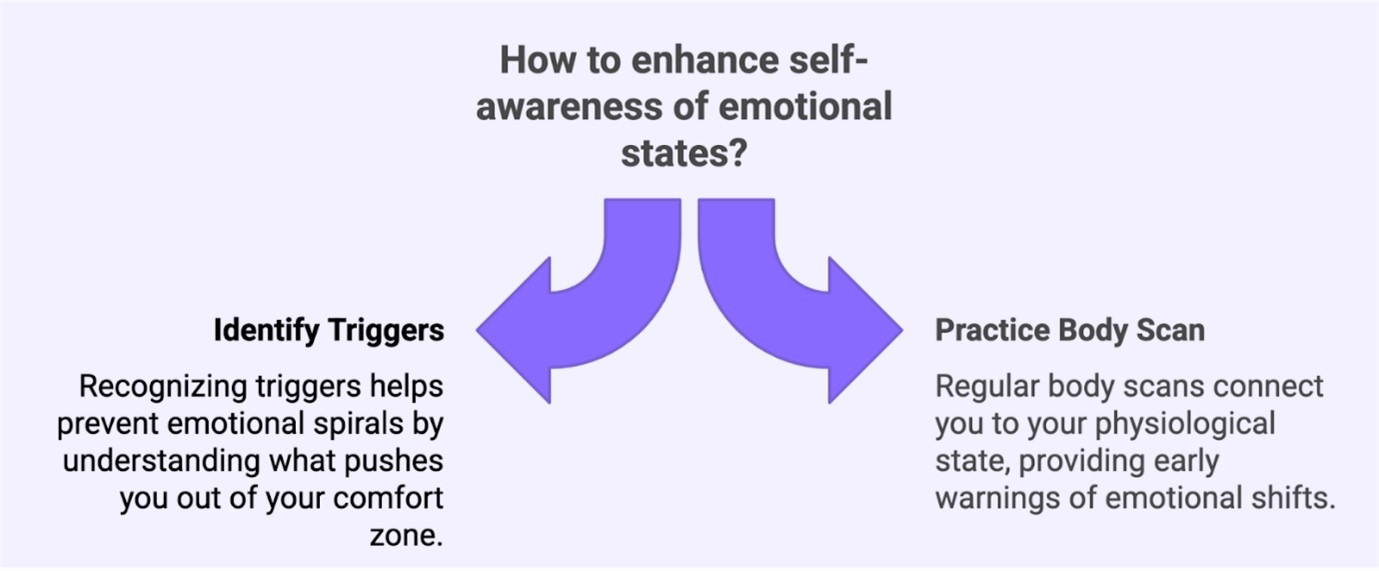
- Practice Body Scan and Mindful Observation: Regularly check in with your body. What sensations are present? Are your shoulders tense? Is your breath shallow? Where do you feel calm, and where do you feel agitated or numb? Practicing mindful body scans helps you develop a deeper connection to your physiological state, which is often the first indicator of where you are in relation to your window.
Step 2: Short-Term Self-Regulation Strategies
When you find yourself outside your window, the goal is not to "fix" or "stop" the feeling, but to gently guide your nervous system back towards a regulated state.
- For Hyperarousal: These techniques aim to bring your energy down and ground you in the present moment.
- Grounding: Focus on your senses or what we call the 5-4-3-2-1 exercise. What five things can you see? Four things you can touch? Three things you can hear? Two things you can smell? One thing you can taste?
- Breathwork: Practice slow, deep, diaphragmatic breathing. Inhale slowly through your nose for a count of four, hold for one, exhale slowly through your mouth for a count of six. The longer exhale activates the parasympathetic nervous system.
- Sensory Input: Hold an ice cube, splash cold water on your face, listen to calming music, hug a pet, use a weighted blanket.
- Movement: Engage in gentle stretching, walking, or shaking out your limbs.
- For Hypoarousal: These techniques aim to gently activate your nervous system and bring you back into engagement.
- Gentle Movement: Stand up, stretch, walk around, sway gently, or dance to uplifting music.
- Sensory Engagement: Look at vibrant colors, listen to engaging music, smell an invigorating scent (e.g., peppermint oil), or taste something strong (e.g., a sour candy).
- Safe Activation: Engage in a simple, achievable task, make eye contact with a trusted person, or hum or sing (vocalizations can stimulate the vagus nerve).
- Orienting: Look around the room and name objects, noticing details. This helps bring your awareness back to the present environment.
Step 3: Long-Term Practices for Sustainable Resilience
These are the daily habits that proactively strengthen and widen your window over time:
- Mindfulness and Meditation: Regular mindfulness practice trains your attention and helps you observe thoughts and feelings without judgment, increasing your capacity to stay present even with discomfort.
- Build Healthy Habits: Prioritize consistent sleep, nourishing nutrition, and regular exercise. These foundational elements are crucial for nervous system regulation and overall well-being.
- Cultivate Positive Relationships (Co-regulation): Spend time with people who make you feel safe, seen, and understood. Healthy relationships provide opportunities for co-regulation, where the calm presence of another person helps to regulate your own nervous system.
- Engage in Meaningful Activities: Pursue hobbies, creative outlets, or volunteer work that brings you joy, purpose, and a sense of accomplishment. These activities foster positive emotions and a sense of connection.
- Practice Self-Compassion: Challenge the internal narratives that tell you your emotional responses are a sign of weakness. Practice self-compassion by treating yourself with the same kindness and understanding you would offer a dear friend. Acknowledge the difficulty of your journey and celebrate small victories.
Expanding your Window of Tolerance takes time, patience, and compassion. There will be days when you feel wide, spacious, and capable, and other days when the window feels impossibly small again. Both are part of the process. What matters is that you begin to notice the patterns, use your tools, and trust that your nervous system is capable of change. A Subreddit discussing techniques to expanding the window of tolerance found that creating awareness of bodily sensations helped them.
At Coach for Mind, we believe healing isn’t about becoming "unbreakable." It’s about learning to ride the waves of your nervous system with greater steadiness, compassion, and choice. Little by little, your window widens - and with it, your capacity to live, connect, and thrive. Your body is not the enemy. It's been trying to protect you all along. Therapy is the process of teaching it that safety, calm, and connection are possible again.
When my client, Piya (name changed) first came to therapy, she described herself as “always on edge.” The smallest disagreements at work would leave her in panic, her heart racing for hours. At home, she often shut down emotionally, unable to engage with her husband. She thought of herself as “too sensitive” and carried deep shame for not being able to “just handle things.” Through trauma-informed therapy, Piya learned that these patterns weren’t weakness, they were her nervous system’s way of protecting her after years of childhood unpredictability. Step by step, we helped her identify triggers and notice how certain tones of voice or deadlines pushed her out of her window. We worked on grounding tools like simple breathwork and sensory grounding to calm hyperarousal. Therapy also helped her learn how to re-engage after shutdowns: using gentle movement and orienting techniques to come back from numbness. Over the months, we built safety in the therapeutic relationship and created space for co-regulation. Riya noticed changes: she could sit through tense meetings without spiraling, recover more quickly from conflict with her partner, and even feel moments of calm she hadn’t known were possible. Her window didn’t widen overnight, but with patience, she began to live more fully in that balanced space.
Sustaining Emotional Resilience in Relationships
Your Window of Tolerance isn't just about how you handle emotions on your own - it deeply shapes your relationships. When your nervous system is balanced, you can show up with presence, empathy, and clarity. But when you're pushed outside your window, communication becomes reactive, boundaries blur, and even small conflicts can feel overwhelming.
The encouraging news is that the effort you put into understanding your window is an effort to transform your relationships. By sharing your internal world and learning how to co-regulate, you create a more stable, compassionate space for connection.
tegrate this understanding into your interactions can transform how you connect with others.
Communicating Your Window: Setting Boundaries
In therapy, we often talk about self-advocacy - learning to communicate your internal state not as a blame, but as an invitation for support. When you can name what’s happening in your nervous system, you give the people in your life a chance to meet you with understanding, rather than misinterpreting your silence or reactivity. This is where boundaries become bridges instead of walls. They protect your energy, reduce misunderstandings, and model healthy, clear communication.
- When you feel Hyperarousal (Anxious/Angry): Try saying "I'm feeling a bit overwhelmed right now, and I need to take a few minutes to myself." The therapeutic power here is that this helps interrupt the fight/flight cycle and set a clear limit without attacking the other person
- When you feel Hypoarousal (Numb/Disconnected): Try saying "I'm feeling a bit numb and disconnected. Can we just sit quietly together for a bit? I need a gentle connection without pressure." The therapeutic power here is that this helps you avoid withdrawing completely and invite connection on your terms, honoring the freeze state.
- During conflict, try saying "I can feel my heart racing and my mind spiraling. Let's revisit this conversation in an hour when my system has settled." What this does is help you, prioritize nervous system coherence over immediate emotional venting, making resolution possible later.
Setting clear, compassionate boundaries protects your window and teaches others how to support you. It moves beyond generic advice to actionable, individualized plans for relational well-being.
Co-regulation: Supporting Each Other's Stability
A fundamental truth of human experience, often explored in Attachment Theory, is that we don’t regulate alone. In safe, healthy relationships, our nervous systems naturally co-regulate, or tune into each other. Your steady, calm presence can help anchor a loved one, and vice versa. Understanding your partner's or friend's window can help you respond with empathy rather than reactivity.
How to Offer Co-Regulation:
- For the Hyperaroused Loved One (Anxious, Angry, Panicked): Your role is to be a non-anxious presence. Listen without judgment and avoid escalating the energy. Simply maintaining eye contact, speaking in a slow, steady voice, or reminding them to feel their feet on the floor can help anchor their system back toward the window.
- For the Hypoaroused Loved One (Shut Down, Disconnected, Foggy): Offer gentle, non-pressuring presence. Instead of demanding they "snap out of it," invite connection in simple, low-stakes ways - a shared cup of tea, sitting side-by-side, or a gentle touch on the arm (if appropriate). This respects the freezing state while keeping the door open.
When both people understand the Window of Tolerance, they stop taking reactions personally and start responding with empathy and curiosity. This is how you transform conflict into connection and build a truly resilient relational dynamic.
The Benefits of a Wider Window: A Life Reclaimed
The journey to expand your Window of Tolerance requires dedication and patience, but the rewards are profound and far-reaching, transforming not just your emotional life but your entire experience of being.
Enhanced Emotional Regulation
With a wider window, you'll find yourself less prone to extreme emotional swings. You'll be able to experience intense emotions without being consumed by them. This doesn't mean you won't feel anger or sadness, but you'll have the capacity to process these feelings, learn from them, and return to a state of equilibrium more quickly and effectively.
Improved Relationships
With greater self-awareness and steadiness, you can express needs more clearly, set necessary boundaries without guilt, and connect authentically. Trust, intimacy, and empathy deepen because you are present for the relationship, rather than consumed by your own dysregulation.
Greater Resilience and Adaptability
A wider window means you're better equipped to handle life's inevitable stressors and challenges. You'll be more flexible, adaptable, and able to navigate difficult situations with a sense of inner strength, rather than being thrown off course. This builds a profound sense of self-efficacy and confidence.
Increased Capacity for Joy and Presence
When your nervous system isn’t stuck in chronic survival mode, you can fully enjoy life. Everyday moments, sharing a laugh, noticing beauty, feeling connected to yourself and others - become richer and more accessible. Your capacity for savoring expands. This is where truly thriving begins.
Conclusion
The Window of Tolerance gives us a compassionate lens to understand why we sometimes feel "too much" or "not enough." Remember, your emotional responses are not a reflection of weakness, but rather the intricate workings of a nervous system striving for safety.
The path forward isn’t about eliminating difficult emotions. It's about increasing your capacity to hold them, work through them, and return to balance with greater ease. Through self-awareness, tailored regulation strategies, nurturing relationships, and trauma-informed therapy, your window can and will expand.
At Coach for Mind, we have worked with a lot of clients taking this journey: from feeling stuck in cycles of reactivity to experiencing more calm, clarity, and genuine connection. Healing isn't about becoming invulnerable: it's about becoming more steady, compassionate, and free.
FAQs
The Window of Tolerance is the zone where your nervous system feels safe enough to function well. Inside the window, you can think clearly, feel emotions without being overwhelmed, and connect with others.
- Above the window (hyperarousal): your system is in fight-or-flight , anxious, angry, panicked, flooded.
- Below the window (hypoarousal): your system shuts down , numb, disconnected, shut off.
Your nervous system learned its “window size” based on early caregiving. If your childhood felt unpredictable or unsafe, your body may have narrowed its window, scanning for danger even in safe moments. Therapy at Coach for Mind helps widen that window so life feels less overwhelming. What this means is that, over time, your nervous system learns it doesn’t have to jump so quickly into fight, flight, freeze, or shutdown when stress arises. Instead, you gain more “room” inside yourself to handle big emotions, conflict, or uncertainty without being hijacked. We do this by combining approaches:
- Somatic and polyvagal-informed work: teaching your body practical ways to return to calm , breathwork, grounding, movement , so regulation becomes second nature.
- Trauma-focused therapies (CBT, EMDR): gently reprocessing old experiences that trained your body to see danger everywhere.
Relational therapy: using the therapist–client relationship itself as a safe, steady space where you can experience dysregulation and repair , showing your nervous system a new, healthier pattern.
Hyperarousal is when your body feels “too much.” Signs include racing thoughts, heart pounding, anger that feels explosive, or anxiety that feels uncontainable. You might say something like: “I know I’m overreacting, but I can’t stop it.”
Being outside the window doesn’t mean you’re weak , it means your nervous system is remembering old dangers. In trauma-informed therapy, we frame this as your body doing exactly what it was trained to do to protect you.
At Coach for Mind, we:
- Use somatic awareness to help you recognize early cues (before the overwhelm takes over).
- Apply IFS (Parts Work): meeting the “panicked protector” part that leaps in to keep you safe.
- Use CFM: exploring the unconscious belief you’re testing in that moment (e.g., “If I show anger, I’ll be abandoned”) and experiencing a new, safe response.
You’re not “bad at coping.” You’re living with a nervous system that was trained in survival. Therapy helps expand your tools so you can come back to balance more easily.
Think of it as helping your body feel safe enough to come back into balance.
In the moment strategies:
- Slow, lengthened breathing (especially long exhales).
- Grounding through the five senses (naming what you see, hear, feel).
- Movement , even standing and shaking out your arms helps release adrenaline.
At Coach for Mind, we use long-term strategies:
- Somatic therapy or polyvagal work to train your nervous system to regulate faster.
- Trauma-focused CBT to reframe triggers.
Relational therapy: using the therapist relationship as a safe space to practice being dysregulated and welcomed back calmly.
You can practice regulation skills on your own breathing, mindfulness, grounding , and these help. But therapy offers something you can’t fully create alone: a safe, consistent relationship where your nervous system learns, in real time, that it doesn’t have to stay on high alert.
At Coach for Mind, we use:
- IFS + trauma-informed therapy: to heal the younger parts that panic or shut down.
- Relational repair: the therapist models calm presence when you go outside your window, helping your body learn a new response.
Self-practice is powerful, but healing often requires experiencing safety with another. That’s what rewires old patterns.
When you know your window, you can recognize when you’re reacting from survival instead of reality. That awareness helps you:
- Pause before lashing out or shutting down.
- Communicate your state to your partner (“I’m outside my window, I need 10 minutes”).
- Offer compassion to your partner when they leave their window.
At Coach for Mind, we often see couples fight the cycle rather than the issue. Mapping each partner’s window helps them see: “Oh, you’re not ignoring me, you’re overwhelmed.”
Knowing about the window isn’t just self-help; it’s relationship help. It builds empathy on both sides.
This can be hard and it might be happening because your partner often activates the deepest old tests. If, as a child, love felt inconsistent or unsafe, your nervous system now reacts quickly to any sign of danger - a delayed text, a sigh, a moment of distance.
At Coach for Mind, we:
- Use relational therapy to notice these triggers in real time.
- Apply reflection that bring the unconscious “test” into the open.
- Use IFS and somatic tools to soothe the young part that’s driving the reaction.
Reactivity isn’t about being dramatic - it’s your body remembering old wounds. Once we work with those, your reactions soften.
Yes but staying calmer doesn’t mean never feeling strong emotions. It means your nervous system learns to recover faster and stay within your window more often.
At Coach for Mind, we help by:
- Somatic regulation: training your body to come down from hyperarousal or wake up from hypoarousal.
- CM: challenging the belief that stress always equals abandonment or danger.
- IFS: teaching your protective parts that they don’t need to take over so strongly.
It’s not about becoming “zen” all the time. It’s about learning to ride the waves without drowning.
First, remember you can’t force them back. What you can do is create a safe environment for their nervous system to regulate.
Some helpful ways:
- Stay calm yourself , your regulated state helps theirs.
- Ask, not assume: “Do you need space or closeness right now?”
- Offer grounding options (“Want to go for a walk?” “Want me to sit quietly with you?”).
- Avoid criticism while they’re out of their window.
At Coach for Mind, we often coach partners with:
- Relational repair tools: structured check-ins and soothing scripts.
- EFT for couples: helping each partner's name when they’re out of the window and what helps them return.
Supporting a partner doesn’t mean fixing them - it means staying steady and safe while they find their way back. The Window of Tolerance is about nervous system safety. At Coach for Mind, we use CFM, IFS, somatic work, trauma-focused CBT, EMDR, and relational therapy to help you understand your window, expand it, and learn how to return when you slip out , both for yourself and in your relationships.
- Pause and name it: “I’m outside my window.” Naming it helps your brain shift from survival to awareness.
- Ground through the body: slow breathing, feet on the floor, noticing surroundings.
- Movement: shake, stretch, or take a walk to release energy.
- Soothing statement: remind yourself, “This is my nervous system protecting me. I’m safe right now.”
At Coach for Mind, we help you create a personalized “regulation toolkit” , a set of body-based, emotional, and relational strategies that fit your unique triggers. Every time you practice this, you widen your window. Over time, your nervous system learns that you don’t have to stay stuck outside.


