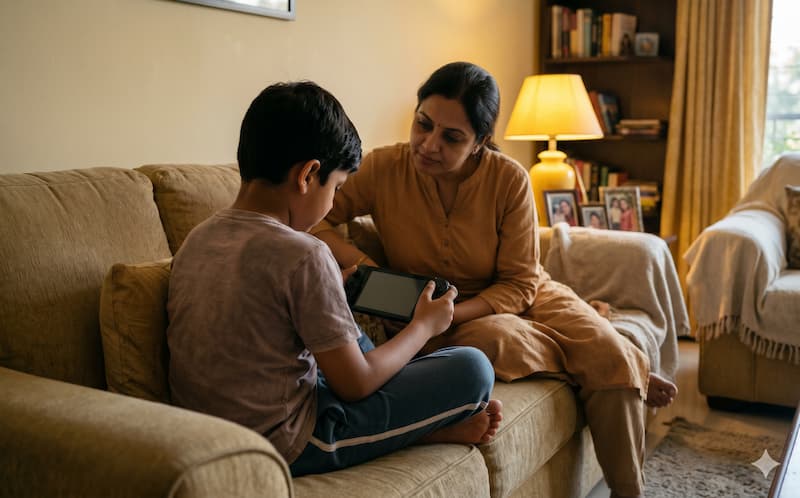
Is This You?
Or maybe it's quieter than that. They've stopped asking to go out. The friend who used to come over every weekend hasn't visited in months. Their grades are slipping, but when you bring it up, all you get is a shrug.
You're not here because you hate video games. You're here because you love your child and something feels wrong.
This guide is for you. No lectures, no alarmism. Just an honest, clinical look at what the research says — and what you can actually do about it.
First: Is Your Child Addicted, or Just an Avid Gamer?
This is the question parents struggle with most, and the answer genuinely matters — because the response to each is different.
Loving something deeply is not the same as being addicted to it. A child who plays for three hours on weekends, draws their favourite characters, talks about game lore at dinner, and still goes to football practice is an enthusiastic gamer. A child who skips hygiene, lies about how long they've been playing, quits friendships that compete with gaming time, and has a complete emotional breakdown when the console gets switched off may be showing signs of Internet Gaming Disorder (IGD).
The clinical distinction, according to DSM-5-TR and ICD-11, comes down to one thing: functional impairment. Not hours. Not enthusiasm. Not the fact that they'd rather game than do homework. The question is whether gaming is meaningfully damaging their life across sleep, school, relationships, or physical health — and whether they have lost the ability to stop.
Here's a quick framework:
| Normal Heavy Use | Possible Gaming Disorder |
|---|---|
| Plays a lot, but stops when asked (even if unhappily) | Extreme aggression or meltdowns when required to stop |
| Has friendships both in and outside gaming | Withdrawing from all offline relationships |
| Keeps up with basic hygiene and sleep | Skipping meals, teeth cleaning, personal hygiene |
| Schoolwork dips occasionally | Consistent, worsening academic decline |
| Gets excited about games | Uses games primarily to escape emotional pain |
| Honest about how much they play | Lies about screen time or hides gaming |
If the right column is where your child is landing, consistently, keep reading.
The Warning Signs: What Gaming Addiction Actually Looks Like in Children
Behavioral Signs
Extreme reactions to stopping. The most commonly reported sign by parents isn't hours played — it's what happens when play ends. Tears, rage, verbal aggression, and physical outbursts when asked to put down the controller are a recognised clinical symptom. This is not simply “bad behaviour.” Research published in PMC (Mohammad et al., 2023) confirms that these responses reflect neurological changes in the brain's reward pathways — a genuine withdrawal reaction, not a choice.
Lying about screen time. If your child minimises how long they've been playing, hides gaming sessions, or denies playing when they clearly have been, this is a significant red flag. Deception about gaming duration is one of the DSM-5-TR diagnostic criteria for Internet Gaming Disorder.
Gaming at all hours. Waking up before dawn to play, staying up past midnight, or using a phone under the covers when they think you're asleep — disrupted sleep architecture from gaming is both a symptom and a consequence of gaming disorder.
Loss of interest in everything else. When sports, hobbies, and activities that once excited them simply stop mattering — not because they found something new, but because nothing compares to the dopamine hit of gaming — that narrowing of interest warrants attention.
Physical Signs
Neglecting hygiene. Multiple parents describe the same thing: their child stops brushing their teeth, skips showers, and resists getting dressed. The game feels more urgent than the body.
Sleep deprivation. Gaming is highly arousing for the nervous system. The blue light suppresses melatonin. The competitive tension of online play keeps cortisol elevated. Children who game late frequently cannot fall asleep even after stopping, leading to chronic fatigue that affects school performance, mood regulation, and immune function.
Physical complaints. Wrist and hand pain (“gamer's thumb”), eye strain, back and neck tension from poor posture, and headaches from prolonged screen exposure are physical indicators of excessive gaming that parents sometimes miss as unrelated.
Social Signs
Social withdrawal — offline, not online. This is the nuance parents often miss. Children with gaming disorder are frequently very social within the game. What changes is their offline social life. Friends stop coming over. Birthday parties get skipped. Family gatherings feel unbearable.
School relationship deterioration. Teachers flag it before parents sometimes — increasing isolation during break times, disengagement in class, irritability with peers.
Why Gaming Is So Hard to Stop: The Brain Science
Understanding what's happening neurologically removes the sense that your child is simply choosing to be difficult.
Games are engineered by teams of behavioural psychologists and game designers to trigger dopamine release at carefully calibrated intervals. The mechanism is called a variable reward schedule — rewards that come unpredictably, which produces stronger compulsive behaviour than predictable rewards. This is the same mechanism behind slot machines.
For children, whose prefrontal cortex (the part of the brain responsible for impulse control, long-term planning, and consequence assessment) is not fully developed until the mid-twenties, these systems hit disproportionately hard. Their brain registers the game's reward loop with the same neurological intensity as an adult's — without the adult capacity to override it.
A comprehensive review by Mohammad et al. (2023), analysing the neuroscience of gaming addiction, found that Internet Gaming Disorder triggers changes in dopamine pathways comparable to substance use disorders. This is why the explosive anger when you switch off the console is not theatre. It is a withdrawal response. The brain expected more dopamine, and it didn't get it.
This also explains why cold-turkey confiscation so often fails. The brain does not simply calm down. It escalates.
Mobile Games and Young Children: A Special Warning
Many parents introduce young children to tablets and mobile phones before console games, assuming these are safer, smaller-stakes experiences. The opposite is frequently true.
Mobile games designed for children — particularly free-to-play titles — are often built around the most aggressive psychological manipulation in the industry. Gacha mechanics (randomised character or item unlocks), daily login rewards, time-limited events, and loot boxes are designed to create FOMO and exploit the underdeveloped impulse control of young children to drive in-app purchases.
One parent described their nine-year-old constantly begging for money for Robux in Roblox. Another found that their child had found ways around parental controls to make purchases without permission.
The irony is that many traditional console games — with a one-time purchase price and a finite story — are less psychologically manipulative than free mobile titles. Age-appropriate games like Minecraft, the LEGO series, and story-driven titles give children a complete experience without engineered addiction loops.
When evaluating your child's gaming, ask: does this game have an end, or does it want them to play forever?
The Unpausable Game Problem: A Script for Real Life
Here is the daily friction point that no parenting guide addresses clearly: your child is in the middle of a multiplayer match, and you're calling them for dinner.
In a live multiplayer game — Fortnite, Valorant, Minecraft with friends, Roblox — leaving mid-session is not simply inconvenient. It penalises the child with a loss, lets down their teammates (real people they know), and in some games triggers automatic account restrictions. When you call them to stop immediately, you are — from their perspective — asking them to betray their friends and absorb a punishment they didn't earn.
This doesn't mean you back down. It means you time the boundary differently.
- Five minutes before the boundary: “You have five more minutes. When this match ends, that's it for today.”
- At the boundary: “Is this match still going? Finish it, then we're done.”
- After the match: Hold the line. One more match is always possible. The conversation you want to have is before the session starts, not at the end of it.
Negotiate stopping points based on natural game breaks — match end, level completion, a save point — rather than arbitrary clock times. This respects the social reality of how their games work, which means they're more likely to comply without a scene.
Good Games vs. Predatory Games: What Parents Need to Know
Not all games are equally risky. Here's how to tell the difference:
- Have a finite story or clear endpoint
- Charge a one-time purchase price
- Allow the game to be paused
- Offer co-op play with people the child knows in real life
- Have age-appropriate content ratings (PEGI or ESRB)
- Be free-to-play with in-app purchases
- Use loot boxes, gacha mechanics, or randomised item rewards
- Have daily login bonuses and time-limited events designed to create FOMO
- Run endless competitive ranked ladders with no natural stopping point
- Feature toxic anonymous online communities
Games like Minecraft, Stardew Valley, the LEGO series, and narrative-driven RPGs like Pokémon tend to fall in the lower-risk category. Free-to-play mobile titles, many live-service shooters, and gacha-heavy games are the ones that generate the most clinical concern.
This doesn't mean banning the higher-risk ones automatically. It means being more actively involved in how, when, and how much your child plays them.
What Research Says About Parenting Approaches
A randomised controlled trial by Krossbakken et al. (2018), studying 5,864 families in Norway, found that generic “screen time rules” leaflets mailed to parents had no meaningful effect on preventing gaming addiction in the general population. The guides weren't useless — parents who already suspected a problem found them actively helpful. But blanket restrictions without relationship don't move the needle.
What does work, according to clinical research by Bonnaire et al. (2019), is what they call Multidimensional Family Therapy (MDFT) adapted for IGD — and the core principle is surprising: ask your child about their game. Not to police it. To understand it.
Parents who show genuine curiosity about what their child is building, what the story is, who their online friends are, create a communication channel that authoritarian approaches destroy. This channel is exactly what you need when things escalate — and it's the difference between a child who comes to you when something goes wrong online versus one who hides everything.
The evidence is clear: collaborative approaches work better than unilateral bans. Confiscating the console without a plan, cutting the Wi-Fi mid-session, or issuing a permanent ban without therapeutic support tends to:
- Escalate aggression significantly
- Drive gaming underground (to a friend's house, a school computer, a hidden phone)
- Damage the trust that makes all subsequent parenting harder
- Leave the underlying need the game was meeting completely unaddressed
The Neurodivergent Child: ADHD, Autism, and Gaming
If your child has ADHD or is on the autism spectrum, gaming addiction carries specific risks that standard advice doesn't account for.
ADHD is characterised by dopamine dysregulation — the same system that games exploit. For a child whose brain finds most daily tasks unstimulating and hard to start, a game that provides immediate rewards, clear structure, and constant novelty can feel like the only place where their brain works normally. This is not a small thing to dismiss.
Time blindness (a hallmark ADHD trait) means their experience of “I'll stop in five minutes” is genuinely different from yours. They are not lying. They cannot reliably sense time passing while hyperfocused. Standard timer-based limits often fail because the timer doesn't register as meaningful when they're in flow.
For autistic children, games may also serve as an important predictable environment in a world that frequently overwhelms them socially and sensorially.
What tends to work better for neurodivergent children:
- Visual timers placed in their peripheral vision during play (Time Timer watches or apps), not audio alerts they can tune out
- Transition warnings that are activity-based, not time-based: “When you reach the next save point” rather than “in ten minutes”
- Sensory transition activities between gaming and the next task — a brief physical movement, a snack, something tactile
- Environmental controls that don't rely on the child's internal regulation: devices that automatically shut off at set times remove the parent from the role of enforcer
If you suspect ADHD and have not had a formal assessment, that is often the most useful place to start. Treating ADHD directly tends to make gaming management significantly more manageable. Our holistic guide to empowering your child with ADHD covers this in more depth.
Age-Specific Guidance
When to Seek Professional Help
Consider a clinical assessment if your child:
- Becomes physically aggressive when gaming ends
- Is lying consistently about their screen time
- Has stopped attending school or seen a significant, sustained academic drop
- Has lost all offline friendships over a period of months
- Is skipping meals or sleeping under four hours regularly
- Is spending money — yours or theirs — on in-game purchases without permission
- Has expressed that the game is the only place they feel good or worthwhile
A clinical assessment at this point is not about pathologising your child. It is about finding out whether gaming is the issue or the symptom — because that distinction drives everything about how you help them. Conditions like depression and anxiety often sit underneath what looks like a pure gaming problem.
A First Session Is a Conversation, Not a Verdict
If you're recognising these patterns in your child, talking it through with someone who works with this every day can help you see the situation clearly.
Book a Free 15-Min CallYour First Session at Coach For Mind
A first session is a conversation, not a verdict. Our RCI-registered clinical psychologists work with children, adolescents, and families to assess what's actually driving the pattern — whether that's ADHD, depression, anxiety, social difficulty, or a combination — and to build a plan that fits your family's real life, not an idealised version of it.
We don't believe in blaming parents. We've seen what happens to exhausted single parents using screens as survival tools, and to gamer parents watching their hobby turn into a source of conflict with their child. We work with you as you are.
Sessions are available in-person in Gurgaon (Sector 70) and online across India and internationally. You can also read more about our broader approach to gaming addiction treatment and how gaming addiction affects mental health.
Frequently Asked Questions
There is no single hour threshold that defines addiction. The World Health Organization and DSM-5-TR both define gaming disorder through behavioural impairment, not clock time. A child gaming two hours a day who is consistently lying, withdrawing socially, and unable to stop without a meltdown raises more clinical concern than a child gaming four hours on a weekend who remains otherwise functional. The more useful questions are: Can they stop when asked? Is their sleep, hygiene, and schoolwork intact? Are they maintaining offline relationships?
The intensity of the reaction is something worth paying attention to, but context matters. Young children (under 8) frequently struggle with transitions off any high-stimulation activity. If the meltdowns are severe, consistent, and escalating — or persist well into adolescence — that warrants a closer look. Research confirms these reactions reflect neurological withdrawal from dopamine stimulation, not simply bad behaviour. A clinical psychologist can help you assess whether this is developmental, temperamental, or something that needs targeted support.
The evidence generally says no — at least not as a first move. Abrupt, unilateral bans tend to escalate aggression, drive gaming underground, and damage the parent-child relationship that you need intact for any further intervention to work. Collaborative approaches — family agreements, structured limits, genuine engagement with what your child loves about gaming — tend to produce better outcomes. Complete abstinence may occasionally be the right clinical recommendation, but it should follow assessment and be supported therapeutically, not imposed in a moment of frustration.
For many children, yes — particularly those who struggle socially offline, or who live in areas with limited peer access. Research confirms that online gaming communities provide genuine social bonds, shared experiences, and real belonging. Dismissing these relationships damages trust and removes your child's motivation to engage with you about their online life. The healthier approach is to take these friendships seriously while also working to ensure offline social connection remains part of their life too.
Often the opposite. Many free-to-play mobile games use the most aggressive psychological manipulation in the industry — loot boxes, gacha mechanics, daily login rewards, and time-limited events — specifically designed to drive spending. These mechanics exploit the underdeveloped impulse control of young children far more aggressively than most traditional console games. A one-time purchase console game with a finite story is frequently a lower-risk choice than a free mobile title with in-app purchases.
Yes, there is a strong documented connection. ADHD involves dopamine dysregulation in the same neural circuits that games are designed to stimulate. Children with ADHD often find gaming one of the few activities where their brain feels regulated and rewarded — which makes it particularly hard to stop. Standard timer-based limits frequently fail because of ADHD-related time blindness. If your child has ADHD and is struggling with gaming, the two issues need to be addressed together. An RCI-registered clinical psychologist can assess both and provide strategies specifically designed for neurodivergent children.
Seek a clinical assessment if your child is consistently showing three or more of the following: lying about screen time, losing sleep regularly due to gaming, withdrawing from all offline friendships, showing academic decline sustained over weeks, becoming physically aggressive when gaming ends, or spending money on games without permission. A psychologist will assess whether gaming is the primary problem or a symptom of something underneath — like depression, anxiety, or ADHD — which makes a significant difference to how you help.