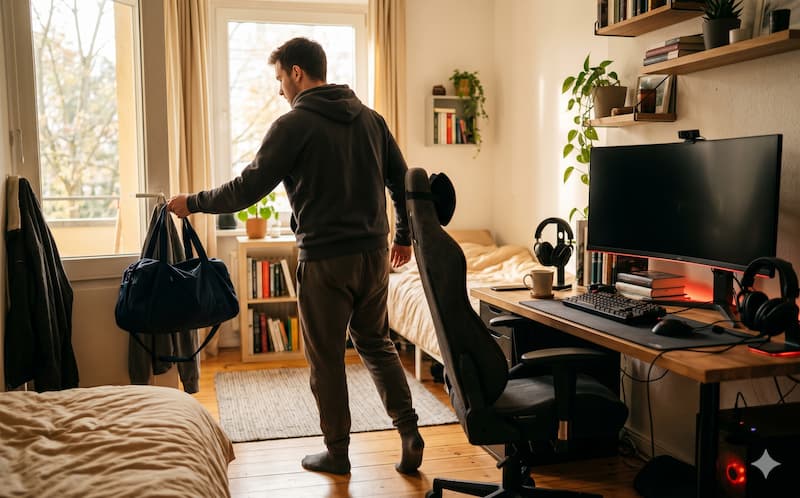
Is This You?
What you're resisting is the solution everyone keeps offering: quit entirely.
And here's the thing — that resistance might not be weakness. For many people, gaming is not a trivial pastime to be discarded. It's how you socialise, decompress, and feel competent when the rest of life feels chaotic. Ripping that out without addressing what sits underneath it tends to leave a gap that fills with something else, or sends people straight back to the game within weeks.
This article is for people who want a realistic path: not quitting, but genuinely regaining control. That path exists. It requires honesty, some structural changes, and in some cases professional support — but it does not require you to hand in your gaming identity at the door.
First: Are You Actually Addicted, or Just Playing a Lot?
This distinction matters more than people realise, because the approach is different.
A literature review by Gorman et al. (2018), published in the American Journal of Play and analysing multiple large-scale studies including a longitudinal study tracking roughly 3,000 youth in Singapore, made something clear that most mainstream coverage ignores: the number of hours you spend gaming is not a diagnostic criterion for Internet Gaming Disorder.
The clinical criteria under DSM-5-TR require at least five of nine specific indicators of distress and dysfunction — things like:
- Using games to escape or relieve negative moods
- Repeated, unsuccessful attempts to reduce play
- Losing interest in previous hobbies due to gaming
- Lying to family or therapists about how much you play
- Risking or losing a significant relationship, job, or educational opportunity because of gaming
- Continuing to play despite awareness of the harm it's causing
What's notably absent from that list is “plays more than X hours per day.”
A person gaming four hours a day who maintains their job, relationships, sleep, and health does not meet the clinical threshold. A person gaming two hours a day who is lying about it, failing at work, and unable to stop when they need to may well meet it.
The Gorman review also found that escapism (gaming specifically to avoid real-life problems) and achievement motivation (gaming to feel competent in ways real life isn't providing) are the strongest predictors of Internet Gaming Disorder — not hours played.
The honest self-audit questions:
- Am I gaming to enjoy gaming, or to avoid feeling something?
- Can I stop when I need to, or does “just one more” override everything?
- Is gaming costing me things I actually care about?
- Am I being honest with the people in my life about how much I play?
If the answers to those questions make you uncomfortable, you're in the right place.
Why Willpower Fails (and Why That's Not Your Fault)
One of the most common things people say when gaming starts to take over their life is some version of: “I feel drained, weak, pathetic, controlled. I would very much love to not feel this way.”
That's not a character description. It's what dopamine dysregulation actually feels like from the inside.
Modern live-service games are not accidentally compelling. They are designed by behavioural psychologists and game engineers to trigger dopamine release at optimally addictive intervals.
| Game Mechanic | Psychological Trigger |
|---|---|
| Daily login rewards | Operant conditioning — rewards for showing up, penalties (missed rewards) for not |
| Loot boxes / gacha | Variable reward schedule — the most potent reinforcement pattern known in behavioural psychology |
| Battle passes | Loss aversion and sunk cost — you paid for it, so you must complete it |
| Ranked ladders | Competitive escalation — always one rank above you to chase, no natural endpoint |
| Daily quests / resets | Artificial time pressure — FOMO built into the game's architecture |
| Pity banners | Near-miss mechanics — the reward feels close, which maintains behaviour longer than random misses |
These are not dark patterns you can simply decide to ignore. They work on the brain's reward circuitry regardless of how aware you are of them. Knowing a slot machine is rigged does not stop the pull.
This is why self-imposed rules like “I'll only play after I finish my work” fail so reliably for people with genuine gaming disorder. The problem is not the rule — it's that the first exposure to the game triggers the dopamine loop, and the prefrontal cortex (responsible for long-term decision-making) loses the argument with the limbic system (which wants the next hit right now).
Gorman et al. (2018) identified high impulsivity as one of the key risk factors for gaming disorder — not laziness, not moral weakness, impulsivity. That's a neurological trait, not a personality flaw. And it's one that responds to structured intervention far better than it responds to shame.
The Core Framework: Moderation vs. Abstinence
The gaming community is sharply divided on this. Some people insist moderation is “copium” — a comforting lie that enables continued addiction. Others believe controlled gaming is achievable once the underlying psychological drivers are addressed.
Both positions have clinical support, and the right answer depends on your specific situation.
- You have tried and failed at moderation multiple times
- The games you're most drawn to are heavily live-service (daily resets, gacha, competitive ranked)
- Your gaming is sitting on top of untreated depression, ADHD, or anxiety
- You're in financial distress from microtransactions
- Your relationships or career are in active deterioration
- Your gaming is primarily social (playing with real-world friends, not anonymous ranked)
- You can identify clear triggers that drive binge sessions, and those triggers are addressable
- The games you play have finite structures (single-player campaigns, cooperative games with friends)
- You have a stable enough real life that gaming is genuinely relaxation, not escape
The key question is whether moderation has ever actually worked for you, or whether “moderation” has historically meant three weeks of control followed by a relapse binge. Honesty here matters more than optimism.
Step 1: Stop Playing the Most Addictive Games First
This is not quitting gaming. This is quitting the specific games engineered to make moderation impossible.
Live-service games with daily resets, gacha pulls, battle passes, and infinite competitive ladders are structurally incompatible with moderation for most people with gaming disorder. They are designed so that every session ends at a moment of unresolved tension — the next daily reset is coming, the next ranked match could recover your losses, the pity counter is building toward a guaranteed pull.
The genre swap is a harm reduction strategy, not surrender.
| Genre | Addiction Risk | Why | Moderation-Friendly? |
|---|---|---|---|
| Gacha / mobile RPG | Very High | Variable rewards, real-money hooks, daily resets | No |
| MMORPG (live service) | Very High | Infinite progression, daily quests, social obligation | No |
| Competitive MOBA / FPS ranked | High | 50/50 loss rate, cortisol spikes, no natural endpoint | Difficult |
| Battle royale (casual) | Medium | Session-based, but live service hooks in most titles | With limits |
| Single-player narrative RPG | Low–Medium | Finite story, pauseable, no daily requirements | Yes |
| Co-op with known friends | Low | Social accountability, session-based, pauseable | Yes |
| Indie / puzzle / strategy | Low | Usually finite, no live-service hooks | Yes |
| Sandbox (Minecraft, etc.) | Low–Medium | Creative and open-ended, but can become escapist | Generally yes |
Gorman et al. (2018) found that RPGs and RTS games show higher addiction correlation than action or mobile games — so “single-player” doesn't automatically mean low-risk. The question is whether the game has a natural end and whether it requires daily engagement to avoid falling behind.
If you are trying to establish moderation, starting that process while still playing a gacha game with a daily reset is like trying to moderate alcohol while working in a bar. The structural conditions make it far harder than it needs to be.
Step 2: Remove the Decision from the Equation
Relying on an alarm to stop playing fails for a specific neurological reason: by the time the alarm goes off, you are in a state of hyperarousal, and your prefrontal cortex is losing the argument. The decision to stop is being made by the least capable version of your brain.
The solution is to remove the decision entirely by setting up environmental controls before you start.
- Smart plug timers: Plug your console or PC into a smart plug set to cut power at a fixed time. Not an alarm. Actual power loss. The game ends whether or not you're ready.
- Router schedules: Most modern routers (and parental control apps like Circle or Google Home) allow you to schedule internet availability. Competitive multiplayer becomes unplayable when the router shuts off the connection.
- App blockers: On PC, tools like Cold Turkey or Freedom can lock access to specific games or game launchers during set hours. They are deliberately difficult to override.
- Physical distance: Keeping the console in a common room rather than your bedroom makes late-night sessions structurally harder. Friction works.
- Unlinked payment methods: If microtransactions are a problem, removing stored cards from your gaming accounts and switching to physical gift cards introduces a friction step between impulse and spend. Most impulse purchases do not survive a deliberate friction step.
The principle here is pre-commitment: setting up conditions in advance that make it harder to override your intentions when the dopamine loop is active. This is the same logic behind people who don't keep junk food in the house — not because they lack willpower, but because willpower is finite and environment is more reliable.
Step 3: Address What the Game Is Actually Doing for You
This is the step most self-help guides skip, because it requires genuine self-examination rather than a productivity hack.
The Gorman review identified two motivational profiles most strongly associated with gaming addiction:
The Escaper: Gaming to avoid something — stress, emotional pain, a relationship problem, grief, boredom that feels unbearable. The game isn't the goal; the not-feeling-that is the goal.
The Unregulated Achiever: Gaming to feel competent, accomplished, and recognised in a way real life isn't providing. The dopamine hit from ranking up, completing a raid, or being respected in a guild fills a hole that work, relationships, or personal goals are failing to fill.
Neither profile is shameful. Both make psychological sense. And both mean that reducing gaming without addressing the underlying driver tends to produce one of two outcomes: the person finds a different escape (alcohol, food, doom-scrolling), or they relapse to gaming within weeks.
To identify your pattern, ask:
- What am I thinking about just before I open the game?
- What would I have to feel or face if the game weren't there?
- What does the game give me that I'm not getting elsewhere?
If the answers point to depression, anxiety, loneliness, ADHD, or unprocessed trauma, those are the actual clinical targets. Gaming is the coping mechanism, not the disease.
Step 4: Build Real-World Alternatives That Actually Compete
The standard advice is “find new hobbies.” This advice fails because it ignores neuroscience.
After a period of heavy gaming, your dopamine system is calibrated for high-intensity, high-speed reward. Going for a walk or picking up a book produces dopamine — just very slowly, and at low amplitude by comparison. Your brain registers this as boring. Not because it is boring, but because your reward system is calibrated to a different baseline.
This is temporary. Dopamine sensitivity recovers over roughly two to four weeks of reduced high-stimulation input. But during that window, you need a strategy that bridges the gap rather than white-knuckling through it.
- Physical exercise: Gaming soundtracks (fast-paced, high-energy game OSTs) played during a workout provide stimulation while building a genuinely rewarding real-world habit. The endorphin response from exercise is real and lasting.
- Competitive real-world activities: The psychological need that competitive multiplayer meets (mastery, ranking, social recognition) can be met by martial arts, chess, competitive sport, or debate. These provide real-world competence loops.
- Real-life gamification: If the achievement loop is what you're chasing, apply game design elements to real-world goals. Track XP in a fitness app. Use a habit-tracking tool like Habitica that literally gamifies daily tasks. Set up personal quests with real rewards attached to milestone completion.
- Creative production: Gaming often scratches an aesthetic and creative itch. Music production, game modding, 3D design, writing, and programming all offer the same engagement loop (start → effort → visible progress → completion) without the live-service manipulation.
The principle is to pair new activities with higher-stimulation elements initially, then gradually reduce the stimulus as the activity becomes its own reward. The goal is not to find a hobby that feels as good as gaming immediately. It's to build activities that, over time, produce a deep enough reward signal to compete.
Step 5: Handle the Social Layer
For many people with gaming addiction, the social dimension is the hardest part to address. Online friends are real friends. Guilds, squads, and gaming groups provide genuine belonging. Cutting gaming without a plan for this social layer tends to produce loneliness — which is one of the drivers of gaming in the first place.
If your primary social life is in-game, the goal is parallel development, not replacement: maintain the online friendships, message the people you game with outside the game, and use your shared interests as a bridge to other social contexts — Discord servers, local gaming events, game-adjacent communities.
If clan or group obligations are keeping you in the game longer than you want, this is a real pressure and it deserves a real answer:
- “I've got a lot going on at the moment — I'm going to step back from dailies for a while.”
- “I'm keeping my account active but I need to miss raids for the next few weeks.”
- “I'm trying to set some limits on my hours — not going anywhere, just changing how I play.”
You are not obligated to explain your mental health to your online guild. A low-key, low-drama statement of reduced availability is enough. The people worth staying close to will respect it.
The Sunk Cost Trap: Letting Go of What You've Already Spent
For anyone who has spent significant money on gacha games, microtransactions, or battle passes, there is a specific psychological barrier to moderation that isn't discussed enough: the sunk cost.
“I've spent ₹30,000 on this account. I can't just stop — I'll lose everything I've built.”
This logic is understandable and it is also a trap. The money is already gone. It does not come back if you keep playing. The account value is only meaningful if you continue paying for it, which means the sunk cost is actively costing you more.
Letting go of a heavily invested account is genuinely painful. It can feel like grief. If you find this step impossible to take on your own, it is worth discussing with a therapist — not because the account is clinically significant, but because the shame and loss attached to it often are.
When Moderation Isn't Enough: Recognising the Need for Professional Support
Controlled gaming is a realistic goal for many people. It is not a realistic goal for everyone, and knowing the difference matters.
Consider seeking clinical support if:
- You have attempted moderation multiple times and it consistently collapses within weeks
- Your gaming sits on top of depression, ADHD, or anxiety that you haven't addressed with treatment
- You are in financial distress from in-game spending and feel unable to stop
- Your relationship or family situation is in crisis because of gaming
- You are using gaming to cope with trauma, grief, or significant psychological pain
A clinical assessment is not a verdict. It is a way of getting an accurate picture — whether gaming is the issue, or the symptom, and what the most efficient path forward looks like for your specific situation. If you're more concerned about a child's gaming than your own, our guide on signs of gaming addiction in children covers that ground separately.
You Don't Have to Choose Between Gaming and Your Life
A first session isn't about handing over the console. It's about understanding what's underneath the pattern and building something that actually fits.
Book a Free 15-Min CallYour First Session at Coach For Mind
At Coach For Mind, our RCI-registered clinical psychologists work with adults who are trying to build a healthier relationship with gaming — not necessarily quit, but genuinely regulate.
We don't pathologise gaming. We don't start by telling you to hand over the console. We start by understanding what gaming is doing in your life, what's underneath it, and what a functional, sustainable version of your relationship with it looks like.
This includes assessment for co-occurring conditions like ADHD, depression, and anxiety that may be driving the pattern, and evidence-based approaches including Cognitive Behavioral Therapy. You can also read more about our broader gaming addiction treatment approach.
Sessions are available in-person in Gurgaon (Sector 70) and online across India and internationally.
Frequently Asked Questions
For many people, genuine moderation is achievable — but the research is clear that it requires more than willpower and good intentions. It typically requires addressing the psychological drivers (what the game is doing for you), switching away from structurally addictive game types (live-service, gacha, infinite ranked), and setting up environmental controls that don't depend on in-the-moment self-regulation. For people whose gaming sits on top of untreated ADHD, depression, or anxiety, moderation is significantly harder until those conditions are addressed directly.
Total hours played is not a clinical criterion for Internet Gaming Disorder. The DSM-5-TR requires at least five of nine specific dysfunction indicators — things like lying about screen time, failed attempts to cut back, using games to escape negative emotions, and losing significant relationships or opportunities due to gaming. A clinical psychologist can help you assess this accurately. The more useful self-check is not how many hours you play, but whether gaming is costing you things you genuinely care about and whether you can stop when you need to.
Probably nothing — the limits you were setting relied on in-the-moment willpower, which research consistently shows is insufficient when the dopamine loop is active. The most effective approach is pre-commitment: setting up environmental controls (smart plugs, router schedules, app blockers, unlinked payment methods) before a session starts, so the decision to stop doesn't depend on you making a good choice while hyperaroused. The other variable is whether the games you're playing are structurally designed to resist stopping — gacha and live-service games are specifically built to prevent natural session endpoints.
The shame is understandable and common. Gacha mechanics are designed by teams of behavioural psychologists specifically to exploit variable reward responses and loss aversion — they are not accidentally compelling. The sunk cost trap (“I can't stop, I've already spent so much”) is one of the most reliable psychological hooks in gacha design. The money you've spent does not return if you keep playing — it continues to cost you. If the shame and financial impact feel impossible to address alone, this is worth bringing to a therapist. Not because the spending is catastrophic in itself, but because the shame attached to it often blocks the ability to change. If the spending has crossed into real-money betting rather than in-game purchases, see our page on online gambling addiction treatment, which uses a related but distinct approach.
Generally yes, with a caveat. Single-player, narrative-driven games with clear endpoints are structurally far more moderation-friendly than live-service titles because they don't have daily resets, don't punish you for taking a break, and have a natural stopping point when the story ends. The caveat from Gorman et al. (2018) is that RPGs can still be associated with gaming disorder symptoms — particularly for people using them for escapism. A game with a great story can still become a place you hide from real life. The genre matters less than the motivation behind why you're playing.
You don't owe anyone a detailed explanation. A low-key statement works: “I've got a lot going on, I'm going to be less available for a while.” Most people in gaming communities understand this. The relationships worth keeping will survive reduced availability. If you're in a guild or clan with daily obligations that feel impossible to step back from, that obligation structure is itself part of what's making moderation difficult — and it may be worth stepping back from that specific commitment entirely, even if you continue gaming in lower-pressure contexts.
Yes, significantly. ADHD involves dopamine dysregulation in the same neural circuits that games are engineered to stimulate — which makes games feel uniquely rewarding for people with ADHD, and makes stopping them particularly hard due to time blindness and hyperfocus. Standard moderation advice (timers, willpower, habit rules) tends to fail for people with ADHD specifically because of these traits. The most effective approach combines ADHD-specific strategies (external environmental controls, transition cues) with direct ADHD treatment. If you haven't had a formal ADHD assessment, that is often the most valuable place to start.