Is This You?
You were in a yoga class, mid-pigeon pose, and it happened without warning. No memory surfaced, no specific thought. Just a wave of grief, or rage, or relief that came out of nowhere and left you shaking on the mat while everyone else moved calmly into the next pose.
Or maybe you've heard your yoga teacher say "the hips store trauma," and you're not sure whether that's profound or pseudoscience. You want a straight answer, not a wellness slogan and not a dismissal of something that felt unmistakably real in your body.
Both things can be true at once: the phrase "trauma is stored in the hips" is often used too literally, and what you experienced on that mat was a genuine physiological event. This article explains the actual anatomy and nervous system science behind it, without romanticizing or dismissing what you felt.
TL;DR
The psoas muscle is deeply involved in the body's fight-or-flight response because it helps create the protective, curled posture humans instinctively adopt during stress and danger. Chronic stress and trauma can keep the nervous system partially stuck in survival mode, leading to long-term muscular bracing, shallow breathing, hip tightness, and persistent physical tension. Emotional reactions during hip-opening stretches are usually linked to nervous system regulation and physiological release, not because emotions are literally "stored" inside the muscles. The psoas and diaphragm are anatomically connected, which means chronic hip tension can influence breathing patterns, vagal regulation, and autonomic nervous system functioning. Modern trauma research supports the idea that traumatic stress affects the body physiologically through posture, muscle tone, breathing, pain sensitivity, and autonomic conditioning over time. Somatic practices such as gentle stretching, breathwork, grounding, yoga, and trauma-informed movement may help reduce chronic guarding and improve nervous system flexibility when practiced safely and gradually. The goal of psoas release is not dramatic emotional catharsis, but helping the body feel safe enough to soften long-held protective patterns and return to a more regulated state.
Can Trauma Really Be Stored in the Hips?
Yes, trauma can be stored in the hips, but not in the simplistic way social media often describes it. Over the last several years, the idea that "the hips store trauma" has become increasingly popular across yoga spaces, somatic therapy communities, trauma-informed wellness culture, and online mental health conversations. Many people report unexpectedly emotional experiences during deep hip stretches — crying during poses like pigeon pose, shaking, restlessness, anger, relief, or sudden vulnerability that seems to appear without any obvious psychological trigger.
These experiences are widely discussed in online communities as well as clinical ones. People describe crying, shaking, panic, emotional flooding, and sudden feelings of vulnerability during stretches targeting the hips and lower back. While anecdotal experience is not scientific evidence on its own, the consistency of these reports reflects how commonly people notice a connection between muscular tension, emotional states, and nervous system regulation during body-based practices. In one widely shared discussion on Reddit, users described crying, shaking, panic, emotional flooding, and sudden feelings of vulnerability during stretches targeting the hips and lower back. While anecdotal experiences should not be treated as scientific evidence, the consistency of these reports reflects how commonly people experience a connection between muscular tension, emotional states, and nervous system regulation during body-based practices.
Wellness culture sometimes presents the hips as a kind of emotional storage unit where unresolved trauma physically accumulates until it is "released" through stretching. Critics, on the other hand, dismiss the entire concept because emotions are not literally stored inside muscles the way memories are stored on a hard drive.
The reality sits between both extremes. Modern trauma research increasingly shows that stress is not only psychological — it is physiological. Chronic stress and traumatic experiences influence breathing patterns, posture, muscle tension, heart rate, sleep, digestion, and nervous system regulation. Over time, the body adapts around prolonged states of stress and protection in ways that become deeply habitual.
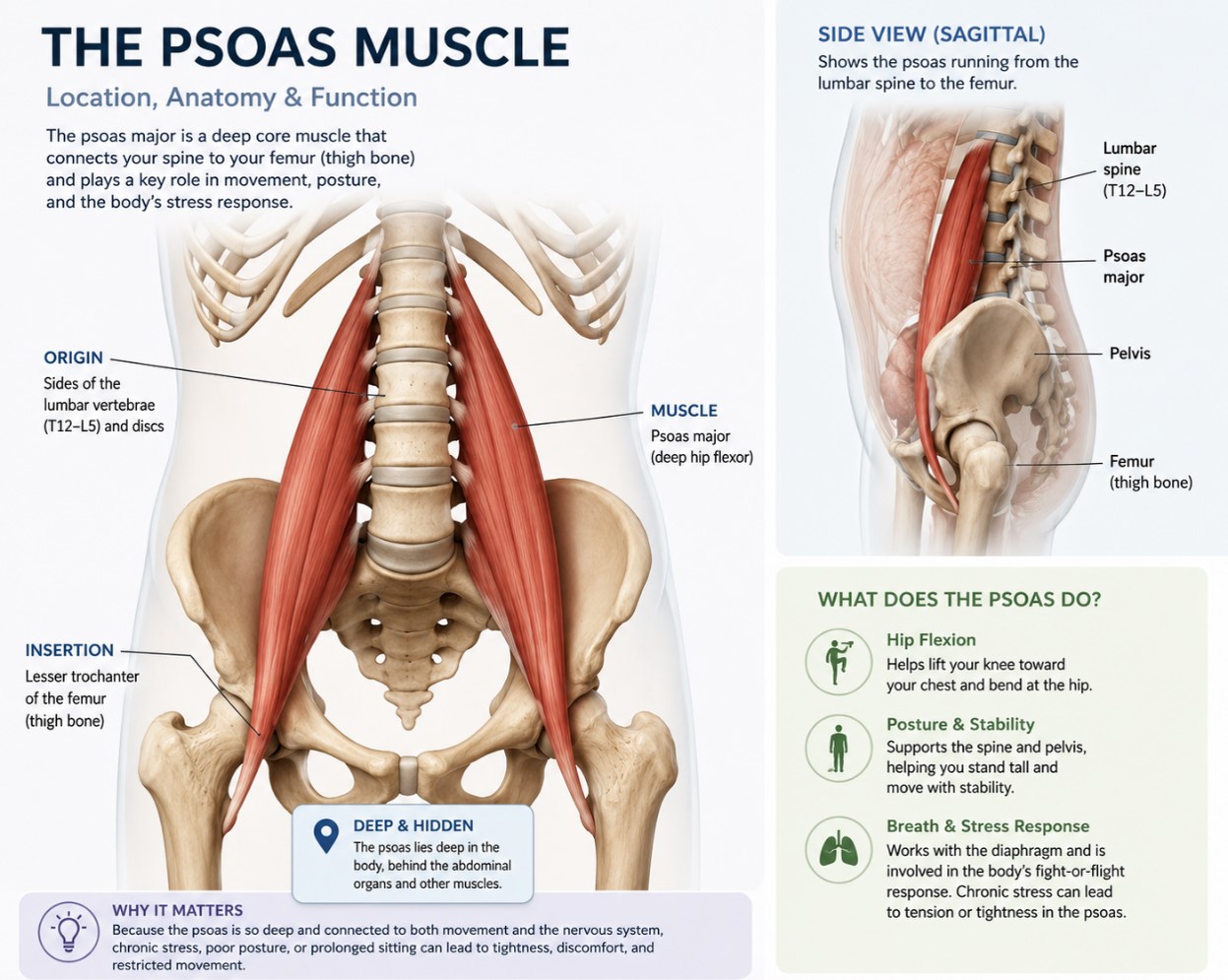
This is where the psoas muscle becomes especially important. The psoas is one of the body's deepest core muscles and plays a major role in posture, movement, spinal stability, and the stress response. Because it helps the body curl inward and prepare for protection or escape, it often activates during fear, anxiety, hypervigilance, and chronic stress states. When people finally slow down enough to stretch, breathe deeply, and release some of this long-held muscular tension, the nervous system may also shift — and for some, this produces emotional or physical experiences that feel disproportionate to the stretch itself.
That does not mean the body is "releasing trauma" in a mystical sense. It means the nervous system, muscles, breathing patterns, and emotional states are deeply interconnected.
Why Do You Cry When You Stretch Your Hips?
Emotional release during hip-opening stretches often involves the psoas muscle, the primary hip flexor. It contracts as part of the body's fight-or-flight response and can remain in chronic partial contraction during sustained stress or trauma. Stretching the psoas releases this held tension, which can allow incomplete fight-or-flight cycles to complete, producing physiological discharge that may be experienced as emotion, tremoring, heat, or spontaneous movement. This is not a psychological phenomenon with a physical component — it is a physiological phenomenon, and the emotional experience is a downstream effect of it.
During moments of fear, danger, overwhelm, or chronic stress, the psoas contracts as part of the fight-or-flight response. The body curls inward slightly, the muscles brace, breathing becomes shallower, and the hips prepare for rapid movement, protection, or escape. In short-term stress, this is adaptive — once the threat passes, the nervous system settles and the muscles return to baseline.
When stress becomes chronic, or traumatic experiences leave the body in prolonged hypervigilance, some of these muscular patterns persist long after the danger has ended. The psoas can remain subtly contracted, contributing to tight hips, lower back discomfort, shallow breathing, postural rigidity, and a persistent sense of internal tension.
Anatomically, the psoas originates from the lower thoracic and lumbar spine (vertebrae T12 to L5) and travels through the pelvis to attach to the femur. Because it lies close to the diaphragm and structures involved in autonomic regulation, it forms an important bridge between movement, posture, breathing, and stress physiology. This proximity is part of why hip-opening stretches can feel unexpectedly intense. As long-held muscular guarding softens in a safe, regulated environment, breathing often deepens and the nervous system may temporarily shift out of defensive activation — producing trembling, shaking, warmth, crying, agitation, relief, or spontaneous emotional release in some people.
Community voice (representative, r/yoga): "I was doing a lunge stretch in yoga and started sobbing out of nowhere. No thought, no memory, just this wave of something that had to get out. My yoga teacher said it was stored trauma. I was skeptical. But something definitely released that has not been back since."
Clinical precision: Emotional release during hip stretching is not universal or inevitable, and its absence does not indicate the absence of stored tension. The release depends on the current state of nervous system activation, the depth and quality of the stretch, and the person's capacity to stay with sensation rather than immediately suppressing it. Crying in a hip-opening stretch is one possible completion. It is not the goal, and its absence is not evidence of failure.
What Is the Biological Link Between the Psoas, the Diaphragm, and Fight-or-Flight?
The diaphragm is the body's primary breathing muscle. The psoas is one of the deepest muscles of the core and the body's primary hip flexor. Anatomically, they connect through fascial structures along the lumbar spine, particularly the medial arcuate ligament and surrounding fascial networks. The crura of the diaphragm, which anchor it to the lumbar vertebrae, sit directly adjacent to the origin of the psoas along the lower thoracic and lumbar spine.
This close structural relationship means tension in one region mechanically influences the other. During a stress response, the nervous system shifts into sympathetic activation — fight-or-flight. Heart rate increases, muscles brace, attention narrows, digestion slows, and breathing changes to prioritize rapid oxygen delivery and quick muscular action.
The psoas becomes highly active during this process because it prepares the body for movement and protection — flexing the hips, stabilizing the spine, and contributing to the slightly curled, guarded posture humans instinctively adopt during fear or threat. At the same time, breathing typically becomes shorter and more rapid. In acute stress, these changes are adaptive and temporary; once the threat passes, the parasympathetic nervous system helps the body return to baseline.
The problem emerges with chronic stress. In people experiencing long-term anxiety, hypervigilance, unresolved trauma, burnout, or prolonged emotional suppression, the body may remain partially organized around threat even in objectively safe environments. The psoas can stay subtly contracted for extended periods, and because of its relationship with the diaphragm, this chronic tension may begin restricting full diaphragmatic movement.
Research on stress physiology consistently associates chronic sympathetic activation with reduced diaphragmatic breathing and increased upper-chest breathing patterns. Instead of the diaphragm moving fully downward during inhalation, breathing becomes shallower, faster, and concentrated in the chest and neck musculature, reinforcing physiological arousal over time.
This matters clinically because diaphragmatic breathing plays a major role in regulating the autonomic nervous system. When the diaphragm moves fully and rhythmically, it influences vagal activity through a mechanism called respiratory sinus arrhythmia — the natural fluctuation in heart rate during breathing (heart rate slightly increases during inhalation and decreases during exhalation). This variability is strongly associated with vagal tone and heart rate variability, both considered markers of nervous system flexibility and resilience.
Higher vagal tone and healthier heart rate variability are generally associated with improved emotional regulation, greater physiological adaptability, and an increased ability to transition out of defensive states. Chronic stress and trauma, conversely, are often associated with reduced heart rate variability and diminished parasympathetic regulation. When diaphragmatic movement becomes restricted by chronic muscular bracing, the nervous system may lose some of its ability to efficiently shift out of fight-or-flight activation.
This is one reason many trauma-informed therapeutic approaches incorporate breathwork, body awareness, movement, grounding exercises, and somatic regulation techniques alongside traditional cognitive therapies, including Cognitive Behavioral Therapy. The goal is not simply emotional insight, but restoring flexibility to physiological systems that have become chronically organized around stress and protection.
The psoas also lies close to the kidneys and adrenal glands, central to the body's hormonal stress response through the hypothalamic-pituitary-adrenal (HPA) axis. While some wellness narratives exaggerate this proximity in mystical ways, there is a legitimate physiological relationship between chronic stress hormones, inflammation, muscular tension, and autonomic regulation. Elevated cortisol and prolonged stress activation influence muscle tone, immune functioning, sleep, digestion, and pain sensitivity throughout the body.
How Does Trauma Affect Muscle Tension Over Time?
Trauma changes the way the body organizes itself around safety, protection, and survival. When the nervous system perceives danger, the body shifts into defensive states designed to increase the chances of survival — muscles tighten, breathing changes, heart rate increases, attention narrows. In the short term, these reactions are adaptive.
The problem is that the body does not always fully return to baseline after chronic or overwhelming stress. In people exposed to prolonged stress, repeated fear, emotional unpredictability, abuse, neglect, hypervigilance, or traumatic experiences, the nervous system can remain partially organized around threat even when immediate danger is no longer present. Over time, this creates chronic patterns of muscular guarding — often subtle rather than dramatic.
Some people unconsciously clench their jaw throughout the day. Others maintain tension in the shoulders, neck, abdomen, pelvic floor, hips, or lower back without realizing it. Many trauma survivors describe feeling physically braced all the time, as though their body never fully relaxes. This reflects measurable autonomic and neuromuscular changes associated with chronic stress activation, not simply psychological stress "felt physically."
This process is closely linked to procedural and implicit memory systems. Not all memory is verbal or narrative — the brain also learns patterns through repetition, conditioning, and bodily experience. A person who grew up in an unpredictable or unsafe environment may unconsciously develop chronic muscular bracing long before they have words to describe anxiety or fear. Over time, these protective responses become automatic and deeply embodied.
This is one reason trauma is often experienced physically even when a person intellectually understands they are safe. Shoulders remain raised. Breathing stays shallow. The abdomen remains tight. Sleep becomes lighter and more easily disrupted. Startle responses become exaggerated.
Some individuals move toward hyperarousal — tense, anxious, restless, hypervigilant. Others move toward hypoarousal or shutdown states — numb, collapsed, exhausted, disconnected, emotionally blunted. Many trauma survivors fluctuate between both states depending on context and stress levels.
Importantly, this does not mean muscles literally "store memories" the way the brain stores autobiographical events. The body stores patterns of response. The nervous system learns which muscular, postural, and physiological states are associated with protection, and those patterns can persist long after the original threat has passed. This is why body-based interventions such as breathwork, stretching, grounding, yoga, somatic therapy, progressive muscle relaxation, and trauma-informed movement practices can sometimes feel emotionally significant. As chronic guarding softens, sensations, emotions, or states of tension that had previously remained outside conscious awareness may surface.
Does Science Support the Idea of "Stored Trauma" in the Body?
Partially yes, but not in the literal way the phrase is often used online. Muscles do not contain emotional memories the way the brain stores autobiographical experiences. There is no evidence that grief, fear, or traumatic memories are physically trapped inside specific tissues waiting to be mechanically released through stretching.
At the same time, modern neuroscience and trauma research strongly support the idea that traumatic stress has profound effects on the body. Trauma changes the functioning of the autonomic nervous system, stress hormone regulation, muscle tension, pain perception, immune activity, sensory processing, and interoception (the brain's ability to perceive internal bodily states). Brain regions involved in threat detection, emotional regulation, and survival responses — particularly the amygdala, hippocampus, brainstem, and prefrontal cortex — can become altered by chronic or overwhelming stress exposure.
Research on post-traumatic stress, chronic anxiety, and prolonged stress exposure consistently shows associations with elevated muscular tension, altered breathing patterns, reduced heart rate variability, disrupted sleep, exaggerated startle responses, chronic pain syndromes, gastrointestinal dysregulation, and increased inflammatory activity.
This is why many trauma researchers prefer terms such as embodied trauma, autonomic conditioning, procedural memory, or somatic patterns rather than saying trauma is literally "stored" in muscle tissue. The body learns survival responses through repetition. If a person repeatedly experiences danger, helplessness, unpredictability, or emotional overwhelm, the nervous system may become conditioned toward chronic vigilance or defensive activation, and these responses can become automatic enough that they feel physical rather than consciously chosen.
There is also growing evidence that body-based approaches can help regulate trauma-related symptoms when used appropriately. Practices involving breath regulation, movement, grounding, mindfulness, yoga, vagal regulation, and somatic awareness show potential benefits for stress reduction, emotional regulation, and autonomic flexibility in some individuals. Researchers also caution against exaggerated claims — no single stretch, posture, or somatic exercise can automatically "release years of trauma." Healing from trauma is usually gradual, multidimensional, and influenced by safety, relationships, nervous system regulation, environment, therapy, and psychological processing.
It is also important to recognize that intense emotional reactions during bodywork or stretching are not always therapeutic. Emotional release alone does not necessarily equal resolution. In some cases, body-based practices may feel overwhelming for individuals with severe trauma histories if not introduced carefully and safely.
The science supports something more nuanced than wellness culture slogans. Trauma is not stored inside the body like an object hidden in tissue. But traumatic stress absolutely shapes physiology, muscle tension, posture, breathing, sensation, and nervous system functioning over time. The body remembers patterns of protection, and those patterns can influence both physical and emotional experience long after the original danger has passed.
What Are the Best Somatic Stretches for Psoas Release?
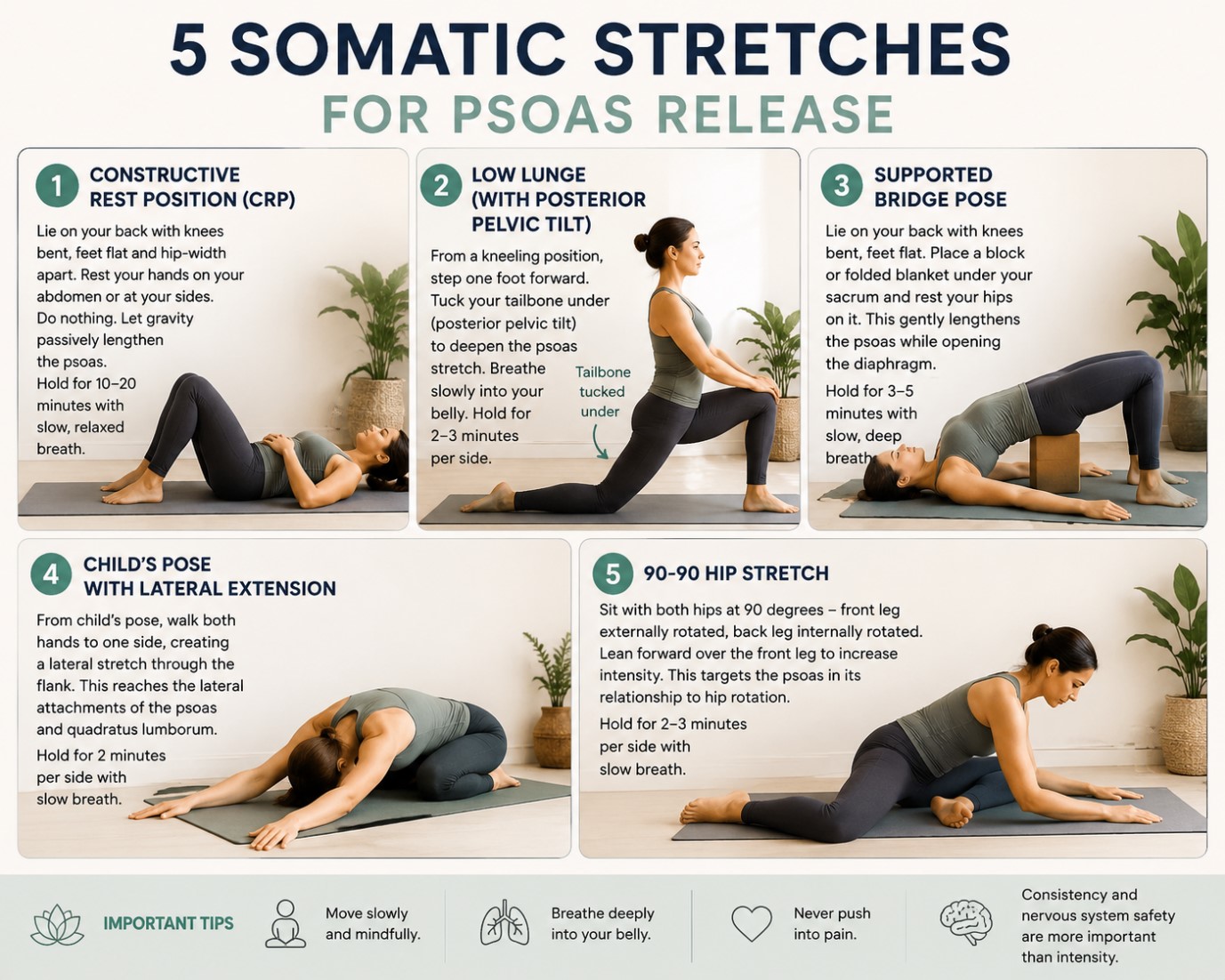
Five evidence-consistent psoas-targeting stretches for somatic release: Constructive Rest Position (supine, knees bent, feet flat, allowing the psoas to passively lengthen under gravity); low lunge with posterior pelvic tilt for direct hip flexor lengthening with breath; supported bridge pose for gentle psoas lengthening with diaphragmatic freedom; child's pose with lateral extension to reach the lateral psoas fibers; and the 90-90 hip stretch targeting internal and external hip rotation with full psoas engagement. Hold each for 3–5 minutes with slow, deep breaths to allow genuine release rather than surface stretching.
The most effective psoas stretches are not necessarily the most intense ones. Aggressive stretching can sometimes increase muscular guarding, especially in people living with chronic stress, anxiety, or trauma-related hypervigilance. The goal of somatic stretching is not to force the muscle open, but to create enough safety for the nervous system to gradually reduce protective tension. Slow breathing, long holds, and gentle support tend to work better than pushing aggressively into discomfort.
- Constructive Rest Position (CRP)
Often considered one of the safest and most regulating positions for releasing chronic psoas tension because it relies on passive support rather than force. Lie on your back with knees bent and feet flat on the floor, hip-width apart. Allow the lower back to rest naturally; hands can rest on the abdomen or beside the body. The goal is not to stretch actively, but to remain still and allow gravity to gradually soften the front of the hips and lower spine.
Many people notice how difficult true rest initially feels — the body may continue subtly bracing even in stillness. Remaining here for 10 to 20 minutes with slow, relaxed breathing can help the nervous system shift away from constant muscular activation. Because there is minimal physical intensity, this position is often more tolerable for individuals with significant stress histories or nervous system sensitivity.
- Low Lunge (with Posterior Pelvic Tilt)
Directly lengthens the hip flexors, but the key detail is pelvic position. From a kneeling lunge with one foot forward and the opposite knee on the ground, gently tuck the tailbone underneath with a slight posterior pelvic tilt rather than simply leaning forward. This shifts the stretch deeper into the psoas rather than compressing the lower back. The stretch should feel steady and spacious rather than sharp. Holding two to three minutes per side, with slow diaphragmatic breathing, often produces a deeper release than shorter, more aggressive stretching intervals.
- Supported Bridge Pose
Combines gentle hip extension with diaphragmatic openness, useful for people carrying both hip and breathing tension simultaneously. Lie on your back with knees bent, feet flat. Lift the hips slightly and place a yoga block, bolster, or folded blanket beneath the sacrum for support, allowing the hips to remain elevated without muscular effort. Because the chest and diaphragm are more open in this position, fuller breathing patterns often emerge naturally. Remaining here for several minutes with slow breathing can help reduce habitual bracing across the front of the body.
- Child's Pose with Lateral Extension
Targets the psoas and surrounding muscles involved in stress-related guarding, particularly the quadratus lumborum and lateral fascial tissues. From child's pose, slowly walk both hands toward one side until a stretch is felt along the opposite flank and lower back, with slow, unrestricted breathing. Many people unconsciously hold tension along the sides of the torso during chronic stress. Holding one to two minutes per side may help soften lateral tension patterns contributing to lower back and hip tightness.
- 90-90 Hip Stretch
Focuses on hip rotation and mobility patterns often restricted by chronic sitting, stress-related guarding, or reduced pelvic mobility. Sit with the front leg bent at roughly 90 degrees in external rotation and the back leg bent behind you at 90 degrees in internal rotation. Keeping the spine long, slowly lean forward over the front leg to deepen the stretch gradually. Many people notice significant asymmetry between sides, reflecting longstanding movement habits or muscular imbalance.
Across all of these stretches, the goal is regulation rather than intensity. If a position produces numbness, panic, dizziness, sharp pain, or emotional overwhelm, slow down, reduce intensity, or stop altogether. Somatic work is most effective when the nervous system feels safe enough to remain present rather than pushed beyond tolerance.
What a therapist actually sees: The emotional release that sometimes accompanies psoas work is not always therapeutic. Clients can enter a yoga class, move into pigeon pose, begin to cry, and spiral into retraumatization because there was no containment, no titration, and no capacity to process what emerged. The somatic release is a beginning, not an endpoint. For people with significant trauma histories, this work is best done in a structured somatic therapy context rather than in a group class, until the window of tolerance is wide enough to handle what it opens.
When to Seek Professional Support
Gentle psoas stretching is safe for many people to explore independently. But if you have a significant trauma history, complex PTSD, dissociation, panic symptoms, or intense emotional activation during body-based practices, working with a trauma-informed therapist or somatic practitioner can provide the safety, pacing, and regulation this work sometimes requires.
This is also worth considering alongside support for related conditions — chronic anxiety, burnout, or persistent stress that shows up physically as much as emotionally. Somatic experience is rarely separate from the psychological patterns underneath it, and addressing both tends to produce more durable change than addressing either alone.
Support at Coach For Mind
At Coach for Mind, we understand that stress, trauma, anxiety, and emotional overwhelm are not experienced only in the mind. They are often carried through the body as chronic tension, hypervigilance, emotional numbness, fatigue, shallow breathing, or a persistent sense of being “on edge.” Our approach integrates evidence-based psychotherapy with a trauma-informed understanding of the nervous system, helping clients explore both emotional patterns and embodied stress responses in a safe, regulated, and compassionate way.
We work with concerns such as anxiety, burnout, trauma, relationship difficulties, emotional dysregulation, overthinking, self-esteem issues, chronic stress, and psychosomatic distress. Rather than focusing on quick catharsis or wellness trends, we prioritise long-term nervous system safety, emotional insight, and sustainable healing. Depending on the individual’s needs, therapy may include cognitive, relational, somatic, mindfulness-based, or trauma-informed approaches that help clients reconnect with themselves gradually and safely.
If you have been feeling emotionally overwhelmed, physically tense all the time, disconnected from your body, or stuck in survival mode, support is available. Healing does not require forcing emotional release or pushing yourself beyond your limits. Sometimes it begins with learning how to feel safe in your own body again. You can reach out to Coach for Mind to explore therapy and trauma-informed mental health support in a space that is thoughtful, non-judgmental, and grounded in both science and compassion.
Sessions available online across India and internationally for NRI clients, and in-person in Gurgaon.
Frequently Asked Questions
Potentially, yes. Chronic psoas tension is a common and often overlooked contributor to lower back pain because the muscle attaches directly to the lumbar spine and influences posture, pelvic positioning, and spinal stability. A persistently shortened psoas can increase compression in the lower back and contribute to tightness, stiffness, or referral pain patterns that sometimes mimic disc-related discomfort. However, lower back pain is usually multifactorial and may also involve discs, joints, movement patterns, inflammation, stress, sleep, or prolonged sitting. If pain is severe, persistent, or radiating, professional assessment is important. At Coach For Mind, we often help clients understand how chronic stress, nervous system dysregulation, and muscular bracing can contribute to persistent physical tension alongside emotional distress.
For many people, gentle psoas stretching is safe to explore independently. However, individuals with significant trauma histories, complex PTSD, dissociation, panic symptoms, or intense emotional activation during body-based practices may benefit from working with a trauma-informed therapist or somatic practitioner. Somatic work can sometimes bring strong sensations, emotions, or memories into awareness, and professional support can help create safety, pacing, and regulation throughout the process. If you are unsure how your body responds to these practices, starting slowly with gentler exercises such as the Constructive Rest Position is usually a safer approach.
Potentially, yes. Because the psoas is closely connected to breathing mechanics and the body's stress response, reducing chronic tension in this region may help some people feel calmer and more regulated. Tightness in the hips and lower back is often associated with shallow breathing, muscular guarding, and chronic sympathetic activation. Gentle stretching combined with slow diaphragmatic breathing may support parasympathetic regulation and improve bodily awareness over time. However, psoas work alone is not a complete treatment for anxiety disorders, especially when anxiety is influenced by psychological, relational, environmental, or neurobiological factors.
Some people experience crying, agitation, relief, trembling, or unexpected emotions during deep hip stretches because slowing down and releasing muscular guarding can temporarily shift the nervous system out of defensive states. This does not necessarily mean trauma is literally stored inside the hips, but rather that chronic stress affects muscle tension, breathing, posture, and autonomic regulation in interconnected ways. When the body feels safer and tension begins to soften, emotions and sensations that were previously suppressed or outside conscious awareness may surface.
Yes, for some people it can be. Emotional responses during yoga, stretching, breathwork, or somatic practices are not uncommon, especially in slower practices that encourage stillness, body awareness, and nervous system regulation. Crying can occur because the body is relaxing after prolonged tension, because emotions become more noticeable in moments of quiet, or because the nervous system is shifting out of chronic activation. However, emotional release is not required for healing, and not experiencing strong emotions does not mean the practice is ineffective.
Trauma is not literally stored inside muscles like memories stored in a container, but traumatic stress absolutely affects the body physiologically. Research shows that chronic stress and trauma can alter breathing patterns, posture, muscle tone, pain sensitivity, autonomic nervous system functioning, and emotional regulation over time. Many trauma survivors experience these patterns physically through chronic tension, hypervigilance, numbness, fatigue, or difficulty relaxing.
Shaking or trembling during stretching, breathwork, or somatic practices can sometimes occur as the nervous system releases muscular tension or shifts out of defensive activation. Tremoring is part of the body's natural stress response system and may happen after intense fear, prolonged muscular contraction, or nervous system arousal. In some cases, these sensations simply reflect fatigue or muscular effort rather than emotional release. Gentle pacing is important because overwhelming the nervous system can increase distress instead of regulation.
Yes. Chronic stress often contributes to increased muscular tension throughout the body, particularly in regions involved in protective postures such as the jaw, shoulders, abdomen, pelvic floor, hips, and lower back. Because the psoas plays an important role in the fight-or-flight response, prolonged stress and hypervigilance may contribute to persistent tightness or bracing around the hips and pelvis. Long periods of sitting, reduced movement, poor sleep, and anxiety can further reinforce these patterns.
The relationship between chronic stress, muscular tension, breathing patterns, and nervous system regulation is well supported by research. However, some claims made online about "releasing trauma from the psoas" are exaggerated or oversimplified. There is evidence that movement, stretching, breathwork, yoga, and somatic therapies may support stress reduction and autonomic regulation for some individuals, but no single stretch can automatically release years of trauma. Healing is usually gradual and multidimensional.
The safest approach is usually the gentlest one. Slow, supported positions combined with relaxed breathing are often more effective than intense stretching or forcing emotional release. Practices such as Constructive Rest Position, supported bridge pose, and gentle hip openers allow the nervous system to gradually reduce muscular guarding without becoming overwhelmed. Paying attention to signs of distress, numbness, panic, dizziness, or emotional flooding is important, especially for people with trauma histories.