
Your Unforgettable Guide to Thriving with Social Anxiety
For millions of people, social interactions aren’t just uncomfortable , they’re a battlefield. Your heart pounds, palms sweat, and a relentless inner critic whispers every possible judgment, paralyzing you with fear. You feel trapped, misunderstood, and profoundly alone, often hearing the dismissive advice to “just get over it.” But if you could simply “get over it,” you would, wouldn’t you?
This isn’t mere shyness. This is social anxiety disorder (SAD) , a debilitating condition that sabotages careers, isolates you from loved ones, and robs you of the simple joy of connection.
Social anxiety often feels like being caught in a relentless cycle: fear, avoidance, and self-judgment. You dread social situations, avoid them whenever possible, and then criticize yourself for “failing” yet again. The result? A growing sense of isolation and the painful belief that no one else truly understands what you’re going through.
Most guides on social anxiety stop at basic definitions and lists of treatments. While helpful, they rarely address the messy, real-life reality of living with social anxiety. What about the moments when your mind goes blank in a meeting? When you want to say no but freeze? When you long to connect but feel your body shutting down?
If this sounds familiar, you’re not alone , and you’re not broken. What you need isn’t another generic reminder to “just face your fears.” You need a practical, compassionate, and sustainable roadmap that meets you where you are. One that helps you:
- Navigate specific, high-stakes social situations step by step
- Communicate your struggles to others in ways that feel safe and empowering
- Build real confidence that lasts beyond “performance” moments
- Sustain long-term recovery instead of endlessly managing symptoms
This article is written as that guide, blending the latest trauma research with a deeply human, empathetic perspective. We’ll explore how childhood experiences like neglect, bullying, or critical parenting shape social anxiety, why your nervous system reacts the way it does, and, most importantly, what you can do now to start breaking free from the cycle.
This guide is for you if you’ve ever:
- Felt drained after a simple hangout
- Struggled to breathe in crowded places
- Avoided or even quit a job because of uncomfortable co-worker interactions
- Yearned to connect but stayed silent for fear of judgment or rejection
Together, we’ll move beyond surface-level definitions and into a comprehensive, empathetic, and actionable roadmap, your personal survival kit for navigating social challenges, cultivating deep self-compassion, and building a fulfilling life alongside (and eventually beyond) social anxiety.
Understanding Fear vs. Anxiety: Your Body's Protection System
Before diving into social anxiety specifically, it's important to understand how our emotional warning systems work. Fear is your body's immediate response to a clear, present danger, like swerving to avoid an oncoming car. Your heart races, adrenaline surges, and your body mobilizes for action. Once the threat passes, the response naturally subsides.
Anxiety is different. It's your nervous system's way of preparing for potential future threats or responding to past dangers that feel present. Unlike fear, anxiety can:
- Persist long after a triggering event has ended
- Anticipate threats that may never materialize
- Activate without an immediately identifiable cause
- Feel just as intense as responses to real danger
This is why someone with social anxiety might spend days dreading a work meeting, feel their heart racing during a casual conversation, or replay social interactions for hours afterward, analyzing every word and gesture for signs of rejection or judgment.
Adaptive anxiety serves a purpose, it helps us prepare, practice, and stay appropriately cautious. But when anxiety becomes so intense that it interferes with daily life, relationships, and well-being, it shifts from protective to problematic.
What Is Social Anxiety Disorder?
Social anxiety disorder affects approximately 7.1% of adults in any given year, with 12.1% experiencing it at some point in their lifetime. Recent international studies suggest even higher rates among young people, with over one-third (36%) of individuals aged 16-29 meeting criteria for social anxiety disorder across seven countries. This represents a significant increase from previously reported figures, highlighting social anxiety as one of the most common mental health conditions affecting millions globally.
Social anxiety disorder is characterized by persistent, intense fear of social situations where a person believes they might be judged, embarrassed, or humiliated. This goes far beyond normal social nervousness. The key features include:
- Fear lasting 6 months or longer that significantly impairs functioning
- Recognition that the fear is excessive, yet feeling unable to control it
- Avoidance of social situations or enduring them with intense distress
- Physical symptoms like racing heart, sweating, trembling, or nausea
- Interference with work, relationships, or daily activities
What makes social anxiety particularly challenging is that it often begins in early to mid-teens, a crucial time for developing social skills and identity. Unlike shyness, which tends to ease with familiarity, social anxiety can persist and even worsen without appropriate understanding and support.
As trauma expert Dr. Gabor Maté explains: "Social anxiety is not a character flaw. It is the imprint of unmet needs for acceptance and safety during childhood. When a child learns that being authentic, crying, expressing anger, being vulnerable, elicits rejection, ridicule, or withdrawal, the psyche adapts. It says: better hide, better shrink, better pre-empt rejection by avoiding others."
This reframe is revolutionary. Instead of asking "What's wrong with me?" we can ask "What happened to me that taught my nervous system that social situations are dangerous?"
Social Anxiety Disorder (SAD): Beyond Shyness and Introversion
18% of people with social anxiety disorder don't recognize their condition, believing they're simply shy despite meeting diagnostic criteria. While there can be some overlap, they are fundamentally different – and understanding this distinction is crucial. This highlights how social anxiety can manifest in many ways, some people may even appear confident and outgoing while struggling internally.
- Shyness is a personality trait that doesn't typically require treatment. It means feeling discomfort or inhibition in new social situations, which often fades as you become more familiar with people or places. Crucially, it doesn't usually cause significant distress or impair your daily life.
- Introversion is a preference. Introverts recharge by spending time alone or in quiet settings. They can enjoy social interaction, but it's often draining, requiring solitude afterward . It's a healthy personality type, not a disorder.
- Social Anxiety Disorder (SAD), also known as social phobia, is a persistent, intense fear of social situations. This fear stems from an overwhelming dread of negative judgment, scrutiny, or humiliation by others. This fear is disproportionate to any actual threat and significantly interferes with daily life, relationships, work, or school 9. As one community member powerfully put it: "Introversion is a normal and healthy personality trait... whereas social anxiety disorder involves intense fear and distress in social situations that can interfere with daily functioning and typically requires professional treatment."
Social anxiety disorder is a mental health condition that can worsen over time without treatment. Key distinctions include:
- Intensity: Social anxiety symptoms are more severe and persistent
- Duration: Shyness is often situational, while social anxiety persists before, during, and after social events
- Impairment: Social anxiety significantly interferes with daily functioning, while shyness generally doesn't
- Recognition: Many people with social anxiety disorder may appear extroverted and confident to others
This distinction isn't just academic; it's vital. When social anxiety is dismissed as mere shyness, it invalidates the profound suffering of those who live with it. Let's be clear: this isn't a choice; it's a real mental health condition.
The Debilitating Impact of Social Anxiety
Social anxiety isn't just a feeling; it's a pervasive, destructive force that actively sabotages fundamental aspects of your life. It creates a profound struggle for functionality and autonomy, preventing you from achieving personal goals and living the fulfilling life you deserve 13.
Real-world experiences paint a vivid, often heartbreaking, picture of its impact:
- "My social anxiety has also prevented me from finding any potential romantic experiences." 14
- "I just quit my current job bc i feel uncomfortable w my co-workers." 15
- "I’m 55 years old and because of it I have been depressed my whole life and have always been alone. I have completely cut off everyone including family. Quit my job and have not left my home since sept or october."
How Childhood Experiences Shape Social Fear
Scientists have discovered something remarkable: social anxiety often develops as a protective response to childhood experiences. When researchers compared adults with social anxiety to those without it, they found dramatically different childhood histories. Studies that followed children over time proved that certain experiences actually cause social anxiety to develop later.
Understanding this connection explains why social anxiety can feel so intense and why simply "facing your fears" often isn't enough. Your nervous system learned early that social situations could be threatening, and it's still trying to protect you based on that old information.
- When Love Comes with Conditions: Emotional Abuse
The strongest predictor of adult social anxiety is childhood emotional abuse. A groundbreaking study found that 51% of adults with social anxiety experienced emotional abuse as children.
What Emotional Abuse Actually Looks Like
Emotional abuse isn't always obvious, it often happens in families that seem "normal" from the outside. It includes:
- Constant criticism: "You're so clumsy," "Why can't you do anything right?" or "You're just like your father”
- Threats and intimidation: "I'll give you something to cry about" or threatening to leave or hurt the child. Verbal aggression: Yelling, screaming, or shouting at the child. Symbolic aggression: Threatening to hit or throw something at the child.
- Isolation as punishment: Using isolation or confinement as punishment. Locking children in their room for hours or giving them the silent treatment
- Terrorizing: Deliberately scaring children or threatening to abandon them
- Rejection and coldness: Being emotionally unavailable, dismissive, or treating the child like a burden. Denying emotional responsiveness: Being detached, uninvolved, or rejecting.
- Corrupting/exploiting: Encouraging antisocial or developmentally inappropriate behavior.
How This Creates Social Anxiety
Children who experience emotional abuse internalize several core beliefs that directly fuel social anxiety:
"Something is wrong with me": Repeated criticism teaches children that something is inherently wrong with them, creating deep shame that persists into adulthood. As adults, they live in fear that others will discover these "flaws."
"Being myself is dangerous": When the people who should love you unconditionally instead criticize or reject you, you learn that showing your true self leads to pain.
"I must be perfect": When caregivers, the people meant to love unconditionally, are rejecting or critical, children learn that being authentic leads to pain. As a result, children become hypervigilant about their behavior, constantly watching for signs of disapproval and trying desperately not to make mistakes, believing "Others will reject me if they know the real me".
"People are dangerous": If even your home wasn't safe, involved criticism and emotional threat, your nervous system decides that social situations are threatening by default.
- The Silent Wound: Emotional Neglect
36% of adults with social anxiety experienced emotional neglect as children, compared to only 7% of those without social anxiety. Neglect is often harder to recognize than abuse because it's about what didn't happen rather than what did.
Recognizing Emotional Neglect
Emotional neglect includes:
- Lack of emotional support during distressing times: Not receiving love or support when you were scared, or hurt
- Minimal expressions of love, care, or affection: Rarely hearing "I love you" or receiving hugs and physical comfort
- Dismissal of emotions: Being told "don't be sad," "you're fine," or "stop being so sensitive"
- No celebration of achievements: Parents who don't show pride, interest or encouragement in your accomplishments
- Emotional unavailability or detachment from caregivers: Parents who are physically present but emotionally absent
- Lack of attention to the child's emotional needs
The "Good Enough" Trap
Many people who experienced emotional neglect struggle to recognize it because their basic physical needs were met. They may think, "I had food, shelter, and clothing, how can I complain?" This minimizes the very real need children have for emotional connection and attunement.
How Neglect Creates Social Anxiety
Lack of emotional mirroring: Children need caregivers to reflect their emotions back to them to learn emotional regulation ("I see you're really upset about this"). Without this, they struggle to understand and manage their own feelings.
Absence of secure base: Children who don't experience consistent emotional availability learn that they can't rely on others for comfort or support, leading to social self-reliance taken to an extreme.
Invalidation of emotional experience: When emotions are consistently ignored or minimized, children learn that their internal experience doesn't matter, leading to profound self-doubt in social interactions.
Underdeveloped social skills: Without attuned caregiving, children miss crucial learning about reading social cues, expressing needs appropriately, and navigating interpersonal relationships.
- Bullying and Peer Rejection: Social Trauma in Action
The comprehensive studies found that peer victimization showed the strongest association with later social anxiety development. This research is particularly compelling because it follows children over time, demonstrating causation rather than just correlation.
Types of Peer Victimization
Research identifies several forms of peer victimization that contribute to social anxiety:
- Relational aggression: Social exclusion, spreading rumors, or damaging friendships
- Verbal bullying: Name-calling, teasing, or threats
- Physical bullying: Hitting, pushing, or damaging property
- Cyberbullying: Online harassment or public humiliation
Critical Timing: Adolescent Vulnerability
Peer relationships become increasingly important during adolescence, making this period particularly vulnerable for social anxiety development:
- Identity formation happens largely through peer feedback
- Social comparison intensifies during teenage years
- Peer acceptance becomes central to self-worth
- Social hierarchies become more rigid and consequential
The Neurobiological Impact of Social Rejection
Neuroimaging studies show that social rejection activates the same brain regions as physical pain. For adolescents, whose brains are still developing, repeated experiences of peer rejection can:
- Sensitize pain pathways in the brain
- Create lasting associations between social situations and physical threat
- Dysregulate stress hormone systems
- Impair development of social cognition areas in the prefrontal cortex
Long-term Consequences
Effects of peer victimization on social anxiety can persist for years:
- Social anxiety symptoms often persist into adulthood
- Earlier bullying has stronger effects than later experiences
- Chronic victimization causes more damage than isolated incidents
- The anxiety remains even after accounting how anxious someone was before the bullying
Walking on Eggshells: Inconsistent Caregiving
Research on attachment styles reveals how inconsistent parenting creates social anxiety. When children experience the unpredictability of their caregiver’s love and attention, the "anxious-ambivalent" attachment pattern, where children never know if their parents will be loving or rejecting is strongly linked to social anxiety.
Characteristics of Inconsistent Caregiving
Unpredictable emotional availability: Sometimes loving and warm, other times distant or overwhelmed
Mood-dependent parenting: Whether you get care or not depends on your parent's emotional state, not your needs
Conditional love: Affection tied to child's behavior or achievement rather than unconditional acceptance. In other words, love conditional on “being a good kid”.
Role reversal: Child becomes responsible for managing parent's emotions
Critical perfectionism: High expectations combined with harsh criticism or judgment when you fall short
How Inconsistency Creates Social Anxiety
Hypervigilance to emotional cues: You learn to constantly monitor others' emotional states to predict safety or danger, leading to exhausting social interactions in adulthood.
Fear of abandonment: Never knowing when love and support will be withdrawn creates persistent anxiety about relationships ending.
People-pleasing: Children learn that their worth depends on making others happy, leading to loss of authentic self in social situations or relationships.
Emotional dysregulation: Without consistent co-regulation from caregivers, children don't develop internal capacity to manage intense emotions triggered by social stress.
Approach-avoidance: You simultaneously crave and fear close relationships, creating confusing patterns in social situations.
Without consistent emotional support, you never develop the ability to manage intense feelings that social situations can trigger.
Family Conflict and Domestic Violence: Living in a War Zone
The longitudinal study by Morelli et al. (2022) following 1,281 children found that exposure to family conflict significantly increases risk for anxiety and mood problems. This research is particularly important because it shows that even witnessing conflict (not just being directly victimized) can have lasting effects.
Types of Family Conflict
Verbal aggression between parents: Yelling, screaming, insulting, or threatening
Physical violence: Hitting, throwing objects, or destroying property
Emotional warfare: Silent treatment, manipulation, or emotional blackmail
Financial conflict: Arguments about money that create household instability
Substance abuse-related conflict: Violence or chaos related to addiction
Divorce and custody battles: High-conflict separations that put children in the middle
The Child's Perspective
Children experiencing family conflict often develop:
- Hypervigilance: Constantly scanning environment for signs of impending conflict
- Emotional parentification: Feeling responsible for preventing or managing adult conflicts
- Chronic stress activation: Living in persistent fight-or-flight mode
- Unpredictable safety: Never knowing when the next "explosion" will occur
- Divided loyalties: Feeling caught between conflicting adults
Social Anxiety Development Mechanisms
Generalized threat detection: If home, the primary social environment, is dangerous, all social situations become potential threats.
Conflict avoidance: Children learn that expressing needs or opinions can trigger conflict, leading to social inhibition.
Emotional suppression: Learning to "disappear" emotionally during conflict generalizes to all social situations.
Trust difficulties: Experiencing betrayal and unpredictability from primary relationships makes trusting others feel dangerous.
Social skills deficits: Missing opportunities to learn healthy conflict resolution and communication skills.
Loss of Loved Ones During Formative Years
The study by Tyrka et al. (2008) found that childhood parental loss significantly increases riskfor depressive and anxiety disorders, including social anxiety. This research is particularly important because it examines a specific, measurable event rather than subjective experiences.
Types of Significant Loss
Death of a parent: Particularly devastating during early childhood
Death of siblings: Can disrupt family dynamics and create survivor guilt
Loss of primary caregiver: Grandparents or other attachment figures
Abandonment: Parent leaving without explanation or contact
Incarceration: Losing a parent to prison
Military deployment: Extended separations during wartime
Developmental Impact by Age
Early childhood (0-5 years): Loss disrupts basic attachment formation and sense of safety in the world
School age (6-11 years): Loss interferes with identity development and peer relationship formation
Adolescence (12-18 years): Loss during identity formation can create lasting beliefs about relationships being unreliable
Mechanisms Leading to Social Anxiety
Attachment disruption: Loss of primary attachment figure creates insecurity about all relationships
Anticipatory anxiety: Persistent fear that other important people will also leave
Emotional numbing: Learning to shut down emotions to avoid pain can generalize to all social connections
Survivor guilt: Feeling responsible for the loss or guilty about continuing to live
Social withdrawal: Avoiding close relationships to prevent future losses
Complicated Grief in Children
When children don't receive adequate support to process loss, they may develop:
Frozen grief: Emotions about the loss remain unprocessed and interfere with social development
Idealization: Creating unrealistic standards for relationships based on the lost relationship
Anniversary reactions: Increased anxiety around dates related to the loss
Somatic symptoms: Physical manifestations of unexpressed grief that can be triggered by social stress.
How Your Body Remembers: The Neurobiology of Social Fear
Social anxiety is not just "in your head", it's a whole-body experience rooted in the brain's protective systems. As trauma researcher Dr. Bessel van der Kolk emphasizes: "People with social anxiety don't just have negative thoughts, they feel unsafe. Their hearts race, their stomachs churn, their voices tighten, their bodies flush. This is the body remembering."
Recent neuroimaging research has revealed abnormalities in specific brain regions involved in fear processing, social cognition, and emotional regulation, demonstrating that social anxiety disorder represents genuine neurobiological dysfunction.
Key Brain Systems in Social Anxiety
The Amygdala: Your Hypervigilant Alarm System
The amygdala functions as your brain's smoke detector, constantly scanning for danger. In people with social anxiety, research consistently shows hyperactivity in the amygdala when exposed to social situations. Recent studies reveal heightened amygdala reactivity to social threat cues, such as angry or contemptuous faces.
When the amygdala perceives danger, it triggers an avalanche of survival responses: increased heart rate and blood pressure, rapid shallow breathing, muscle tension and trembling, digestive disruption, heightened alertness and threat scanning, and blood flow redirected from thinking areas to survival systems.
The Prefrontal Cortex: When Thinking Gets Hijacked
The prefrontal cortex is responsible for rational thinking, planning, and emotional regulation. In social anxiety, there is often reduced activity in these regions, impairing the ability to regulate heightened fear responses. During episodes, reduced prefrontal control means the thinking brain gets "hijacked," explaining experiences like "my mind went completely blank" or "I knew I was overreacting but couldn't stop it."
Additional Neural Networks
Research identifies dysfunction in multiple brain systems:
- Frontal-limbic circuit: Hyperactivity in limbic areas combined with low cognitive control
- Default mode network: Abnormalities indicating excessive self-referential thinking
- Cognitive control network: Dysfunction affecting emotional regulation strategies
- Motivation network: Altered processing reducing pleasant experiences in social activities
Neurotransmitter Imbalances
Several brain chemical systems contribute to social anxiety:
- Serotonin dysregulation affects mood and social confidence
- GABA deficiency reduces the brain's natural anxiety "brakes"
- Dopamine system alterations impact motivation and social reward processing
- Norepinephrine elevation contributes to physical anxiety symptoms
The encouraging news? The brain remains adaptable throughout life. Through effective treatment and healing experiences, new neural pathways can form, gradually retraining the nervous system for greater calm and confidence.The best psychologist in Dallas can help you harness this adaptability by guiding you through therapies that strengthen resilience, reduce anxiety, and build healthier ways of responding to stress.
The Polyvagal Perspective: Understanding Your Nervous System States
Dr. Stephen Porges' Polyvagal Theory provides crucial insights into how our autonomic nervous system shapes social experiences. This framework reveals that social anxiety represents dysregulation in the nervous system's hierarchy of responses to safety and threat.
The Three States of Your Nervous System
- Ventral Vagal: Connection and Safety
When this system is active, we feel calm, connected, and socially engaged. Our voice is warm, our posture is open, and we can think clearly while interacting with others. This is the optimal state for healthy relationships and social connection.
- Sympathetic: Fight or Flight
When we perceive a threat, this system activates for mobilization and action. In social anxiety, this might manifest as:
- Racing heart and sweating
- Urge to escape or avoid
- Rapid speech or complete silence
- Muscle tension and fidgeting
- Hypervigilance to others' reactions
- Dorsal Vagal: Shutdown and Freeze
When overwhelm becomes too intense, this ancient system causes us to freeze or shut down. In social situations, this might look like:
- "Mind going blank" or feeling spacey
- Emotional numbness or detachment
- Inability to speak or move
- Feeling "not really there"
- Extreme fatigue after social interactions
Dr. Porges explains: "In social anxiety, the system shifts rapidly out of the ventral vagal into defensive states... because past experiences, bullying, rejection, trauma, trained their neuroception to expect danger in human interaction."
Neuroception is your nervous system's unconscious process of detecting safety or danger. For those with trauma histories, neuroception often becomes hypersensitive, interpreting neutral social cues as threatening:
- A neutral facial expression reads as disapproval
- A pause in conversation signals rejection
- Being noticed feels like being in danger
- Others' emotions feel personally threatening
Neuroception: Your Unconscious Safety Detector
Neuroception is your nervous system's unconscious process of detecting safety or danger. For those with trauma histories, neuroception often becomes hypersensitive, interpreting neutral social cues as threatening:
- A neutral facial expression reads as disapproval
- A pause in conversation signals rejection
- Being noticed feels like danger
- Others' emotions feel personally threatening
The best psychologist in Dallas can help you retrain this unconscious safety detector, teaching your nervous system to distinguish between real danger and perceived threat, so that you can move through social situations with more ease and balance.
The Inner Experience: What Social Anxiety Really Feels Like
Understanding social anxiety from the inside builds compassion for yourself and others. The experience typically involves distinct phases:
Before Social Situations: Anticipatory Anxiety
- Days or weeks of dread before social events
- Vivid imagination of worst-case scenarios
- Physical symptoms starting well before the event
- Elaborate avoidance strategies or excuse-making
- Sleep disruption from worried thoughts
During Social Interactions: Survival Mode Activation
- Hypervigilance to others' facial expressions and tone
- Self-consciousness about every word, gesture, and reaction
- Physical symptoms that feel uncontrollable and embarrassing
- Cognitive disruption: difficulty concentrating or thinking clearly
- Performance monitoring: constant evaluation of how you're doing
After Social Situations: The Anxiety Hangover
- Exhaustion from nervous system activation
- Post-event analysis: replaying every interaction
- Rumination about perceived mistakes or awkward moments
- Shame about anxiety symptoms others may have noticed
- Avoidance planning for future similar situations
The best psychologist in Dallas understands these phases deeply and can guide you in breaking free from this exhausting cycle, offering tools to regulate your nervous system, shift unhelpful thought patterns, and approach social interactions with confidence.
Symptoms and Manifestations
Social anxiety manifests through multiple interconnected symptoms affecting every aspect of functioning:
Physical Manifestations
The fear isn't just mental, it's deeply, viscerally embodied. Physical symptoms are hallmarks of social anxiety, often intensifying embarrassment and creating vicious cycles where fear of these reactions becomes a significant trigger:
- Blushing, sweating, or trembling
- Rapid heartbeat and palpitations
- Nausea, stomach upset, or digestive issues
- Shortness of breath or feeling unable to breathe
- Muscle tension, especially in shoulders, jaw, and stomach
- Dizziness or lightheadedness
- Shaky or unsteady voice
- "Mind going blank" during interactions
Emotional and Cognitive Symptoms
- Intense fear of judgment, embarrassment, or humiliation
- Worry about others noticing anxiety symptoms
- Perfectionism and fear of making mistakes
- Negative self-talk and harsh inner criticism
- Catastrophic thinking about social outcomes
- Difficulty accepting compliments or positive feedback
Behavioral Patterns
- Avoidance of social gatherings, parties, or networking events
- Minimal eye contact or looking away frequently
- Speaking very quietly or giving brief responses
- Eating alone rather than with colleagues or friends
- Avoiding public restrooms when others are present
- Declining invitations or making excuses to leave early
- Procrastination on tasks involving social interaction
Social and Relational Impact
The debilitating impact creates profound struggles for functionality and autonomy:
- Difficulty forming close relationships or dating
- Career limitations from avoiding presentations or leadership roles
- Educational challenges like not participating in class discussions
- Social isolation leading to loneliness and depression
- Dependence on others for social tasks like making phone calls
Real-world experiences illustrate the heartbreaking impact: "My social anxiety has also prevented me from finding any potential romantic experiences," "I just quit my current job bc i feel uncomfortable w my co-workers," "I'm 55 years old and because of it I have been depressed my whole life and have always been alone."
This reddit user shared,
"I have bad bad social anxiety since childhood … I fear talking to people because I zone out during conversations. I can play guitar and have done some gigs also. I have good confidence to play guitar and sing in front of a large audience but I don't want people to approach me."
When Your Mind Becomes a Threat Detector: How Trauma Creates Distorted Thinking in Social Anxiety
If you have social anxiety, you're probably familiar with the constant stream of worried thoughts that flood your mind in social situations. These aren't just "negative thinking" that you can simply choose to stop, they're protective mechanisms that developed to keep you safe in environments where social threat was real. Understanding this connection can transform how you relate to your anxious thoughts.
The Mind's Security System Gone Haywire
Cognitive distortions are patterns of thinking that systematically misinterpret reality, usually in ways that increase anxiety and fear. For people with social anxiety, these distortions act like an overly sensitive security system, one that was calibrated in childhood based on real experiences of social threat, rejection, or criticism.
When trauma occurs during formative years, the developing brain learns to expect danger in social situations. These expectations become so deeply embedded that they operate automatically, beneath conscious awareness. What looks like "irrational thinking" is actually your mind trying to protect you based on what it learned about social interactions during vulnerable periods of development. The best psychologist in Dallas can help you manage and restructure these cognitive distortions by using evidence-based approaches like cognitive behavioral therapy (CBT). With guidance, you can learn to identify unhelpful thinking patterns, challenge them with more balanced perspectives, and gradually retrain your mind to respond with greater confidence and calm in social situations.
The Big Three: Core Distortions in Social Anxiety
- Mind-Reading: "They Must Think I'm Stupid"
Mind-reading involves assuming you know what others are thinking about you, and it's almost always negative. In social anxiety, this might sound like:
- "Everyone can see how nervous I am"
- "They think I'm weird for being so quiet"
- "She's judging my appearance right now"
- "He knows I don't belong here"
Children who experienced criticism, emotional abuse, or rejection learned that others' thoughts about them could be dangerous. If a parent's disapproval led to punishment, withdrawal of love, or emotional attack, the child's survival depended on accurately predicting when judgment was coming.
How It Develops: A child repeatedly told "What will people think?" or "You're embarrassing me" learns that others' opinions are threats to monitor constantly. The brain develops hypervigilance to social evaluation, always trying to read minds to prevent the pain of criticism or rejection.
The Adult Impact: Even in safe social situations, your mind continues scanning for signs of judgment. A neutral facial expression becomes disapproval, a pause in conversation signals rejection, and a glance away means they're bored or annoyed.
- Catastrophizing: "If I Stumble Over My Words, It Will Ruin Everything"
Catastrophizing involves predicting the worst possible outcome from social mistakes or imperfections:
- "If I say something wrong, everyone will think I'm incompetent"
- "One awkward moment will destroy my reputation forever"
- "If I blush, people will think there's something wrong with me"
- "Making this mistake means I'll never be accepted here"
Children who experienced disproportionate consequences for normal mistakes learn that small errors can lead to devastating outcomes. If a minor social misstep resulted in rage, punishment, humiliation, or abandonment, the child's brain learns to treat all potential mistakes as catastrophic threats.
How It Develops: In families where perfectionism was demanded or where children faced severe consequences for normal childhood behavior, the developing mind learns that anything less than perfection is dangerous. The brain creates elaborate disaster scenarios to motivate perfect performance and avoid catastrophic outcomes.
The Adult Impact: Your mind creates detailed, vivid predictions of social disasters. A simple presentation becomes a career-ending humiliation, asking someone out becomes complete social destruction, and speaking up in a meeting becomes professional suicide.
- Personalization: "If the Group Is Quiet, It's Because I'm Boring"
Personalization involves taking responsibility for others' emotions, behaviors, or reactions, assuming you're the cause of negative social dynamics:
- "The conversation died because I said something wrong"
- "Everyone left early because they didn't want to be around me"
- "My friend seems upset, I must have done something"
- "The meeting was awkward because of my presence"
Children in chaotic, unpredictable, or emotionally volatile families often develop an inflated sense of responsibility for others' emotional states. If a parent's mood determined the child's safety, the child learned to monitor and feel responsible for managing adult emotions.
How It Develops: In families with addiction, mental illness, domestic violence, or emotional instability, children often become emotional caretakers. They learn that others' negative emotions might be their fault and that preventing or fixing these emotions is their responsibility, and their safety depends on it.
The Adult Impact: You automatically assume you're the cause of any negative social dynamic. Group tension, someone's bad mood, awkward silences, or interpersonal conflict all feel like your fault, even when they have nothing to do with you.

Beyond the Big Three: Additional Trauma-Based Distortions
All-or-Nothing Thinking
"If I'm not perfectly charming, I'm completely socially inadequate." This black-and-white thinking often develops when children received inconsistent love, either perfect acceptance or complete rejection, with no middle ground.
Fortune Telling
"I know this party will be awkward and terrible." When past social experiences were consistently negative or traumatic, the brain learns to predict similar outcomes to avoid repeated harm.
Emotional Reasoning
"I feel anxious, so this situation must be dangerous." Children who lived in genuinely threatening environments learn to treat their anxiety as accurate information about current threat levels, even in objectively safe situations.
Should Statements
"I should be more confident/funny/interesting." These often reflect internalized critical voices from childhood, the demanding, never-satisfied parent or caregiver whose expectations became your own harsh inner critic.
Mental Filter
Focusing exclusively on negative aspects of social interactions while ignoring positive ones. This develops when children's survival depended on detecting potential threats, leading to hypervigilance to negative social cues.
Magnification and Minimization
Exaggerating your social mistakes while downplaying your positive qualities or successful interactions. This pattern often reflects how trauma teaches children that they are fundamentally flawed while their strengths don't really matter.
The Neurobiology of Distorted Thinking
Understanding what happens in your brain helps explain why these thought patterns feel so automatic and convincing:
The Amygdala's Overprotection
Trauma sensitizes the amygdala (your brain's alarm system) to detect social threats. When activated, it floods your system with stress hormones and hijacks rational thinking, making distorted thoughts feel like urgent, accurate information rather than biased interpretations.
Prefrontal Cortex Shutdown
The prefrontal cortex, responsible for balanced, rational thinking, goes offline during anxiety episodes. This means your capacity for perspective, logic, and balanced evaluation disappears precisely when you need it most.
Neural Pathway Reinforcement
Every time you experience a distorted thought and it leads to avoidance (which temporarily reduces anxiety), your brain strengthens that neural pathway. The thought pattern becomes more automatic and feels more "true" over time.
Memory Bias Formation
Trauma creates memory biases that make negative social experiences more vivid and easily recalled while positive interactions fade or seem less significant. Your brain literally has easier access to "evidence" that supports your distorted thoughts.
The "Default Script": How Trauma Writes Your Internal Narrative
The concept of an internalized "default script" is crucial for understanding trauma-based cognitive distortions. This script is like a background program running in your mind, automatically interpreting social situations through the lens of past experiences.
Common Default Scripts in Social Anxiety
The Inadequacy Script: "I'm not enough, not smart enough, attractive enough, interesting enough. Others will inevitably discover this and reject me."
The Danger Script: "Social situations are minefields. I must be constantly vigilant to avoid saying or doing something that will lead to humiliation or abandonment."
The Performance Script: "Love and acceptance are conditional. I must continuously prove my worth through perfect behavior, achievements, or meeting others' needs."
The Invisibility Script: "The safest way to exist is to take up as little space as possible. Being noticed equals being in danger."
The Burden Script: "I'm too much, too needy, too emotional, too sensitive. Others barely tolerate me, and I must not ask for anything or I'll be abandoned."
Why These Aren't "Just Thoughts"
It's crucial to understand that trauma-based cognitive distortions aren't simply bad mental habitsthat you can think your way out of. They're embodied survival responses that involve your entire nervous system:
- Somatic Components
Distorted thoughts are accompanied by physical sensations, racing heart, tense muscles, shallow breathing, nausea. Your body believes the threat is real because, in your developmental experience, it was.
- Emotional Flooding
These thoughts trigger intense emotional reactions that can feel overwhelming and uncontrollable. The emotions aren't "overreactions", they're proportional to the original trauma, not the current situation.
- Behavioral Compulsions
Distorted thoughts create urgent behavioral impulses, to escape, hide, people-please, or perform perfectly. These behaviors temporarily relieve anxiety, reinforcing the thought patterns.
- Identity Integration
Over time, these thought patterns become integrated into your sense of self. They stop feeling like "thoughts you have" and start feeling like "truths about who you are."
How the Script Gets Written
Repetitive messaging: Children who repeatedly heard "You're too sensitive," "No one will like you if you act that way," or "What's wrong with you?" internalize these messages as core beliefs about themselves and social interactions.
Emotional conditioning: When authentic expression led to punishment, criticism, or withdrawal of love, the child's brain learned to associate being genuine with danger. The default script becomes: "Hide who you really are or face rejection."
Survival adaptations: In chaotic or threatening family environments, hypervigilance to social cues literally helped children survive. The script that developed, "Watch for danger in every interaction", was adaptive then but becomes problematic in safe adult relationships.
Trauma bonding: Sometimes children received attention or care only during crises or when they were "perfect." The default script becomes: "I'm only worthy of love when I'm in distress or performing perfectly."
Diagnosis of Social Anxiety: When to Seek Professional Help
The question, "How do you know if you have social anxiety?" is incredibly common, often rooted in a deep desire for validation and understanding 28. If you experience persistent, intense fear in social situations that significantly impacts your daily life, it's crucial to seek professional help. The best psychologist in Dallas can provide a diagnosis based on criteria outlined in the Diagnostic and Statistical Manual of Mental Disorders (DSM-5).
Key diagnostic criteria they will assess include:
- Marked fear or anxiety about one or more social situations where you are exposed to possible scrutiny by others.
- You fear that you will act in a way or show anxiety symptoms that will be negatively evaluated.
- Social situations almost always provoke fear or anxiety.
- You avoid social situations or endure them with intense fear or anxiety.
- The fear or anxiety is out of proportion to the actual threat posed by the social situation.
- The fear, anxiety, or avoidance is persistent, typically lasting for months or more.
- The fear, anxiety, or avoidance causes clinically significant distress or impairment in social, occupational, or other important areas of functioning.
It's important to remember that SAD often co-occurs with other mental health conditions like depression and substance use disorders. This makes a comprehensive assessment not just helpful, but vital for your overall well-being.
Comprehensive Treatment Pathways for Social Anxiety
The good news? Effective social anxiety disorder treatment in India is absolutely possible. It typically involves a combination of psychotherapy, medication, and self-help strategies, tailored to your unique needs.
Building Your Trauma-Informed Toolkit
Understanding Your Nervous System:
- Notice Your Triggers: What consistently activates your stress response?
- Track Your Window of Tolerance: When do you feel calm versus overwhelmed?
- Identify Your Responses: Fight-flight, freeze, or fawn patterns?
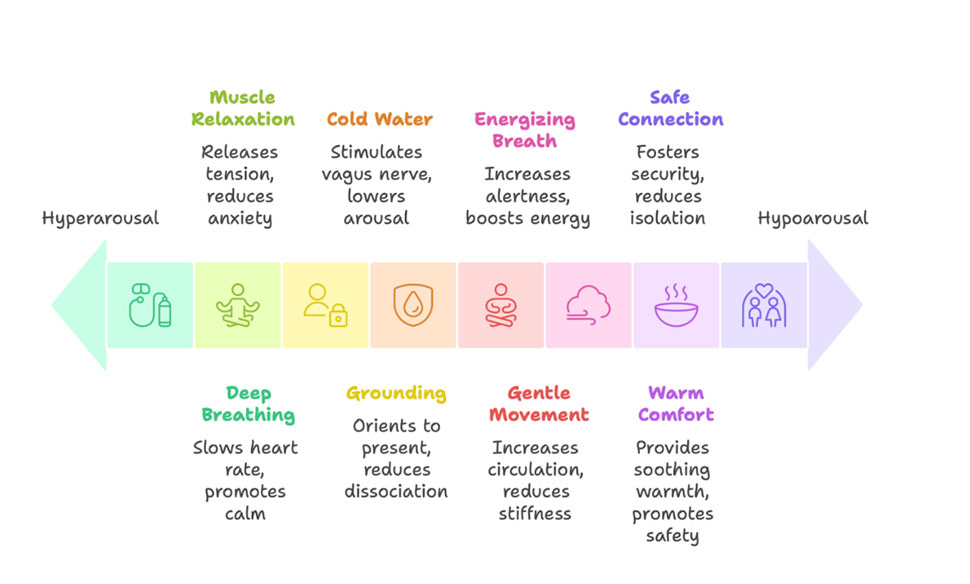
Nervous System Regulation Techniques:
For Hyperarousal (Fight-Flight):
- Deep, slow breathing: 4-7-8 technique (inhale 4, hold 7, exhale 8)
- Progressive muscle relaxation
- Grounding: Name 5 things you see, 4 you hear, 3 you touch
- Cold water: Splash face or hold ice to activate vagus nerve
For Hypoarousal (Freeze/Shutdown):
- Gentle movement: Stretch, walk, light exercise
- Energizing breath: Quick, short breaths to reactivate
- Warm comfort: Heating pad, warm tea, cozy blanket
- Safe connection: Reach out to someone secure
Developing Self-Compassion
- Recognize responses as adaptive: Your anxiety developed to protect you
- Practice patience: Nervous system healing takes time
- Avoid self-criticism: Judgment activates shame, narrowing tolerance
- Celebrate small progress: Notice any moments of increased comfort
Therapy for Social Anxiety
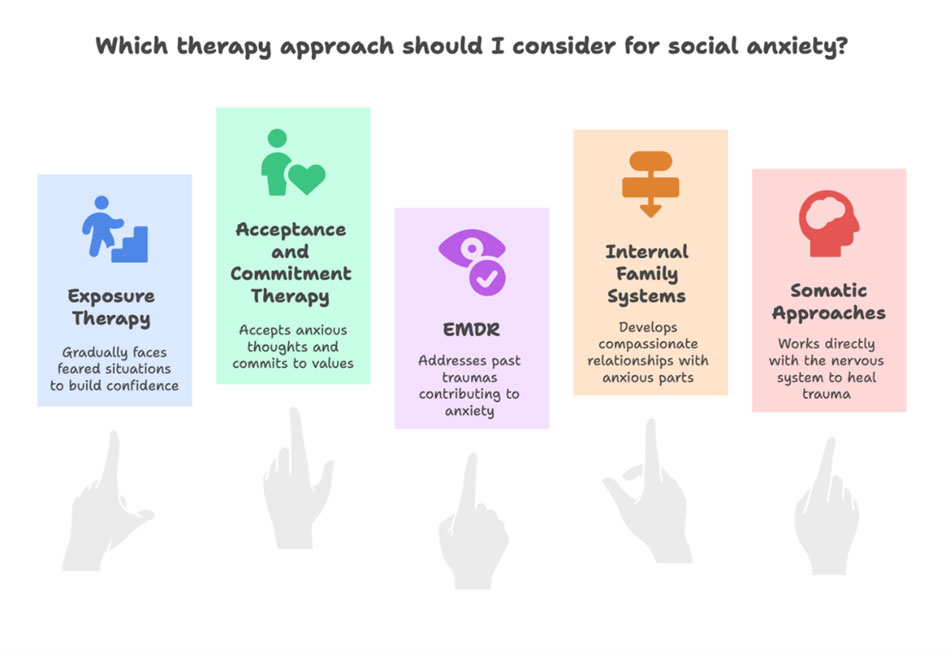
Cognitive Behavioral Therapy (CBT) is widely recognized as the most effective first-line psychotherapy for SAD 32. CBT empowers you to identify and challenge the negative thought patterns and behaviors that fuel your anxiety.
- Exposure Therapy: A core, powerful component of CBT, exposure therapy involves gradually facing your feared social situations in a controlled and systematic way 33. This helps to desensitize you to your triggers and build genuine confidence. The "Anxiety Ladder" approach, where you tackle increasingly challenging situations, is a practical application of this that we'll explore further 34.
- Acceptance and Commitment Therapy (ACT): This approach focuses on accepting anxious thoughts and feelings rather than fighting them, while committing to actions aligned with your deepest values 35.
- Eye Movement Desensitization and Reprocessing (EMDR): While primarily known for PTSD, some research suggests EMDR may offer benefits for anxiety disorders, especially if past traumas contribute to your social anxiety 3 . However, it's important to note it's not universally endorsed as a primary treatment for SAD by mainstream medical sites 3 .
- Internal Family Systems (IFS): As Dr. Richard Schwartz explains: "Social anxiety is not the whole person, it's a part of them. Specifically, it's usually a protector part working to keep you safe from humiliation or rejection." IFS helps develop compassionate relationships with anxious parts while healing wounded inner children that carry social trauma.
- Somatic Approaches: Healing Through the Body: Since trauma lives in the body, somatic therapies work directly with the nervous system:
- Somatic Experiencing helps complete interrupted survival responses from past trauma
- Body-based interventions help develop nervous system awareness and self-regulation
- Polyvagal-informed therapy helps understand nervous system responses and develop co-regulation skills
Finding the right therapist is crucial – it's a partnership. As one community member wisely noted, "Finding the right therapist can really help people who struggle." 38 Don't be discouraged if the first therapist isn't a perfect fit; this is an investment in your well-being, and it's worth finding the right support.
This Reddit user said,
“The exposure therapy helped tremendously. After hard work and dedication, going to therapy, working on my fitness and being mindful – I eventually started finding my old self again.”
Another one said,
“Go to therapy first, mostly social anxiety appears due to circumstances that triggered it, and therapy will help you realize the real cause of your anxiety so it makes it go away.”
Medication for Social Anxiety
Medication can be a valuable tool, especially for moderate to severe cases, and is often most effective when used in conjunction with therapy 39.
- Selective Serotonin Reuptake Inhibitors (SSRIs) and Serotonin-Norepinephrine Reuptake Inhibitors (SNRIs): These antidepressants are frequently the first-line medication for SAD, working to regulate mood and anxiety symptoms 40. Common examples include escitalopram (Lexapro), sertraline (Zoloft), and venlafaxine (Effexor XR) 41. Be aware that it can take several weeks for these to become fully effective, and side effects can occur 42.
- Beta-Blockers: Medications like propranolol can be taken "as needed" to manage the physical symptoms of anxiety – think rapid heartbeat, trembling, and blushing – particularly in high-stakes performance situations like public speaking 43. As one user shared, finding significant relief: "Propanalol for sure. I used to flush red at interviews, public speaking, any high stakes social interaction. Now I know I have the pills and I’m cool, calm, and confident." 44
- Buspirone (Buspar): An anti-anxiety medication that can be effective for generalized anxiety and sometimes prescribed for social anxiety 45.
- Gabapentin: An anticonvulsant sometimes used off-label for anxiety, with some users reporting positive experiences 4 .
It's crucial to discuss all medication options thoroughly with your doctor, carefully weighing potential benefits against side effects. As one user wisely suggests, "Definitely the way to go treatment wise is a combination of both [medication and therapy]." 4
Addressing Financial & Accessibility Barriers to Treatment
Let's be real: the practicalities of affording therapy or medication, navigating insurance, or finding qualified specialists are significant challenges often overlooked in general advice 48. We understand these barriers can feel overwhelming, but solutions exist.
- Insurance Coverage: Deeply understand your mental health benefits. Many plans cover therapy and medication, but be aware of co-pays and deductibles, which can sometimes be high.
- Sliding Scale Fees: Many therapists offer reduced rates based on income. Never hesitate to ask – your well-being is worth it.
- Community Mental Health Centers: These centers often provide affordable, accessible services.
- University Training Clinics: Psychology departments at universities frequently run clinics where supervised students offer therapy at lower costs. This can be an excellent, budget-friendly option.
- Online Therapy Platforms: While not always cheaper, these platforms can significantly reduce travel costs and increase access to specialists, especially for those in rural areas or with limited mobility.
Beyond Treatment: Your Real-World Survival Kit for Thriving with Social Anxiety
Managing social anxiety isn't just about reducing symptoms; it's about building a life where you feel truly empowered and deeply connected. This section is your Real-World Survival Kit, delving into practical, step-by-step strategies for long-term thriving.
- Cultivating Deep Self-Compassion: Quieting the Inner Critic
Your "inner critic" isn't you; it's often a protective mechanism that's gone rogue, trying to keep you "safe" by anticipating and preventing perceived social threats. But its methods are damaging. Cultivating deep self-compassion is a core, sustainable coping mechanism that goes far beyond just challenging negative thoughts.
Here's how to start quieting that inner critic:
- Name Your Inner Critic: Give it a distinct name (e.g., "The Judge," "The Perfectionist"). This externalizes it, making it easier to observe its messages without identifying with them 51.
- Respond with Radical Kindness: When the critic speaks, acknowledge its presence, but then consciously choose to respond with the same kindness and understanding you would offer a struggling friend 52. Try phrases like: "It sounds like you're worried about X, but I'm going to try Y anyway, and it's okay if it's not perfect."
- Practice Self-Havening: This simple, powerful technique involves gently stroking your arms or face while focusing on a distressing thought. It can help calm your nervous system and reduce emotional intensity 53.
- Explore Mindful Self-Compassion: Look for guided meditations and exercises specifically focused on self-compassion. These can help rewire your brain for greater kindness towards yourself 54.
- The Anxiety Ladder: Celebrating Micro-Victories
Exposure therapy is incredibly powerful, but it's not just about facing fears head-on. It's about celebrating micro-victories that gradually rewire your brain for confidence, one tiny, intentional step at a time 55.
Here’s how to build and climb your own Anxiety Ladder:
- Build Your Ladder: Create a personalized list of social situations, ranking them from least to most anxiety-provoking. Start with something that causes only mild discomfort.
- Example:
- Smiling at a stranger.
- Saying "hello" to a cashier.
- Asking a store employee for help.
- Complimenting someone's outfit.
- Making eye contact for 3 seconds during a conversation.
- Ordering food at a busy restaurant.
- Initiating a brief conversation with a colleague.
- Attending a small social gathering.
- Giving a short presentation.
- Focus on Process, Not Perfection: The goal isn't to eliminate all anxiety. It's to tolerate the discomfort and learn that the feared outcome often doesn't happen, or that you are capable of coping with it.
- Acknowledge Every Step: Even if you only manage the first rung, celebrate it wholeheartedly. Each small step is a monumental victory that builds unstoppable momentum.
- Navigating Specific High-Stakes Social Scenarios
Beyond general small talk, certain high-stakes social scenarios can feel particularly overwhelming. Here’s your tactical guidance for some common challenges:
- Job Interviews:
- Preparation is Your Superpower: Research the company thoroughly, prepare answers to common questions, and practice out loud. This drastically reduces uncertainty and boosts confidence.
- Practice "Power Posing": Before the interview, spend a few minutes in a confident posture (e.g., hands on hips). This simple trick can actually boost your self-assurance 5 .
- Shift Your Focus: Instead of dwelling on internal anxiety, genuinely listen to the interviewer and focus on understanding their questions. This redirects your energy outwards.
- Post-Interview Self-Compassion: Regardless of the outcome, acknowledge your immense courage for showing up and putting yourself out there.
- Public Speaking in Professional Settings:
- Master Your Material: Practice until you're so familiar with your content that you can speak naturally, reducing reliance on rote memorization.
- Gradual Practice: Start practicing in front of a mirror, then trusted friends or family, gradually increasing your comfort level.
- Strategic Deep Breathing: Before and during your talk, use slow, deep breaths to activate your parasympathetic nervous system and calm your body 58.
- Connect with Friendly Faces: Find a few friendly faces in the audience and make eye contact with them. This helps create a sense of connection and reduces feelings of isolation.
- Dating:
- Start Low-Pressure: For first dates, consider low-pressure activities like coffee or a casual walk, rather than intense dinners that can feel like an interrogation.
- Authenticity, Gradually: You don't need to reveal everything on a first date, but allow genuine glimpses of your true self to shine through.
- Manage Expectations: Not every date will lead to a relationship, and that is perfectly okay. Focus on the experience of connecting with another human.
- Explain Your Anxiety (When Ready): If a connection develops, consider explaining your social anxiety(we'll cover how in the next section).
- Navigating New Social Groups:
- Observe First: Take a few minutes to observe the group dynamics and energy before jumping into the conversation.
- Find an Anchor "Buddy": If possible, go with a friend or find one person to connect with initially. This gives you a safe base.
- Prepare Open-Ended Questions: Arm yourself with a few open-ended questions like, "What brings you here?" or "What do you think of X?" These invite conversation rather than yes/no answers.
- It's Okay to Take Breaks: If you feel overwhelmed, step away for a few minutes to regroup and then re-engage when you're ready. This is self-care, not avoidance.
- Explaining Social Anxiety to Others: Fostering Understanding
One of the most frustrating pain points of living with social anxiety is the misunderstanding and invalidation from others 59. Learning how to effectively explain social anxiety to friends, family, employers, or educators can transform relationships, fostering genuine understanding and support, rather than judgment or unintentional enabling.
- For Friends and Family:
- "It's not you, it's my anxiety.": Clearly explain that your avoidance or quietness isn't a personal slight or disinterest, but a genuine symptom of your condition.
- Use Powerful Analogies: Help them truly feel what it's like. Try: "Imagine feeling like you're about to give a major speech every time you enter a room," or "It's like having an invisible disorder that makes me hyper-alert to every perceived threat." 1
- Educate, Don't Apologize: Share resources or articles (like this one!) that explain SAD. You don't need to apologize for a medical condition.
- Be Specific About Support: Guide them. "It would really help if you could check in on me before a party," or "Please don't tell me to 'just get over it'; it makes me feel even more alone and misunderstood."
- For Employers/Educators:
- Focus on Functionality, Not Excuses: Explain how SAD impacts your work/studies (e.g., difficulty with presentations, group work, networking) without oversharing deeply personal details.
- Propose Solutions & Accommodations: Instead of just stating a problem, offer solutions: "I excel at X, but struggle with Y. Could we explore Z as an alternative?"
- Emphasize Your Commitment: Reassure them that you are actively seeking treatment and fully committed to your responsibilities.
- Utilize HR/Student Disability Services: These departments exist to provide formal accommodations and support. Don't hesitate to use them.
- Leveraging Technology for Positive Social Connection
Beyond online therapy, technology can be a powerful, strategic tool for building confidence and social skills in controlled, less intimidating environments.
- Virtual Communities: Dive into online forums, gaming groups, or interest-based communities. These low-stakes environments are perfect for practicing communication, sharing interests, and building genuine connections without the immediate pressure of face-to-face interaction.
- Video Calls (Gradual Exposure): Start with familiar friends or family, then gradually expand your comfort zone. Video calls can be a fantastic bridge between text-based communication and in-person interaction.
- Online Courses/Workshops: Participate in online learning that includes interactive elements. This offers a structured way to engage with new people around a shared goal.
- Mindfulness Apps: Apps like Calm or Headspace can be invaluable for managing anticipatory anxiety and cultivating present-moment awareness, effectively reducing overthinking.
- Strategic Use of Safety Behaviors
Safety behaviors (like avoiding eye contact, rehearsing conversations, or bringing a "prop" such as your phone) offer temporary relief, but often inadvertently reinforce anxiety in the long run 5. However, you can strategically turn them from a temporary crutch into a launchpad for genuine connection and growth.
- Identify Your Safety Behaviors: Become keenly aware of what you do to "cope" in social situations. What are your go-to comfort actions?
- Gradual Reduction: Instead of trying to eliminate them entirely (which can feel overwhelming), try reducing them incrementally. If you typically avoid eye contact, challenge yourself to make it for one second, then two.
- Use as a "Launchpad": For example, if you always bring a friend to an event, challenge yourself to initiate one conversation with someone new while your friend is nearby. Your friend becomes your safety net, not your excuse for avoidance.
- Focus on the "Why": Understand that the ultimate goal is to learn that you can cope without them, not just to stop doing them. This is about building true resilience.
7 . Addressing the "Fear of Positive Evaluation"
While the fear of negative judgment is central to social anxiety, a surprisingly common, yet rarely explored, barrier is the fear of positive evaluation. This is the anxiety stemming from heightened expectations, being put on the spot, or the pressure to constantly maintain a positive image.
If this resonates with you, here's how to navigate it:
- Acknowledge It: Recognize that this fear is incredibly real and valid. You're not alone in feeling this.
- Challenge Perfectionism: Understand that you absolutely don't need to be perfect all the time. It's okay to have off days or not always meet others' (or even your own) sky-high expectations.
- Re-center on Your Values: Remind yourself why you're engaging in the activity. If it's for genuine connection or personal growth, that's infinitely more important than maintaining a flawless façade.
- Embrace "Good Enough": Consciously aim for "good enough" rather than striving for flawless performance. This is a powerful act of self-compassion.
- Sustaining Long-Term Recovery & Relapse Prevention
Recovery from social anxiety is a journey, not a destination. Sustaining your hard-won progress requires ongoing effort and a proactive plan for managing triggers and potential setbacks.
- Maintain Therapy "Booster Sessions": Even after formal treatment ends, occasional check-ins with a therapist can be invaluable. They help reinforce coping skills and address any new challenges that arise.
- Continue Exposure Practice: Don't stop climbing your anxiety ladder! Regularly engage in social situations that gently push your comfort zone. Consistency is key.
- Master Self-Monitoring: Become keenly aware of early warning signs of increased anxiety (e.g., increased avoidance, rumination, physical symptoms). The sooner you notice, the sooner you can act.
- Build a Robust Support Network: Actively cultivate genuine connections with people who truly understand and support you. You don't have to do this alone.
- Prioritize Lifestyle Factors: Never underestimate the power of sleep, nutrition, and regular exercise. These are fundamental pillars for your overall mental well-being..
- Develop a Relapse Prevention Plan: Proactively outline the specific steps you will take if symptoms re-emerge. This might include reviewing your coping strategies, reaching out to your support system, or scheduling a therapy appointment.
Practical Support for Loved Ones: A Guide to Empathetic Support
If you're supporting someone with social anxiety, understand that your role is absolutely crucial. You are called to be a champion, not an enabler.
Here's how to offer truly empathetic and effective support:
- Educate Yourself: Take the time to genuinely learn about SAD. Understand that it's a real, debilitating condition, not just shyness or a choice 3.
- Validate Their Experience: Phrases like "I can see how hard this is for you" or "It sounds incredibly overwhelming" are far more helpful and healing than the dismissive "just get over it"
- Encourage, Don't Force: Gently encourage them to try new social situations, but always respect their boundaries. Pushing too hard can be counterproductive and backfire.
- Offer Practical Support: Instead of just saying "Let me know if you need anything," offer specific help: "Can I go with you?" or "How can I help you prepare for X?"
- Avoid Enabling Avoidance: While being supportive, be mindful not to inadvertently reinforce avoidance behaviors. For example, don't always make excuses for them to miss events; instead, help them find ways to manage the challenge.
- Celebrate Every Victory: Acknowledge and praise every single step they take, no matter how small. These micro-victories are monumental.
- Practice Profound Patience: Recovery is a process with ups and downs. Your consistent, non-judgmental support is an invaluable gift .
Reclaiming Your Social Life
Living with social anxiety is undeniably challenging, often leading to profound despair and isolation but here's the truth: it is not a life sentence.
This guide has shown you that by understanding the true nature of the disorder, exploring anxiety disorder treatment in India, and adopting a proactive, self-compassionate approach, you can break free from the cycle of fear and avoidance. This isn't just information; it's your personalized roadmap to agency, connection, and a life lived on your terms.
Your journey is unique, and progress is rarely linear. So, be patient with yourself, celebrate every micro-victory, and never underestimate the power of seeking help and cultivating deep self-compassion. You are not alone, and a life of meaningful connection is not just a dream, it's within your reach. Take that first brave step today.
Ask Yourself These Key Questions:
Intensity and Duration:
- Do your fears about social situations feel overwhelming or out of proportion?
- Have these feelings persisted for 6 months or longer?
- Do you worry about social situations for days or weeks before they happen?
Physical Response:
- Do you experience rapid heartbeat, sweating, trembling, nausea, or feeling like your "mind goes blank" in social situations?
- Are these physical symptoms intense enough to be noticeable or embarrassing?
- Do you feel exhausted after social interactions, even brief ones?
Avoidance Patterns:
- Do you regularly avoid social situations you'd like to participate in?
- Have you turned down job opportunities, avoided dating, or missed social events due to anxiety?
- Do you find yourself making excuses to avoid social interactions?
Life Impact:
- Is this affecting your work, school, relationships, or other important areas?
- Do you feel like anxiety is limiting your life choices or preventing you from reaching your goals?
- Are you experiencing loneliness or isolation as a result?
Thought Patterns:
- Do you frequently worry about being judged, embarrassed, or humiliated?
- Do you spend significant time after social interactions analyzing what you said or did?
- Do you often assume others are thinking negatively about you?
Common Experiences That Suggest Social Anxiety:
- Dreading work meetings or class presentations for weeks beforehand
- Avoiding eating in public places or using public restrooms
- Difficulty making eye contact during conversations
- Feeling like everyone is watching and judging you when you enter a room
- Physical symptoms (blushing, sweating, shaking) that make you more self-conscious
- Intense fear of dating or romantic situations
- Avoiding speaking up even when you have valuable contributions
- Feeling "different" or "broken" compared to others who seem naturally social
When It's Probably More Than Shyness:
- Your fear is persistent and doesn't improve with familiarity
- You recognize the fear is excessive but can't control it
- Physical symptoms are significant and distressing
- You're avoiding important life opportunities due to social fears
- The anxiety is causing depression, loneliness, or other secondary problems
What to Do If This Sounds Familiar:
Seek Professional Assessment: A mental health professional can provide proper diagnosis and rule out other conditions. Many people find relief just in having their experiences validated and understood.
Start with Your Primary Care Doctor: They can provide initial assessment and referrals to mental health specialists.
Consider Online Assessments: While not diagnostic, reputable online screening tools can help you organize your thoughts before professional consultation.
Don't Wait for "Bad Enough": You don't need to be completely unable to function to deserve help. If it's impacting your quality of life, that's enough reason to seek support.
Remember:
- You're not alone: Social anxiety disorder affects millions of people
- It's not your fault: This is a real condition, not a personal weakness
- Help is available: Effective, evidence-based treatments exist
- Recovery is possible: Many people with social anxiety go on to live fulfilling, socially connected lives
- You deserve support: Your suffering is valid, and you deserve to feel better
Immediate Steps You Can Take:
- Keep a journal of social situations that cause anxiety and your responses
- Practice basic stress management like deep breathing and grounding exercises
- Reach out for support from trusted friends, family, or mental health professionals
- Educate yourself about social anxiety to better understand your experiences
- Be patient with yourself as you begin this journey of understanding and healing
The fact that you're asking this question shows courage and self-awareness. Many people struggle with social anxiety for years without recognizing what it is or seeking help. Taking this first step toward understanding and potentially getting support is significant and deserving of recognition.
Why CoachForMind?
Experienced Psychologists: We are a team of licensed RCI-registered clinical psychologists. Our team is well-experienced in various forms of therapy such as CBT, DBT, EMDR, and Narrative Therapy.
Personalized Approach: We are dedicated to treating our clients in the best-suited way, carefully curated as per the client's needs, and adhering to one-on-one, client-centered therapy.
Scientific Techniques: Our treatment plans and therapeutic methods are based on highly researched scientific findings such as CBT, DBT, EMDR and Narrative Therapy.
Quality service: We at CoachForMind ensure quality services in our treatment regime and therapeutic approaches. Our clients hold the most value to us, so we ground our techniques in empathy while maintaining professionalism.
Begin with a free 15-minute discovery call For more information, please visit our website or contact us directly at [email protected]
Written by Ms Tamana - Psychotherapists at Coach For Mind
FAQs About Social Anxiety
This question is incredibly common, often rooted in a deep desire for validation and understanding. If you experience persistent, intense fear in social situations that significantly impacts your daily life, it may be social anxiety disorder rather than normal nervousness or shyness.
Key Signs to Look For:
Duration and Intensity: Social anxiety disorder involves fear lasting 6 months or longer that feels overwhelming and disproportionate to the actual situation.
Physical Symptoms: Your body responds as if facing real danger, racing heart, sweating,trembling, blushing, nausea, shortness of breath, muscle tension, or feeling like your "mind goes blank".
Avoidance Patterns: You consistently avoid social situations like parties, meetings, presentations, or dating. When you can't avoid them, you endure them with intense distress.
Life Impairment: The fear significantly interferes with work, school, relationships, or other important areas of your life. You might turn down job opportunities, avoid making friends, or struggle academically.
Anticipatory Anxiety: You worry for days or weeks before social events, create elaborate excuses to avoid them, or experience physical symptoms just thinking about social interactions.
Important Distinctions:
Social Anxiety vs. Shyness: Shyness is temporary discomfort that fades with familiarity and doesn't significantly impair your life. Social anxiety is persistent, intense, and interferes with daily functioning.
Social Anxiety vs. Introversion: Introversion is a healthy personality preference for quieter environments and smaller groups. You can be introverted without having social anxiety, and extroverted people can have social anxiety disorder.
Professional Assessment: A mental health professional can provide a proper diagnosis based on DSM-5 criteria. Don't hesitate to seek help, 18% of people with social anxiety disorder don't recognize their condition, believing they're simply shy.
Based on research and real-world experiences, here are the most effective strategies:
Nervous System Regulation Techniques:The 4-7-8 Breathing Technique: Inhale for 4 counts, hold for 7, exhale for 8. This activates your parasympathetic nervous system and calms the fight-or-flight response.
Grounding Exercises: When feeling overwhelmed, name 5 things you can see, 4 things you can hear, 3 things you can touch, 2 things you can smell, and 1 thing you can taste. This brings you back to the present moment.
Cold Water Activation: Splash cold water on your face or hold ice cubes. This activates the vagus nerve and can quickly calm your nervous system.
Cognitive Strategies:Challenge Mind-Reading: When you think "everyone thinks I'm stupid," ask yourself: "What evidence do I actually have for this? Am I reading minds?" Most of the time, people are focused on themselves, not judging you.
The Anxiety Ladder: Create a hierarchy of social situations from least to most anxiety-provoking. Start with the easiest and gradually work your way up, celebrating each small victory.
Focus Outward: Instead of monitoring your internal anxiety, practice genuine curiosity about others. Ask questions, really listen to answers, and engage with what they're saying rather than your internal critic.
Self-Compassion Practices:Name Your Inner Critic: Give it a distinct name like "The Judge" or "The Perfectionist." This helps you recognize when it's active and choose not to identify with its harsh messages.
Practice the "Good Friend" Test: Ask yourself, "Would I speak to my best friend the way I'm speaking to myself right now?" Treat yourself with the same kindness you'd offer someone you care about.
Practical Social Strategies:Prepare Without Over-Preparing: Having a few conversation starters ready can help, but excessive rehearsing often increases anxiety.
Give Yourself Permission to Leave: Having an "exit strategy" can paradoxically help you stay present longer because you know you're not trapped.
Start Small: Begin with low-stakes interactions like saying "thank you" to a cashier or making brief eye contact, then gradually increase the challenge.
Based on research and real-world experiences, here are the most effective strategies:
Nervous System Regulation Techniques:
The 4-7-8 Breathing Technique: Inhale for 4 counts, hold for 7, exhale for 8. This activates your parasympathetic nervous system and calms the fight-or-flight response.
Grounding Exercises: When feeling overwhelmed, name 5 things you can see, 4 things you can hear, 3 things you can touch, 2 things you can smell, and 1 thing you can taste. This brings you back to the present moment.
Cold Water Activation: Splash cold water on your face or hold ice cubes. This activates the vagus nerve and can quickly calm your nervous system.
Cognitive Strategies:
Challenge Mind-Reading: When you think "everyone thinks I'm stupid," ask yourself: "What evidence do I actually have for this? Am I reading minds?" Most of the time, people are focused on themselves, not judging you.
The Anxiety Ladder: Create a hierarchy of social situations from least to most anxiety-provoking. Start with the easiest and gradually work your way up, celebrating each small victory.
Focus Outward: Instead of monitoring your internal anxiety, practice genuine curiosity about others. Ask questions, really listen to answers, and engage with what they're saying rather than your internal critic.
Self-Compassion Practices:
Name Your Inner Critic: Give it a distinct name like "The Judge" or "The Perfectionist." This helps you recognize when it's active and choose not to identify with its harsh messages.
Practice the "Good Friend" Test: Ask yourself, "Would I speak to my best friend the way I'm speaking to myself right now?" Treat yourself with the same kindness you'd offer someone you care about.
Practical Social Strategies:
Prepare Without Over-Preparing: Having a few conversation starters ready can help, but excessive rehearsing often increases anxiety.
Give Yourself Permission to Leave: Having an "exit strategy" can paradoxically help you stay present longer because you know you're not trapped.
Start Small: Begin with low-stakes interactions like saying "thank you" to a cashier or making brief eye contact, then gradually increase the challenge.
This is a nuanced question that depends on what we mean by "cured." The encouraging news is that social anxiety is highly treatable, and many people experience significant, lasting improvement.
Research on Recovery:
Treatment Effectiveness: Studies show that 47.8% to 73.5% of people with social anxiety show reliable positive change with cognitive behavioral therapy.
Long-term Outcomes: One of the most encouraging findings is that CBT benefits continue to grow even after treatment ends. Research shows symptoms continue improving 12 months or more after treatment cessation. This "lag effect" suggests people develop skills that keep working long after therapy ends.
Relapse Rates: Relapse rates after 3-12 months range from 0% to 14%, indicating most people maintain their gains over time.
What "Recovery" Actually Looks Like:
Reduced Impairment: You can engage in previously avoided activities, dating, job interviews, social gatherings, public speaking, without overwhelming distress.
Improved Relationships: You form deeper, more authentic connections because you're not constantly managing anxiety or wearing masks.
Increased Flexibility: Instead of rigidly avoiding all social situations, you can choose which ones align with your values and energy levels.
Better Self-Relationship: You develop self-compassion and recognize anxious thoughts as temporary experiences rather than absolute truths.
Important Caveats:
Not Elimination: Recovery doesn't mean never feeling social anxiety again. It means developing tools to manage it when it arises and not letting it control your life decisions.
Individual Variation: Some people experience dramatic improvement while others have more modest but still meaningful gains. Both are valid forms of recovery.
Ongoing Management: Like physical fitness, mental health requires ongoing attention. Many people benefit from periodic "booster sessions" or continuing to practice coping skills.
Getting over social anxiety typically involves a multi-faceted approach combining professional treatment, self-help strategies, and sometimes medication. Here's a comprehensive roadmap:
Professional Treatment (Most Effective):
Cognitive Behavioral Therapy (CBT): This is the gold standard treatment with the strongest research support. CBT helps you:
- Identify and challenge distorted thinking patterns
- Gradually face feared situations through exposure exercises
- Develop practical coping skills
- Build confidence through behavioral experiments
Trauma-Informed Approaches: If your social anxiety stems from childhood experiences, consider:
- EMDR for processing specific traumatic memories
- Internal Family Systems for healing wounded inner parts
- Somatic therapies for nervous system regulation
Self-Help Strategies:
- Understand Your Nervous System: Learn to recognize when you're in fight-flight versus freeze states, and practice specific regulation techniques for each.
- Practice Exposure Gradually: Create your own "anxiety ladder" and systematically practice increasingly challenging social situations.
- Develop Self-Compassion: Treat yourself with the same kindness you'd offer a struggling friend. Your anxiety developed to protect you, thank that part while working to update its threat assessment.
- Address Safety Behaviors: Identify what you do to "cope" in social situations (avoiding eye contact, over-preparing, bringing friends everywhere) and gradually reduce these crutches.
Lifestyle Factors:
- Regular Exercise: Physical activity naturally regulates mood and reduces anxiety symptoms.
- Sleep Hygiene: Poor sleep significantly worsens anxiety. Prioritize 7-9 hours of quality sleep.
- Limit Caffeine and Alcohol: Both can worsen anxiety symptoms, though alcohol might seem helpful in the short term.
- Social Support: Build connections with people who understand your struggles and support your growth.
When to Consider Medication:
If anxiety is severe enough to prevent you from engaging in therapy or daily activities, medication can provide the stability needed to begin psychological work. Combination therapy (medication plus therapy) often produces the best outcomes.
Timeline Expectations:
- Initial Improvement: Many people notice some improvement within 4-8 weeks of starting treatment.
- Significant Change: Meaningful improvement typically occurs over 3-6 months of consistent work.
- Ongoing Growth: Benefits often continue accumulating for years after treatment, as you apply skills to new life situations.
Supporting someone with social anxiety requires understanding, patience, and specific strategies. Your role is to be a champion of their healing, not an enabler of avoidance.
Educate Yourself:
- Learn About the Condition: Understand that social anxiety is a real mental health condition, not just shyness or choice. It involves genuine neurobiological changes that create intense fear responses.
- Recognize the Symptoms: Know that physical symptoms (sweating, blushing, trembling) are involuntary and often intensely embarrassing for the person experiencing them.
Validation and Support:
- Use Validating Language: Say "I can see how hard this is for you" or "That sounds really overwhelming" rather than dismissive phrases like "just relax" or "don't worry about it."
- Avoid Minimizing: Don't say "everyone gets nervous" or "you're overreacting." This invalidates their genuine suffering.
- Ask How to Help: Instead of assuming what they need, ask "How can I support you?" or "What would be helpful right now?"
Practical Support Strategies:
- Offer Specific Help: Rather than "let me know if you need anything," try "Can I go with you to this event?" or "Would it help if I picked you up?"
- Practice Together: Offer to practice presentations, phone calls, or conversations in a safe, non-judgmental environment.
- Be a Social Bridge: Introduce them to others at gatherings, include them in conversations, and help facilitate social connections.
- Respect Their Limits: Don't push them beyond what they can handle, but gently encourage gradual progress.
What NOT to Do:
- Don't Enable Excessive Avoidance: While being supportive, avoid always making excuses for them or removing all social challenges from their life.
- Don't Take It Personally: Their social withdrawal or anxiety isn't about you or your relationship with them.
- Don't Offer Alcohol as a Solution: While it might temporarily reduce symptoms, this can lead to problematic coping patterns.
- Don't Give Unsolicited Advice: Unless asked, avoid launching into suggestions about what they should do.
Encourage Professional Help:
- Normalize Therapy: Share that getting help is a sign of strength, not weakness.
- Offer Practical Support: Help them research best psychologist in Dallas, make appointments, or provide transportation if needed.
- Be Patient with the Process: Recovery takes time, and there will be ups and downs along the way.
Celebrate Progress:
- Acknowledge Small Steps: Recognize any movement toward facing fears, no matter how minor it might seem.
- Focus on Effort, Not Outcome: Praise their courage in trying, regardless of how the situation went.
While professional treatment often provides the most comprehensive and fastest results, there are many natural approaches that can be highly effective, especially when combined thoughtfully:
Nervous System Regulation:
- Deep Breathing Practices: Regular practice of diaphragmatic breathing, box breathing (4-4-4-4), or the 4-7-8 technique can retrain your nervous system's baseline activation level.
- Progressive Muscle Relaxation: Systematically tense and release muscle groups to reduce physical tension and increase body awareness.
- Cold Exposure: Brief cold showers or ice baths can strengthen your nervous system's resilience and improve stress response.
- Yoga and Tai Chi: These combine movement, breathing, and mindfulness to regulate the nervous system naturally.
Mindfulness and Meditation:
- Present-Moment Awareness: Regular mindfulness practice helps you observe anxious thoughts without being overwhelmed by them.
- Body Scan Meditations: Develop awareness of how anxiety manifests in your body and practice releasing tension.
- Loving-Kindness Meditation: Specifically helps with self-compassion and reduces harsh self-criticism.
Exposure and Behavioral Strategies:
- Gradual Self-Exposure: Create your own hierarchy of feared situations and systematically practice facing them.
- Social Skills Practice: Join clubs, classes, or groups aligned with your interests to practice social interaction in structured environments.
- Volunteer Work: Helping others can shift focus away from self-consciousness while providing social interaction opportunities.
Nutritional Approaches:
- Omega-3 Fatty Acids: Found in fish oil, flax seeds, and walnuts. Research suggests they may help reduce anxiety symptoms.
- Magnesium: Can help with muscle relaxation and nervous system regulation. Found in leafy greens, nuts, and seeds.
- Herbal Teas: Chamomile, lemon balm, and passionflower have mild calming properties.
- Limit Caffeine: Excessive caffeine can worsen anxiety symptoms and trigger panic-like responses.
Physical Exercise:
- Aerobic Exercise: Regular cardio exercise naturally reduces anxiety and depression while building confidence.
- Strength Training: Can improve body image and provide sense of empowerment and control.
- Dancing: Combines physical activity with social elements and creative expression.
Sleep and Recovery:
- Consistent Sleep Schedule: Aim for 7-9 hours nightly at consistent times.
- Sleep Hygiene: Dark, cool room; no screens before bed; relaxing bedtime routine.
- Rest and Restoration: Allow time for your nervous system to recover from social challenges.
Important Considerations:
- Professional Guidance: While these approaches can be powerful, severe social anxiety may benefit from professional assessment and treatment.
- Individual Variation: What works for one person may not work for another. Be patient in finding your optimal combination.
- Gradual Implementation: Don't try to change everything at once. Start with one or two approaches and gradually add others.
- Safety First: If you're having thoughts of self-harm or substance abuse to cope, seek professional help immediately.
Yes, social anxiety disorder (SAD) is officially recognized as a mental health condition in the Diagnostic and Statistical Manual of Mental Disorders (DSM-5). However, this classification is important to understand properly.
Official Recognition:
- DSM-5 Classification: Social anxiety disorder is listed as an anxiety disorder with specific diagnostic criteria including persistent fear of social situations, avoidance behaviors, and significant life impairment.
- Medical Legitimacy: It's recognized by major medical organizations including the American Psychiatric Association, World Health Organization, and National Institute of Mental Health.
- Prevalence: Affecting 7.1% of adults annually and 12.1% lifetime, it's one of the most common mental health conditions.
What This Means (And Doesn't Mean):
- It's Real and Treatable: Recognition as a mental illness validates that your suffering is genuine and that effective, evidence-based treatments exist.
- It's Not Your Fault: Mental illness designation helps combat stigma and self-blame. You didn't choose to have social anxiety any more than someone chooses to have diabetes.
- It's Not a Character Flaw: The "illness" label clarifies that this isn't about being weak, defective, or lacking willpower.
The Trauma-Informed Perspective:
- Adaptive Response: Many experts now view social anxiety as an understandable response to childhood experiences rather than simply a brain disorder. As Dr. Gabor Maté explains: "What we call a 'disorder' is really a normal response to abnormal conditions."
- Protective Function: Your anxiety developed to protect you from real or perceived social threats. It made sense given your experiences, even if it's now causing problems.
- Neurobiological Changes: Research shows genuine brain differences in people with social anxiety, including hyperactive amygdalas and altered prefrontal cortex functioning.
Practical Implications:
- Insurance Coverage: Mental illness classification typically ensures insurance coverage for treatment.
- Workplace Accommodations: You may be entitled to reasonable accommodations under disability laws.
- Reduced Stigma: Official recognition helps family, friends, and colleagues understand this isn't something you can simply "get over."
- Treatment Access: Classification facilitates research funding and development of evidence-based treatments.
While social anxiety disorder is classified as a mental illness, this doesn't define you as a person. Many people with social anxiety are highly intelligent, creative, empathetic, and successful in various areas of life. The "illness" label is a tool for understanding and treatment, not a judgment about your worth or potential.
Research on supplements for anxiety shows mixed but promising results for certain options. While supplements can be helpful, they're generally most effective as part of a comprehensive approach rather than standalone treatments.
Supplements with Research Support:
Omega-3 Fatty Acids: Multiple studies suggest omega-3s may help reduce anxiety symptoms. The anti-inflammatory effects may benefit brain function and mood regulation.
- Dosage: 1000-2000mg daily of combined EPA/DHA
- Sources: Fish oil capsules, or food sources like salmon, sardines, walnuts
Magnesium: Often called "nature's relaxant," magnesium helps regulate the nervous system and may reduce physical anxiety symptoms.
- Dosage: 200-400mg daily (magnesium glycinate is well-absorbed)
- Note: Deficiency is common and can worsen anxiety symptoms
L-Theanine: An amino acid found in green tea that promotes relaxation without sedation. It can reduce acute anxiety and improve sleep quality.
- Dosage: 100-200mg daily, or 30-60 minutes before stressful situations
- Benefit: Works synergistically with caffeine to reduce jitters
GABA: While the research is limited on oral GABA supplements crossing the blood-brain barrier, some people report benefits for relaxation.
Ashwagandha: An adaptogenic herb that may help regulate cortisol and reduce stress response.
- Dosage: 300-600mg daily of standardized extract
- Caution: May interact with certain medications
Herbal Options:
- Chamomile: Mild anxiolytic properties, particularly helpful for sleep and digestive symptoms related to anxiety.
- Valerian Root: Traditional remedy for anxiety and insomnia, though research is mixed.
- Lemon Balm: May help with mild anxiety and stress-related sleep issues.
- Passionflower: Some studies suggest benefits for generalized anxiety, though more research is needed.
Important Considerations:
- Quality Matters: Supplement industry is poorly regulated. Look for third-party tested products from reputable companies.
- Drug Interactions: Even natural supplements can interact with medications. Always consult healthcare providers, especially if you're taking other medications.
- Individual Variation: What works for one person may not work for another. Start with one supplement at a time to assess effectiveness.
- Not Magic Bullets: Supplements work best as part of comprehensive approaches including therapy, lifestyle changes, and stress management.
- Dosage and Timing: Follow recommended dosages and give supplements 4-6 weeks for full effects to be apparent.
What Supplements Can't Do:
- Replace Professional Treatment: For significant social anxiety, supplements alone are rarely sufficient.
- Address Root Causes: They may reduce symptoms but don't typically resolve underlying trauma or learned patterns.
- Provide Immediate Relief: Unlike medications, most supplements take weeks to show effects.
Certain supplements, particularly omega-3s, magnesium, and L-theanine, have research support for anxiety reduction. They're generally safe and can be valuable additions to comprehensive treatment approaches. However, they work best combined with therapy, lifestyle changes, and professional guidance rather than as standalone solutions.
Yes, several medications have proven effective for social anxiety disorder, often providing crucial relief that enables people to engage in therapy and daily activities more effectively.
First-Line Medications:
SSRIs (Selective Serotonin Reuptake Inhibitors):
- Sertraline (Zoloft): Often first choice due to extensive research support
- Escitalopram (Lexapro): Well-tolerated with fewer side effects for many people
- Paroxetine (Paxil): Specifically FDA-approved for social anxiety disorder
- Fluoxetine (Prozac): Longer half-life, may be activating for some
Timeline: Takes 4-8 weeks for full effects, though some improvement may be noticed sooner.
SNRIs (Serotonin-Norepinephrine Reuptake Inhibitors):
- Venlafaxine (Effexor XR): Particularly effective for social anxiety with physical symptoms
- Duloxetine (Cymbalta): May help with co-occurring depression or pain
Situational Medications:
Beta-Blockers:
- Propranolol (Inderal): Highly effective for performance anxiety and situational social anxiety
- Mechanism: Blocks physical symptoms (racing heart, trembling, sweating) without affecting mental alertness
- Usage: Can be taken 30-60 minutes before anxiety-provoking events
- User Experience: "Propranolol for sure. I used to flush red at interviews, public speaking, any high stakes social interaction. Now I know I have the pills and I'm cool, calm, and confident."
Alternative Options:
Buspirone (BuSpar):
- Anti-anxiety medication that's non-addictive
- Takes several weeks to work but may be helpful for generalized social anxiety
- Fewer side effects than SSRIs for some people
Gabapentin:
- Originally an anti-seizure medication, sometimes used off-label for anxiety
- Some users report positive experiences, though research is limited
- May be particularly helpful for physical anxiety symptoms
Benzodiazepines (Short-term only):
- Lorazepam (Ativan), Alprazolam (Xanax), Clonazepam (Klonopin)
- Provide rapid relief but have high addiction potential
- Generally reserved for severe, acute situations or short-term use
- Not recommended as long-term treatment due to tolerance and dependency risks
Important Considerations:
- Combination Approach: As one user wisely notes, "Definitely the way to go treatment wise is a combination of both [medication and therapy]."
- Individual Response: What works for one person may not work for another. Finding the right medication often involves trying different options.
- Side Effects: Common side effects of SSRIs/SNRIs include:
- Initial increased anxiety (usually temporary)
- Nausea, headaches, sleep changes
- Sexual side effects
- Weight changes
- Timeline: Antidepressants typically take 4-8 weeks for full benefits, though side effects may appear sooner.
- Discontinuation: Never stop psychiatric medications suddenly. Work with your doctor to gradually taper if needed.
Working with Healthcare Providers:
- Be Honest: Share all symptoms, other medications, and substance use.
- Track Response: Keep notes on benefits and side effects to help guide treatment decisions.
- Stay in Communication: Regular check-ins help optimize dosages and address concerns.
- Patience: Finding the right medication and dosage often takes time and patience.
The Role of Medication in Recovery:
Medication can be incredibly helpful for:
- Reducing symptoms enough to engage in therapy effectively
- Providing stability during initial treatment phases
- Managing severe symptoms that interfere with daily functioning
- Supporting long-term recovery when combined with psychological interventions
Remember: medication is a tool, not a cure. The most effective long-term approach typically combines medication with evidence-based therapy to address both symptoms and underlying causes.
This question reflects the confusion and distress many people feel when trying to understand their experiences. Here's a framework to help you evaluate whether what you're experiencing might be social anxiety disorder:


