
How to Unlock Financial Intimacy in a Relationship?
Money. It's often the unspoken third partner in your relationship, and for many couples, it becomes a source of constant tension, stress, and even heartbreak. Are you tired of financial arguments that leave you feeling exhausted, misunderstood, or questioning the future of your marriage? You're not alone. From over four decades of rigorous relationship research involving thousands of couples in the renowned "Love Lab," one truth emerges with remarkable consistency: how couples handle financial discussions is far more predictive of relationship success than their actual financial circumstances. If money is one of several recurring conflicts, our couples therapy approach addresses the full pattern, not just the financial piece.
The Gottman research demonstrates that 70% of married couples argue about money more than any other topic, yet the couples who master financial intimacy don't avoid these discussions — they approach them with evidence-based strategies that predict lasting love across all relationship dimensions. What if money could be a catalyst for deeper intimacy, unwavering trust, and shared growth? This isn't just another budgeting guide. This is your comprehensive blueprint for transforming financial friction into a powerful force that builds an unshakeable, truly bulletproof relationship.
Understanding Financial Intimacy: Beyond Budgets and Bank Accounts
Defining Financial Intimacy Through Multiple Lenses
Financial intimacy represents one of the most crucial yet underexplored dimensions of romantic relationships. Far beyond simple budgeting or financial planning, financial intimacy involves the deep emotional connection, transparency, and vulnerability that couples develop around money matters. Like other forms of intimacy in relationships, financial intimacy requires vulnerability, trust, and ongoing communication.
The Three Pillars of Research-Backed Financial Intimacy
- Financial Partnership: Making Joint Decisions and Planning Together
True financial partnership extends far beyond splitting bills or maintaining joint accounts. It involves a fundamental shift from "mine and yours" to "ours" — not just in terms of money, but in terms of financial decision-making authority, responsibility, and accountability. Couples struggling to navigate financial partnership often benefit from working with our therapists at Coach For Mind, who can help address underlying patterns of communication, control, or anxiety around money.
Financial partnership manifests in several key ways:
- Collaborative Decision-Making: Both partners have input on financial choices, from daily spending decisions to major life investments.
- Shared Financial Planning: Partners engage together in short-term and long-term financial planning, from monthly budgeting to retirement strategies.
- Mutual Financial Responsibility: Both partners take active roles in understanding their financial situation, regardless of who handles day-to-day money management.
- Joint Problem-Solving: When financial challenges arise, partners approach them as a team rather than assigning blame.
Research consistently demonstrates that couples practicing true financial partnership report higher levels of relationship satisfaction, better financial outcomes, and greater resilience during financial stress.
- Financial Trust and Disclosure: Open Communication About Money Without Secrets
Financial trust represents the bedrock of financial intimacy, requiring complete transparency and ongoing honest communication about all aspects of money management. Couples experiencing difficulty in building financial trust can work with our therapists at Coach For Mind, who provide tools to cultivate transparency and reduce anxiety around money.
- Complete Financial Transparency: Partners have full knowledge of each other's financial situation, including income, debts, assets, credit scores, and financial history.
- Emotional Honesty About Money: Partners share not just financial facts but their feelings, fears, anxieties, and dreams related to money.
- Ongoing Financial Communication: Regular, structured conversations about money that go beyond crisis management to include proactive planning and value alignment.
- Accountability Without Judgment: Partners can discuss financial mistakes in an atmosphere of support and problem-solving rather than shame and blame.
- Shared Financial Meaning: Aligning Individual Dreams with Collective Purpose
The deepest level of financial intimacy involves creating shared meaning around money that honors both individual aspirations and collective goals. When couples struggle to align their financial values or dreams, guidance from a therapist at Coach For Mind can provide frameworks for integration, negotiation, and mutual respect.
- Values Alignment: Understanding and respecting each other's core values around money while finding common ground for shared financial decisions.
- Dream Integration: Finding ways to support both partners' individual financial dreams within the context of shared financial goals.
- Legacy Building: Developing a shared vision for what you want your financial life to represent and what legacy you want to leave.
- Meaning-Making Around Financial Challenges: Viewing financial difficulties as opportunities for growth and value clarification rather than just obstacles to overcome.

The Psychology Behind Money and Relationships
Money as Symbol and Trigger: The Deeper Psychological Landscape
Money carries profound psychological weight that extends far beyond its practical function. In our society, money represents worth, security, control, autonomy, and identity. When couples experience financial stress or disagreements, they're rarely arguing just about dollars and cents — they're navigating complex emotional terrain involving safety, attachment needs, and fundamental values.
Money as Security and Safety
For many individuals, money represents existential security — the difference between safety and danger, survival and thriving. This connection often stems from early experiences of financial instability, where money availability directly correlated with basic needs being met. When partners have different relationships with financial security, conflicts can feel life-threatening rather than merely disagreeable.
Money as Power and Control
Money represents autonomy, choice, and personal agency. Financial control can become a way of maintaining independence or, conversely, controlling others. In relationships, money dynamics often mirror broader power dynamics, reflecting who has decision-making authority, whose needs get prioritized, and how conflicts get resolved.
Money as Love and Worth
Money can symbolize love, care, and personal value. Spending money on others becomes an expression of affection, while financial restraint might be interpreted as lack of caring. One partner's frugality might be experienced by the other as emotional withholding, while generous spending might be seen as financial irresponsibility rather than love expression.
Money as Identity and Status
Financial choices often reflect and reinforce personal identity and social status. Career choices, spending patterns, saving strategies, and investment approaches all communicate messages about who we are and what we value. When partners have different approaches to money, they may feel their core identity is being threatened or criticized.
Attachment Styles and Financial Communication: The Neurobiological Foundation
Research reveals that attachment styles — formed through early caregiver relationships — significantly influence how couples communicate about finances and manage money together. Working with a therapist at Coach For Mind can help couples understand these patterns and implement healthier financial communication strategies.
- Secure Attachment and Financial Collaboration: Individuals with secure attachment (approximately 50-60% of the population) approach financial discussions with emotional regulation, open communication, collaborative problem-solving, and trust and transparency.
- Anxious Attachment and Financial Preoccupation: Individuals with anxious attachment (approximately 15-20%) often experience financial catastrophizing, hypervigilance about financial changes, emotional overwhelm during money discussions, and repeatedly seeking financial reassurance.
- Avoidant Attachment and Financial Withdrawal: Individuals with avoidant attachment (approximately 20-25%) often prioritize financial independence, become emotionally distant during financial stress, minimize financial intimacy, and avoid conflict altogether.
- Disorganized Attachment and Financial Chaos: Individuals with disorganized attachment (approximately 5-10%) often have unpredictable relationships with money, alternating between extreme financial behaviors and experiencing trauma responses to financial stress.
Understanding these attachment-based patterns helps couples recognize why financial discussions trigger certain emotional responses. Working with a therapist at Coach For Mind can provide professional guidance in navigating these dynamics and building financial intimacy.
The Impact of Financial Trauma on Relationships
Understanding Money Trauma
Money trauma refers to the emotional and psychological distress associated with financial experiences that overwhelm an individual's capacity to cope, creating lasting impressions on their relationship with money, security, and self-worth. Studies suggest that as many as 68% of people are living with some level of money trauma. Working with a therapist at Coach For Mind can provide tailored guidance for both acute and complex money trauma, helping clients navigate financial stress while maintaining relationship health.
Types of Money Trauma
- Developmental Financial Trauma: Occurs during childhood — chronic financial instability, financial abuse within families, parentification around money, and financial shaming that creates deep shame around money.
- Acute Financial Trauma: Results from specific incidents — sudden job loss, financial betrayal, economic disasters, or financial exploitation.
- Intergenerational Financial Trauma: Passes through family systems across generations — inherited financial behaviors and cultural or historical financial trauma.
Manifestations of Money Trauma in Relationships
Money trauma manifests in relationships through various behavioral and emotional patterns:
- Financial Hypervigilance: Obsessive monitoring of accounts, extreme frugality even when financially secure, or inability to enjoy financial resources due to constant fear of loss.
- Financial Dissociation: Complete avoidance of financial planning or "spacing out" during money conversations as a protective mechanism.
- Financial Compulsions: Compulsive spending, hoarding money, or making impulsive financial decisions as ways of managing underlying trauma-related emotions.
- Financial Projection: Attributing one's own financial fears or behaviors to their partner.
Working with a therapist at Coach For Mind can help couples and individuals navigate these patterns, heal financial trauma, and develop healthier financial communication and decision-making habits.
The Neuroscience of Financial Decision-Making: Trauma's Impact on the Brain
Various forms of trauma influence the development and functioning of neural pathways within the brain, directly affecting decision-making processes, emotional regulation, and interpersonal behavior around money.
- Amygdala Hyperactivation: When individuals have unresolved financial trauma, their amygdala becomes hypervigilant to perceived financial threats. Money-related conversations or decisions may trigger fight, flight, or freeze responses that feel disproportionate to current circumstances.
- Prefrontal Cortex Impairment: Trauma affects the prefrontal cortex, responsible for executive functioning, logical reasoning, and emotional regulation. When triggered by financial stress, individuals may lose access to their ability to think rationally or plan effectively.
- Hippocampus and Memory Processing: Trauma significantly affects the hippocampus, leading to implicit memory activation (financial situations triggering responses from past trauma without conscious awareness), narrative disruption, and time confusion (past financial threats feeling present and immediate).
Nervous System Dysregulation and Financial Behavior
Sympathetic Nervous System Activation (Fight or Flight): Fight responses show as aggressive reactions during financial discussions or controlling financial decisions to manage anxiety. Flight responses manifest as avoidance of financial planning, procrastination, or leaving during money conversations.
Parasympathetic Nervous System Activation (Freeze or Fawn): Freeze responses involve complete shutdown during financial discussions or dissociating during money-related stress. Fawn responses involve agreeing to financial arrangements that don't serve one's interests or excessive people-pleasing around money issues.
Window of Tolerance and Financial Discussions: Every individual has a "window of tolerance" — the zone of arousal in which they can think clearly and respond rather than react. Financial stress often pushes people outside this window, making productive money conversations impossible. Understanding this neurobiological component helps couples approach financial discussions with greater compassion.
The Financial Intimacy Scorecard: A Self-Assessment for Couples
To begin, assess your current level of financial openness and alignment across five dimensions — Transparency, Trust, Alignment, Communication, and Autonomy — rating each 1-10. A low score in any area indicates a need for focused attention using the strategies outlined below.
Building Financial Intimacy: The Gottman Method Framework
The Sound Relationship House and Financial Partnership
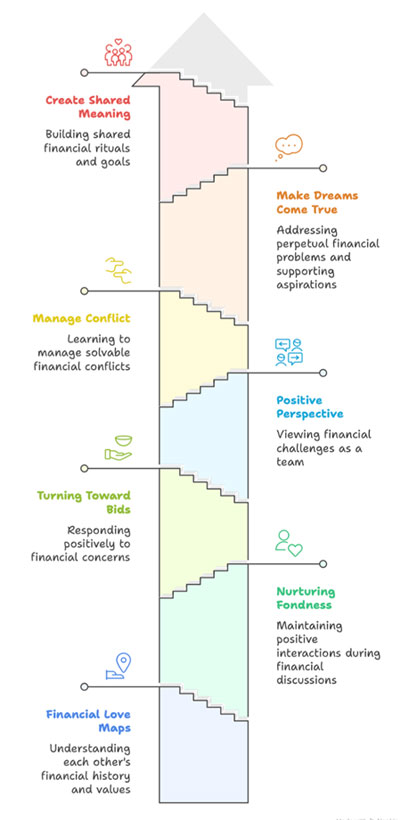
The Sound Relationship House Theory provides a research-based framework for understanding how couples can build financial intimacy, supported by the weight-bearing walls of Trust and Commitment.
Floor 1: Building Financial Love Maps
The foundation of financial intimacy begins with detailed Love Maps — the cognitive space where partners store intimate knowledge of each other's financial history, fears, dreams, and values. Essential Financial Love Map Questions include: What are your partner's earliest memories involving money? How did their family handle financial stress? What does financial security mean to them emotionally? What are their secret financial fears and biggest financial dreams?
Floor 2: Nurturing Fondness and Admiration in Financial Discussions
The second floor involves maintaining positive sentiment override even during challenging financial conversations. Gottman's research reveals the crucial "magic ratio" of 5:1 — for every negative interaction during financial conflict, stable and happy couples maintain five or more positive interactions.
Floor 3: Turning Toward Financial Bids
When one partner expresses anxiety about expenses, excitement about a financial goal, or frustration with money management, the other partner's response determines whether trust builds or erodes. Turning Toward means: "I can hear that you're concerned. Let's look at it together and make a plan." Turning Away means: "Don't worry about it." Turning Against means: "You're always worried about money. Just relax."
Floor 4: The Positive Perspective in Financial Relationships
The fourth floor involves maintaining an overall positive view of your partner and your financial partnership, even during challenging times. This means seeing your partner as a teammate working toward shared financial goals rather than an adversary. When couples achieve a positive perspective, they operate from the assumption that both partners have good intentions, even when they disagree about money matters.
Floor 5: Manage Financial Conflict
Gottman's research distinguishes between two types of financial problems:
Solvable Financial Problems have clear solutions: creating and sticking to a monthly budget, deciding how to handle a specific large expense, addressing overspending incidents, negotiating individual spending limits.
Perpetual Financial Problems reflect deeper differences in values: different risk tolerance levels, varying approaches to money management, different priorities for discretionary income, conflicting beliefs about debt.
Floor 6: Make Financial Dreams Come True
The sixth floor involves supporting and honoring each partner's individual financial dreams within the context of your shared financial partnership. Essential Financial Dream Conversations: What financial achievements would make you feel most proud? If money were no object, how would you spend your time? What does your ideal financial legacy look like? How do you want money to serve your deepest values?
Floor 7: Create Shared Financial Meaning
The seventh and highest floor involves intentionally building shared meaning, purpose, and rituals around money that reflect your unique values and identity as a couple. Financial Rituals of Connection include weekly money dates, monthly financial celebrations, annual financial visioning, and daily financial gratitude. Shared Financial Symbols include a joint mission statement, financial legacy vision, shared definition of "enough," and an agreed money values hierarchy.
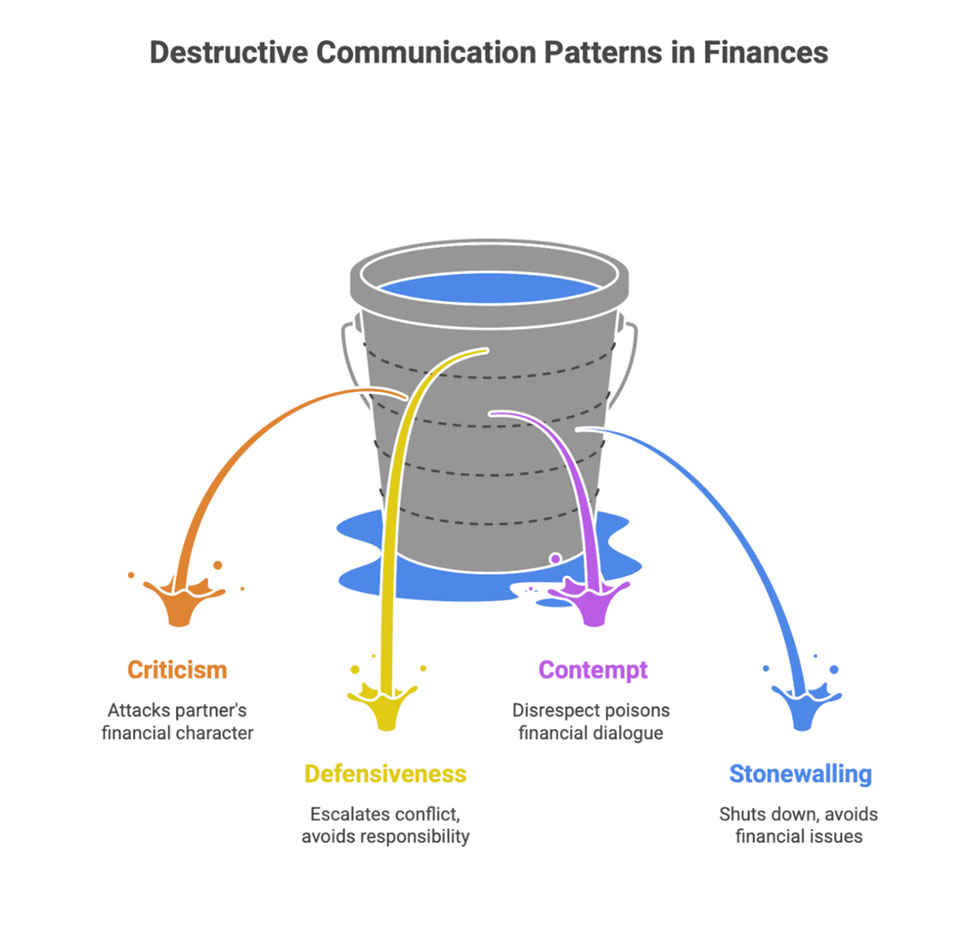
The Four Horsemen of Financial Conflict
Perhaps no aspect of Gottman's research has more direct application to financial intimacy than identifying The Four Horsemen — communication patterns that predict relationship failure with over 90% accuracy.
- Criticism in Financial Discussions: Attacks the partner's character rather than addressing specific financial behaviors. "You're so irresponsible with money, you never think about our future." Antidote: Complain without blame, using "I" statements about your feelings and needs.
- Defensiveness and Financial Shame: Emerges when partners feel attacked about their financial decisions — counterattacking, playing the victim, or making excuses. Antidote: Take responsibility for your role in financial challenges and approach money discussions with curiosity.
- Contempt: The Most Destructive Financial Pattern: Involves superiority, mockery, and disdain — eye-rolling during budget discussions, name-calling about spending habits. Antidote: Build a culture of respect and admiration, even when addressing serious financial disagreements.
- Stonewalling During Money Conversations: Emotional withdrawal from financial discussions due to feeling overwhelmed or flooded. Antidote: Recognize when you're feeling flooded, communicate your need for a break, and agree to return when both partners can engage productively.
The Soft Startup Formula for Financial Conversations
Research demonstrates that 96% of the time, how a financial conflict begins directly predicts how it will end.
The Research-Backed Gottman Formula: "I feel [emotion] about [specific financial situation], and I need [positive, specific action]"
- Budget Concerns — Harsh: "You're so irresponsible with money!" Soft: "I'm feeling really stressed about our budget this month. Can we sit down together and plan how to cut some expenses?"
- Unequal Contributions — Harsh: "You don't pull your weight financially!" Soft: "I feel worried about our financial balance and want to make sure we're both comfortable. Could we talk about how we're each contributing?"
- Financial Planning — Harsh: "You never want to plan for the future!" Soft: "I've been feeling overwhelmed thinking about our financial future. I'd love to work together on a plan. Are you open to setting aside time to discuss our long-term goals?"
Understanding Your Financial Roots
Our relationship with money is deeply rooted in childhood experiences, family dynamics, and cultural background. These "money scripts" unconsciously influence current financial behaviors and conflicts.
Step 1: Individual Reflection — Each partner reflects on earliest money memories, family attitudes toward money, significant financial events, messages received about money and worth, and how financial stress was handled in their family of origin.
Step 2: Share Your Stories — In a non-judgmental space, share your "money story" with your partner, explaining how these experiences shaped your current values, fears, and behaviors.
Step 3: Identify Triggers — Recognize specific financial situations that trigger emotional reactions: What financial discussions make you feel anxious, angry, or shut down? When do you feel most defensive about money?
Step 4: Reconcile and Respect — Understand that differing financial values are often products of different experiences rather than character flaws. Develop compassion for your partner's financial triggers.
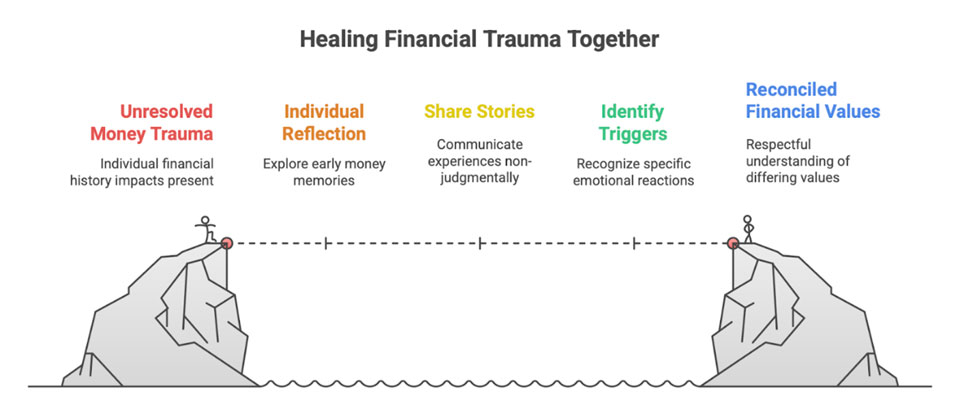
Healing Financial Trauma as a Couple
For couples where one or both partners carry financial trauma, healing becomes a shared journey:
- Recognizing Trauma Responses: Learn to identify when financial discussions trigger fight, flight, or freeze responses in yourself or your partner.
- Nervous System Regulation: Deep breathing exercises before money conversations, grounding techniques when feeling overwhelmed, co-regulation strategies to support each other through difficult emotions.
- Creating Safety: Agree on times and settings for money discussions, practice active listening without judgment, validate emotions even when disagreeing with perspectives.
- Building New Associations: Celebrate financial milestones together, practice gratitude for financial resources, develop money rituals that feel supportive rather than stressful.
Navigating Practical Financial Decisions
Joint vs. Separate Finances: Research provides clear guidance on the options:
- 62% of couples keep at least some money separate
- 38% utilize solely shared accounts
- 34% employ a mix of both joint and individual accounts
- 27% opt for complete financial separation
Joint bank accounts correlate with higher marital satisfaction (94% vs. 82% for separate accounts). However, the key factor isn't the specific structure but the level of communication, transparency, and mutual agreement about financial arrangements.
Table: Joint vs. Separate vs. Hybrid Financial Models
| Model | Description | Pros | Cons |
|---|---|---|---|
| Fully Joint | All income pooled into shared accounts; all expenses paid from joint funds. | Simplifies budgeting, fosters "our money" mentality, full transparency. | Less individual autonomy, potential for control issues. |
| Fully Separate | Each partner manages their own income and expenses; shared bills are split. | High individual autonomy, avoids arguments over spending habits. | Can feel transactional, less shared vision, potential for financial secrets. |
| Hybrid (Pooled) | A portion of income (e.g., for shared bills) is pooled; rest remains separate. | Balances autonomy with shared responsibility, fosters partnership. | Requires clear rules, ongoing communication to adjust contributions. |
Fairness Beyond 50/50: Navigating Income Disparity with Grace
Income disparity is a common source of tension in relationships. The Equitable Wealth-Building Pact moves beyond rigid 50/50 splits:
- Proportional Contribution: Contribute to household bills and savings based on your income percentage. If one partner earns 70% of household income, they contribute 70% of shared expenses.
- Shared Investment Goals: All investments and savings, regardless of individual contribution, should be considered jointly owned.
- Personal Allowances: After proportional contributions, each partner should have personal discretionary spending money they can use without scrutiny.
- Recognition of Non-Financial Contributions: Acknowledge that caregiving, household management, and other non-paid contributions have economic value that should factor into financial arrangements.
Weathering the Storm: Protecting Your Finances & Relationship in Uncertain Times
External economic factors like inflation, recessions, or market volatility can significantly impact a couple's financial stability and mental health. Strategies include scenario planning ("what-if" discussions), flexible budgeting, diversifying income and savings, and regular economic check-ins as a united front against external pressures.
Communication During Crisis: Distinguish between problems you can control versus external factors. Focus on your response and adaptation. Maintain financial intimacy practices even when stressed. Seek professional support when external pressures threaten relationship stability.
The Mental Load Redistribution Matrix
Financial management involves significant cognitive labor — bill paying, investment research, insurance evaluation, tax preparation, budget creation, financial goal setting, estate planning, credit score monitoring — that often falls disproportionately on one partner. Making this invisible labor visible prevents burnout and resentment.
Equitable Distribution Process
- List All Financial Tasks: Brainstorm every financial task, no matter how small.
- Assign Current Responsibility: For each task, identify who currently handles it.
- Assess Cognitive Burden: Discuss the mental energy, time, and stress associated with each task.
- Redistribute Equitably: Based on skills, preferences, and overall workload, reassign tasks to achieve a more balanced distribution.
- Regular Review: Review and adjust periodically, especially during life transitions.
Prioritizing Peace: When Mental Health Needs Come First
Persistent sadness, anger, fatigue, withdrawal, increased irritability, changes in sleep or appetite, and a loss of interest in activities are all red flags that mental well-being needs attention. Prioritize self-care, support each other by listening without judgment, and encourage professional help when needed. Neglecting mental health exacerbates financial and relational problems, creating a downward spiral. Prioritizing mental well-being is a foundational element for navigating life's challenges.
Professional Support: When to Seek Help
One of the strongest points of agreement among experts is the value of seeking professional help for complex financial and relational issues. This is not a sign of failure, but a proactive step towards healing and growth:
- Couples Therapy: A trained therapist at Coach For Mind can help navigate power dynamics, gender roles, and money trauma in a safe, structured space.
- Financial Counselling/Therapy: A financial therapist goes deeper than a financial planner, addressing the psychological and emotional aspects of money — helping couples understand their money scripts and heal financial trauma.
- Legal Counsel: In cases of severe financial infidelity or abuse, or when considering separation, legal advice is essential to protect individual rights and assets.
Don't wait until the breaking point. Proactive engagement with professionals can provide the tools, insights, and support needed to transform financial distress into relational resilience.
A Month-by-Month Gottman Plan for Financial Unity
Week 1: Building Financial Love Maps — Complete comprehensive financial history sharing, explore childhood money memories, identify individual financial strengths, create shared financial vocabulary.
Week 2: Establishing Positive Financial Sentiment — Practice daily financial appreciation exercises, identify and celebrate each partner's unique contributions, implement 5:1 ratio in money conversations.
Week 3: Mastering Financial Conflict Management — Practice soft startup techniques, learn to identify and antidote the Four Horsemen, distinguish between solvable and perpetual financial issues.
Week 4: Creating Shared Financial Meaning — Align individual financial dreams with relationship goals, create joint financial mission statement and values, establish ongoing financial ritual and check-in systems.
Research-Based Predictions for Success
Positive Predictors of Financial Intimacy Success:
- Maintaining 5:1 positivity ratio during financial discussions
- Consistent soft startup approach to money conversations
- Mutual influence and compromise in financial decisions
- Detailed financial Love Maps with regular updates
- Absence of Four Horsemen in financial conflicts
- High levels of financial transparency and trust
Warning Signs Requiring Immediate Attention:
- Consistent harsh startup in financial discussions
- Presence of contempt during money conversations
- Financial stonewalling and emotional withdrawal
- Financial infidelity and ongoing secrecy
- Mental health symptoms related to financial stress
- Complete avoidance of financial planning conversations
Conclusion
The journey through money, marriage, and mental health is undeniably complex, fraught with potential for conflict and emotional strain. Yet, within these challenges lies an unparalleled opportunity for profound intimacy, unwavering trust, and shared growth. By embracing open, authentic communication, understanding your unique financial stories, and proactively building a resilient financial foundation, you can transform money from a source of anxiety into a powerful catalyst for a deeper, more connected relationship.
Remember, you are not alone. The path to financial intimacy is an ongoing one, requiring empathy, patience, and a commitment to continuous learning and adaptation. Don't let money define your struggles. Let it be the foundation for your strongest connection yet.
Why CoachForMind?
Experienced Psychologists: We are a team of licensed RCI-registered clinical psychologists. Our team is well-experienced in various forms of therapy such as CBT, DBT, EMDR, and Narrative Therapy.
Personalized Approach: We are dedicated to treating our clients in the best-suited way, carefully curated as per the client's needs, and adhering to one-on-one, client-centered therapy.
Scientific Techniques: Our treatment plans and therapeutic methods are based on highly researched scientific findings such as CBT, DBT, EMDR and Narrative Therapy.
Quality service: We at CoachForMind ensure quality services in our treatment regime and therapeutic approaches. Our clients hold the most value to us, so we ground our techniques in empathy while maintaining professionalism.
Begin with a free 15-minute discovery call. For more information, please visit our website or contact us directly at [email protected]
Written by Ms Tamana and Dr Kudrat — Psychologists at Coach For Mind
FAQs About Financial Intimacy
Financial intimacy goes far beyond sharing bank accounts or splitting bills. It represents the deep emotional connection, transparency, and vulnerability that couples develop around money matters. True financial intimacy encompasses three core components: Financial Partnership (making joint decisions and planning together), Financial Trust and Disclosure (complete transparency about all aspects of money), and Shared Financial Meaning (aligning individual dreams with collective purpose and creating shared rituals around money). Research demonstrates that couples who achieve all three levels of financial intimacy report significantly higher relationship satisfaction, better financial outcomes, and greater resilience during financial challenges.
Gottman's research distinguishes between two types of financial problems. Solvable Financial Problems have concrete solutions: creating a monthly budget, deciding how to handle a specific large expense, addressing overspending incidents. Perpetual Financial Problems reflect deeper differences in values: different risk tolerance, varying money personalities (spender vs. saver), different priorities for discretionary income. If you find yourselves having the same financial argument repeatedly without resolution, or if the disagreement touches on core identity or values, you're likely dealing with a perpetual problem. The solution: manage perpetual problems through ongoing dialogue and creative accommodation rather than trying to eliminate the difference.
Financial infidelity involves hiding financial activity from your partner — secret spending, hidden debts, undisclosed accounts, or major financial decisions made without your partner's knowledge. Research reveals: 40-42% of people in committed relationships have committed some form of financial infidelity, and 45% consider financial secrets as damaging as physical infidelity. It's so destructive because it shatters trust around security and planning, threatens the betrayed partner's ability to make informed decisions about their own financial security, makes the betrayed partner question their entire relationship reality, and creates unhealthy power dynamics. Unlike other relationship betrayals, financial infidelity often has practical consequences — debt, damaged credit — that compound the emotional damage.
Rebuilding trust requires a systematic, trauma-informed approach. Phase 1 — Full Disclosure: The betraying partner must disclose all financial secrets completely, provide access to all accounts, and take full responsibility without excuses. Phase 2 — Empathy and Validation: The betrayed partner needs space to express their full range of emotions without judgment and time for processing without pressure. Phase 3 — New Systems and Boundaries: Establish complete financial transparency, create regular financial check-ins, agree on spending limits, implement consequences for future dishonesty. Phase 4 — Consistent Action: Trust rebuilds through consistent, transparent actions over time — not just words or promises. Trust reconstruction typically takes 1-3 years of consistent effort.
Research shows couples with joint financial management experience better relationship outcomes — couples with joint accounts report higher marital satisfaction (94% vs. 82%). However, the key factor isn't the specific account structure but the level of communication, transparency, and mutual agreement. Fully Joint (38% of couples) simplifies budgeting but reduces individual autonomy. Fully Separate (27%) maintains autonomy but can feel transactional. Hybrid (34%) balances partnership with autonomy. Best practice: choose the approach that maximizes transparency and mutual agreement while honoring both partners' needs.
Income disparity requires moving beyond simple 50/50 splits. The Proportional Contribution Model suggests contributing proportionally based on income percentage — if one partner earns 70% of household income, they contribute 70% to shared expenses. Key principles: recognize non-financial contributions (caregiving, household management) as having economic value; treat all investments and savings as jointly owned regardless of who contributed more; give each partner personal discretionary spending money regardless of earning level; and avoid using income disparity to make unilateral financial decisions. Studies show couples who address income disparity through proportional contributions report higher relationship satisfaction.
Use the Soft Startup Technique — "I feel [emotion] about [specific financial situation], and I need [positive, specific action]." Avoid the Four Horsemen: attack the problem not your partner's character (criticism), take responsibility rather than counter-attacking (defensiveness), maintain respect even during disagreement (contempt), take breaks when overwhelmed but commit to returning (stonewalling). Maintain the 5:1 ratio: for every negative interaction during financial conflict, include five positive interactions. Schedule financial discussions when both partners are calm and regulated, not during high-stress moments.
Financial stress creates cascading effects. On mental health: increased anxiety and depression, sleep disruption, difficulty concentrating, heightened irritability, and social withdrawal. On relationships: financial stress is the strongest predictor of negative communication patterns in couples, increased criticism and emotional distance, decreased physical and emotional intimacy, higher rates of conflict across all relationship domains. The vicious cycle: financial stress damages relationship functioning, which reduces couples' ability to work together effectively on financial problems, which increases financial stress. Breaking the cycle requires prioritizing mental health, addressing trauma responses through therapy, and creating emotional safety before attempting financial problem-solving.
Immediate red flags: financial infidelity or major trust breaches, persistent mental health symptoms related to financial stress, inability to have calm conversations about money, financial abuse or control patterns, considering separation due to money conflicts. Ongoing struggles: repeatedly having the same financial arguments without resolution, major differences in financial values that feel impossible to bridge, trauma responses during financial discussions, avoidance of financial planning despite obvious need. Types of professional support: Couples Therapy (addresses communication patterns and emotional dynamics), Financial Therapy (combines financial planning with psychological insights), Individual Therapy (helps address personal money trauma, anxiety, or depression). Don't wait until you're in crisis — proactive professional support is most effective.
Start with a Financial Love Map Conversation (20-30 minutes). Step 1 — Create Safety: Choose a calm time, agree this is about understanding not problem-solving, commit to listening without judgment. Step 2 — Take Turns Sharing: Each partner shares answers to: What's your earliest money memory? How did your family handle money? What does financial security feel like emotionally? What's one financial fear you've never shared? What's one financial dream that really matters to you? Step 3 — Reflect Together: Share one new thing you learned about your partner, express appreciation for their vulnerability, identify one way this understanding might help future financial discussions. This single step begins transforming money from a source of stress into a pathway for deeper intimacy and connection.


