
Beyond Symptoms: How Integrated EMDR & IFS Unlock Deep, Lasting Trauma Healing

When trauma leaves its mark on our lives, traditional therapy approaches sometimes feel like they're only scratching the surface. You might find yourself thinking, "I understand what happened to me intellectually, but I still feel stuck." Or perhaps you've noticed that certain triggers still send your nervous system into overdrive, even after months or years of therapy. If this resonates with you, you're not alone, and there's hope. If you're new to this work, start with our overview of IFS therapy, or read more on what an IFS and EMDR session actually looks like.
Two powerful therapeutic approaches, Eye Movement Desensitization and Reprocessing (EMDR) and Internal Family Systems (IFS) therapy, are increasingly being combined to create a revolutionary path to healing. This integrated approach addresses trauma not just in your mind, but in your body, your nervous system, and your deepest sense of self.
Understanding How Trauma Gets "Stuck" in Your System
To understand why this integration is so transformative, we must first understand how trauma impacts you. Trauma is not what happened to you, but what happened inside you as a result of what happens to you. How your nervous system responded to overwhelming experiences and how those responses continue to shape your life today. This internal disruption affects every aspect of your being, from the cellular level of your nervous system to your capacity for trust, intimacy, and joy.
The Neurobiological Reality of Trauma
When you experience trauma, your brain's alarm system (the amygdala) becomes hyperactive while your thinking brain (the prefrontal cortex) goes offline. This creates a profound split: you may intellectually understand that you're safe now, but your body continues to react as if the threat is still present. Your nervous system remains stuck in what researchers call a "biology of threat", perpetually scanning for danger even in safe environments.
This isn't a character flaw or a sign of weakness, it's neuroplasticity in reverse. Your brain, in its remarkable adaptability, has literally rewired itself to prioritize survival over thriving. The neural pathways that once supported feelings of safety, connection, and spontaneous joy have been overshadowed by networks dedicated to threat detection and emotional numbing.
Research reveals that trauma creates measurable changes in brain structure:
- The amygdala becomes enlarged and hyperactive
- The hippocampus (crucial for memory and learning) can actually shrink
- Connections between emotional and thinking brain regions become disrupted
These changes explain why trauma survivors often feel like they're "living in a body that no longer feels like home".
The Embodied Nature of Traumatic Memory
Perhaps most importantly, traumatic memories are stored differently than normal memories. Instead of being filed away as completed experiences with a clear beginning, middle, and end, trauma gets stored in fragments, sensations, images, emotions, and beliefs that remain unprocessed and intrusive. These fragments can be triggered by seemingly innocuous reminders, flooding your system with the same overwhelming emotions you felt during the original experience.
Think of it this way: your brain is like a filing system. Under normal circumstances, experiences get properly "filed away" as memories with a clear beginning, middle, and end. But trauma disrupts this filing system. Instead of being stored as completed experiences, traumatic memories remain unprocessed, like papers scattered across your mental desk, ready to spill over at any moment.
The good news? Your brain has an incredible capacity for healing called neuroplasticity, its ability to form new neural pathways and reorganize itself throughout your life. This means that even long-standing trauma patterns can be changed, allowing you to reclaim your sense of safety, connection, and authentic self.
This is why traditional talk therapy, while valuable, often feels insufficient for trauma healing. You cannot heal trauma through understanding alone. The body, with its nervous system responses, breathing patterns, muscle tension, and gut reactions, must be included in the healing process.
What is EMDR?
Eye Movement Desensitization and Reprocessing (EMDR), developed by Dr. Francine Shapiro in the 1980s, represents one of the most significant breakthroughs in trauma treatment. At its core, EMDR harnesses your brain's natural capacity for healing through bilateral stimulation, a process that mimics what happens during REM sleep when your brain naturally processes and integrates daily experiences.
The core idea behind EMDR is that traumatic experiences can become "stuck" in the brain's neural networks, leading to symptoms like flashbacks, anxiety, and emotional dysregulation. By activating both sides of the brain, EMDR helps to reprocess these maladaptively stored memories, allowing them to be integrated into a more adaptive, less distressing form. The goal is not to erase the memory, but to transform its emotional charge, allowing you to recall the event without the associated distress. EMDR is particularly effective for single-incident trauma, PTSD, phobias, and anxiety disorders. Trauma and PTSD Therapists in New York at Coach for Mind are trained in treating trauma related issues, PTSD, phobias, and anxiety disorders.
The Science of Bilateral Stimulation
EMDR's bilateral stimulation, typically side-to-side eye movements, but sometimes sounds or tactile sensations, creates specific brainwave patterns called delta waves, vibrating at 1.5 Hz frequency. This is the exact same frequency your brain produces during deep sleep when it naturally sorts through memories and files them away properly.
Think of traumatic memories like worn grooves in a record that keep playing the same distressing song over and over. In your brain, these "grooves" are actually connections between brain cells in your amygdala, your brain's built-in alarm system. When trauma happens, these connections become super-strong, like highways that get more traffic than they can handle.
Building Communication Between Brain Regions
While EMDR is calming down your alarm system, it's simultaneously building stronger communication pathways between two crucial parts of your brain that often don't talk well after trauma:
- Your emotional brain (limbic system) is like a sensitive security guard who feels everything intensely but doesn't always think things through
- Your thinking brain (prefrontal cortex) is like a wise counselor who can analyze situations rationally but sometimes gets overwhelmed by strong emotions
- Decreased amygdala activity: Your brain's alarm system becomes less reactive
- Increased hippocampal volume: Your memory center grows by up to 6%
- Better communication between brain hemispheres: Integration of logical and emotional processing
After trauma, these two often work against each other, your emotional brain screams "DANGER!" while your thinking brain tries to say "You're actually safe right now," but neither can hear the other clearly.
EMDR's bilateral stimulation literally grows new neural pathways between these brain regions, like building better phone lines so they can communicate effectively. Instead of your emotional and thinking brains being in constant conflict, they start working as a coordinated team.
Documented Brain Changes from EMDR
The research on EMDR's neurobiological effects shows remarkable results:
Recovery Rates:
- 91% of people no longer had PTSD after EMDR treatment
- 100% of people with single-trauma experiences recovered after just six sessions on average
Learning and Memory Improvements:
- Brain scans show EMDR creates a 300% faster learning rate compared to other trauma therapies, your brain literally learns to heal three times faster
- The hippocampus (your brain's memory center and learning hub) actually grows larger by up to 6% after EMDR treatment
Fear Response Changes:
- Your brain's alarm system (amygdala) becomes 30% faster at calming down fear responses compared to other therapy approaches
- Brain scans reveal that EMDR creates measurable changes in brain structure and function, including decreased activity in the fear center (amygdala) and improved functioning in areas responsible for emotional regulation and memory processing.
Instead of being hijacked by traumatic memories, your brain learns to process them like any other life experience. The memory doesn't disappear, but it loses its power to control your present moment.
Think of it like this: before EMDR, a traumatic memory might feel like watching a horror movie where you're trapped in the front row with the volume turned all the way up. After EMDR, it's more like viewing that same scene from the back of the theater with normal volume, you can see what happened, but it no longer overwhelms your entire experience.
The EMDR Process
EMDR follows a careful eight-phase protocol designed to ensure safety and effectiveness:
- History Taking: Your therapist gathers background information and identifies target memories
- Preparation: You learn coping skills and establish safety
- Assessment: Detailed mapping of traumatic memories and associated beliefs
- Desensitization: Using bilateral stimulation to reduce emotional charge of memories
- Installation: Strengthening positive beliefs to replace negative ones
- Body Scan: Addressing any remaining physical tension or distress
- Closure: Ending each session with stabilization techniques
- Reevaluation: Assessing progress and planning next steps
This systematic approach helps ensure that traumatic memories are fully processed rather than simply suppressed or avoided.
Internal Family Systems: Honoring the Multiplicity Within
While EMDR addresses the neurobiological aspects of trauma, Internal Family Systems (IFS), developed by Dr. Richard Schwartz, illuminates something equally important: the complex internal relationships that develop in response to life experiences. IFS recognizes that we all have different "parts" of ourselves, each with their own feelings, memories, and ways of trying to help us survive and thrive.
Understanding Your Internal Family
Rather than seeing psychological symptoms as disorders, IFS understands them as adaptive strategies developed by different parts of your psyche. Think about how you might act differently with your boss than with your best friend, or how a certain part of you becomes activated when you feel criticized. IFS suggests that these aren't just mood changes, they represent different aspects of your internal system, each trying to help you navigate life's challenges. IFS is highly effective for complex trauma, relational trauma, attachment issues, chronic anxiety, depression, and fragmentation.
Meet Your Internal Team
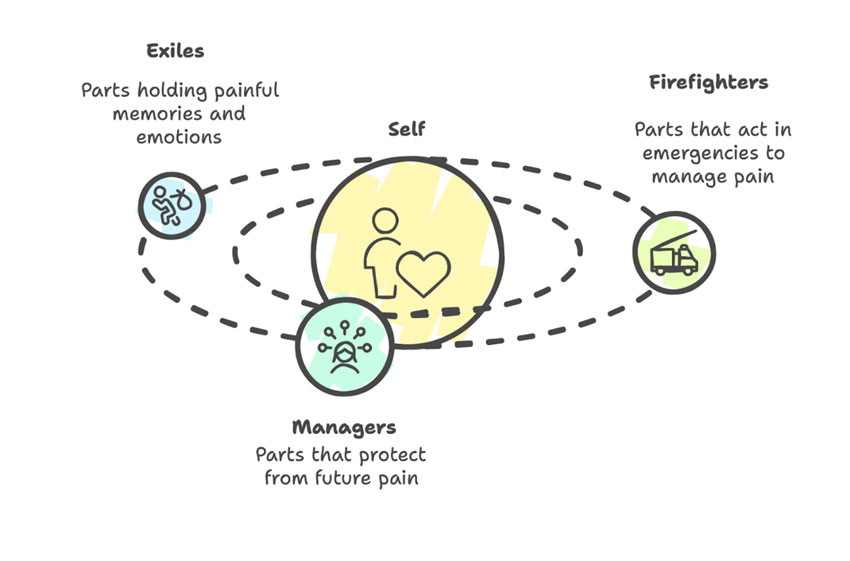
IFS identifies three main types of parts:
- Exiles: Exiles are like the sensitive family members who got hurt and never quite healed. These are the parts of you that hold onto painful memories and difficult emotions, often from childhood or other vulnerable times in your life. They carry feelings like sadness, fear, shame, or that deep longing to be truly seen and loved.
An exile might be the part of you that still feels like that eight-year-old who was told they were "too much," or the teenager who felt invisible at school. These parts often feel frozen in time, even though you're an adult now, they're still experiencing that original pain as if it's happening today. For example, you might have an exile that still feels like the scared child who was criticized or abandoned.
- Managers: Manager parts are like having a highly dedicated personal assistant whose job is to make sure you never get hurt like that again. They work around the clock, scanning for potential threats and trying to control situations before anything goes wrong.
You might recognize managers in yourself as:
- The perfectionist part that won't let you submit anything unless it's flawless
- The people-pleaser who says yes to everything to avoid conflict
- The hypervigilant part that's always watching for signs of rejection or criticism
- The analyzer who tries to think through every possible outcome before taking action
These parts mean well, they're genuinely trying to keep your tender exile parts safe from re-experiencing old wounds.
- Firefighters: When your managers can't prevent pain and those exile parts do get triggered, when the pain breaks through despite all the protective strategies, firefighter parts jump into action like an emergency response team rushing to put out a blazing fire.
Firefighters don't have time to think about long-term consequences; they just need to stop the emotional emergency right now. They might show up as:
- Reaching for a drink, food, or substances to numb the pain
- Diving into compulsive behaviors like shopping, scrolling, or working non-stop
- Explosive anger that creates distance from the vulnerable feelings underneath
- Sexual acting out or other behaviors that provide intense distraction
- Any quick escape from overwhelming emotions
Their sole goal is to "put out the fire" of emotional distress.
The Power of Self-Leadership
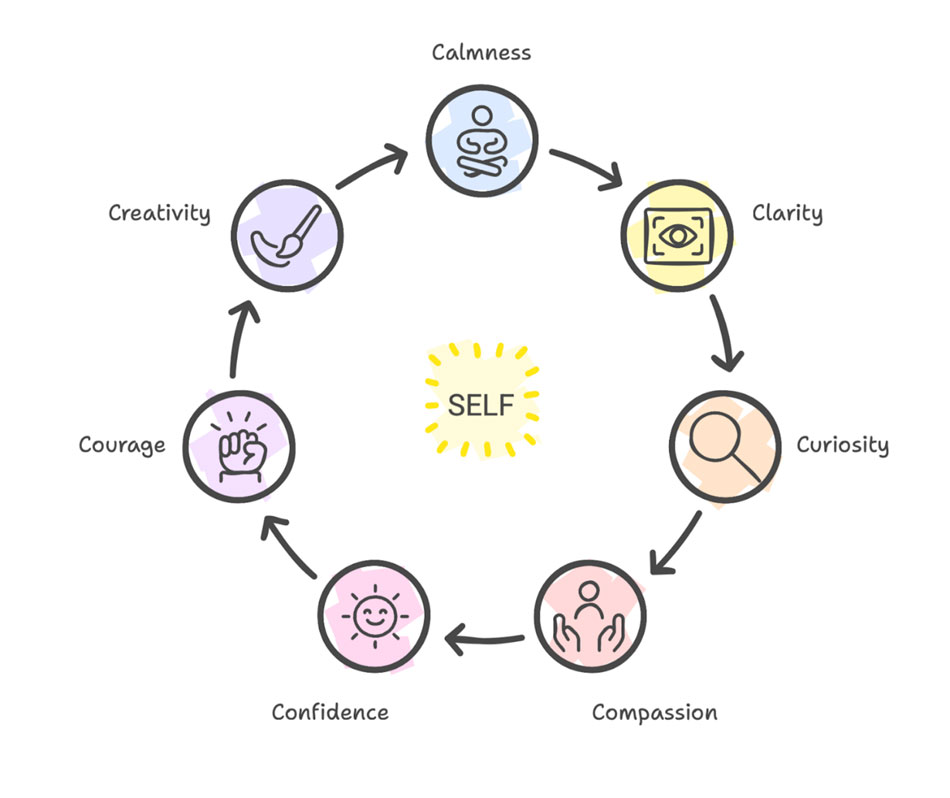
Underneath all your struggling parts, the anxious manager, the hurt exile, the reactive firefighter, there's a wise, compassionate, authentic essence. In IFS, this is called your Self. Unlike your parts, which developed in response to life experiences, your Self has always been there. It possesses what Dr. Richard Schwartz calls the "8 Cs":
- Calmness
- Clarity
- Curiosity
- Compassion
- Confidence
- Courage
- Creativity
- Connectedness
The goal of IFS isn't to eliminate parts, but to help them trust your Self to lead. When your parts feel safe and cared for by your Self, they can relax their extreme roles and contribute their gifts in healthier ways. This creates what researchers call Self-leadership, a state that correlates with increased activity in the medial prefrontal cortex and improved emotional regulation.
IFS and Trauma
IFS is particularly powerful for trauma healing because it's inherently non-pathologizing. Instead of viewing your responses to trauma as symptoms or disorders, IFS sees them as parts that developed creative strategies to help you survive difficult experiences. This perspective immediately reduces shame and increases self-compassion.
Recent research on IFS shows promising results. In a study of trauma survivors, 73% of participants attended 12 or more group sessions, and 53% showed clinically meaningful improvement in PTSD symptoms. Participants also demonstrated significant improvements in emotional regulation, self-compassion, and the ability to step back from overwhelming emotions. Trauma and PTSD Therapists in New York at Coach for Mind are trained in IFS
IFS's Impact on Your Nervous System
IFS work creates changes in your autonomic nervous system, the part of your nervous system that controls your fight, flight, freeze, or fawn responses. As your parts learn to trust your Self-leadership:
- Your nervous system becomes more regulated: You can stay calm in situations that used to trigger you
- Your window of tolerance expands: You can handle more stress without becoming overwhelmed
- Your parts can "unburden": They release the extreme emotions and beliefs they've been carrying
The Core Principles and Approach: A Comparative Look
While distinct, EMDR and IFS share fundamental beliefs about healing and your innate capacity for it. Let's look at how they compare:
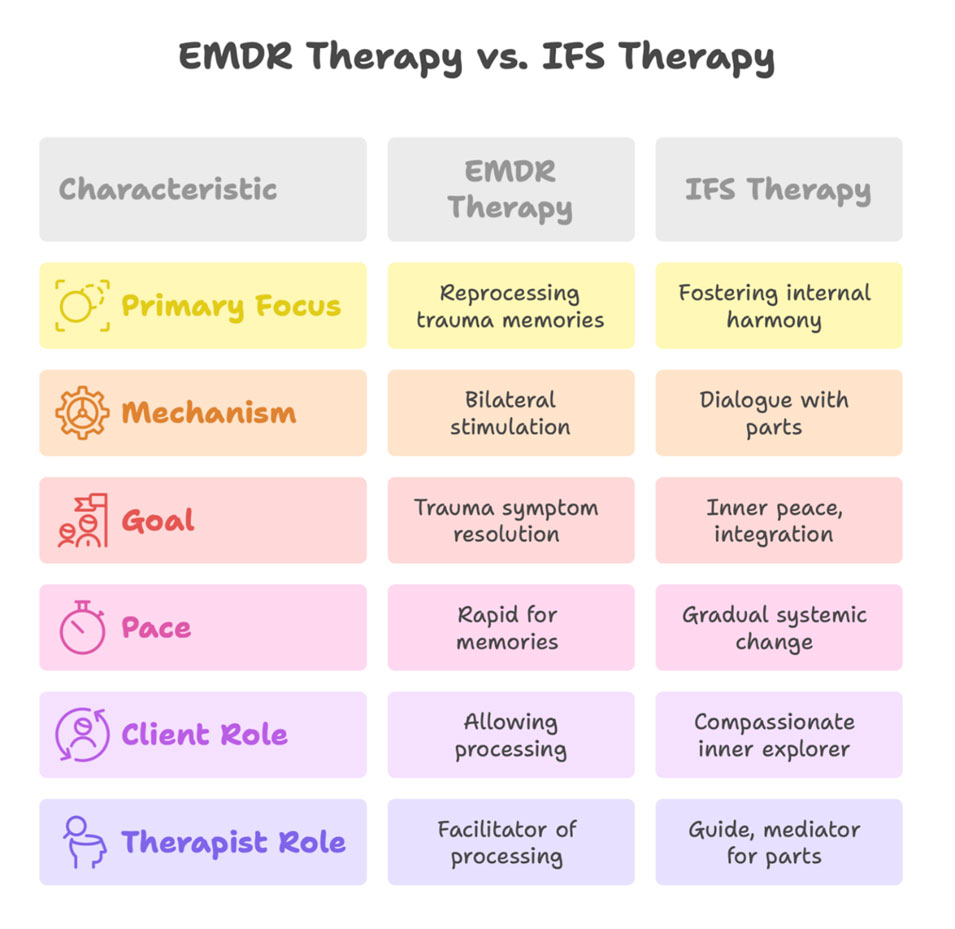
Both modalities are powerful, evidence-based therapies for trauma recovery, trusting your innate capacity to heal and aiming for lasting change without necessarily requiring intense reliving of trauma 7. They are also both considered "top-down" (cognitive/emotional) and "bottom-up" (somatic/nervous system) approaches, albeit through different mechanisms.
Targeted Conditions and Issues: Where Each Shines
Understanding where each therapy excels individually helps us appreciate their combined power.
EMDR excels at:
- Processing specific traumatic memories
- Reducing their emotional charge through bilateral stimulation
- Helping your brain file memories away as completed experiences
- Single-incident trauma: Accidents, natural disasters, specific assaults.
- Post-Traumatic Stress Disorder (PTSD): Particularly when there are clear, identifiable traumatic memories.
- Phobias and Panic Attacks: By reprocessing the initial sensitizing events.
- Performance Anxiety: Addressing past failures or fears.
IFS excels at:
- Understanding the complex ways trauma affects your whole internal system
- Building safety and self-compassion
- Creating sustainable change in how you relate to yourself and others
- Complex Trauma (C-PTSD): Resulting from prolonged, repeated trauma, often in childhood or relational contexts.
- Relational Trauma and Attachment Wounds: Healing patterns established in early relationships.
- Dissociation and Fragmentation: Helping you integrate disparate aspects of your personality.
- Chronic Anxiety and Depression: By addressing the underlying protective strategies and exiled pain.
- Eating Disorders and Addictions: Understanding the protective roles these behaviors play.
- Self-Criticism and Shame: By fostering compassion for inner parts.
For individuals with complex trauma, which often involves multiple traumatic events, relational betrayal, and a fragmented sense of self, a standalone approach may not be sufficient. This is precisely where the integration of EMDR and IFS becomes not just beneficial, but often essential. For example, many Trauma and PTSD Therapists in New York are beginning to combine these modalities because of how effectively they address both memory-level trauma and inner-system dynamics.
How EMDR and IFS Work Together: A Powerful Partnership
When EMDR and IFS are skillfully integrated, they create something far more powerful than either approach alone. This combination addresses trauma not just as stored memories to be processed, but as a complex disruption of your relationship with your own embodied experience. Think of it this way: EMDR provides the technology to reprocess traumatic memories, while IFS provides the roadmap for navigating your inner world safely and sustainably.
Why Integration is the Gold Standard for Complex Trauma
Integrating EMDR and IFS creates a robust framework for healing, especially for complex trauma, where your system may be highly fragmented, protective, and easily overwhelmed. IFS acts as a "meta-framework" that can contain and enhance EMDR, rather than just another modality 8.
Here's how this synergy works to create a safer, more profound healing journey:
- Preparation and Safety First (IFS): Before diving into EMDR's memory reprocessing, IFS helps to "get protective parts on board." Many individuals with complex trauma have highly activated protectors who fear re-experiencing pain or losing control. IFS allows you, guided by your Self-energy, to understand these protectors' positive intentions, reassure them, and build internal trust. This crucial preparatory phase ensures safety, prevents overwhelm, and significantly reduces the likelihood of "backlash" or re-traumatization during EMDR processing 9.
- Targeted Processing (EMDR): Once your internal system feels safer and protective parts are on board, EMDR can be used to efficiently process specific traumatic memories. EMDR acts like a "master archivist," helping to re-file distressing experiences in your brain's "filing cabinet" so they no longer trigger intense emotional responses.
- Integration and Aftercare (IFS): After EMDR processing, IFS facilitates the integration of new insights and emotional shifts. It helps you understand how the unburdened memories impact your internal system, allowing exiled parts to be retrieved and integrated. This phase also addresses any remaining protective strategies that are no longer needed, fostering greater internal harmony and Self-leadership in your daily life.
This combined approach emphasizes a gentle, paced, and compassionate journey, ensuring that healing doesn't require intense reliving of trauma. It respects your pace and internal wisdom, allowing for profound, lasting transformation. This is why many specialized practitioners, including leading Trauma and PTSD Therapists in New York, consider the integration of these two approaches one of the most effective pathways for long-term recovery.
The Safety-First Approach
One of the most significant advantages of combining EMDR and IFS is the enhanced safety it provides. Traditional EMDR can sometimes overwhelm protective parts that aren't ready to let down their guard, creating what appears to be "treatment resistance". But this resistance isn't pathological, it's protective parts doing their job.
IFS-informed EMDR takes a completely different approach. Before processing traumatic memories, your therapist helps you get to know your protective parts and understand their concerns. Instead of bypassing resistance, this approach honors and collaborates with protective parts:
"I notice a part of you seems worried about going into this memory. Can you ask that part what it's afraid might happen if we process this?"
"What does this protective part need to feel safe enough to allow us to do this work?"
By honoring and collaborating with your protective parts rather than trying to bypass them, you're more likely to feel safe enough to do the deeper work of trauma processing.
Memory Reconsolidation: The Ultimate Neuroplasticity
When EMDR and IFS work together, they tap into a process called memory reconsolidation, the only form of neuroplasticity that can actually update traumatic learning rather than simply override it. This means that traumatic memories aren't just suppressed or managed, they're actually updated with new information. The memory remains, but its emotional charge and meaning change.
Imagine if you could go back and edit a painful chapter in your life's story, not to pretend it never happened, but to change what it means about you and your worth. Memory reconsolidation is your brain's incredible ability to do exactly that, but at the deepest neurological level.
Most forms of therapy work like putting a Band-Aid over a wound, they help you cope with traumatic memories, manage triggers, or develop skills to override your automatic responses. But memory reconsolidation is different. It's like your brain's "edit" function, allowing you to actually update the original traumatic learning itself.
Here's a real example of how this works: Let's say you have a memory of being abandoned as a child, and your brain learned "I'm unworthy of love" from that experience. Traditional therapy might help you intellectually understand that wasn't true, or teach you coping strategies when that belief gets triggered.
But with memory reconsolidation, something more profound happens. The memory of abandonment doesn't disappear, but its core meaning transforms. Instead of "I'm unworthy of love," your entire being, not just your thinking mind, comes to know "That was painful, and it wasn't about my worth." This isn't just a nice thought you tell yourself; it becomes your lived, felt truth.
This process requires three specific conditions:
- Memory Reactivation: Opening the File
First, the traumatic memory needs to be "opened" and emotionally activated, like opening a computer file to edit it. This is tricky because traumatic memories often feel too overwhelming to access safely.
EMDR's bilateral stimulation creates the perfect neurobiological conditions for this. The back-and-forth eye movements (or taps or sounds) help your brain access the memory without becoming completely overwhelmed by it. It's like having a skilled technician help you safely open a corrupted file.
- Prediction Error: New Information That Changes Everything
For your brain to update a memory, it needs to encounter information that contradicts what it originally learned from the trauma. This is called a "prediction error", when reality doesn't match what your brain was expecting based on past experience.
This is where IFS becomes crucial. When you access a painful memory while being led by your Self, experiencing genuine compassion, safety, and wisdom, your brain encounters something it wasn't expecting. Your internal system learned "I'm alone and unworthy" from the original trauma, but now it's experiencing "I'm held and valued" while remembering the same event. This contradiction creates the necessary prediction error.
- The Reconsolidation Window: Perfect Timing
There's a brief neuroplastic window, usually lasting a few hours, when memories become "editable" after being reactivated. Miss this window, and the memory gets stored again in its original form.
When EMDR and IFS work together, they create optimal conditions for this window. The bilateral stimulation keeps the memory accessible and neuroplastically "soft," while Self-leadership provides the new, healing information that gets integrated into the memory trace.
Think of it like this: instead of learning to live with a smoke alarm that constantly goes off due to faulty wiring, memory reconsolidation actually fixes the wiring itself. The alarm system is still there (which is good, you still need to be able to recognize real danger), but it stops triggering false alarms based on outdated information.
Compound Brain Changes
When EMDR and IFS work together, they create measurable, physical changes in your brain that you can literally see on brain scans. These aren't just temporary improvements, they represent your brain actually rewiring itself for healing.
- Calming Your Brain's Alarm System (Amygdala Normalization):
Your amygdala is like having a smoke detector in your brain, it's supposed to alert you to real danger. But trauma can make this detector hypersensitive, triggering panic even when you're perfectly safe.
The integration of EMDR and IFS creates a remarkable dual effect:
- EMDR's bilateral stimulation teaches your amygdala to turn off fear responses 30% faster than other approaches
- IFS parts work prevents you from becoming overwhelmed during this process by ensuring your protective parts feel safe
It's like having a skilled technician recalibrate your smoke detector while a trusted friend stays with you for support. Your brain's alarm system becomes appropriately sensitive, it can still detect real threats, but it stops going off every time someone burns toast.
- Strengthening Your Brain's CEO (Prefrontal Enhancement):
Your prefrontal cortex is like the CEO of your brain, responsible for emotional regulation, decision-making, and self-awareness. Trauma often leaves this region under-active, like having a CEO who's been locked out of the boardroom while panicked employees run the company.
When you operate from Self-leadership during EMDR processing, brain scans show dramatically increased activity in these executive regions. It's literally like watching your brain's CEO come back online, taking calm, wise control of the whole system.
- Growing Your Memory Center (Hippocampal Growth):
Perhaps most remarkably, the hippocampus, your brain's memory processing and learning center, actually grows larger during this integrated treatment. We're talking about measurable structural changes, with increases of up to 6% in volume.
Think of it like your brain building a bigger, better filing system. Instead of traumatic memories being scattered in chaotic piles that fall over whenever you try to access them, they get organized into proper files that you can handle safely. The safety created through IFS parts work provides the perfect conditions for this growth to occur.
- Breaking the Rumination Loop (Default Mode Network Transformation):
Your default mode network is the brain system that's active when you're not focused on something specific, it's often called the "monkey mind" because it tends to jump from worry to worry, rehashing old problems and creating mental loops.
The combination of bilateral stimulation and internal parts dialogue literally interrupts these rumination patterns. It's like having a gentle but firm teacher redirect a classroom full of anxious students away from their worried chatter and toward productive learning. Your brain learns to rest in present-moment awareness instead of getting stuck in repetitive worry cycles.
- Optimizing Your Brain's Chemistry (Neurochemical Balance):
When you operate from Self-leadership while processing trauma, your brain chemistry shifts in powerful ways:
- Oxytocin increases: This "love hormone" promotes bonding, trust, and feelings of safety
- Cortisol regulates: Your stress hormone levels normalize instead of staying chronically elevated
These chemical changes create the optimal internal environment for EMDR's bilateral stimulation to work. It's like preparing the perfect soil before planting seeds, the neurochemical conditions support deeper, more lasting healing.
Overcoming Treatment Resistance Through Parts Awareness
What traditional therapy often labels as "resistance" takes on a completely different meaning through an IFS lens. These protective responses aren't obstacles to healing, they're valuable information about your internal system's needs and concerns.
Understanding Protective Strategies
When you're doing deep trauma work with EMDR and IFS, don't be surprised if parts of you seem to put on the brakes just when things are getting intense. These aren't signs that you're "failing" at therapy or being "resistant", they're actually your protective parts doing exactly what they've always done: trying to keep you safe.
- Cognitive Blocking: When Your Mind Goes Blank -
What it looks like: You're in the middle of processing a memory and suddenly... nothing. Your mind goes completely blank, like someone just erased a whiteboard. You might feel confused, frustrated, or like you're "doing it wrong."
What's really happening: This is often your manager parts stepping in like a concerned librarian who suddenly decides certain books are off-limits. These parts have learned that accessing certain memories or emotions leads to overwhelming pain, so they quite literally block access to protect you from re-experiencing that intensity.
Think of it like having a security guard at the door of your memories who says, "I'm sorry, but that section is closed for renovations." Your manager parts aren't trying to sabotage your healing, they're genuinely worried about what might happen if those painful memories become fully accessible.
This reddit user shared,
“I first started with my therapist because she does EMDR. But as she got to know me, she put a hold on EMDR because I was too dissociative and we moved to IFS. We tried EMDR a few times & I wasn’t getting anywhere so we backed off again. The last time I tried EMDR it was with a part. She was able to heal from a really hard trauma experience from when I was a kid & she now sits in the sun. Sunshine equals safety.”
Another user said,
"During an EMDR session I was stuck and unable to continue due to rationalization (borrowing my therapist's language) or a protector (IFS view). Before the next EMDR session I spent time with this protector and then I was able to continue EMDR."
- Somatic Shutdown: When Your Body Goes Numb -
What it looks like: During bilateral stimulation, instead of feeling emotions or sensations, you feel... nothing. Your body might feel disconnected, heavy, or like you are outside your body. You're present but not really present.
What's really happening: This is your protective parts creating distance between you and your vulnerable exile parts. It's like having bodyguards who step between you and something they perceive as threatening, in this case, the emotional pain those exile parts carry.
Your body is essentially saying, "If we can't feel anything, we can't get hurt." It's the same protective mechanism that might have helped you survive difficult experiences in the past, now showing up to "help" during therapy.
- Emotional Overwhelm: When Firefighters Jump Into Action -
What it looks like: Processing starts to feel too intense, and suddenly you're flooded with emotions that feel unmanageable. You might feel an urgent need to leave, distract yourself, or engage in behaviors that typically help you cope with distress.
What's really happening: Your firefighter parts are springing into action like an emergency response team. They sense that your exile parts are in danger of being overwhelmed, so they activate whatever strategies have worked in the past to "put out the fire" quickly, even if that means disrupting the therapy process.
These parts aren't trying to sabotage your healing. They're genuinely trying to rescue you from what feels like an emotional emergency. From their perspective, it's better to interrupt the process than to let you drown in overwhelming feelings.
- Behavioral Resistance: When You Want to Quit -
What it looks like: You find yourself canceling sessions, showing up late, or suddenly discovering all the reasons why this therapy might not be right for you. You might feel like running away from the whole process.
What's really happening: This is often your protective parts having a board meeting and deciding the therapeutic process feels too risky. They might be thinking, "This is getting too close to the painful stuff. We need an exit strategy."
These parts have spent years, maybe decades, keeping you safe by avoiding situations that might trigger old wounds. From their perspective, deliberately accessing traumatic memories feels like walking into a burning building. Of course they want to get you out of there.
The IFS-Informed Response
Instead of pushing through resistance, integrated treatment works with protective responses:
"I notice a part of you seems to be protecting you right now. Can we pause and get curious about what this part needs?"
"What would help this protective part feel safer about continuing this work?"
"Can we ask this part to stay close and let us know if the processing becomes too overwhelming?"
This approach honors the wisdom of protective parts while gradually building the internal safety necessary for deep trauma processing.
As this reddit user shared,
"Working with parts in conjunction with EMDR has been amazing, but I needed to develop trust within my system first. The first time I did EMDR I had no awareness of parts and had a pretty bad time... A few years later after doing exclusively IFS I tried EMDR again and it was a totally different experience."
A Real-World Example
Sanya is a 35-year-old woman who experienced childhood emotional neglect. Despite years of traditional therapy, she struggled with perfectionism, anxiety, and difficulty trusting others. In integrated EMDR-IFS work, her healing journey unfolded in layers:
- First, she got to know her perfectionist part and understood how it had been trying to protect her from criticism and rejection
- Then, she identified the young part that held the pain of feeling "not good enough" when her emotional needs were dismissed or minimized.
- Next, using EMDR with parts awareness, she processed specific memories of being criticized or ignored, while her perfectionist part felt safe enough to allow this vulnerable work.
- Finally, her Self was able to provide the care and validation her exile had always needed, while her manager could relax its extreme vigilance.
Six months later, Sanya reported: "I still have perfectionist tendencies, but they don't run my life anymore. I can feel my own feelings and make choices based on what I actually want, not just what I think others expect. For the first time in my adult life, I feel like myself."
This approach doesn't just reduce symptoms, it fundamentally changed Sanya's relationship with herself.
Clinical Applications: When Integration Makes the Difference
The integrated EMDR-IFS approach is particularly effective for several types of trauma and related challenges:
Complex PTSD
Complex PTSD (C-PTSD) results from prolonged, repeated trauma, often in relationships of care or dependency. Unlike single-incident PTSD, C-PTSD affects your sense of self, your ability to regulate emotions, and your capacity for relationships.
Traditional approaches sometimes struggle with C-PTSD because they focus on individual traumatic events, when the real issue is how your entire system adapted to chronic threat. IFS-informed EMDR honors this complexity, working with your protective system while gradually processing underlying wounds.
Developmental Trauma
When trauma occurs during crucial developmental periods, it can affect the formation of your sense of self. You might struggle with questions like "Who am I?" or feel like you're wearing masks to fit in with others.
IFS is particularly powerful for developmental trauma because it helps you discover and nurture your authentic Self, the part of you that was always there but may have gone into hiding for protection.
Attachment Trauma
If your early relationships were characterized by neglect, abuse, or inconsistent care, you might struggle with attachment patterns that affect all your relationships. The integration addresses attachment trauma by:
- Processing specific memories that shaped your attachment patterns through EMDR
- Helping your parts develop secure relationships with your Self through IFS
- Creating new templates for healthy relationships both internally and externally
Highly Protected Systems
Some people have particularly strong protective parts that make traditional trauma processing difficult. You might find yourself:
- Unable to access emotions during therapy
- Experiencing strong resistance to discussing certain topics
- Feeling like you're going through the motions without real change
IFS-informed EMDR is specifically designed to work with highly protected systems, taking time to understand and honor your protectors before attempting deeper work.
How Integrated EMDR-IFS Therapy Works in Practice
An integrated EMDR and IFS session doesn't follow a rigid, linear path but rather a flexible, client-led flow that responds to your internal system's needs in real-time. Here's how this dynamic process typically unfolds:
Real-Time Integration Example
Imagine you're processing a childhood memory where you felt deeply criticized. During EMDR's bilateral stimulation, a protective "Critic" part suddenly becomes active, saying "This isn't working" or "You're doing this wrong." Rather than pushing through this resistance, your therapist seamlessly pauses the EMDR and switches to IFS.
They'll invite you to turn toward that Critic part with Self-energy: "Can you ask this part what it's worried about right now?" You might discover the Critic is trying to protect you from feeling the same vulnerability you felt as a child. Once this part feels genuinely heard and reassured by your Self, you can return to EMDR processing with your entire internal system aligned rather than fighting against itself.
The Four Phases of Integrated Treatment
Phase 1: Building Internal Awareness (IFS-Heavy Foundation)
Your therapist will spend considerable time helping you map your internal landscape. This foundational work might seem unrelated to trauma processing, but it's crucial for creating the safety necessary for deep healing.
What You'll Explore:
- Identifying your internal cast of characters: What parts are most active in your daily life? You might discover a "Worrier" protector trying to keep you safe by anticipating all dangers, and a "Shamed Child" exile holding deep feelings of inadequacy.
- Understanding protective strategies: How do your parts try to keep you safe? What are they most worried about happening if they let their guard down?
- Recognizing Self-energy: What does it feel like when you're operating from your authentic Self rather than from protective parts? These moments become your internal compass for healing.
Example: Sanya discovers she has a "Perfectionist Manager" that drives her to work 70-hour weeks, a "People-Pleaser" that says yes to everything to avoid conflict, and underneath it all, a young "Abandoned Child" exile that believes "I'm only lovable when I'm useful."
Phase 2: Creating Internal Safety (Resource Development)
Before processing traumatic memories, you'll work on building genuine internal safety. This phase combines IFS parts work with EMDR's resource installation techniques.
Building Internal Resources:
- Learning to recognize part activation: When does your Critic come online? What triggers your Protector parts into high alert?
- Developing Self-leadership skills: How can your Self provide what your parts need? What would help an overwhelmed part feel safe and cared for?
- EMDR resource installation: Your therapist might use bilateral stimulation to strengthen positive internal resources, a "safe place" image, a "nurturing figure," or the felt sense of your Self's compassion.
Creating internal agreements: Your parts learn that your Self is trustworthy to handle difficult emotions, while your Self commits to never abandoning or overwhelming your parts.
Example: Sanya's Perfectionist learns that her Self can handle "imperfect" work without catastrophic consequences, while her Abandoned Child begins to trust that her Self will never leave her alone with overwhelming feelings.
Phase 3: Parts-Informed Memory Processing (EMDR-Heavy, IFS-Guided)
When you begin EMDR processing, your therapist will continually attune to your internal system, ready to pause and address any protective responses that arise.
How This Looks:
- Seamless switching: If a protective part becomes activated during bilateral stimulation, your therapist fluidly moves between EMDR and IFS approaches within the same session.
- Parts permission: Before intensifying processing, your therapist checks: "How are your protector parts feeling about going deeper with this memory?"
- Real-time troubleshooting: When you hit a "stuck point" or feel overwhelmed, instead of pushing through, you pause to understand which part is activated and what it needs.
Navigation Example: During processing of a school humiliation memory, Sanya's "Disconnector" part wants to numb out. Instead of forcing continued processing, her therapist helps Sanya's Self offer comfort to this part: "I understand you're trying to protect us from this pain. Can you trust me to handle this memory while you stay close and let me know if it becomes too much?" Once the Disconnector feels heard, processing can resume safely.
This approach might initially feel slower than traditional EMDR, but it creates deeper, more sustainable change because your entire internal system participates in the healing rather than fighting against it. Our therapists at Coach For Mind help you acknowledge and befriend your protector instead of pushing past it.
Phase 4: Integration and Unburdening (IFS-Heavy Integration)
After memories are reprocessed through EMDR, the real transformation happens during IFS unburdening work. This is where parts release the painful beliefs and emotions they've been carrying, sometimes for decades.
The Unburdening Process:
- Checking in with exiles: How do the wounded parts feel now that the traumatic memory has been processed? What do they need from your Self?
- Protective parts relaxing: As exile parts feel genuinely cared for, protective parts can step back from their extreme roles. The Perfectionist doesn't have to work so hard; the People-Pleaser can rest.
- Self-leadership expanding: With parts feeling safe and cared for, your Self can lead more fully in daily life. You experience greater internal harmony, self-compassion, and capacity for authentic connection.
Sanya's Integration: After processing her school memory, Sanya's Abandoned Child exile finally feels truly seen and valued by her Self. Her Perfectionist can relax its desperate striving, and her People-Pleaser learns it's safe to have boundaries. Sanya reports: "I feel like I'm living from my center for the first time. I still work hard, but it comes from choice, not desperation."
Timeline and Expectations
The length of treatment varies greatly depending on:
- The complexity of your trauma history
- How protected your internal system is
- Your current life circumstances and support systems
- Your specific goals for therapy
Some people experience significant shifts within months, while others benefit from longer-term work. The key is allowing your internal system to set the pace rather than rushing toward predetermined outcomes.
Potential Benefits of Integrated Therapy
The combined application of EMDR and IFS offers a comprehensive array of benefits for individuals seeking deep and lasting trauma healing:
- Holistic Healing: Addresses both specific traumatic memories (EMDR) and the broader internal system and relational patterns (IFS), leading to more complete resolution.
- Enhanced Safety and Pacing: IFS prepares your internal system, ensuring protective parts are on board, which significantly reduces the risk of overwhelm or re-traumatization during EMDR processing.
- Deeper, More Lasting Transformation: By unburdening exiled parts and reprocessing core memories, you can experience profound shifts in your internal landscape, leading to sustainable change beyond mere symptom reduction.
- Increased Self-Leadership and Internal Harmony: You develop a stronger connection to your inherent Self-energy, enabling you to navigate life's challenges with greater wisdom, compassion, and clarity.
- Improved Emotional Regulation: The ability to understand and soothe internal parts, combined with the desensitization of triggers, leads to greater stability and control over emotional responses.
- Nervous System Regulation: Both modalities contribute to calming your nervous system, reducing hyperarousal and hypoarousal states often associated with trauma.
- Greater Compassion for Self and Others: Understanding your own parts fosters self-compassion, which naturally extends to empathy and understanding in relationships.
- Transformation in Daily Life and Relationships: As internal harmony grows, clients often report improved relationships, increased capacity for joy, greater resilience, and a sense of purpose and freedom that was previously unattainable 12.
Success Stories and Research Evidence
The research on both EMDR and IFS individually is robust, and emerging evidence on their integration is promising:
EMDR Research Highlights
- 24 randomized controlled trials support EMDR's effectiveness for trauma
- 91% of participants no longer met PTSD criteria after treatment
- Results are maintained over time, with continued improvement after treatment ends
- Brain imaging shows measurable structural and functional changes
IFS Research Evidence
- 53% of participants showed clinically meaningful PTSD improvement
- 73% treatment completion rate indicates high client engagement
- Significant improvements in emotional regulation and self-compassion
- 92% of participants would recommend IFS treatment to others
Navigating the Journey: Considerations and Practicalities
Embarking on a therapeutic journey is a significant step. Understanding the practicalities and how to find the right support is crucial.
Finding a Qualified Therapist: The True Integrator
This is perhaps the most critical aspect of pursuing integrated EMDR and IFS therapy. It's not enough for a therapist to be certified in both modalities; they must genuinely understand how to integrate them seamlessly.
How to Vet and Find a Therapist:
- Look for Dual Certification: Ensure the therapist is certified in EMDR (e.g., EMDRIA-approved training) and has completed at least Level 1 and preferably Level 2 IFS training, or is a Certified IFS Therapist.
- Ask About Their Integrated Approach: During an initial consultation, specifically ask:
- "How do you typically combine EMDR and IFS in your practice?"
- "Can you give me an example of how you might use IFS to prepare a client for EMDR processing, or how you might pivot from EMDR to IFS if a protector part becomes active?"
- "What is your philosophy on 'parts work' in relation to memory reprocessing?"
- "How do you ensure client safety and prevent overwhelm when working with complex trauma?"
- Seek Specialized Experience: Look for therapists who explicitly state they specialize in complex trauma, C-PTSD, or attachment trauma, as these are areas where integration is most beneficial.
- Consider Supervision and Consultation: A highly skilled integrated therapist will likely engage in ongoing supervision or consultation specific to integrated work, demonstrating their commitment to best practices.
- Trust Your Gut: The therapeutic relationship is paramount. Do you feel a sense of safety, trust, and connection with the therapist?
Online directories for EMDRIA and the IFS Institute can be starting points, but always follow up with direct questions about their integrated approach. Our therapists at Coach For Mind are trained in EMDR.
The Role of Medication Alongside Integrated Therapy
For many individuals, medication can play a valuable role in managing symptoms like severe anxiety, depression, or sleep disturbances, creating a more stable foundation for therapeutic work. Integrated EMDR and IFS therapy can be highly effective whether or not you are on medication.
- Complementary, Not Conflicting: Medication can help regulate your nervous system and reduce overwhelming symptoms, making it easier for you to engage in the deeper processing required by EMDR and the introspective work of IFS.
- Collaboration is Key: It's crucial to have open communication with both your therapist and your prescribing physician. They can collaborate to ensure your treatment plan is holistic and supports your overall well-being.
- Reduced Reliance Over Time: As you heal through integrated therapy, some may find that their need for medication decreases, though this should always be discussed and managed with a medical professional.
Conclusion: Your Path to Wholeness
The journey to healing from trauma, especially complex trauma, can feel daunting. However, the powerful synergy of EMDR and IFS therapy offers a beacon of hope. By combining EMDR's efficient memory reprocessing with IFS's compassionate approach to internal harmony and Self-leadership, you can access a truly integrated, holistic path to healing. This approach respects your pace, prioritizes your safety, and addresses the deep, complex layers of your experience, leading to profound, lasting transformation beyond mere symptom reduction.
If you're ready to move beyond managing symptoms and truly heal, to find internal harmony and a profound sense of peace, then exploring integrated EMDR and IFS therapy might be your next powerful step. The key is finding a qualified therapist who doesn't just know these modalities, but truly understands how to weave them together, unlocking your innate capacity for wholeness and helping you thrive in every aspect of your life. Your path to lasting transformation awaits.
FAQs
EMDR (Eye Movement Desensitization and Reprocessing) focuses on reprocessing traumatic memories using bilateral stimulation—typically eye movements—to help your brain literally rewire how it stores and responds to traumatic experiences. Research shows EMDR creates measurable brain changes, with 91% of participants no longer meeting PTSD criteria after treatment.
IFS (Internal Family Systems) recognizes that we all have different "parts" within us—some wounded (exiles), some protective (managers), and some reactive (firefighters)—alongside our core Self that possesses natural wisdom and compassion. IFS helps you develop a healing relationship with these parts rather than fighting against them.
Why combine them? EMDR excels at processing memories, but sometimes protective parts block this processing because they're trying to keep you safe. IFS helps these parts feel genuinely understood and cared for, creating the internal safety necessary for EMDR to work effectively. Together, they address both the neurobiological impacts of trauma and the protective strategies you developed to survive.
The integration creates what researchers call "compound neuroplasticity effects"—healing that occurs simultaneously at cognitive, emotional, somatic, and relational levels, often producing deeper and more sustainable change than either approach alone.
This approach may be particularly helpful if you:
- Have tried traditional talk therapy but still feel emotionally stuck or triggered
- Notice different "parts" of yourself (like an anxious part, angry part, or shut-down part) that seem to have minds of their own
- Experience complex trauma—repeated or ongoing traumatic experiences, often starting in childhood
- Have attachment wounds from inconsistent, neglectful, or harmful early relationships
- Feel disconnected from your body or struggle with emotional numbness alternating with overwhelm
- Have strong protective responses that make traditional trauma therapy feel too overwhelming or threatening
Research shows this integration is especially effective for:
- Complex PTSD and developmental trauma
- Highly protected systems where traditional approaches feel blocked
- People who've experienced treatment resistance or felt re-traumatized by previous therapy attempts
If you find yourself thinking "I understand what happened to me, but I still don't feel better," or "Part of me wants to heal, but another part feels too scared," integration therapy specifically addresses these internal conflicts.
Yes, absolutely. While originally developed for trauma, 53% of participants in IFS research showed improvements not just in PTSD symptoms, but also in emotional regulation, self-compassion, and overall well-being. Many people notice significant improvements in:
Anxiety: Often rooted in protective parts that learned hypervigilance was necessary for safety. When these parts feel genuinely cared for by your Self, chronic anxiety often naturally diminishes.
Depression: Frequently involves exiled parts carrying profound sadness, shame, or despair. EMDR can process the memories these parts hold, while IFS helps you develop a compassionate relationship with your own pain.
Burnout: Usually reflects manager parts working overtime to control outcomes and prevent failure. Integration helps these parts trust your Self to make wise decisions without constant hypereffort.
Emotional Dysregulation: The combination helps your nervous system shift from chronic threat activation to what researchers call "ventral vagal safety"—the neurobiological state where emotional regulation occurs naturally.
Remember, much of what we label as anxiety, depression, or burnout actually stems from unresolved trauma and protective survival strategies that are no longer serving you.
Integrated sessions are fluid and client-led rather than rigidly structured. A typical session might unfold like this:
Check-in with Your System (10-15 minutes): "How are your parts doing today? What's needed right now?" This helps identify which parts are active and what they need to feel safe.
Building Internal Safety: If parts seem protective or activated, time is spent understanding their concerns: "What is this worried part afraid might happen if we process today?"
Memory Processing (if appropriate): Only when your internal system feels genuinely safe does EMDR processing begin. This might involve bilateral stimulation while accessing a specific memory.
Parts Awareness During Processing: If protective parts become activated during EMDR ("I'm feeling overwhelmed" or "I want to stop"), you pause to dialogue with those parts until they feel safe to continue.
Integration and Closing: Sessions end with checking in with all parts, ensuring everyone feels cared for, and strengthening your connection to Self-leadership.
The key difference: Traditional EMDR might push through resistance, while integrated therapy honors resistance as valuable information about your internal system's needs.
Absolutely not. This is one of the biggest misconceptions about trauma therapy. You don't need to provide graphic details or "tell your whole story" for healing to occur.
EMDR works through felt sense and imagery rather than narrative detail. You might focus on a specific moment, emotion, or body sensation while engaging in bilateral stimulation, but you're not required to verbally describe traumatic events in detail.
IFS adds another layer of protection: If parts become overwhelmed during processing, you immediately shift attention to caring for those parts rather than pushing through distressing material.
What matters is how your mind and body process the memory, not the amount of detail spoken aloud. Many clients report profound healing while sharing very few specific details of their traumatic experiences.
The approach prioritizes your sense of safety and control throughout the process. You're always the expert on your own system and can pause, slow down, or shift focus whenever needed.
Timeline varies significantly based on several factors:
- Your trauma history: Single-incident trauma often resolves more quickly than complex, developmental, or attachment trauma.
- Level of internal protection: Highly protected systems may need more time to build trust and safety before deep processing can occur.
- Current life circumstances: Ongoing stress, lack of support, or life transitions can affect pacing.
- Your specific goals: Symptom reduction versus deeper personality integration involve different timelines.
Research findings:
- 100% of single-trauma survivors recovered after an average of just 6 EMDR sessions
- 73% of complex trauma survivors stayed engaged for 12+ sessions, with meaningful improvement
Integration therapy often requires longer preparation phases but can produce deeper, more sustainable changes
Typical patterns:
- 3-6 months: Building internal awareness and safety
- 6-18 months: Active memory processing with parts support
- Ongoing: Integration, life application, and maintenance
Most importantly: Healing unfolds at the pace your system can safely integrate changes. Rushing often activates protective parts and slows overall progress.
Yes, when practiced by properly trained therapists. The integration actually enhances safety compared to traditional approaches:
Built-in Safety Mechanisms:
- Parts work ensures protective systems are respected before processing begins
- Processing only occurs when your entire internal system feels genuinely safe
- Immediate attention to protective parts if they become activated during EMDR
Reduced Risk of Re-traumatization: IFS specifically prevents the overwhelm that can occur with traditional exposure-based approaches by honoring rather than overriding protective responses.
Polyvagal Safety: The approach specifically works to maintain "ventral vagal" nervous system states—the only autonomic condition where deep healing can occur safely.
Research Safety Data: Studies show high treatment completion rates (73%), indicating that clients find the approach tolerable and beneficial rather than overwhelming.
However, safety requires:
- Therapists trained in both modalities and their integration
- Trauma-informed care principles
- Ongoing attention to your nervous system state and internal parts
- Flexibility to adjust pacing based on your system's needs
Our therapists at Coach For Mind are trained in EMDR.
Not at all. Medication and integrated therapy work hand-in-hand rather than in competition. Many clients find that medication helps manage anxiety, depression, or sleep difficulties, making therapy more accessible and effective.
Common helpful medications:
- Antidepressants can stabilize mood and reduce overwhelming emotions
- Anti-anxiety medications may help nervous system regulation
- Sleep aids ensure adequate rest for trauma processing
- ADHD medications can improve focus and emotional regulation
The integration actually supports medication effectiveness: As your nervous system becomes more regulated through therapy, some people find they need lower doses or fewer medications over time—but this should always be decided collaboratively with your prescribing physician.
Never stop medications abruptly or without medical supervision. Changes should be gradual and carefully monitored as your system stabilizes through therapeutic work.
Think of medication as scaffolding that supports the healing process rather than something that interferes with it.
Essential qualifications to look for:
EMDR Training:
- EMDRIA certification (EMDR International Association)
- Completed basic EMDR training (typically 50+ hours)
- Ongoing consultation and advanced training
IFS Training:
- Level 1 IFS training minimum (Level 2+ preferred)
- Training through the official IFS Institute
- Understanding of parts work and Self-leadership principles
Integration Training:
- Specific programs like the Syzygy Institute's IFS-Informed EMDR training
- Continuing education in trauma-informed integration approaches
- Experience working with complex trauma populations
Questions to ask potential therapists:
- "How long have you been practicing both EMDR and IFS?"
- "Have you received specific training in integrating these approaches?"
- "How do you work with protective parts during EMDR processing?"
- "What's your approach when parts seem resistant or overwhelmed?"
- "Can you describe your experience with complex trauma?"
Where to search:
- EMDRIA therapist directory (emdria.org)
- IFS Institute therapist directory (ifs-institute.com)
- Psychology Today filters for both modalities
- Referrals from trauma-informed treatment centers
Our therapists at Coach For Mind are trained in EMDR.
Clients commonly report the following shifts:
Emotional Regulation:
- Triggers that once overwhelmed you feel more manageable
- Emotions feel more like "weather passing through" rather than overwhelming states
- Increased capacity to stay present during difficult emotions
Internal Relationship:
- Less harsh self-criticism and more self-compassion
- Ability to recognize when parts are activated and respond with curiosity rather than judgment
- Sense of having a "wise, calm center" (Self) that can handle life's challenges
Relational Changes:
- More authentic connections with others
- Reduced fear of abandonment or conflict
- Increased capacity for intimacy and vulnerability
- Better boundaries—knowing when to say yes and no
Physical/Somatic Shifts:
- Return to feeling "at home" in your body
- Improved sleep and appetite regulation
- Reduced chronic pain or tension that was trauma-related
- Better interoception (awareness of internal body signals)
Life Engagement:
- Return of creativity, spontaneity, and joy
- Increased capacity for decision-making from Self rather than protective parts
- Greater resilience during life stressors
- Sense of living your authentic life rather than survival strategies
Realistic expectations: Healing doesn't mean you'll never feel pain, sadness, or fear again. Instead, you develop the internal capacity to move through difficult emotions with presence, wisdom, and self-compassion rather than being overwhelmed or shut down by them.
Many clients describe feeling like they've "come home to themselves" for the first time in years or even decades. As one client shared: "I still have the same parts, but they don't run my life anymore. I can feel my own feelings and make my own choices. For the first time in my adult life, I feel like myself."


