
The ADHD Brain & The Truth About Your Motivation

"I’m tired of constantly wondering if I’m just lazy, or if there’s something real behind why everything feels so mentally exhausting."
If you've ever been told you're "just lazy" or need to "try harder," you're not alone. The frustrating reality for millions of people with Attention-Deficit/Hyperactivity Disorder (ADHD) is that their struggles with the inability to start tasks, the difficulty with follow-through, the perceived lack of motivation are often misunderstood and mislabeled as character flaws, mislabeling them as "laziness."
This pervasive misconception isn't just frustrating; it's soul-crushing. It leads to internalized shame, anxiety, and a feeling of being fundamentally flawed. "Everything has felt SO hard my entire life," one person lamented, while another confessed, "I’ve cried at work throughout my career because I felt lazy and incompetent."
We're here to tell you: it's not your fault. We're going to show you why.
This article will dismantle the harmful myth of ADHD as laziness, offering a definitive guide to understanding the neurobiological realities of ADHD. We'll move beyond simply debunking a myth to providing a comprehensive framework for understanding, communicating, and managing the specific executive function challenges that lead to this perception.
WHAT IS ADHD?
ADHD stands for Attention-Deficit/Hyperactivity Disorder. It’s a neurodevelopmental condition that’s characterised by distinctive patterns of the brain function and not voluntary choice. ADHD affects how people pay attention, manage time, control impulses and regulate emotions. It’s not about being lazy, careless, or unmotivated. It’s about how the brain is wired to work differently, especially in areas that handle things like planning, organizing, staying on task, switching between tasks, and managing frustration.
ADHD is like your brain having a Ferrari engine with bicycle brakes.
Imagine your brain is super fast, like a Ferrari. Thoughts race, ideas fly in all directions, emotions surge and the energy is high, all the while you can be creative, passionate, full of potential. The problem here is the brakes, the part of your brain that helps you plan, pause, focus, stop the impulses and stay organised, isn’t strong enough to keep up. They’re like minuscule bicycle brakes on this powerful engine. So even though you want to slow down and focus, it’s hard to control the speed and direction of your thoughts and actions.
Some people with ADHD are more hyperactive or impulsive, they may talk a lot, interrupt, act without thinking, or feel like they’re always ‘on the go’. Others may be more inattentive, they might seem like they’re daydreaming, lose things often, forget details, or struggle to stay focused even on things they want to do. Many people have a mix of both. It also impacts what we call executive functions, things like remembering what you were just doing, managing your time, staying motivated, breaking down tasks, and shifting focus when needed. These aren’t signs of laziness. They’re actual neurological challenges.
UNDERSTANDING THE UNDERPINNINGS OF ADHD
ADHD involves consistent differences in brain structure and function, especially in the prefrontal cortex, the brain’s “CEO”, located right behind your forehead. This part of the brain is responsible for:
- Attention and focus: Filtering out distractions and staying on task
- Working memory: Holding information in mind while using it
- Impulse control: Thinking before acting
- Emotional regulation: Managing big feelings appropriately
These brain functions rely heavily on chemical messengers called neurotransmitters, especially dopamine and norepinephrine. In ADHD, these chemicals often don’t work as efficiently as they should, which can make focusing and self-control harder. That's why stimulant medications (which boost these chemicals) can be so helpful, they're essentially giving the brain's "CEO" better tools to do its job.
Research shows that ADHD is highly heritable, meaning it often runs in families. Twin studies suggest that genetics account for about 70-80% of ADHD traits. But here's the crucial point:
Genetics increase susceptibility to ADHD but do not fully determine outcomes.
Environmental factors still play a huge role in whether and how ADHD symptoms show up. How ADHD traits develop depends on:
- The timing, dose, and quality of environmental inputs interacting with these genetic predispositions.
- This means genes set the stage, but the environment directs the play.
The Role of Sensitivity and Environment
Dr. Gabor Maté, renowned trauma therapist, argues that what’s inherited is not ADHD itself, but sensitivity, a heightened responsiveness to environmental stimuli. This sensitivity becomes problematic only in stressful environments:
- Without genetic sensitivity: ADHD does not develop, no matter the environment
- Without environmental stress: ADHD does not develop, even if genetic sensitivity exists
- Sensitivity + Environmental stress: ADHD symptoms can develop
This view helps explain why ADHD looks different in different people and why the environment matters so much.
Attunement: The Brain's Social Nutrition
Attunement is when a caregiver is emotionally “tuned in” to a child, recognizing their needs, responding warmly and predictably, creating a sense of safety and connection. It might look like:
- Making eye contact and sharing facial expressions
- Responding to a baby's cries with comfort
- Celebrating a toddler's excitement about something new
- Helping a child calm down when they're upset
- Creating predictable routines and interactions
Attuned caregiving triggers dopamine release in the child’s brain, supporting motivation, learning, memory, and the development of attention and self-control circuits in the prefrontal cortex. When children experience frequent, joyful, responsive interactions, their brains get repeated "doses" of dopamine that help build stronger attention and self-control circuits.
Stress: The Disruptor of Development
When children experience chronic stress, whether from inconsistent caregiving, family conflict, poverty, trauma, etc, their brains prioritize survival over learning and development.
Under stress, the body releases hormones like cortisol. In small doses, cortisol is helpful, it mobilizes energy to deal with challenges. But when stress is chronic, high cortisol levels can:
- Suppress dopamine production (reducing motivation and focus)
- Impair prefrontal cortex function (making self-control harder)
- Bias attention toward threats (making it hard to focus on learning)
- Narrow behavioral flexibility (leading to rigid, reactive responses)
When a child's environment feels unpredictable or overwhelming, they may mentally “check out” as a protective survival response. The child's nervous system essentially says, "This is too much, I'm going to disconnect to protect myself." Over time, this survival mechanism can look very similar to ADHD symptoms.
The Gene-Environment Dance:
The brain goes through specific periods when it's especially plastic and responsive to environmental input. For attention and self-control circuits, the most critical periods are:
- Infancy (0-2 years): Basic stress response and attachment patterns form
- Preschool (3-5 years): Rapid prefrontal cortex development
- Adolescence: Final maturation of attention and impulse control systems
Think of your genes as having a light switch on top of them. Your environmental experiences can actually turn these genes "on" or "off" without changing the DNA sequence itself. Environmental factors that can trigger ADHD in sensitive children include:
- Prenatal stress affecting fetal brain development
- Maternal depression, anxiety, or trauma during pregnancy and early infancy
- Inconsistent or overwhelmed caregiving
- Family dysfunction or conflict
- Socioeconomic stress and poverty
- Cultural and societal pressures
This having a dual focus, respecting the strong heritability of ADHD while actively targeting and improving the environmental contexts, can help massively. At Coach for Mind, ADHD treatment for adults in India can help you manage these challenges.
So what does This Mean for Understanding ADHD:
- Some children are born with genetic vulnerabilities that make them more likely to develop attention and impulse control challenges
- Whether those vulnerabilities become significant problems depends heavily on environmental factors, especially early caregiving experiences
- Stress and trauma can create ADHD-like symptoms even in children without genetic vulnerabilities
- Conversely, supportive environments can help genetically vulnerable children develop much better self-regulation skills
Important Cautions:
- This doesn't mean parents are "to blame" for ADHD, many factors outside parental control affect child development such as economic pressures requiring both parents to work extensively, cultural emphasis on productivity over emotional well-being, erosion of extended family support systems, childcare systems lacking adequate emotional attunement and social isolation and community breakdown.
- Genetic factors are real and significant; environmental approaches alone aren't always sufficient
- Medication can be tremendously helpful and often makes other interventions more effective
Is it Laziness or ADHD? Are you also struggling to tell the difference?
“Laziness” is the choice to not engage in a task despite having the ability, time, and minimal internal resistance to do it. It’s often short-lived, circumstantial, and doesn’t usually come with guilt or shame. A person might choose rest, boredom, or delay, and be fine with it.
ADHD, on the other hand, is a neurodevelopmental condition that impairs executive functioning, the brain’s ability to plan, initiate, sustain attention, and complete tasks, even when a person wants to.
ADHD is not a lack of willpower. It’s a difficulty with executive function, the part of the brain that helps with organizing, prioritizing, starting, and following through. For someone with ADHD, it’s not a matter of trying harder, it’s about understanding how we can work through it.
Even worse is when you start misunderstanding yourself, internalizing labels like “lazy,” “undisciplined,” or “not living up to potential.”
Let’s be clear: ADHD is not laziness. It often looks like it, from the outside, and even from within.
Why ADHD Gets Misunderstood as Laziness
From the outside, both laziness and ADHD can look like unfinished work, disorganization, missed deadlines, or procrastination. However, the internal experience couldn’t be more different.
The Effort Paradox
People with ADHD often want to do something, even try to start, but feel an invisible barrier between intention and action. The paradox is: the more effort a task requires, and the less inherently interesting it is, the harder it becomes to activate.
This isn't a matter of willpower; it’s a biological mismatch between motivation and task initiation. ADHD brains can do hard things, but often struggle to do boring ones.
The Dopamine Connection: Motivation’s Missing Link
ADHD isn't about lacking motivation or discipline, it’s about how the brain processes motivation itself. One of the key neurological factors in ADHD is dopamine dysregulation, which directly affects how we start, sustain, and complete tasks.
What Is Dopamine, and Why Does It Matter?
Dopamine is a neurotransmitter that plays a central role in:
- Motivation
- Reward
- Pleasure
- Task initiation and follow-through
It acts as a kind of “go signal” in the brain, helping us feel driven to act, especially when a task offers some form of reward, stimulation, or interest.
In people with ADHD, this dopamine system doesn’t function efficiently. The ADHD brain may have:
- A lower baseline level of dopamine
- Inefficient dopamine signaling
- Difficulty sustaining dopamine levels during tasks that are boring, repetitive, or emotionally neutral
Why Certain Tasks Feel Impossible
This dopamine imbalance explains why certain everyday tasks, like doing laundry, sending emails, or filling out forms can feel almost physically impossible to start. These tasks don’t offer immediate stimulation, reward or novelty, so they fail to engage the ADHD brain.
This isn't about avoidance. It's not laziness. It's what Dr. Thomas Brown calls “inconsistent availability of attention”, a biological limitation, not a moral failing.
Simple Dopamine-Friendly Hacks for ADHD Brains
If you have ADHD, your brain often needs more stimulation, structure, and novelty to kickstart dopamine production. These small tweaks can help make tasks feel more doable, and even enjoyable.
- Body Doubling
- Work alongside someone, physically or virtually (e.g., Zoom, Focusmate).
- The presence of another person creates gentle social pressure and shared energy, helping you stay engaged.
- Add Novelty
- Change your environment: move to a different room, a café, or even stand instead of sit.
- Switch tools: try a colorful pen, a different app, or a timer you haven’t used before.
- Make it a mini challenge: “How much can I get done in the next 15 minutes?”
- Break Tasks into Micro-Steps
- Instead of “clean the kitchen,” start with “clear the counter” or even “put away the mugs.”
- Micro-steps reduce overwhelm and give you more frequent dopamine boosts as you check things off.
- Gamify It
- Turn chores into a race against the clock or compete with yourself to beat your last time.
- Use reward points or tokens for small wins, even silly ones work.
- Pair with Something Pleasant
- Listen to upbeat music, a favorite podcast, or an audiobook while doing a boring task.
- The added stimulation can make low-interest tasks more bearable.
- Create Urgency Without Stress
- Set a short, self-imposed deadline and use a visible timer.
- Announce your plan to a friend so you feel accountable to follow through.
- Move Before You Start
- A short burst of physical activity, jumping jacks, stretching, or a walk, can boost dopamine and wake up your brain for focus.
Tip: You don’t need to use all these hacks at once. Experiment and notice which ones actually help you start and keep going. For most people, combining 2–3 at a time works best.
The PINCH Model (Dr. William Dodson): The Interest-Based Nervous System
According to psychiatrist Dr. William Dodson, the ADHD brain isn’t motivated by importance or rewards like the neurotypical brain. It’s driven by PINCH:
- Passion – tasks connected to personal values or joy
- Interest – activities that are genuinely stimulating
- Novelty – new or surprising experiences
- Challenge – situations that test skills or present competition
- Hurry (Urgency) – last-minute pressure that forces activation
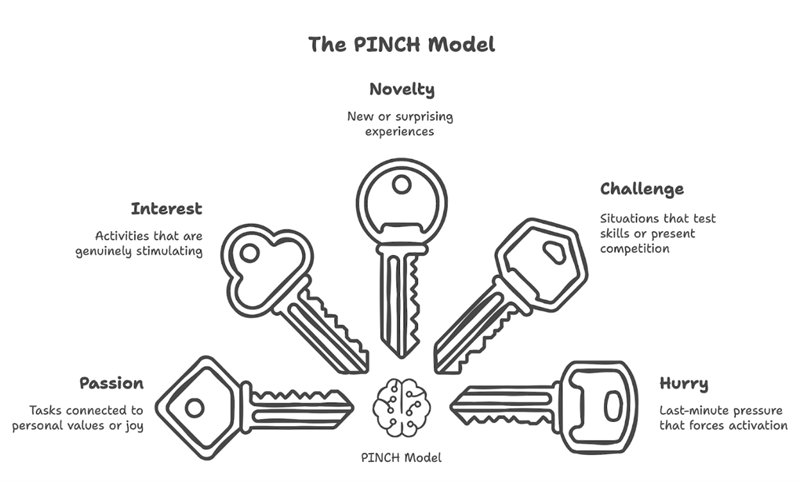
This explains why someone with ADHD can hyperfocus on a video game for hours but completely shut down in front of a to-do list. It’s not selective laziness, it’s how their brain is wired to find focus.
How to Identify Your PINCH Triggers
Understanding your own PINCH triggers helps you work with your brain, rather than fighting against it.
Step 1: Keep an Activation Journal
For one week, notice when you feel unusually focused, energized, or “in the zone.” Write down:
- What you were doing
- How you felt before starting
- What drew you in
- How much time passed before you lost focus
This helps you spot patterns you might miss in the moment.
Step 2: Reflect on Each PINCH Element
P – Passion
- Ask yourself: What activities light me up, even if they’re hard?
- Look for moments when you forget to check the time because you’re so engaged.
I – Interest
- Identify topics or activities you’re curious about for their own sake.
- Interest often shows up as “I just want to know more,” not necessarily “I have to.”
N – Novelty
- Notice when you’re drawn to something because it’s fresh, different, or surprising.
- Ask: When was the last time something new gave me an energy boost?
C – Challenge
- Think about times you became more engaged once there was a problem to solve or a skill to master.
- Challenges that feel like puzzles, not impossible walls, can spark motivation.
H – Hurry (Urgency)
- Track moments when a deadline or time pressure made you suddenly productive.
- Urgency can be a double-edged sword, use it strategically, not constantly.
Step 3: Spot Your Signature Triggers
Most people have 2–3 dominant PINCH triggers that show up repeatedly. For example:
- You might light up when there’s Novelty and Challenge, but deadlines just create anxiety.
- You might thrive on Passion and Hurry, finding you only start big tasks when the clock is ticking.
Step 4: Reverse-Engineer Tasks
Once you know your top triggers, you can hack your motivation:
- Add novelty to routine work (new location, different approach)
- Turn chores into a timed challenge
- Link boring tasks to something you care deeply about
- Create artificial deadlines to mimic urgency
Step 5: Practice Without Shame
Your triggers aren’t flaws, they’re part of your brain’s operating system. The more you learn to activate them intentionally, the less you’ll have to rely on last-minute panic to get things done.
At Coach For Mind, we help clients map their PINCH profile so they can stop forcing themselves into neurotypical productivity models, and start building a life that fits the way their brain actually works.
Time Blindness & Task Paralysis
People with ADHD often struggle with:
- Time blindness: Difficulty sensing how much time has passed or how long a task will take. This leads to underestimating deadlines or overcommitting.
- Task paralysis: Feeling stuck, even when you know what to do. The overwhelm of not knowing where to start can freeze the entire system.
These aren’t character flaws. They are neurological barriers that can’t be overcome with simple motivation.
What It Looks Like in Daily Life
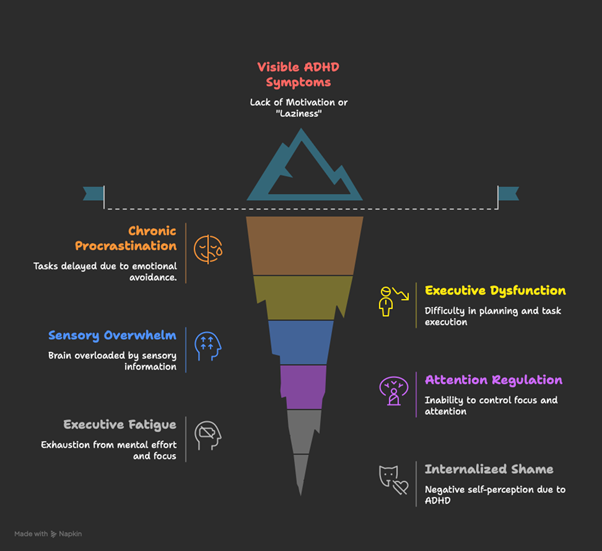
- Chronic Procrastination
Tasks are delayed, not because of apathy, but because of emotional avoidance, executive dysfunction, or sensory overwhelm. You may care deeply, talk about the task constantly, and still not be able to start.
- Inconsistent Performance
One day you're productive and focused, the next you're completely scattered. This inconsistency leads to confusion from others, and shame from within.
As Dr. Thomas E. Brown says: “ADHD is not a disorder of knowing what to do. It’s a disorder of doing what you know.”
- Disorganization
Piles, tabs, unfinished planners, not because you don't try, but because your brain struggles with sequencing, transitions, and spatial awareness.
- Distractibility & Zoning Out
Your mind drifts even when you want to focus. You apologize, you feel guilty, and yet it keeps happening. This isn’t indifference, it’s attention regulation dysfunction.
- Starting Everything, Finishing Little
You begin with excitement. Then it drops. You don’t finish, not from carelessness, but from executive fatigue and you blame yourself.
- Self-Blame & Shame
After years of being called lazy, careless, or “wasting potential,” many people with ADHD internalize these messages. They start to believe they’re defective.
Laziness doesn’t come with this kind of inner torment. ADHD often does.
So What Is the Difference?
|
Laziness |
ADHD |
|
Task avoidance by choice |
Task avoidance due to neurological inhibition |
|
Minimal distress about not acting |
High internal conflict, anxiety, guilt |
|
Temporary and situational |
Persistent, across settings and years |
|
Little to no effort made |
Often excessive effort tried, with inconsistent results |
|
Low self-blame Consistently low effort across different situations Avoids all difficult tasks, regardless of interest level Time-aware: Usually knows how long things take but chooses not to do them Measured response: Puts in just enough effort to get b Generally not distressed by their choice to avoid effort |
High self-blame, internalized shame Can be highly motivated but still unable to execute consistently Inconsistent performance: Great some days, terrible others Interest-driven: Can hyperfocus on engaging tasks while struggling with boring ones Time-blind: Difficulty estimating how long tasks will take All-or-nothing: Either completely absorbed or completely distracted Often develops anxiety or depression related to repeated "failures" |
As this reddit user summarised,
"Being lazy is having to do something but choosing not to. Having ADHD is desperately wanting to do something but not being able to."
The real question isn’t “Am I lazy?”
It’s: “What’s getting in the way of me doing what I want to do?”
At Coach For Mind, we help you unpack that question, not with judgment, but with curiosity and care. Together, we explore how your brain works, how to support it, and how to stop measuring your worth by your productivity.
You are not lazy. You are navigating an invisible barrier most people can’t see. With understanding, support, and the right tools, you can stop battling your brain and start working with it.
When to Consider Professional Help from a Trauma-Informed Therapist for ADHD therapy in India
Over time, these misunderstandings can create layers of emotional harm, humiliation at school, tension at home, workplace stress, which can lead to trauma responses. A trauma-informed therapist at Coach For Mind can address both the neurological aspects of ADHD and the psychological wounds that have built up over years of being misunderstood.
Why Trauma and ADHD Often Overlap
- Cultural stigma: Talking about mental health is still taboo in many families.
- Misinterpretation of symptoms: Forgetfulness or impulsivity is seen as “disrespect” or “carelessness.”
- Punitive environments: Children may grow up in schools or households where mistakes are met with shaming, physical punishment, or emotional withdrawal.
- Chronic stress: Navigating an ADHD brain in a culture that demands constant academic and social performance leads to burnout and hypervigilance.
These experiences can lead to complex trauma, a prolonged state of emotional strain that changes how you see yourself and relate to the world.
Signs You Might Need Trauma-Informed ADHD Support
- Persistent Emotional Distress
- You carry a constant sense of not being good enough.
- Harsh self-talk is your default: “I’m lazy,” “I’m stupid,” “I always mess up.”
- You feel anxiety or dread before starting tasks, especially those tied to judgment or evaluation.
- Everyday mistakes trigger panic or intense shame.
- Rejection Sensitive Dysphoria (RSD)
- Even mild criticism or neutral feedback feels devastating.
- You replay perceived rejections in your head for days.
- You avoid new opportunities because the possibility of failing feels unbearable.
- Your self-worth rises and falls entirely on how others respond to you.
- History of Repeated Negative Experiences
- You were frequently punished or humiliated at school for being “careless” or “lazy.”
- Family members compared you to “more disciplined” siblings or cousins.
- You experienced bullying, exclusion, or verbal abuse for being different.
- At work, colleagues or managers have labeled you “unreliable” despite effort.
- Burnout from Masking ADHD
- You’ve spent years hiding your struggles, keeping grades high, showing up early, double-checking everything, at the expense of your mental health.
- Outwardly, you appear successful; inwardly, you’re exhausted and disconnected.
- You fear letting people see your “real” self because you expect criticism or withdrawal.
- Interpersonal Strain
- Relationships feel draining because you are constantly managing how others perceive you.
- Cultural or family expectations (obedience, perfection, academic achievement) leave little room for neurodivergent needs.
- Friends, partners, or colleagues accuse you of being careless, uncommitted, or selfish.
- You avoid social settings where your symptoms might be noticed.
- Physical and Nervous System Symptoms
- Trouble sleeping due to racing thoughts or constant planning to avoid mistakes.
- Somatic tension (tight shoulders, jaw clenching, headaches) when facing deadlines.
- Sudden emotional overwhelm that feels like “too much all at once.”
- Physical restlessness that spikes when trying to sit still for long periods.
Why Choose a Trauma-Informed Approach for ADHD treatment for Adults in India
A trauma-informed therapist understands that:
- Your ADHD symptoms are not “bad habits” but neurological differences.
- Years of criticism and misunderstanding can create survival strategies that now look like anxiety, avoidance, or perfectionism.
- Cultural expectations (obedience, academic excellence, self-sacrifice) may have shaped your coping mechanisms and self-image.
This approach creates safety first, so you can explore both your ADHD and your emotional wounds without fear of judgment.
What You Can Expect in Trauma-Informed ADHD Therapy
- Validation: Recognizing that your struggles are real and rooted in brain wiring, not moral weakness.
- Unpacking your history: Exploring how school, family, and cultural norms have shaped your self-beliefs.
- Nervous system regulation: Learning grounding and calming techniques to manage overwhelm before tackling tasks.
- ADHD-friendly strategies: Breaking down goals, using interest-based motivation, and building routines that match how your brain works.
- Boundary setting: Learning to protect your mental health from people or situations that reinforce shame.
As this reddit user shared,
"Trauma Therapy helped me emotionally regulate, it's helped me desensitize experiences where I've felt rejected, decreased the amount of trauma responses I experience, it's helped me feel more confident with myself. I now have the tools to deal with things when my symptoms show up & overall has helped me so much. EMDR has been life changing for me. I also have done IFS which has also been incredibly helpful with accepting different parts of who I am. Trauma therapy is so tough but worth it. Would highly recommend."
Why This Matters Now
Without intervention, the combination of ADHD and unprocessed trauma can lead to:
- Chronic depression or anxiety
- Emotional exhaustion and burnout
- Damaged self-esteem and self-trust
- Avoidance of opportunities due to fear of failure
Professional help isn’t about “fixing” you, it’s about helping you understand your brain, heal from past wounds, and create a way of living that doesn’t require constant self-erasure.
At Coach For Mind, we believe ADHD Treatment for adults in India must be both neuroaffirming and culturally attuned. That means we address the unique mix of brain wiring, personal history, and social pressures you face, so you can stop surviving and start living authentically.
Why CoachForMind?
Experienced Psychologists: We are a team of licensed RCI-registered clinical psychologists. Our team is well-experienced in various forms of therapy such as CBT, DBT, EMDR, and Narrative Therapy.
Personalized Approach: We are dedicated to treating our clients in the best-suited way, including a specialist ADHD assessment for women, carefully curated as per the client's needs, and adhering to one-on-one, client-centered therapy.
Scientific Techniques: Our treatment plans and therapeutic methods are based on highly researched scientific findings such as CBT, DBT, IFS, EMDR and Narrative Therapy.
Quality service: We at CoachForMind ensure quality services in our treatment regime and therapeutic approaches. Our clients hold the most value to us, so we ground our techniques in empathy while maintaining professionalism.
Begin with a free 15-minute discovery call For more information, please visit our website or contact us directly at [email protected]
Written by the therapists at Coach For Mind
FAQs: Understanding ADHD
Addressing common questions about ADHD, its misconceptions, and how it affects daily life
The word "lazy" gets used a lot especially in Asian subcontinent, but it's usually more of a judgment than a real explanation. Laziness is rarely the root cause of someone "not doing things." More often, what gets labeled as laziness is actually a symptom of something deeper.
| Looks like laziness | Could actually be... |
|---|---|
| Not starting tasks | Executive dysfunction (e.g., ADHD) |
| Can't focus or finish | Anxiety, depression, burnout |
| No motivation | Sleep deprivation, low dopamine, trauma |
| Avoiding everything | Fear of failure or perfectionism |
| Constant procrastination | Overwhelm, lack of clarity, lack of support |
When someone isn't doing something we think they should be doing, it's easy to label them as lazy. However, at Coach For Mind, we've seen that what looks like laziness on the surface often has something much deeper underneath. It might be avoidance. It might be burnout. Sometimes it's fear of failure, or the heavy weight of depression.
For many people with ADHD, it's actually a struggle with executive functioning or day to day management, the cognitive skills needed to plan, start, and finish tasks. These aren't signs of laziness but signs that something psychological or neurological getting in our way.
So instead of asking, "Why am I being lazy?" it's often more helpful to ask, "What's making this feel so hard right now?" That question opens the door to understanding, compassion, and change, and that's where Coach for Mind therapist would start.
It can be hard to tell, because ADHD and trauma often overlap.
- ADHD is a neurodevelopmental condition present from childhood, affecting attention, executive function, and impulse control.
- Trauma results from distressing or overwhelming life experiences, creating long-lasting emotional and physiological effects.
If you have ADHD, years of criticism, rejection, or failure can lead to secondary trauma, feelings of shame, hypervigilance, and low self-worth. Conversely, trauma can mimic ADHD symptoms, such as distractibility or difficulty focusing.
At Coach For Mind, we help you untangle these experiences. We explore your life history, identify symptom patterns, and distinguish between what's driven by your brain's wiring and what's a response to past emotional pain. This clarity allows us to address both in a way that's practical, compassionate, and culturally attuned.
ADHD is still underdiagnosed in India for several reasons:
- Cultural stereotypes: Hyperactive boys are noticed, but inattentive girls are often seen as shy or dreamy, not as having a neurological difference.
- Academic masking: High-performing students hide ADHD symptoms by overcompensating with extreme effort, often at the cost of their mental health.
- Gender expectations: Women are often expected to be organized, emotionally available, and responsible, so their struggles are attributed to stress, hormones, or "poor time management."
- Lack of awareness among professionals: Many schools, workplaces, and even clinicians still see ADHD through a narrow childhood-focused, Western lens.
At Coach For Mind, we are deeply aware of these cultural blind spots. We use screening approaches and interview styles that look beyond stereotypes and dig into your lived experience, so you can be seen for who you are, not just how you appear.
Trauma therapy doesn't "cure" ADHD, but it can dramatically improve quality of life by addressing:
- Emotional wounds from years of criticism, misunderstanding, or punishment
- Rejection Sensitive Dysphoria (RSD) and the intense pain from perceived criticism
- Negative self-beliefs such as "I'm lazy" or "I'm not smart enough"
- Hypervigilance and anxiety that make task initiation even harder
At Coach For Mind, we blend trauma-informed care with ADHD-specific tools. This means we help you process emotional pain while also teaching strategies that work for your brain, like breaking tasks into micro-steps, using interest-based activation, and building supportive environments.
You might want to see a trauma-informed ADHD specialist if:
- You've experienced repeated humiliation, rejection, or emotional neglect related to your ADHD traits.
- You notice intense emotional reactions that feel "out of proportion" to small triggers.
- You've developed coping mechanisms like perfectionism, people-pleasing, or extreme avoidance that keep you stuck.
- Past therapy didn't help because it focused on discipline, willpower, or "just trying harder" instead of addressing both ADHD and trauma.
At Coach For Mind, we specialize in the intersection of ADHD and trauma. Our clinical Psychologist understand that discipline-only approaches often create more shame. We prioritize safety, understanding, and strategies tailored for neurodivergent brains.
Not necessarily. While medication can be very effective for many people with ADHD, especially when dopamine regulation is a major factor, it's not the only option. Trauma therapy can help with emotional regulation, self-esteem, and identifying environmental supports. Many people use a combined approach:
- Medication to improve attention and impulse control
- Therapy to heal emotional wounds, build resilience, and develop ADHD-friendly strategies
At Coach For Mind, we respect your preferences and comfort level. If you want to explore medication, we can guide you toward trusted psychiatrists in India. If you prefer a non-medication approach, we'll focus on therapy, coaching, and practical tools that align with your values and needs.
Laziness usually means you could do something, but you're choosing not to, maybe because you're tired, uninterested, or just don't feel like it. There's often a sense of ease in that decision.
ADHD is different. It's not about not wanting to do the task. It's about wanting to and still not being able to. The internal experience sounds more like, "I care about this. I know it matters. I even want to get it done but I just can't seem to start."
ADHD is not a lack of willpower. It's a difficulty with executive function, the part of the brain that helps with organizing, prioritizing, starting, and following through. For someone with ADHD, it's not a matter of trying harder, it's about understanding how can we work through it.
At Coach For Mind, we help clients understand this difference and unlearn the shame that often comes from being mislabeled as lazy. Once we move past blame, we can start building real toolkit that would actually work for you.
Always remember with ADHD, it is not a choice, it's brain wiring.


