TL;DR
- The 2026 data is a diagnostic, not a warning: 61% of HR leaders saw mental health leaves increase in the past year. Nearly 1 in 6 organisations reported a spike of 25% or more. 89% of HR leaders believe their benefits provide competitive advantage. Only 9% can show they are reducing health plan spend. The gap between belief and evidence is the crisis.
- Legacy EAPs are not failing at the margins — they are failing structurally: A 4% average utilisation rate means 96% of employees are not accessing support until they reach crisis. At that point, a limited-session model is inadequate for the presentations that HR leaders are now seeing: complex trauma, substance use, eating disorders, AI-induced occupational anxiety.
- The manager is the most underused clinical lever in the organisation: Managers influence employee mental health as significantly as a spouse — yet the 2026 data shows that 34% of employees don't know whether their organisation even provides mental health support. That is a communication failure, and it sits at the manager layer.
- The Active Bridge model is specific and trainable: It is not sensitivity training. It is a defined set of competencies — early distress recognition, psychologically safe dialogue, resource navigation, and adaptive workflow — that moves managers from passive observers to active connectors.
- Precision prevention changes the model from reactive to proactive: By identifying leading indicators — sleep disruption, financial stress, AI anxiety — before they become leave events, organisations can intervene at a fraction of the cost of a mental health leave of absence.
- The 90-day roadmap gives you a structure for action: Diagnose risk (Days 1–30). Remove barriers to care (Days 31–60). Build a CFO-ready scorecard (Days 61–90).
Introduction: The Gap Between Investment and Impact
Every year, organisations invest more in employee mental health benefits. Yet each year, many HR teams are still seeing rising burnout, more mental health leave, and employees who need support but never reach it.
The 2026 Workplace Mental Health Report makes this gap hard to ignore. Based on responses from more than 2,000 HR leaders and employees across five countries, including India, the findings are striking: 61% of HR leaders reported an increase in mental health-related leave in the past year. Nearly 1 in 6 organisations saw that increase rise beyond 25%. At the same time, 89% believed their mental health benefits gave them a competitive advantage, while only 9% could show measurable reduction in healthcare spending.
That contrast matters. It suggests the challenge is not simply about budget or intention. It is about design.
Many workplace mental health systems were built for an older model of distress: visible crises, self-referrals, and short-term intervention. But the reality of today’s workforce often looks different. Distress may be quieter, slower, and easier to miss. Employees may still be attending meetings, meeting deadlines, and appearing “fine” while struggling internally.
We often see this clinically. By the time someone reaches therapy, the issue is rarely “sudden burnout.” More often, it is months of accumulated stress, poor sleep, emotional exhaustion, and feeling unable to ask for help until functioning begins to break down.
This article is for HR leaders and people managers who can sense that gap already - in the data, in rising leave rates, or in one-on-ones where something feels off but remains unspoken. The goal is to offer a practical and psychologically informed framework for closing it.
Part One: Understanding What You Are Actually Dealing With
Silent Burnout: The Struggle Legacy Systems Often Miss
The workplace mental health crisis is not always dramatic. It often shows up as what many now call silent burnout.
Silent burnout happens when an employee continues to function on the outside while internally feeling depleted, disconnected, and emotionally overextended. They are still logging in. Still replying. Still delivering. But motivation, resilience, and a sense of meaning may be steadily eroding
This is where many traditional support systems fail. If support depends on employees openly identifying distress, requesting help, or reaching a breaking point first, a large group of struggling employees remain invisible.
Many burned-out employees fall into the category of presenteeism: physically present, psychologically drained. They may stop contributing ideas, withdraw socially, become more reactive, or do only what is necessary to get through the day. Productivity may continue for a while, but wellbeing is already declining.
In therapy, this often sounds like:
“Nothing is wrong exactly… I’m just tired all the time.”
“I’m doing everything I’m supposed to do, but I feel numb.”
“I don’t know why I’m crying on Sundays.”
These are not minor complaints. They are often early signs of nervous system overload and chronic stress. In India, silent burnout can be even harder to identify. Many professionals grow up equating competence with endurance. In high-pressure sectors such as tech, consulting, startups, and corporate services, exhaustion can become normalised. Add AI-related job insecurity, long work hours, and constant availability culture, and many employees learn to keep performing while quietly struggling.
Strategic implication: If your organisation's early warning system depends on employees self-reporting or voluntarily accessing support, it cannot see the 30% of your workforce that is currently most at risk. The architecture of detection must change.
The Leading Indicators: What to Notice Before Crisis
A more effective approach is prevention. That means identifying early warning signs before burnout turns into extended leave, disengagement, or attrition.
- Sleep Disruption
Sleep problems are often one of the earliest indicators of stress overload. Difficulty falling asleep, waking frequently, unrestful sleep, or feeling tired despite rest can all signal that the body is staying in a heightened stress state.
In therapy, sleep is rarely “just a sleep issue.” It is often connected to anxiety, unresolved pressure, rumination, or emotional fatigue. When organisations pay attention early, support can begin before performance drops.
At Coach For Mind, employees presenting with sleep concerns are often supported through stress assessment, CBT-based tools for rumination, nervous system regulation work, and deeper exploration of the pressures keeping the mind switched on.
- Financial Stress
Financial pressure is one of the most consistent predictors of emotional distress. When employees are worried about debt, family responsibilities, rising costs, or instability, their nervous system may remain in a chronic state of threat.
This can show up as irritability, reduced concentration, shame, avoidance, or burnout that appears “performance-related” but is rooted elsewhere. Mental health and financial wellbeing are not separate lanes. They regularly interact.
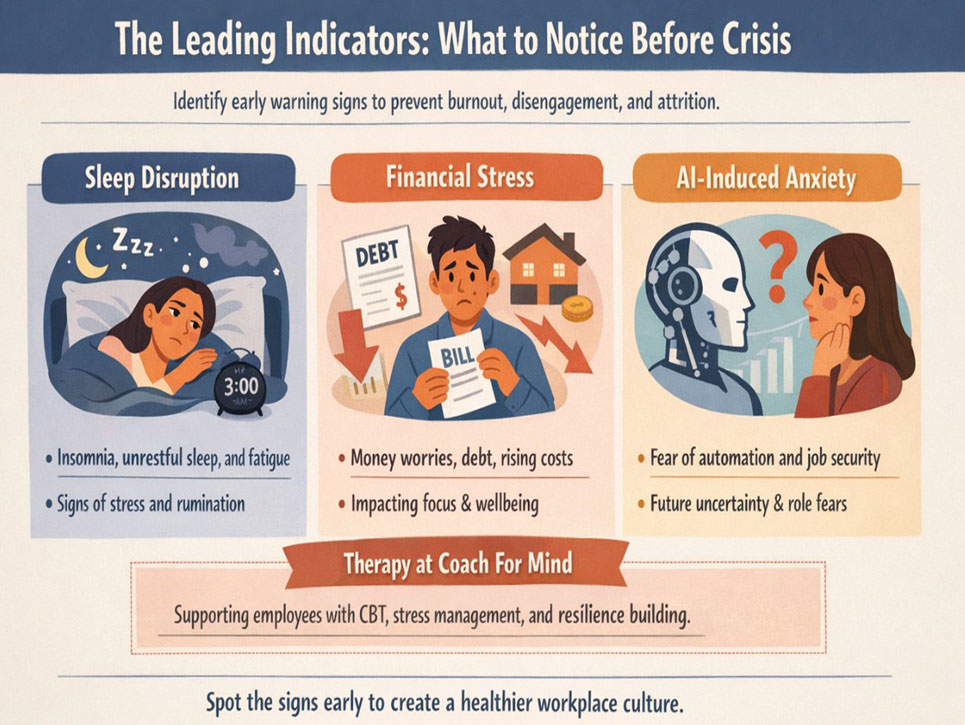
- AI-Induced Occupational Anxiety
A growing workplace stressor is fear around automation, redundancy, and changing skill demands. Even when no immediate job loss exists, uncertainty alone can create persistent anxiety.
We increasingly hear concerns like: “Will my role exist in two years?” or “I’m working hard but still feel replaceable.”
This type of anticipatory stress can quietly drain energy and confidence over time. Generic reassurance rarely helps. What helps more is clear organisational communication, role clarity, opportunities for upskilling, and access to psychological support that addresses the anxiety beneath the surface.
When organisations learn to notice these leading indicators early, they move from reacting to crises toward building a healthier and more sustainable workplace culture.
Part Two: Why the Legacy EAP Model Often Falls Short
4% Utilisation Is a System Problem, Not an Employee Problem
The traditional Employee Assistance Programme (EAP) was largely built as a crisis support model. It works best when an employee already knows they need help, is ready to seek it, and has enough emotional bandwidth to navigate the process. But many employees experiencing burnout are not in that position.
They may be exhausted, mentally overloaded, unsure whether their struggle is “serious enough,” or hesitant about confidentiality. In that state, even small barriers can become reasons not to seek support. This helps explain why low utilisation matters. If only a small percentage of employees use the support available, it does not automatically mean people are doing well. It may mean the pathway to care is too difficult, too unclear, or too disconnected from how distress actually shows up at work.
When support systems rely on employees reaching out only after distress becomes visible, many people get help late, after burnout deepens, functioning drops, or leave becomes necessary.
When the Need Is More Complex Than the Model
Today’s workplace mental health concerns are also more layered than many older EAP systems were designed for. Employees may be navigating trauma histories, grief, substance use, eating concerns, identity stress, family strain, chronic anxiety, or AI-related job insecurity. These experiences often need more than a few generic sessions. They may require continuity, specialised care, and a therapist who can understand the wider context of the person’s life.
At Coach For Mind, we often support employees who first arrive thinking they have a “work stress issue,” only to discover the stress is interacting with unresolved perfectionism, caregiving pressure, relationship strain, or long-standing anxiety patterns. That is where deeper, evidence-based therapy can make the difference. If you are struggling with any of these concerns and do not know where to start, click here to book your free discovery call today.
Why ROI Stays Hard to Prove: Many organisations want measurable returns from mental health investment. That is a fair and important goal. But if the model is underused, hard to access, or mismatched to employee needs, results will naturally be difficult to demonstrate. Low ROI is not always a sign that wellbeing does not matter. Often, it is a sign that the current support structure is not built for real-world uptake or meaningful recovery.
The Awareness Gap: A Communication Problem at the Manager Layer
Even the best support system cannot help employees who do not know it exists. One of the clearest findings in the 2026 data is the gap between manager awareness and employee awareness. Managers were significantly more likely to know about available benefits and use them. Non-managers were far less informed, and many were unsure whether any support existed at all. This matters because managers are often the closest link between policy and lived experience.
Employees usually do not experience workplace wellbeing through policy documents. They experience it through their day-to-day manager:
- whether wellbeing can be discussed safely
- whether boundaries are respected
- whether support resources are mentioned early
- whether asking for help feels normal or risky
A benefit hidden in a portal or mentioned once during onboarding is easy to miss. A manager who says, “You don’t have to wait till things get worse: support is available, and I can help you access it,” can completely change whether someone reaches out. We have seen employees begin therapy only because one manager normalised it in a check-in conversation. Sometimes that single moment of permission is what turns awareness into action.
The Opportunity for HR Leaders
The good news is that communication gaps are solvable. Unlike large structural overhauls, awareness can improve quickly through:
- manager training
- repeated benefit communication
- easy booking pathways
- visible leadership endorsement
- regular reminders during high-stress periods
- psychologically safe team cultures
In many organisations, this is one of the fastest and highest-impact places to start.
Part Three: The Active Bridge Model
What an Active Bridge Is — and Is Not
One of the strongest recommendations from the 2026 report is this: managers should not be expected to become therapists, but they can become powerful bridges to support. An Active Bridge is a manager who knows how to notice early signs of distress, open safe conversations, and guide employees toward the right professional help.
That distinction is important.
Managers are not responsible for diagnosing mental health conditions, offering therapy, or carrying the emotional weight of solving personal problems. Their role is not treatment. Their role is connection.
Many organisations struggle because manager training tends to fall into one of two extremes:
- Too vague: generic messages like “be empathetic” or “check in more” without practical skills
- Too blurred: training that accidentally makes managers feel responsible for counselling employees
The Active Bridge model avoids both. It gives managers clear boundaries and useful tools.
A simple sentence like, “I’ve noticed you’ve seemed quieter lately, how are things going?” can be more meaningful than it appears. Clinically, moments like this can create a sense of safety. When people feel genuinely noticed rather than evaluated, they are often more able to speak honestly.
We see this often in therapy. Many employees say they delayed seeking support for months, but one respectful conversation at work helped them realise they did not need to carry it alone.
The Four Core Competencies
- Recognising early distress: Burnout and emotional strain often appear first through behaviour, not formal disclosure. Managers can be trained to notice patterns such as:
- withdrawal from team conversations
- irritability or sharper tone in communication
- missed details or unusual dips in quality
- lower participation in meetings
- visible fatigue or disengagement
These signals are easy to miss when performance metrics are the only lens being used. At Coach For Mind, we often help leaders differentiate between a temporary rough week and signs of sustained distress that need attention.
- Psychologically safe dialogue: Noticing is only step one. The next skill is knowing how to ask. Employees are more likely to open up when conversations feel supportive rather than investigative. That means:
- asking open-ended questions
- staying curious instead of assuming
- listening without rushing to fix
- separating wellbeing conversations from performance reviews
- reassuring confidentiality within professional limits
For example:
Less helpful: “Are you burned out?”
More helpful: “You seem stretched lately. How have things been for you?”
The second approach invites reflection instead of defensiveness. This matters because many employees fear being seen as weak, unreliable, or “not coping.” A psychologically safe conversation reduces that fear.
- Resource navigation: The ability to provide a specific, named, trusted pathway to support — not a vague reference to 'HR' or 'the EAP.' A manager who can say 'there is a 15-minute discovery call available through our benefits, here is the direct link, and I have used it myself' is providing something categorically different from a manager who says 'you should talk to someone.'
- Adaptive workflow: The practical authority to reduce the structural load contributing to the burnout: adjusting deadlines, redistributing tasks, establishing explicit norms around after-hours communication, and protecting recovery time. Many managers have this authority and do not use it proactively because the organisational culture has not given them permission to treat these as legitimate mental health interventions.
The active bridge model requires organisational permission, not just individual skill. A manager who has been trained in psychologically safe dialogue but whose own manager rewards 24/7 availability and penalises boundary-setting cannot implement what they have been trained to do. The cultural context must support the individual competency.
Part Four: Precision Prevention — The Next Model
From Reactive Crisis to Proactive Detection
Traditional systems often respond once someone is already struggling significantly. Precision prevention shifts the focus earlier. The idea is simple: notice risk before it becomes a crisis, then match support to the level of need. That may include:
- early wellbeing check-ins
- pulse surveys focused on burnout indicators
- engagement trend monitoring
- workload mapping
- confidential access to therapy or coaching
- manager observations followed by supportive outreach
The goal is not to over-monitor employees. It is to reduce the number of people who suffer silently until collapse. When done ethically, with transparency and consent, data can highlight patterns. Human relationships then turn those insights into care. Technology may show where pressure is building. A trusted manager helps someone feel safe enough to use support. Both matter.
The 90-Day Roadmap: From Belief to Action
The 2026 report provides a structured implementation framework for HR leaders who need to translate strategic intent into organisational action:
Days 1–30: Diagnose where risk is concentrated. In the first 30 days, the focus is on understanding where the biggest risks lie. This can include running anonymous surveys to assess burnout, reviewing leave trends, checking who knows about available benefits, and identifying teams carrying unsustainable workloads.
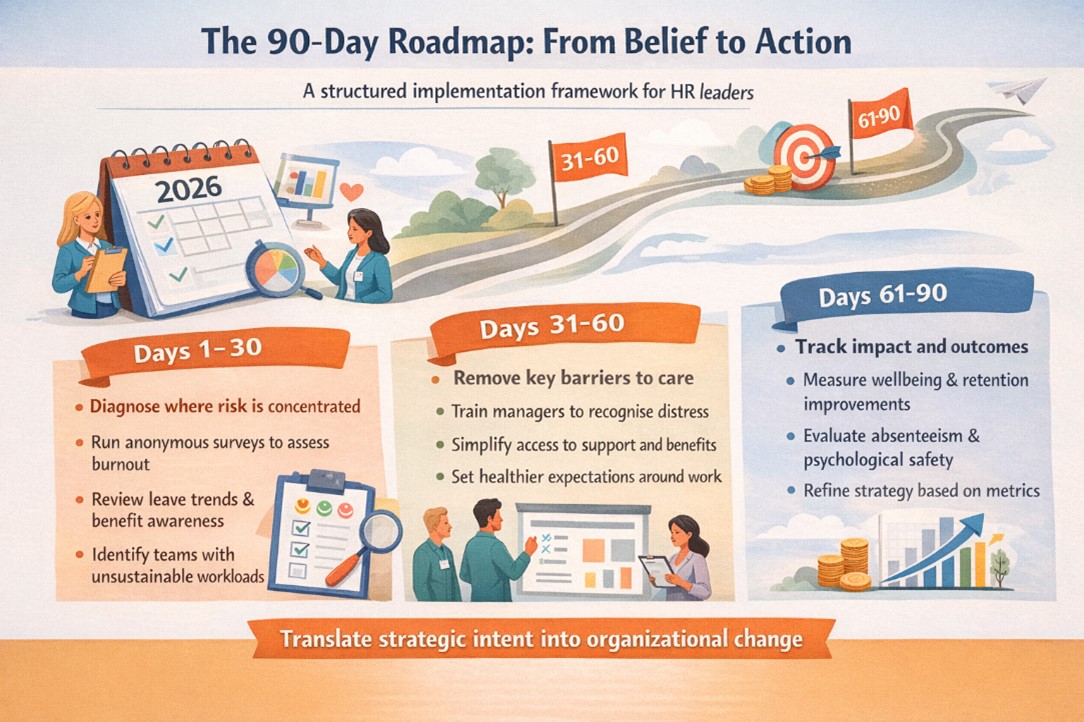
Days 31–60: Remove key barriers to care: In this phase, the priority shifts to making support easier to access. This may involve training managers to recognise distress and guide employees to help, simplifying benefit access, improving return-to-work plans after leave, and setting healthier expectations around workload, boundaries, and AI-related changes at work.
Days 61–90: Organisations can begin measuring impact more clearly. The strongest mental health strategies track not just usage, but outcomes such as improvement in employee wellbeing, lower absenteeism, better retention, reduced costs, and stronger psychological safety. When measured well, mental health support becomes more than a benefit. It becomes a strategic business investment.
Part Five: India-Specific Implementation Considerations
The 2026 report’s India findings deserve special attention because workplace mental health does not exist in a cultural vacuum. Many existing models come from Western corporate settings, but what works in one context may need adaptation in another.
In India, one of the biggest shifts needed is the normalisation of help-seeking. In many workplaces, professionalism is still associated with being composed, available, and able to “handle it.” Mental health support may still carry stigma, or be seen as something only for severe problems. Because of this, organisations need more than training programmes. They need cultural permission.
That means employees should hear and feel a clear message from leadership: seeking support is a sign of responsibility and self-awareness, not weakness. This message is strongest when leaders model it themselves. Not through performative awareness posts, but through everyday behaviour: ] taking time off when needed, respecting boundaries, speaking honestly about wellbeing, and not expecting 24/7 availability on calls or WhatsApp.
The data suggests many Indian organisations already recognise the importance of wellbeing. The challenge is often execution. Policies may exist, but employees still do not feel safe using them. This is why psychological safety matters so deeply. When employees trust that asking for help will not damage their reputation, growth, or job security, support becomes usable. At Coach For Mind, we often see that once workplaces create genuine safety, employees engage with therapy earlier, communicate more openly, and recover more sustainably.
Alongside performance metrics, consider tracking psychological safety scores across teams. This helps organisations measure whether people feel safe to speak up, ask for support, admit mistakes, and set boundaries. What gets measured gets prioritised. And what gets prioritised is far more likely to shape culture than awareness campaigns alone.
Partnering With Coach For Mind
Coach For Mind works with organisations across India to support the implementation of evidence-based workplace mental health strategy — including clinical assessment services, active bridge manager training support, and individual therapy for employees navigating burnout, AI anxiety, and the specific pressures of India's high-performance corporate culture.
We provide RCI-registered clinical psychology services with genuine cultural fluency for the Indian corporate context — not a Western model applied without adaptation, but a clinically rigorous and contextually appropriate approach to the workforce mental health presentations the 2026 data describes.
Online across India and internationally. In-person in Gurgaon.
www.coachformind.com | [email protected]
RCI-registered clinical psychologists. Evidence-based. India-contextualised.
References
2026 Workplace Mental Health Report. Released April 9, 2026. Survey of 2,000+ HR leaders and full-time employees across the US, Canada, Mexico, India, and UK.
Maslach, C., Schaufeli, W.B., & Leiter, M.P. (2001). Job burnout. Annual Review of Psychology, 52, 397–422.
London School of Economics and Political Science. Return on investment in mental health at work. LSE Research Online.
World Health Organization. (2022). World Mental Health Report: Transforming Mental Health for All.
Deloitte. (2022). Mental Health and Employers: The Case for Investment. Deloitte Insights.
This article is for HR and organisational leadership reference. Individual clinical decisions should involve qualified mental health professionals.
Frequently Asked Questions
It is completely valid that leadership teams, especially CFOs, need to see clear value before increasing investment in mental health. What often gets missed is that low utilisation and rising leave are not signs that support is unnecessary, but that the current system is not reaching people early enough.
Psychologically, distress that goes unaddressed tends to compound, what begins as manageable stress can develop into burnout, disengagement, or extended leave, all of which carry significantly higher organisational cost. When organisations shift focus from cost of investment to cost of inaction including presenteeism, attrition, and productivity loss, the picture becomes clearer.
At Coach For Mind, we support organisations in building this case through measurable indicators: early intervention rates, symptom improvement, reduced escalation to leave, and manager-led referrals, alongside clinical outcome tracking that connects directly to business metrics.
Many organisations share this concern, and it reflects a responsible approach to employee wellbeing. The hesitation often comes from a misunderstanding that mental health training requires managers to take on therapeutic roles. In reality, the opposite is true. From a psychological standpoint, the biggest risk is not over-involvement, but silence or avoidance when distress is visible.
The Active Bridge model is specifically designed to clarify boundaries: managers are not diagnosing or counselling, they are recognising patterns, opening safe conversations, and guiding employees toward professional support.
At Coach For Mind, our training explicitly reinforces these limits while building confidence in what managers can do safely and effectively. This reduces ambiguity, protects both employee and manager, and increases early access to appropriate care.
If you are feeling that “precision prevention” sounds complex or resource-heavy, that is a common and understandable reaction. In practice, it does not require advanced technology to begin with. Psychologically, early intervention is most effective when it is simple, visible, and human. For most Indian organisations, this starts with three accessible layers: short, targeted pulse surveys that measure burnout indicators (not just engagement), manager training in early distress recognition and conversation, and a clear, low-friction pathway to confidential clinical support. Over time, patterns from these touchpoints help identify where pressure is building.
At Coach For Mind, we help organisations implement this in a phased way, starting with manager capability and access pathways, then gradually strengthening measurement and outcome tracking as the system matures.
It makes sense that organisations may feel uncertain about how to respond to AI-related anxiety, because it is often less visible than traditional stressors. Employees may not openly express fear about redundancy or changing skill relevance, but internally this can create persistent unease.
Psychologically, this is a form of anticipatory anxiety, the mind trying to prepare for a threat that is not fully defined. Without support, it can lead to rumination, reduced confidence, and burnout. Addressing this requires both structural clarity and emotional support. Clear communication about role evolution, reskilling pathways, and organisational direction reduces uncertainty, while access to therapy helps employees process the underlying anxiety.
At Coach For Mind, we work with individuals experiencing AI-related stress by addressing cognitive patterns (such as catastrophising), building tolerance for uncertainty, and restoring a sense of agency in career progression.
It is a very common and often frustrating experience for HR leaders to see low utilisation despite investing in benefits. This does not mean employees do not need support. Psychologically, people are least likely to seek help when they are already overwhelmed, unsure if their struggle is “serious enough,” or concerned about stigma and confidentiality.
Even small barriers, unclear access, impersonal systems, or lack of awareness — can prevent action. The data showing that many employees are unaware of available benefits highlights that this is often a system design and communication issue, not an employee motivation issue.
At Coach For Mind, we address this by simplifying access (for example, direct booking pathways), supporting manager-led referrals, and normalising help-seeking through repeated, psychologically safe communication.
It is completely valid to feel that burnout is difficult to detect when employees are still meeting deadlines and showing up to work. In reality, burnout often develops beneath the surface before it becomes visible in performance metrics. Psychologically, early signs tend to show up in behaviour and experience rather than output: reduced engagement, emotional withdrawal, irritability, decision fatigue, or persistent tiredness. These signals are easy to miss in high-performance environments where output is prioritised. This is why manager observation and regular check-ins are critical.
At Coach For Mind, we train managers to recognise these early patterns and support organisations in integrating simple screening tools that identify risk before it escalates into leave or attrition.
This is a very real and context-specific challenge, and it is important to acknowledge that stigma does not disappear through policy alone. In many Indian workplaces, employees have learned that professionalism means endurance and emotional control, which can make help-seeking feel risky. Psychologically, safety is not created through messaging alone, but through consistent experience over time. Employees need to see that speaking up does not lead to negative consequences. This includes how managers respond in one-on-ones, how leaders model boundaries, and whether people who seek support continue to be trusted and supported in their roles.
At Coach For Mind, we work with organisations to build this at multiple levels — leadership alignment, manager behaviour, and employee access to confidential, high-quality therapy — so that the system reinforces safety, not just communicates it.
It is understandable for managers to feel unsure about where their responsibility begins and ends. Many worry about saying the wrong thing or overstepping. Psychologically, however, one of the most protective factors for employee wellbeing at work is simply being noticed and supported early. Managers are not expected to solve mental health concerns, but they are often the first point of contact when something feels off. Their role is to recognise change, initiate a respectful conversation, and connect the employee to appropriate support. At Coach For Mind, we frame this as a contained and trainable role — one that increases early intervention without placing emotional or clinical burden on the manager.
It is completely reasonable to want clear evidence of impact, especially when resources are being allocated. One of the challenges is that traditional metrics like utilisation alone do not capture effectiveness. Psychologically, what matters is not just whether employees access support, but whether that support leads to meaningful improvement.
A more complete measurement approach includes leading indicators (awareness, early access, manager referrals), clinical outcomes (symptom reduction, improved functioning), and organisational outcomes (reduced absenteeism, improved retention, lower escalation to crisis).
At Coach For Mind, we help organisations build these multi-layered scorecards so that mental health strategy can be evaluated with the same rigour as other business investments.