TL;DR
- Not All Manipulation Is Narcissistic Abuse — and the Distinction Matters Clinically: Emotional manipulation is a broad category found across many personality profiles. Narcissistic abuse is a specific, patterned form rooted in the psychology of NPD, with a distinct cycle, a distinct mechanism, and a distinct impact on the victim's sense of reality.
- The Core Difference Is the Underlying Psychology, Not Just the Tactics: Both involve gaslighting, guilt-tripping, and control. What distinguishes narcissistic abuse is the specific dynamic: an insatiable need for admiration, absent genuine empathy, and a relational cycle of idealisation, devaluation, and discard.
- Narcissistic Abuse Is Chronically Underrecognised — Including in Healthcare: Research found that narcissistic abuse is a 'lesser known concept' not commonly recognised in healthcare settings, leaving many survivors without validation or appropriate support for years.
- Emotional Dependence Significantly Raises the Risk: Research on the 'Echo and Narcissus Syndrome' found that narcissistic traits mediated 38.44% of the link between emotional dependence and psychological abuse in relationships.
- Intent Does Not Negate Impact: Whether the manipulation is conscious and calculated or a reactive, dysregulated response to perceived threat, the psychological damage is real and requires the same quality of clinical attention.
- Recovery Pathways Differ: Healing from narcissistic abuse involves specific challenges — trauma bonding, identity erosion, severely disrupted reality — that require trauma-informed, specialist therapeutic support.
- Coach For Mind Offers Trauma-Informed Support for Both: Assessment of relational trauma, individual therapy, EMDR, somatic approaches, and a non-judgmental clinical space for survivors to rebuild self-trust.
Introduction: The Confusion That Causes Harm
If you have ever left a conversation feeling inexplicably bad about yourself, with a lingering sense that something was not right, but without the words to explain it, you are describing the disorientation that psychological manipulation creates. The experience itself is real. The difficulty of naming it is real too.
Over the past few years, the internet has given many people a language for these experiences, terms like gaslighting, love bombing, discard, and flying monkeys. For many survivors, this has been genuinely helpful. Being able to name something that once felt confusing or invisible is often the first step toward making sense of it.
But this growing vocabulary has also created a clinical challenge: not all harmful or controlling behaviour is narcissistic abuse. When everything is labelled as narcissism, important differences get blurred. This matters for two reasons. First, narcissistic abuse follows a specific pattern: with its own psychological structure and a distinct impact on the person experiencing it. Second, when all forms of manipulation are grouped together, it can prevent people from accessing the kind of support that actually fits their situation.
In our work at Coach For Mind, we often meet clients who come in asking, “Was this narcissistic abuse?” What they are really asking is, “Was what I experienced real, and does it make sense that it affected me this way?” Clarifying the distinction is not about invalidating anyone’s experience, it is about understanding it accurately enough to begin healing.
This article offers a clinically grounded comparison of emotional manipulation and narcissistic abuse, not to defend harmful behaviour, but to create clarity. Because recovery becomes much more possible when what you are dealing with is clearly understood.
Part One: What Is Emotional Manipulation?
The Broad Category
Emotional manipulation refers to a pattern of behaviour where one person uses psychological strategies, rather than open, direct communication, to influence or control another person’s thoughts, feelings, or actions. It exists on a spectrum.
At one end are behaviours that many people may recognise in themselves at times, avoiding direct conversations, using guilt, or withdrawing emotionally when upset. These are not healthy patterns, but they do fall within the range of imperfect human communication.
At the other end, emotional manipulation becomes more consistent and harmful — a repeated way of relating that leaves the other person feeling confused, pressured, or emotionally drained. In therapy, this distinction is important. Not every instance of manipulation reflects a fixed personality pattern, but when it becomes repeated and impactful, it needs to be understood and addressed.
Common Tactics of Emotional Manipulation
Emotional manipulation can take different forms, but certain patterns tend to show up repeatedly:
Guilt-tripping: Using the other person's sense of responsibility or care to generate compliance. 'After everything I've done for you, this is how you treat me.' The goal is to activate the other person's empathy and direct it toward the manipulator's agenda.
Gaslighting: Causing the other person to doubt their own perceptions, memory, or sanity. 'That never happened.' 'You're imagining things.' 'You're too sensitive.' Gaslighting specifically attacks the person's ability to trust themselves, which is the foundation of every capacity for self-protection.
Silent treatment: Withdrawing communication as a form of punishment or control, used not to create genuine space for reflection but to generate anxiety and produce compliance.
Moving the goalposts: Changing expectations in ways that make it difficult for the other person to ever feel “enough.”
DARVO (Deny, Attack, Reverse Victim and Offender): When confronted, the person denies the behaviour, attacks the other, and positions themselves as the victim
Emotional blackmail: Using the other person's fear, obligation, or guilt to prevent boundary-setting. 'If you really loved me, you wouldn't do this.' 'If you leave, I don't know what I'll do.'
In our work at Coach For Mind, clients often describe recognising these patterns only in hindsight. At the moment, they tend to feel like isolated incidents rather than part of a broader dynamic. One client that I worked with shared that she would leave arguments feeling like she had done something wrong, even when she could not identify what. Over time, we traced this back to repeated shifts in expectations and subtle blame that had gradually shaped how she interpreted interactions.
Who Uses Emotional Manipulation — and Why
One of the most important clarifications is emotional manipulation is not limited to people with Narcissistic Personality Disorder. It can appear in individuals with:
- anxiety
- insecure attachment styles
- emotional immaturity
- unresolved trauma
- borderline personality features
- or simply learned relational patterns from family environments
Many people who use manipulative behaviours are not acting with calculated intent. Often, these patterns develop because direct communication feels unsafe or unfamiliar, and manipulation becomes a way to manage discomfort or maintain connection. This does not make the behaviour acceptable and it does not reduce its impact. But it does change how we understand it.
In therapy at Coach For Mind, this distinction becomes important because it shapes the direction of treatment. Some patterns are situational and can shift with awareness and relational work. Others are more deeply embedded and require a different level of intervention.
Part Two: What Is Narcissistic Abuse?
The Specific Pattern
Narcissistic abuse is a distinct and identifiable pattern of psychological, emotional, and sometimes physical or financial harm, typically associated with individuals who have significant narcissistic traits or Narcissistic Personality Disorder (NPD). It is not simply a more intense version of emotional manipulation. It follows a particular internal logic, unfolds in a recognisable cycle, and has a specific impact on the person experiencing it.
The DSM-5 describes NPD as a pervasive pattern of grandiosity (in thought or behaviour), a strong need for admiration, and a lack of empathy, beginning in early adulthood and present across different areas of life. Other common features include a sense of entitlement, a tendency to exploit relationships, and patterns of arrogance or superiority.
Clinically, narcissism tends to present in two broad forms.
- Grandiose narcissism is the more visible presentation, marked by overt confidence, entitlement, self-importance, and a need to be seen as superior.
- Vulnerable narcissism is less obvious but equally significant. It is characterised by fragile self-esteem, heightened sensitivity to criticism, and a pattern of shifting between feelings of superiority and deep insecurity or shame. Research suggests that this form is often linked to early experiences of emotional neglect or inconsistent caregiving, which shape how self-worth and emotional regulation develop.
In practice, both presentations can give rise to similar relational patterns, especially in close, emotionally dependent relationships. To continue reading about what narcissistic abuse is, click here.
The Narcissistic Abuse Cycle
What most clearly distinguishes narcissistic abuse from general emotional manipulation is not just the behaviours involved, but the presence of a recurring relational cycle.
Idealisation (Love Bombing): The relationship often begins with an intensity that feels unusually strong. There may be constant attention, deep emotional connection, and a sense of being uniquely understood or chosen. For many people, this phase feels meaningful and rare, which is precisely what creates the attachment.
In therapy, clients often describe this stage as the “real” relationship, something they continue trying to return to long after it has shifted.
Devaluation: As the relationship stabilises, the dynamic begins to change. The same qualities that were once appreciated may become sources of criticism. Subtle invalidation can turn into more direct blame, withdrawal, or control. Manipulative behaviours such as gaslighting, DARVO, and silent treatment often become more frequent.
One client I worked with described this shift as “walking on eggshells without knowing when the rules changed.” What made it particularly disorienting was not just the criticism, but how unpredictable it felt.
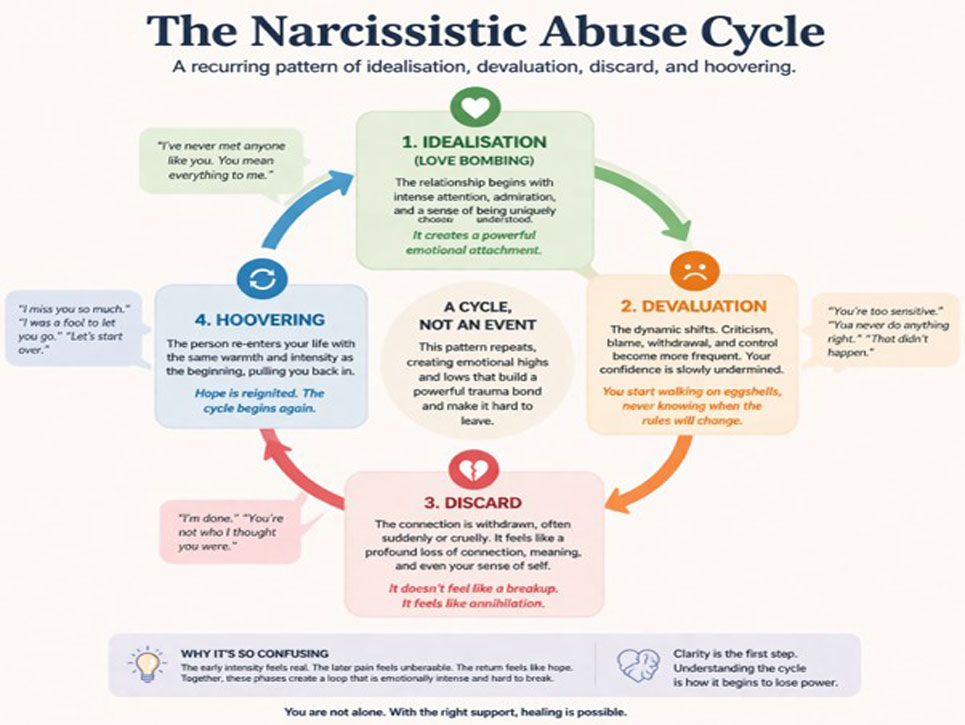
Discard: The relationship may then be withdrawn: sometimes abruptly, sometimes gradually, but often in a way that feels emotionally destabilising. This phase is not experienced as a typical breakup. It can feel like a sudden loss of meaning, connection, and identity within the relationship.
Hoovering: In many cases, the cycle does not end with the discard. The person may re-enter the relationship, often using the same warmth and intensity seen in the beginning. This re-engagement can reignite hope and reinforce attachment, making it harder to fully disengage.
This repeating cycle is central to understanding narcissistic abuse. It is not a one-time pattern — it tends to recur, creating a loop that is both emotionally intense and difficult to exit.
The Role of Empathy — or Its Absence
A key feature that distinguishes narcissistic abuse from other forms of manipulation is the nature of empathy in NPD. Many individuals with narcissistic traits have intact cognitive empathy; they can understand what another person is feeling at an intellectual level. What is often limited or impaired is affective empathy, the ability to emotionally resonate with another person’s experience.
In practical terms, this means that a person may recognise that their behaviour is hurtful, but that recognition does not necessarily lead to restraint or change. The emotional impact on the other person does not function as a consistent internal boundary. This is often one of the most confusing aspects for those on the receiving end. The person may seem aware at times, even apologetic, yet the pattern continues.
At Coach For Mind, we often help clients make sense of this distinction, because it shifts an important question. Instead of asking, “Why don’t they understand how much this hurts me?” the question becomes, “What does it mean if understanding is not enough to change the behaviour?”
That shift is often where clarity begins.
Part Three: The Core Differences — A Clinical Framework
The Motivation Is Different
Emotional manipulation is usually driven by a specific, immediate goal, avoiding discomfort, getting a need met indirectly, or trying to maintain a relationship when direct communication feels difficult. The behaviour is situational and serves a particular purpose in that moment.
Narcissistic abuse, on the other hand, is driven by a deeper and more stable psychological structure. The behaviour is not just about managing a situation — it is about maintaining the individual’s self-concept and their access to validation or “narcissistic supply.” In this dynamic, other people are not engaged with as equals, but are often experienced as extensions, mirrors, or tools that serve a psychological function.
The Continuity Is Different
People who use emotional manipulation may show these behaviours in certain situations, especially under stress or when attachment fears are activated. Outside of those moments, they may still be capable of warmth, accountability, and change.
In narcissistic abuse, the pattern is more consistent. It does not appear only in difficult moments; it reflects a more stable way of relating. Entitlement, lack of empathy, and devaluation are not occasional reactions, they tend to persist across contexts, even when things appear to be going well.
The Impact on the Victim's Sense of Reality Is Different
Both emotional manipulation and narcissistic abuse can create self-doubt. But the depth of that impact differs.
Narcissistic abuse often leads to a more pervasive disruption:- where the person begins to question not just specific interactions, but their overall ability to understand what is real. Over time, this can feel like losing trust in one’s own thoughts, memories, and judgement.
In therapy at Coach For Mind, clients often describe this as a kind of internal confusion that is difficult to explain but deeply unsettling. “I feel so disoriented by what I experienced, like I can’t make sense of anything anymore.” This level of disorientation is not incidental. It is a direct outcome of repeated invalidation and contradiction over time.
The Cycle Is Different
Emotional manipulation does not typically follow a predictable relational pattern. It may appear inconsistently, depending on context and triggers. Narcissistic abuse, however, tends to follow a recognisable cycle, idealisation, devaluation, and discard, often repeating over time. This cycle creates a powerful attachment known as a trauma bond, where periods of closeness and validation are interspersed with distress and withdrawal.
This pattern can be deeply confusing. The same person who once felt intensely affirming can later feel critical or rejecting, and the contrast between these experiences often keeps the attachment in place. In practice, this is one of the key reasons leaving or emotionally disengaging from such relationships can feel much harder than expected.
Part Four: The Echo and Narcissus Syndrome — When Emotional Dependence Meets Narcissism
Research on what has been described as the Echo and Narcissus Syndrome helps explain why narcissistic abuse can repeat across relationships — and why leaving can feel so difficult, even when the harm is clearly recognised.
A study of 271 adults found that individuals with higher emotional dependence were significantly more likely to remain in relationships with partners who showed narcissistic traits. Notably, narcissistic traits explained a substantial portion of the link between emotional dependence and psychological abuse.
The underlying mechanism becomes clearer when we look at how these patterns interact. Emotional dependence, where a person’s sense of safety, self-worth, and identity is closely tied to the relationship, creates a particular vulnerability. The intensity of love bombing meets the need for deep affirmation. The devaluation phase echoes existing self-doubt, making approval feel even more important. And the trauma bond activates the attachment system in a way that can feel, from the inside, like profound connection rather than harm.
In therapy, this often shows up as confusion rather than clarity. One client described knowing the relationship was damaging, but still feeling drawn back repeatedly, as if leaving meant losing something essential about herself. What we were working with was not just the relationship — but the underlying dependence that made it feel necessary.
Understanding this dynamic is not about placing responsibility on the survivor. It is about identifying what needs attention in recovery. Leaving the relationship is often an important step, but it does not automatically resolve the emotional patterns that made the attachment so strong.
At Coach For Mind, work with relational trauma almost always includes addressing attachment patterns and emotional dependence directly. This is not treated as secondary, it is central to reducing the likelihood of the same pattern repeating.
Part Five: The Impact — How Narcissistic Abuse Differs in What It Leaves Behind
Narcissistic abuse is still not consistently recognised in clinical or healthcare settings, despite its significant psychological impact. Research has described it as both under-recognised and potentially severe, with effects that can be long-lasting and complex to recover from.
The impact is not limited to distress during the relationship. It often extends into how a person experiences themselves, others, and the world afterward.
C-PTSD (Complex Post-Traumatic Stress Disorder): One of the most common outcomes is C-PTSD. Because narcissistic abuse tends to be prolonged and cyclical, it creates a pattern of repeated emotional activation and collapse. This can lead to hypervigilance, emotional flashbacks, deep-seated shame, difficulty trusting others, and a persistent sense of threat even in safe environments.
Identity erosion: Another significant impact is identity erosion. Over time, the relationship centres around the narcissistic individual’s perspective, and the other person’s thoughts, preferences, and sense of self can gradually become less visible, even to themselves. Many survivors describe leaving the relationship with a sense of disconnection from who they are.
At Coach For Mind, this is often one of the first things clients name, not just what happened in the relationship, but the feeling of not recognising themselves afterward.
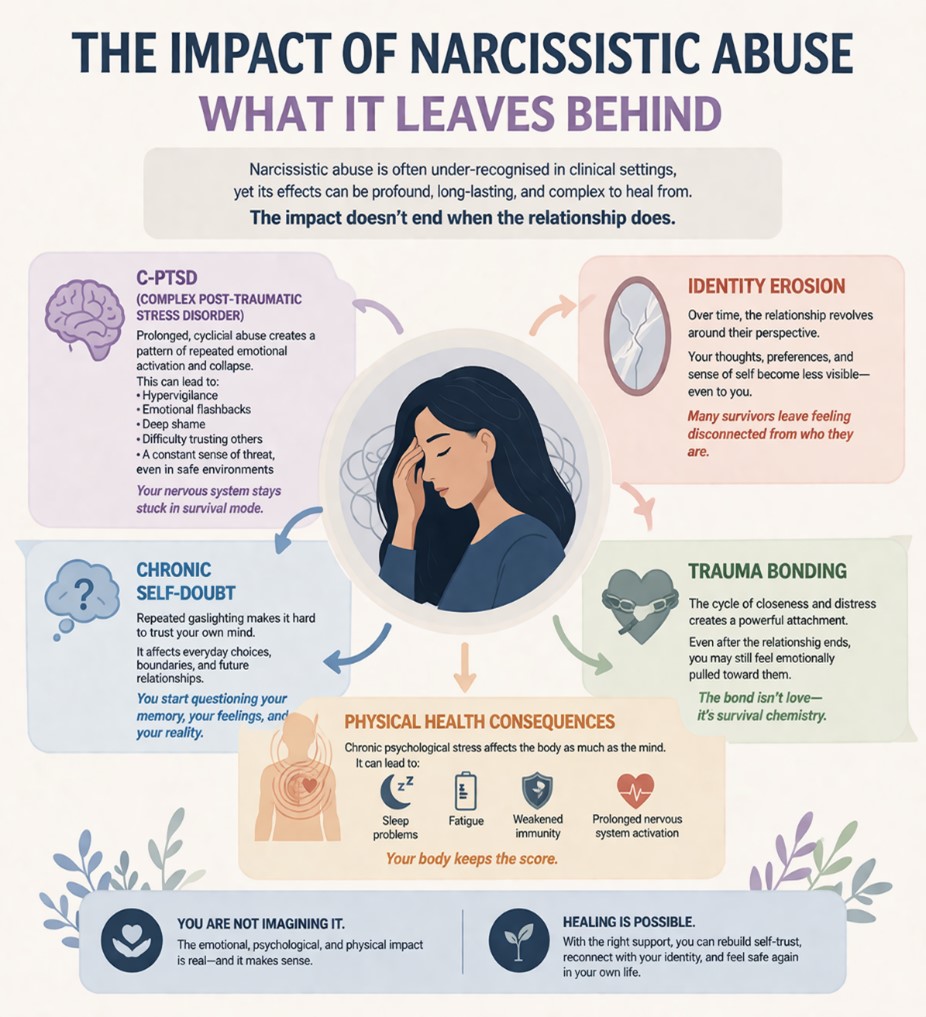
Chronic self-doubt: This is another lasting effect. Repeated gaslighting can lead to a deep difficulty in trusting one’s own perceptions and decisions. This goes beyond uncertainty, it can affect everyday choices, boundaries, and future relationships.
Trauma bonding also plays a significant role. The alternating pattern of closeness and distress creates a strong attachment that can continue even after the relationship ends. Many people describe still feeling emotionally pulled toward the person, even when they are clear about the harm.
Finally, there are physical health consequences. Ongoing psychological stress affects the body as well as the mind, disrupting sleep, increasing fatigue, affecting immunity, and keeping the nervous system in a prolonged state of activation. The impact of narcissistic abuse is not only emotional; it is physiological.
Part Six: How Response Strategies Differ
Responding to General Emotional Manipulation
For individuals who are manipulative but not NPD, who manipulate situationally, from fear or unmet needs rather than from a stable personality structure, several approaches can be effective:
- Direct, clear communication about the impact of specific behaviours because feedback has a chance of being received and acted on
- Boundary-setting with genuine consequences because there is realistic potential for behavioural change
- Couples or relational therapy where genuine motivation exists, skilled relational therapy can address the underlying dynamics
Responding to Narcissistic Abuse
The same strategies do not tend to work in narcissistic abuse and can sometimes make things more difficult.
- Directly communicating hurt or impact is often experienced as criticism, which can trigger defensiveness or escalation rather than reflection. Instead of being understood, the response may involve denial, counter-accusation, or reversal of blame.
- Couples therapy is generally not recommended in these situations. The structure of joint sessions can unintentionally create space for further control, where disclosures made in therapy are later used against the other person.
- One of the most difficult shifts for survivors is recognising that change is not something they can create through effort or explanation. The pattern is not driven by misunderstanding alone, but by a more stable way of relating that does not reliably respond to feedback.
In therapy, we often see how hope for change, especially during phases where the relationship temporarily improves, can keep people engaged longer than feels safe in retrospect. For example, one client described repeatedly trying to explain her experience more clearly, believing that if she “said it the right way,” things would shift. Over time, the pattern remained unchanged, but her own confidence in setting boundaries reduced.
Because of this, the focus of the response shifts. The most clinically important approach in narcissistic abuse is safety-oriented. This includes recognising the pattern, keeping track of experiences when reality feels unclear, building support systems outside the relationship, and planning distance or exit carefully.
At Coach For Mind, this work is paced and structured, not rushed, because leaving these dynamics is not only a practical process, but also an emotional and psychological one.
Part Seven: Healing — Why the Recovery Paths Diverge
Recovery from general emotional manipulation usually involves working through the impact of specific behaviours, rebuilding self-esteem, and developing clearer relational boundaries. With consistent therapeutic support, there is often a relatively direct path - understanding what happened, strengthening self-trust, and learning how to respond differently in future relationships.
Recovery from narcissistic abuse, however, requires an additional and more complex layer of work. It is not only about healing from what happened, but about rebuilding the internal system that allows a person to trust their own perceptions, thoughts, and emotional responses. Narcissistic abuse systematically disrupts this internal reference point. As a result, recovery involves restoring not just confidence, but a more fundamental sense of psychological orientation; the ability to recognise what is real, what feels right, and what can be trusted internally.
In therapy, this often shows up as a gradual shift from “I don’t know if I’m overreacting” to “I can recognise what feels off, and I can respond to it.” That shift is central to recovery. Because of this, treatment for narcissistic abuse tends to be integrative, drawing on multiple approaches that work across cognitive, emotional, relational, and physiological levels.
Trauma-Informed Therapy: Trauma-informed therapy forms the foundation of this work. It recognises that many survivors present with features of complex trauma or C-PTSD including emotional flashbacks, persistent shame, and a heightened sense of threat even in safe situations. Rather than focusing only on insight, therapy is paced carefully, with attention to safety, regulation, and stabilisation before deeper processing. At Coach For Mind, this means working not just with what the client is saying, but also with how their nervous system is responding, especially in moments where reactions feel disproportionate or difficult to control. Click here to book your free discovery call today.
Eye Movement Desensitisation and Reprocessing: EMDR can be particularly effective for processing specific memories and relational moments that continue to feel “stuck.” Many survivors find that certain interactions replay with the same emotional intensity, as if they are still happening. EMDR helps the brain reprocess these experiences so that they are integrated as past events, rather than continuing to trigger present distress. For example, a client who repeatedly found herself frozen during conflict was able, through EMDR, to process earlier moments of intense invalidation. As those memories lost their charge, her ability to stay present and respond in current relationships improved.
Somatic Approaches: Somatic approaches are another important part of recovery. Narcissistic abuse is not only experienced cognitively, it is held in the body as chronic tension, hyperarousal, and heightened startle responses. Techniques that work directly with the nervous system including grounding, breathwork, and body-based trauma processing. They help reduce this physiological load. Over time, this creates a sense of safety that is felt, not just understood. At Coach For Mind, somatic and trauma-informed work are often integrated, allowing clients to move between understanding their experience and physically regulating it, rather than relying on insight alone.
Internal Family Systems (IFS): Parts-based approaches are especially valuable in the process of identity reconstruction. Many survivors develop different “parts” of themselves in response to the relationship, for example, a part that tries to appease, a part that anticipates criticism, or a part that withdraws to stay safe. Therapy helps make sense of these adaptations, not as flaws, but as protective responses that once served a purpose. Over time, these parts can be integrated into a more stable and self-directed sense of identity. Read more here about how IFS is used at Coach For Mind for your healing.
Finally, addressing emotional dependence and attachment patterns is essential. As seen in the Echo and Narcissus dynamic, the pull toward such relationships is often rooted in deeper relational patterns. Without working at this level, the risk of repetition remains.
At Coach For Mind, this work is approached directly, helping clients understand how their attachment system has been shaped, how it shows up in relationships, and how to build a more secure, self-anchored way of relating. Recovery, in this context, is not just about leaving the relationship or reducing distress. It is about rebuilding a sense of self that is internally grounded, relationally aware, and less vulnerable to the same patterns in the future.
Conclusion: Clarity Is the Beginning of Recovery
The emotional disorientation that brings many people to this topic - the sense that something was wrong but hard to explain, the doubt about whether it was “serious enough” to be called abuse, the confusion between your own reactions and the other person’s behaviour, is not a personal failing. It is a predictable outcome of sustained manipulation, and especially of narcissistic abuse. In that sense, the confusion itself is part of what needs to be understood.
Naming the experience accurately is not a small step. It is often the beginning of reclaiming a sense of reality that has been gradually disrupted. Whether what you have experienced is emotional manipulation, narcissistic abuse, or a combination of both, what matters is this: your experience deserves to be taken seriously, understood in its full context, and worked through with the right kind of support.
At Coach For Mind, this process often begins with helping clients rebuild something that has been quietly eroded, trust in their own perceptions, judgements, and internal signals. Not as an abstract goal, but as something that can be experienced again in real, grounded ways.
Because that trust is not just a byproduct of recovery. It is what recovery is built on.
If You Need Immediate Support
If you are currently in an abusive relationship and need support, please reach out:
- India National Domestic Violence Helpline: 181
- iCall (India): 9152987821
- Vandrevala Foundation Helpline: 1860-2662-345 (24/7, free, confidential)
Support at Coach For Mind
If you are trying to make sense of a relationship that left you feeling confused, diminished, or disconnected from yourself — we offer a clinical space to do that work.
Our approach to relational trauma includes trauma-informed individual therapy, EMDR, somatic and nervous system regulation work, and specific support for survivors of narcissistic and emotionally abusive relationships. We work with the full picture: the impact of the abuse itself, the attachment patterns that may have created vulnerability, and the identity reconstruction that recovery requires.
Sessions available online across India and internationally for NRI clients, and in-person in Gurgaon.
www.coachformind.com | [email protected]
Begin with a free 15-minute discovery call. RCI-registered clinical psychologists. Trauma-informed. Evidence-based.
References
Pickard, J. (2019). Recognising narcissistic abuse and the implications for mental health nursing practice. Issues in Mental Health Nursing, 40(8), 644–654.
Verrastro, V. et al. (2024). Vulnerable narcissism and emotion dysregulation as mediators in the link between childhood emotional abuse and binge watching. European Journal of Investigation in Health, Psychology and Education, 14(10), 2628–2641.
Dowgwillo, E.A. et al. (2017). Narcissistic personality disorder in clinical health psychology practice. Behavioural Medicine, 43(3), 156–164.
Wright, A.G.C. et al. (2017). The effect of pathological narcissism on interpersonal and affective processes in social interactions. Journal of Abnormal Psychology, 126(7), 898–910.
Moral-Jiménez, M.V. & Mena-Baumann, E. (2024). Emotional dependence and narcissism in couple relationships: Echo and Narcissus Syndrome. Behavioural Sciences, 14(12), 1190.
This article is for informational purposes only and does not constitute medical advice. If you are in an abusive relationship, please contact a qualified mental health professional or a domestic violence helpline.
By Ms Bhavya Sekhri | Psychotherapist at Coach For Mind
Frequently Asked Questions
Feeling confused about what happened in a relationship is extremely common when manipulation or abuse has been present. Many people sense that something was wrong but struggle to find the language for it. Emotionally manipulative behaviour and narcissistic abuse can look similar on the surface because both may involve tactics like guilt-tripping, gaslighting, or emotional withdrawal. The difference lies in the psychological structure behind the behaviour. Emotional manipulation can occur in many personality styles and is often situational, emerging from insecurity, fear, or poor communication skills. Narcissistic abuse, by contrast, typically reflects a stable personality structure associated with narcissistic traits or Narcissistic Personality Disorder (NPD); characterised by grandiosity, entitlement, impaired empathy, and a recurring relational cycle of idealisation, devaluation, and discard. Research on pathological narcissism highlights how perceived criticism can trigger antagonistic behaviour and relational aggression in individuals with narcissistic traits.
At Coach For Mind, we begin with a careful assessment of relational patterns and trauma impact. Therapy focuses on rebuilding self-trust, processing relational trauma through trauma-informed therapy, EMDR, and somatic approaches, and helping clients understand relationship dynamics without self-blame.
If you have experienced manipulation, it is natural to try to make sense of the person’s behaviour by searching for a diagnosis or label. Wanting clarity about what happened is part of the healing process. Emotional manipulation is not exclusive to narcissism. Research in attachment and interpersonal psychology shows that manipulative behaviours can arise from insecure attachment, emotional immaturity, anxiety, learned family communication patterns, or unresolved trauma. Someone may use guilt, withdrawal, or defensiveness as a way to manage their own emotional discomfort. This does not make the behaviour acceptable, but it does mean that not every manipulative dynamic reflects narcissistic pathology.
At Coach For Mind, therapy focuses less on diagnosing the other person and more on understanding the relational pattern and its impact on you. Modalities such as attachment-focused therapy, Internal Family Systems (IFS), and boundary work help clients rebuild healthy relational expectations and reduce vulnerability to manipulative dynamics in future relationships.
Many survivors struggle with this question. It is very common to wonder whether the harm was deliberate or whether the person simply “couldn’t help it.” Research on pathological narcissism suggests that abusive behaviour is not always consciously planned. Studies indicate that narcissistic individuals often respond aggressively when they perceive threats to their self-esteem or status, a process mediated by intense negative emotions such as shame or anger. However, whether the behaviour is intentional or reactive does not change the psychological impact on the person experiencing it.
At Coach For Mind, therapy focuses on your recovery rather than explaining or excusing the abuser’s behaviour. Trauma-informed therapy, EMDR, and nervous system regulation work help process the emotional and physiological effects of abuse so that clients can move forward with greater clarity and stability.
Many people who leave manipulative relationships worry that something about them “attracts” unhealthy partners. This concern is extremely common and often carries a great deal of self-blame. Research on what has been termed the “Echo and Narcissus Syndrome” suggests that emotional dependence and certain attachment patterns can increase vulnerability to narcissistic partners. Individuals with strong needs for approval or fear of abandonment may be especially responsive to the intense validation of love-bombing and may tolerate devaluation longer than someone with a more secure attachment style.
At Coach For Mind, therapy addresses these deeper relational patterns directly. Through attachment-focused work, IFS, and relational trauma therapy, clients develop a stronger internal sense of worth and safety that reduces susceptibility to exploitative relationship dynamics.
If you have left a relationship that involved manipulation or abuse, it can be difficult to know what type of support will actually help. Research suggests that survivors of narcissistic abuse often present with symptoms similar to Complex Post-Traumatic Stress Disorder (C-PTSD), including emotional flashbacks, hypervigilance, shame-based self-beliefs, and difficulty trusting their own perceptions. Because the abuse often involves prolonged psychological manipulation and intermittent reinforcement, recovery frequently requires trauma-informed approaches rather than purely cognitive therapy.
At Coach For Mind, our work with relational trauma survivors may include EMDR for processing traumatic memories, somatic approaches to regulate the nervous system, trauma-informed psychotherapy, and Internal Family Systems (IFS) to support identity reconstruction and restore self-trust.
Many people hesitate to call their experience abuse, especially when there was no physical violence involved. Feeling uncertain about whether your experience “counts” is extremely common. Emotional abuse is defined by patterns of behaviour that undermine a person’s sense of safety, autonomy, or self-worth. Research on psychological abuse identifies behaviours such as gaslighting, humiliation, coercive control, chronic criticism, and isolation as key indicators. Over time, these patterns can produce profound effects on self-esteem, emotional regulation, and mental health.
At Coach For Mind, therapy provides a space to process the relationship without judgement, understand what occurred, and rebuild confidence in your perceptions and boundaries.
Many survivors feel frustrated with themselves for staying in a relationship that was clearly harmful. This self-criticism can become an additional layer of pain. Psychological research shows that abusive relationships often create trauma bonds, powerful attachments formed through cycles of reward and punishment. Intermittent reinforcement activates the brain’s reward system in ways similar to addictive processes, making the relationship extremely difficult to disengage from even when it becomes harmful.
At Coach For Mind, therapy helps clients understand the neurobiology of trauma bonding, process the emotional attachment through trauma-informed therapy and EMDR, and develop the emotional resources needed to maintain boundaries after leaving.
Many survivors expect that once the relationship is over, the distress should disappear. When symptoms persist, it can feel discouraging or confusing. Research shows that prolonged psychological abuse can lead to long-term effects such as C-PTSD, anxiety disorders, depression, and chronic self-doubt. Survivors may also experience emotional flashbacks, hypervigilance in relationships, or difficulty trusting their own judgement.
At Coach For Mind, treatment focuses on both the psychological and physiological effects of relational trauma. Through trauma-informed therapy, somatic work, and EMDR, clients gradually regain emotional stability, self-trust, and a stronger sense of identity.
Many survivors describe leaving these relationships feeling as though their confidence and identity have been profoundly eroded. Wondering whether self-esteem can truly return is a very natural concern. Narcissistic abuse often involves sustained criticism, gaslighting, and identity erosion, which can lead to deeply internalised negative self-beliefs. Research on relational trauma indicates that self-concept disruption is one of the most significant psychological impacts of prolonged emotional abuse.
At Coach For Mind, therapy focuses on identity reconstruction and self-trust. Modalities such as Internal Family Systems (IFS), trauma-informed therapy, and somatic regulation work help clients rebuild a coherent sense of self that is independent of the abusive relationship.
Many people remain emotionally stuck because they continue hoping that the other person will eventually change. This hope is deeply understandable. Clinical research suggests that individuals with Narcissistic Personality Disorder face significant barriers to treatment, including difficulty acknowledging harmful behaviour and maintaining therapeutic engagement. However, some individuals do seek help, and therapies such as schema therapy and transference-focused psychotherapy have shown promise in treating narcissistic pathology.
At Coach For Mind, therapy focuses on helping clients make decisions based on realistic expectations rather than hope alone, while supporting emotional healing and recovery from the relationship’s impact.
Many people sense that something is wrong in a relationship long before they have language for it. Feeling confused, constantly second-guessing yourself, or feeling like you have to “walk on eggshells” are very common experiences reported by survivors.
Clinically, narcissistic abuse tends to involve a pattern rather than isolated behaviours. Common indicators include love bombing early in the relationship, chronic criticism or devaluation, gaslighting, shifting blame (DARVO), emotional withdrawal as punishment, and cycles of idealisation followed by rejection. Research on narcissistic personality dynamics shows that relationships with individuals high in narcissistic traits often involve unstable interpersonal patterns and exploitation of partners for emotional validation or “narcissistic supply.”
At Coach For Mind, therapy focuses on helping clients identify relational patterns clearly and rebuild trust in their perceptions. Trauma-informed therapy, EMDR, and somatic nervous system work support recovery from the confusion and psychological destabilisation these relationships often produce.
Many people worry that recognising manipulation means their entire relationship must be toxic or abusive. This uncertainty can make it difficult to evaluate what is actually happening. Psychologically, manipulative behaviours can appear in many relationships at times of stress or emotional insecurity. Attachment research shows that individuals with anxious or avoidant attachment styles may resort to tactics like guilt-inducing communication, withdrawal, or defensiveness when they feel threatened. The key distinction is pattern and accountability: in healthy relationships, these behaviours can be acknowledged, discussed, and changed.
At Coach For Mind, therapy helps clients differentiate between situational relational difficulties and entrenched abusive patterns. Through attachment-focused therapy, relational pattern analysis, and boundary development, clients gain clarity about what healthy dynamics look like and how to move toward them.