TL;DR
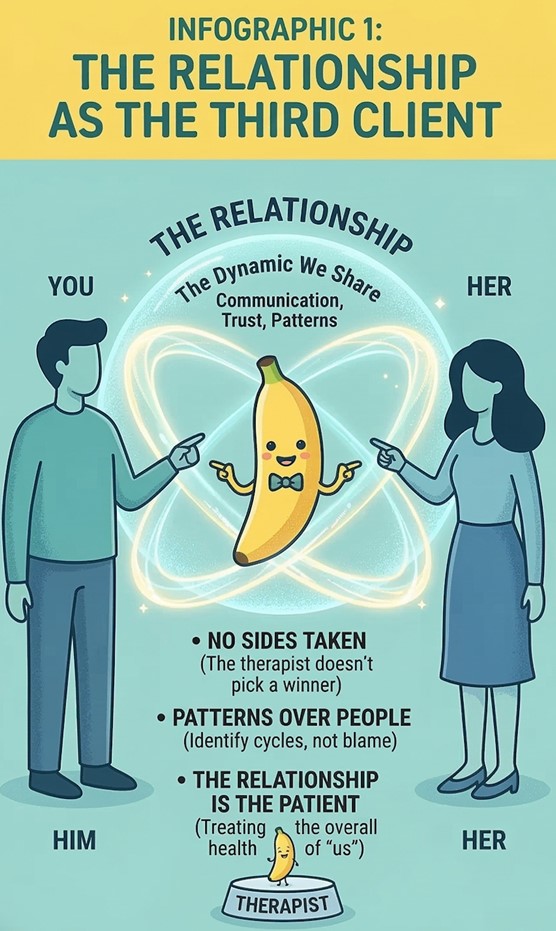
- It Treats the Relationship, Not the Individual: The therapist's client is the relationship itself , not you, not your partner. No sides are taken. Patterns are identified, not people.
- It Works , With Numbers to Prove It: A meta-analysis of 58 studies found couples therapy produces a large effect on relationship satisfaction (Hedges g = 1.12). Waitlisted couples who did nothing showed virtually no improvement.
- Timing Is Everything: Research suggests the average couple waits six years before seeking help. The longer the wait, the deeper the patterns , and the harder the work. Therapy is most effective as a tune-up, not a last resort.
- Both Partners Must Be In: Therapy consistently fails when one partner attends as a gesture rather than a genuine investment. Token participation is not the same as engagement.
- It Will Not Fix an Individual Problem: If untreated trauma, ADHD, addiction, or hidden agendas are the root cause, individual therapy may need to come first , or run alongside.
- The Methods Converge: Whether your therapist uses the Gottman Method, Emotionally Focused Therapy (EFT), or Cognitive Behavioural approaches, meta-analyses show similar outcomes. The therapeutic alliance , the quality of the relationship with your therapist , often matters more than the specific model.
- Change Requires Maintenance: Gains from therapy can dissipate for approximately half of couples over several years without continued practice. The tools need to be used outside the room to last.
Introduction: The Room Where Patterns Come to Light
Most couples arrive in therapy describing a communication problem. They fight about the same things, in the same order, and arrive at the same impasse, every time. What they discover in the therapy room is that communication is not the problem. Communication is the symptom.
Beneath the argument about household responsibilities, or the silence that follows a comment made in the wrong tone, or the slow erosion of physical and emotional closeness , there are patterns. Patterns rooted in attachment histories, nervous system responses, and the accumulated weight of unrepaired ruptures. Couples therapy exists to make those patterns visible, name them, and , crucially , interrupt them.
This article explains what couples therapy actually does: in the session, between sessions, and over time. Not the idealized version. The real one.
Part One: What Couples Therapy Is and What It Is Not
The framing that most accurately captures how effective couples therapy works is this: the therapist is not treating you, and is not treating your partner. The therapist is treating the relationship itself as a third client , the dynamic that exists between two people that neither person fully controls, and that has developed its own patterns and tendencies over time.
This reframing matters because it removes the most common fear that prevents people from attending: the therapist will take my partner's side. A skilled couples therapist is not a judge and does not assign blame. They are, more accurately, an interpreter , someone trained to see the cycle that both partners are caught inside, and to name it in a way that neither partner, alone and in the middle of the conflict, can see.
Therapy vs. Counselling: Does the Distinction Matter?
In the Indian context, the terms are often used interchangeably , and for most purposes, this does not matter significantly. The clinically meaningful distinction is between short-term, skill-focused work (often called counselling) and longer-term, pattern-focused work (therapy). Both have value. What matters is that the approach matches the depth of the issue. A couple navigating a specific adjustment , a move, a new child, a career change , may benefit from focused, shorter work. A couple whose conflict is rooted in attachment injuries, childhood trauma, infidelity or years of accumulated disconnection will likely need something deeper.
At Coach For Mind, we assess this during the intake process , because arriving with the right frame for the work ahead makes a significant difference to outcomes.
Part Two: What the Evidence Actually Says
The Numbers
A rigorous meta-analysis of 58 studies covering 2,092 couples found that couple therapy produces a large effect on relationship satisfaction , far outperforming any control condition. More significantly, couples who were placed on a waitlist and received no intervention showed almost no improvement over the same period.
This is perhaps the most important finding in the couples therapy literature: time does not heal relationship distress. The belief that things will "settle down eventually" or "improve on their own" is not supported by data. Active intervention is what produces change.
A separate systematic review found that Emotionally Focused Couples Therapy (EFT) specifically produced a Hedges g of 2.09 , an extraordinarily large effect size , with improvements sustained at follow-up. This makes EFT one of the most robustly evidenced psychological interventions available, for any clinical condition.
Which Method Is Best?
The honest answer is: they converge. A comparison of Cognitive-Behavioural Couple Therapy (CBCT) and Emotionally Focused Couple Therapy (EFCT) found that contrary to widespread assumptions, both approaches address emotion and cognition, and both produce similar outcomes. The difference between a "logical" and an "emotional" approach to couples work is largely one of framing, not outcome.
What the research consistently shows is that the therapeutic alliance , the quality of the relationship between the couple and their therapist , accounts for a significant proportion of outcomes across all modalities. Finding a therapist both partners feel safe with matters as much as the specific framework they use.
"The therapeutic alliance often accounts for more of the success than the specific modality." , Bodenmann et al. (2020), reviewing CBCT and EFCT
The Attachment–Regulation Cycle
Most evidence-based couples therapy models converge on a shared understanding: relational conflict is rarely about the content of the argument. It is about the activation of attachment systems and the failure of emotional co-regulation.
When a partner perceives threat, criticism, withdrawal, rejection, their attachment system activates. Depending on attachment history, they may pursue (seeking closeness to reduce anxiety) or withdraw (managing overwhelm through distance). These responses are largely automatic, fast, and shaped by early relational experiences.
The partner's response to that behaviour then activates their attachment system, creating a feedback loop. The pursuer's intensity feels like an attack on the withdrawer; the withdrawer's distance feels like abandonment to the pursuer. Neither partner intends harm, but the cycle escalates.
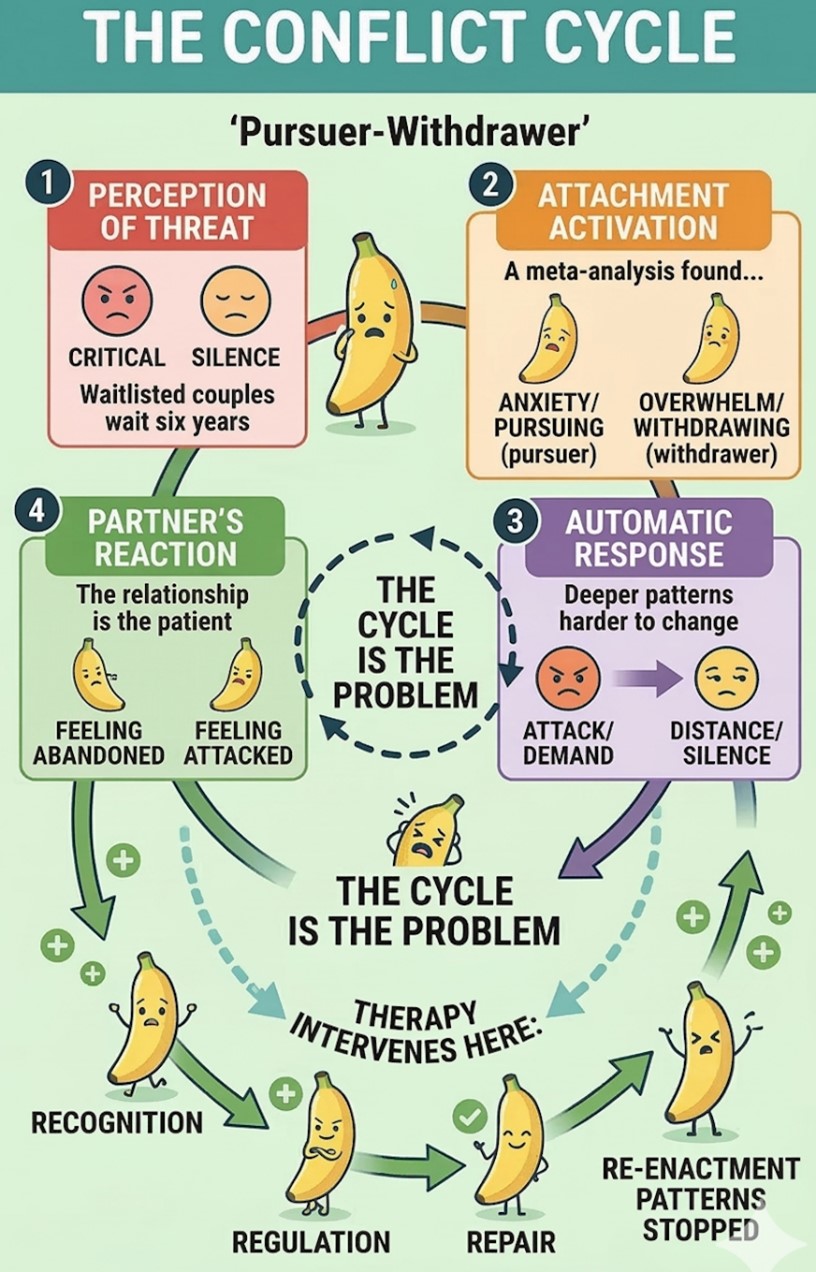
Couples therapy intervenes at multiple points in this cycle:
- Recognition: Making the pattern visible to both partners simultaneously
- Regulation: Building individual capacity to notice activation and pause before reacting
- Reframe: Shifting from "you are the problem" to "the cycle is the problem"
- Repair: Creating structured opportunities to reconnect after ruptures
This framework, drawn from attachment theory (Bowlby), affective neuroscience, and models like EFT (Johnson) and the Gottman Method, explains why insight alone rarely produces change. The nervous system must learn new responses through repeated, regulated practice.
For Couples in Serious Distress
One counterintuitive finding deserves emphasis: greater baseline distress is actually associated with larger gains in therapy. Couples who arrive in a serious crisis , not just a tune-up , tend to show the most significant improvements. This speaks directly to the fear that "it might be too late." For most couples, it is not.
Part Three: What Actually Happens in the Room
The First Session
The first session is typically an assessment, not a confrontation. A skilled couples therapist will want to understand the history of the relationship, the nature of the presenting difficulties, each partner's individual history where relevant, and what both partners are hoping for. Many therapists will also conduct brief individual sessions early in the process to hear each person's perspective privately.
The first session is not the place where old wounds are reopened in full. It is a mapping exercise , establishing enough safety and shared understanding to do deeper work in subsequent sessions.
"What actually happens in the first session?" This is the most common question before a first appointment , and the most important thing to know is that you will not be ambushed. The pace is set collaboratively.
When Conflict Happens in the Session
One of the content gaps in most writing about couples therapy is what actually occurs when a real argument breaks out in the room. It happens. And it is, in fact, part of the work.
When a couple escalates in session, an effective therapist does not watch passively or attempt to adjudicate. They intervene actively , slowing the interaction down, naming the cycle that is emerging in real time, and redirecting both partners from the content of the argument to the underlying pattern. "I notice we've just moved into the familiar cycle. Can we pause here and look at what just happened?" This is the intervention. Not resolving the argument, but making the pattern observable to both people simultaneously.
This is also why emotional regulation is a core component of what couples therapy teaches , not as an abstract concept, but as a live practice. The capacity to notice activation, pause, and respond rather than react is the practical skill the therapy room is training, repeatedly, over time.
A couple in their mid-30s sought therapy nearly a year after an affair disclosure. The partner who had the affair reported intense shame and withdrawal whenever the topic arose. The injured partner experienced panic attacks and repeatedly sought reassurance. Early sessions focused on the affair's details, but progress stalled. When the therapist slowed the interaction, a pattern emerged: the injured partner pursued answers → the other partner became overwhelmed and withdrew → withdrawal intensified fear of abandonment → pursuit escalated further. Naming this cycle shifted the frame. Rather than litigating facts, therapy focused on interrupting the pattern itself. The injured partner practised expressing fear before it became accusation; the withdrawing partner practised staying present despite shame. Conflicts continued, but de-escalated faster, creating space for genuine repair.
Between Sessions: The Homework That Actually Matters
Couples therapy does not happen only in the 60-minute session. What happens between sessions determines whether the insights translate into sustained behavioural change.
Typical between-session work includes:
The de-escalation agreement: A pre-agreed script or signal for when a conversation is escalating beyond the point of productive engagement. Not "we stop talking," but "we pause and return when regulated." The signal is agreed in the therapy room, practised there, and then available for use at home.
Appreciation and acknowledgement practices: Research-backed by the Gottman Institute, regular structured appreciation , naming specific things valued in the partner, not generic compliments , rebuilds the positive sentiment that conflict erodes over time. This takes approximately five minutes a day and has documented effects on relationship satisfaction.
The 'post-session protocol': One of the most overlooked practical necessities in couples work is what happens immediately after a session. Sessions often surface difficult material. The drive home, or the first few hours back in shared space, are neurologically vulnerable , the emotional processing is still active, the defences are temporarily lowered. A mandatory "therapy talk moratorium" for two hours after a session , an agreement not to continue processing the session's content until both partners have had time to regulate , prevents the work of the session from being undone in the car park.
Part Four: What Couples Therapy Can and Cannot Do
What It Can Do
- Make previously invisible patterns visible to both partners simultaneously
- Provide a structured, safe environment for conversations that cannot happen at home
- Teach specific, practised skills for de-escalation, repair, and reconnection
- Address individual mental health outcomes , research confirms couples therapy is an effective treatment for depression, anxiety, and PTSD when these are embedded in relational dynamics
- Help couples navigate specific life transitions: infertility, illness, grief, parenting disagreements, career changes, or the aftermath of infidelity
- Provide a framework for a conscious, respectful separation when a relationship cannot or should not continue
What It Cannot Do
- Force change in a partner who has not genuinely committed to the process
- Resolve individual pathology , untreated ADHD, trauma, addiction, or personality disorders , that is the primary driver of relational difficulty
- Work when there is active abuse, as the safety and neutrality the process requires cannot be established
- Substitute for individual therapy when deeply personal work is needed first
- Couples therapy is contraindicated when there is active physical, sexual, or coercive control. The neutrality and safety the process requires cannot be established. In such cases, individual support and safety planning take precedence.
"Sometimes the 'couple' problem is actually an 'individual' problem that needs separate attention first." , Lazarus (1992), on the prerequisite of individual stability for successful couples work
The question of whether to pursue individual or couples therapy first is one of the most common and most important clinical decisions in this space. A responsible assessment will address it directly. In many cases, the answer is both , running in parallel rather than sequentially.
Part Five: The Indian Context , What Changes, What Doesn't
The Specific Pressures Indian Couples Face
Couples therapy in India operates against a cultural backdrop that shapes both the presenting issues and the barriers to seeking help. Some couples hold religious or cultural frameworks that shape their understanding of marriage, gender roles, and conflict resolution. A skilled therapist will engage these frameworks respectfully rather than dismissing them, while also helping couples distinguish between values they genuinely hold and expectations they have absorbed without examination.
Arranged and semi-arranged marriages often involve couples who did not have extended pre-marital time to establish communication patterns or navigate conflict together. The early years of the marriage can surface fundamental incompatibilities or mismatched expectations that neither family discussion nor individual effort can adequately address. Therapy provides the structured, neutral space that this transition often requires.
Joint family dynamics introduce a layer of complexity that is largely absent from Western couples therapy literature. The negotiation of loyalty, role expectations, and decision-making authority between partners and their families of origin is a genuine clinical variable , and it requires a therapist who understands this context rather than applying a purely dyadic framework.
"Log kya kahenge" , the weight of social perception , creates significant shame around acknowledging relationship difficulty and seeking professional support. Many Indian couples arrive in therapy later than they should, having first cycled through well-meaning family advice, religious counsel, and extended periods of private struggle. The reframing that matters here is direct: seeking therapy is not a sign that the marriage has failed. It is the decision to take it seriously enough to invest in it.
Financial and access barriers: Specialised couples therapy in Indian metros can be expensive, and access to qualified practitioners outside major cities is limited. Online therapy has changed this significantly. Research confirms that telehealth couples therapy produces outcomes comparable to in-person work , removing both the geographic and the logistical barrier of getting two busy people to the same room at the same time.
When ADHD Is in the Room
A specific and frequently mismanaged pattern in Indian couples presenting for therapy is the relationship where one partner has undiagnosed or untreated ADHD. The presenting complaint is almost always communication , one partner feels unheard, unseen, or overburdened; the other feels perpetually criticised and misunderstood. The couples therapist is handed a conflict that is, in significant part, the functional expression of an underlying neurodevelopmental condition.
Communication tools taught in therapy will produce limited results when the root cause is executive dysfunction, time blindness, emotional dysregulation, or Rejection Sensitive Dysphoria. In these cases, parallel ADHD assessment , and where indicated, treatment , is a clinical prerequisite for the couples work to be effective.
At Coach For Mind, we are positioned to assess and address both dimensions , ADHD and relational dynamics , within the same clinical team. When both are present, treating them in isolation produces partial results at best.
Part Six: Finding the Right Therapist , and Knowing When It Is Working
What to Look For
Effective couples therapists share several characteristics that are worth asking about directly:
- Training in a specific evidence-based modality (Gottman Method, EFT, CBCT, or psychodynamic couples work)
- The capacity to remain genuinely neutral , not siding with either partner, and comfortable challenging both
- Active intervention during in-session conflict , not passive observation
- Willingness to discuss the treatment plan, the expected duration, and the markers of progress
The experience of the first two or three sessions is itself diagnostic. If both partners consistently leave feeling attacked, judged, or as though the therapist is aligned with the other person, that is information about fit , not about whether therapy can work.
When Is It Working?
Progress in couples therapy rarely looks like the absence of conflict. It looks like:
- Conflicts that de-escalate more quickly than before
- The capacity to repair after a rupture, rather than letting disconnection persist for days
- Increased ability to express vulnerability rather than only criticism or defensiveness
- A growing sense of being on the same side of the problem, rather than on opposite sides of each other
The Gottman Institute's research on what distinguishes stable from unstable relationships is instructive here: the ratio of positive to negative interactions in satisfied couples is approximately 5:1. Therapy works, in part, by rebuilding this ratio , not by eliminating the negative, but by actively strengthening the positive.
Sustaining Gains
Research indicates that roughly half of couples who benefit from therapy show some decline in satisfaction over the following two to four years. This is not a failure of therapy; it reflects the reality that relationships require ongoing maintenance. The skills learned in therapy are like physical fitness: they decay without practice. Periodic "booster" sessions, continued use of structured appreciation and de-escalation tools, and prompt return to therapy when old patterns resurface all predict sustained outcomes.
Conclusion: The Work That Happens in the Room and After It
Couples therapy is not a magic fix, and anyone who promises otherwise is not telling you the truth. It is hard work. It involves sitting in a room with another person and looking honestly at the patterns both of you have built together , patterns that have often been years in the making and serve psychological purposes that are not immediately obvious.
What it offers, when both partners are genuinely present for it, is something that almost no other context provides: a structured, safe, neutral space where the relationship itself becomes visible , where the cycle can be named, interrupted, and gradually replaced by something more intentional.
The research is unambiguous that this works. The large effects are sustained. The couples who engage seriously with the process , who practise the de-escalation skills at home, who make the repair attempts even when it feels unnatural, who return to the room after the difficult sessions , build something that is genuinely different from what they arrived with.
For many couples, the most important moment in therapy is not a breakthrough insight in the room. It is the first time, at home, without a therapist present, that one of them does something different , pauses instead of escalating, names what they are feeling instead of defending, reaches toward the other person instead of withdrawing. That is the work landing. That is what couples therapy is for.
Take the Next Step: Couples Therapy at Coach For Mind
If something in this article has named an experience you recognise , the same argument cycling endlessly, the growing emotional distance, the exhaustion of wanting something different and not knowing how to get there , the next step is finding out what is actually possible.
At Coach For Mind, our couples therapy is grounded in evidence-based modalities including EFT and Gottman-informed approaches, delivered by our RCI-registered clinical psychologists. We work with the full picture: relational dynamics, individual histories, attachment patterns, and , where relevant , the specific impact of conditions like ADHD on the partnership.
We also offer comprehensive ADHD assessment, which is frequently the missing piece in couples presenting with longstanding communication difficulties.
Sessions are available online across India and internationally for NRI clients, and in-person in Gurgaon. Begin with a free 15-minute discovery call.
Visit www.coachformind.com or contact us at [email protected].
RCI-registered clinical psychologists. Evidence-based. Online and in-person.
References
- Lebow & Snyder (2022). Couple therapy in the 2020s: Current status and emerging developments.
- Bodenmann et al. (2020). Cognitive-behavioral and emotion-focused couple therapy: Similarities and differences.
- Roddy et al. (2020). Meta-analysis of couple therapy: Effects across outcomes, designs, timeframes, and other moderators.
- Rathgeber et al. (2019). The efficacy of emotionally focused couples therapy and behavioral couples therapy: A meta-analysis.
- Beasley & Ager (2019). Emotionally focused couples therapy: A systematic review of its effectiveness over the past 19 years.
- Hewison et al. (2016). The effectiveness of couple therapy: Clinical outcomes in a naturalistic UK setting.
- Lazarus (1992). When is couples therapy necessary and sufficient?
Written by Kudrat - Clinical psychologist at Coach For Mind. www.coachformind.com
Frequently Asked Questions
Yes , with meaningful caveats about timing and commitment. A meta-analysis of 58 studies found a large effect size (Hedges g = 1.12) on relationship satisfaction, far outperforming no treatment. EFT specifically showed an effect size of 2.09 with gains sustained at follow-up. Crucially, couples who waited without active intervention showed virtually no improvement. Time does not heal relationship distress. Therapy does , when both partners are genuinely engaged.
The first session is an assessment, not a confrontation. Your therapist will map the history of the relationship, understand the presenting issues, and establish enough safety to begin deeper work. You will not be ambushed, and old wounds will not be fully excavated on day one. Many therapists conduct brief individual check-ins early in the process. The pace is collaborative and explicitly discussed.
Possibly , and the data is actually encouraging here. Research shows that couples with greater baseline distress tend to experience the largest gains in therapy. Length of distress matters less than whether both partners are genuinely committed to the process. That said, years of unrepaired ruptures have created deeply entrenched patterns that require sustained work, not a quick fix.
It depends on what is driving the relational difficulty. If the primary issue is a communication and interaction pattern that developed between you , couples therapy first, or in parallel. If one or both partners are managing significant untreated individual issues , trauma, ADHD, depression, addiction , individual therapy first, or alongside. A good intake assessment will clarify this. Insisting on only conjoint work when individual issues are the root cause produces limited results.
This is one of the most common barriers to beginning. Individual therapy with a focus on relational patterns is a meaningful starting point , it is not a substitute for couples work, but it can shift the dynamic enough that a resistant partner becomes more willing. Directly inviting a reluctant partner by framing the first session as information-gathering rather than commitment sometimes reduces the barrier. If a partner refuses entirely, individual therapy can still provide tools for managing the relationship and clarity about whether to remain in it.
There is no fixed number. Research on couples therapy generally finds meaningful gains within 12 to 20 sessions, but this varies significantly with the severity of distress, the complexity of individual factors, and the consistency of between-session practice. Some couples do focused, short-term work for a specific transition. Others engage in longer-term work for deeply rooted patterns. Duration is discussed collaboratively, not imposed.
Yes. Research confirms that telehealth couples therapy produces outcomes comparable to in-person delivery. For Indian couples where logistics , two work schedules, commute time, geographic distance , make regular in-person attendance difficult, online therapy removes a real barrier without compromising efficacy. At Coach For Mind, online couples sessions are available across India and for NRI clients internationally.