
Nocturnal Panic Attacks: 5 Essential Key Takeaways
- Identify your nocturnal distress subtype. True nocturnal panic, hypnopompic anxiety, dream-induced panic, autonomic surges, and trauma night awakenings each require different treatment approaches—accurate diagnosis is foundational.
- Regulate your cortisol rhythm. Address HPA axis hyperactivation through morning light exposure, consistent sleep timing, and avoiding caffeine within 6 hours of bedtime to prevent cortisol spikes.
- Rule out medical mimics. Sleep apnea, nocturnal hypertension, GERD, and hypoglycemia can trigger panic-like symptoms—obtain proper medical evaluation before assuming psychological causation.
- Rebuild attachment security. Night dismantles psychological defenses because attachment wounds resurface in darkness—therapies like IFS and attachment-focused work address these primal patterns.
- Engage targeted therapy modalities. CBT-I, EMDR, Somatic Experiencing, and Polyvagal-Informed Therapy directly address the physiological and psychological components of nocturnal panic.
TL;DR
- Nighttime panic attacks are physiological, not a personal failure.
- The 2–4 AM window is vulnerable because of cortisol spikes, sleep-stage transitions, and a half-awake emotional brain.
- There are different subtypes of nighttime distress, each having different causes, symptoms and treatment.
- Emotional defenses weaken at night, making suppressed fear, loneliness, and trauma more noticeable.
- Attachment patterns (anxious/avoidant/disorganized) strongly influence how your nervous system reacts in the dark.
- It is crucial to rule out medical conditions like sleep apnea, GERD, and nocturnal hypertension.
- Panic at night is often the body’s way of protecting you from old emotional pain, not a malfunction.
- A structured recovery plan includes grounding, vagus nerve activation, and cognitive reappraisal.
- Coach For Mind offers a long-term, trauma-informed therapy, with therapists trained in EMDR, CBT-I, IFS, and Polyvagal approaches.
- With the right treatment and nervous-system work, nighttime panic is highly treatable - you do not have to live in fear of sleep.
Why Do You Wake Up With Panic Attacks At Night?

The experience is jarringly specific: You are jolted awake in the dead of night usually between 2 AM and 4 AM by a racing heart, cold sweat, and a profound, paralyzing sense of impending doom.
This is not just a bad dream. It is your body’s stress response system, designed to help you flee a physical threat, activating in the silent, dark hours. It leaves you confused, exhausted, and dreading the next night. As one person described this terrifying cycle: "I dread sleep because it happens every time."
If you are waking up with this terror, you are experiencing a complex physiological hijack often termed nocturnal panic. This ultimate guide is for you. We will pull back the curtain on the biological roots of this 3 AM adrenaline surge, help you rule out serious medical conditions, and provide the actionable, immediate protocols you need to calm your nervous system and reclaim the restorative power of sleep.
Understanding the Subtypes of Night-time Distress
People wake up terrified for different reasons, some are mostly physical, some are tied to dreams or trauma, and some are worried. Recognizing which pattern fits you is the first step because each pattern responds best to different tools. Below we describe each one in plain language so you can spot what’s happening for you.
- The Classic Jolt: True Nocturnal Panic Attack
This is the one that can be described as an explosion in their chest. You are fast asleep and suddenly you are wide awake, heart racing, sweating, terrified and there’s no dream or thought that explains it. This happens because your body’s alarm system fires before your thinking brain wakes up. Nothing “caused” the panic in your mind; it’s a biological surge.
Clients often tell us, “I thought something was medically wrong.” But this is a known pattern, and it responds well to techniques that retrain your body’s response to internal sensations like interoceptive work, slow breathing, and grounding.
Key takeaway: This type is less about a psychological thought and more about a dysregulated biological switch. It responds best to interventions that re-wire the body's perception of internal sensations.
- Hypnopompic Anxiety: Waking Up Into Worry
In this type, you don’t wake up panicked, instead you wake up anxious, and the worry starts immediately. Your mind begins scrolling through problems, future fears, or unfinished tasks, often before you’re fully conscious. This feels more like persistent tension than an explosive panic.
Clients describe this as: “I open my eyes already tense. My mind is running before I’m even awake.”
This happens when morning stress hormones (especially cortisol) rise and your brain grabs onto worry loops. It’s less explosive, more draining.
Good sleep hygiene, calming evenings, and quick mental tools on waking (like grounding thoughts, slow breathing, or a brief journal note) help break this cycle.
Key takeaway: This is anxiety taking hold the moment you wake, not a panic attack and responds best to cognitive tools and evening stress reduction.
- Dream-Induced Panic
Here, the panic begins inside the dream. You may wake with intense fear, dread, or a lingering emotional shock from what you just dreamt. The images may be symbolic, confusing, or deeply emotional.
Clients often say: “I wake up with the same fear I was feeling in the dream. It sticks to me.”
These dreams usually reflect unresolved emotional themes like grief, abandonment fears, helplessness, past trauma. The panic isn’t random; it’s the brain trying to process something meaningful during REM sleep.
Trauma-informed therapies like EMDR or IFS help you explore what the dream was holding and release its emotional charge.
Key takeaway: This isn’t “just a bad dream.” It’s your mind showing you what needs healing
- Autonomic Surges
In this subtype, the body wakes you, and the panic comes after. Maybe your heart spikes, you feel dizzy, sweaty, overheated, or hungry and your brain immediately interprets these sensations as danger. This subtype is the critical difference between my body causing fear and my mind creating fear. The body is the primary trigger.
These surges can come from very normal things: low blood sugar, a cortisol rise, temperature changes, dehydration, or even reflux. Your body signals discomfort, and the anxious brain misreads it as catastrophe.
The work here is twofold:
- Rule out medical causes.
- Stabilize the body so these sensations don’t trigger alarm.
Key takeaway: Sometimes your body is creating the noise, and your mind is just trying to make sense of it.
- Trauma Night Awakenings: The Freeze Response
These wake-ups feel different from panic. Instead of racing heart or sweating, you may wake with dread, numbness, confusion, or the sense that “something is wrong in the room.”
It’s not a fight-or-flight surge - it’s the freeze response.
Clients describe this as: “I wake up feeling like danger is here, but my body is still.”
This reflects an old trauma memory stored in the body, not a story or a thought, but a felt sense of unsafety. Therapy helps your nervous system complete the defensive response it couldn’t complete back then, so the night no longer feels dangerous.
Key Takeaway: These require trauma-focused therapy (like Somatic Experiencing or EMDR) to help my body complete the defensive action that was interrupted during the original event, allowing the nervous system to finally feel safe and stand down.
At Coach For Mind, our therapists are trained to identify which subtype you’re experiencing because each one needs a different treatment path. We don’t use one-size-fits-all panic protocols; we help you understand your nervous system’s pattern.
The Cortisol Hijack: Physiological Causes of the 3 AM Surge
Many clients tell us, “It always happens at the same time… 2 AM, 3 AM. Why does my body choose that hour to freak out?” The answer isn’t random, it’s biological.
Your body follows a natural hormonal rhythm through the night. When that rhythm gets disrupted by stress, trauma, or exhaustion, the early-morning window becomes the perfect storm for a panic spike. Understanding this helps you stop blaming yourself and start working with your body instead of against it.
- The Cortisol Awakening Response (CAR) Gone Rogue
Cortisol is your body’s main “wake-up” hormone. It’s supposed to:
- dip to its lowest point around midnight,
- stay low through the night so you get deep rest,
- then rise gently around 4–6 AM to help you wake up.
But when your nervous system is under chronic stress, this rhythm gets distorted.
Instead of rising slowly in the early morning, your cortisol shoots up too early - often between 2 and 4 AM. Think of it like your internal alarm clock going off hours before your actual alarm.
When cortisol surges at night, this causes panic.
- your heart rate increases,
- adrenaline joins the party,
- your emotional brain wakes before your rational brain,
- and your body interprets these signals as danger.
So you wake up in terror not because something is wrong with you, but because your stress hormones rose at the wrong time.
In individuals experiencing chronic stress, Generalized Anxiety Disorder (GAD), or insomnia, this delicate timing is disrupted. Instead of a smooth, predictable rise, the body experiences an inappropriate or exaggerated spike in cortisol and adrenaline during the sleep maintenance phase. This is the biological trigger for the sudden, panicked awakening.

2. HPA Axis Hyperactivation
The HPA axis is your body’s stress-response network. You can think of it as the control board that decides when to activate fight-or-flight and when to calm down.
It has three main players:
- Hypothalamus → detects threat and sends the first signal
- Pituitary gland → amplifies the message
- Adrenal glands → release cortisol and adrenaline
What happens under chronic stress, trauma, or burnout?
This entire system gets stuck in ON mode. Instead of powering down at night, it stays vigilant, as if you're sleeping with a smoke alarm that misfires at the slightest hint of movement.
How this leads to nocturnal panic:
When the HPA axis stays activated, cortisol never drops low enough for your system to settle into deep sleep. Your body goes to bed already tense, already on alert. In this state, even the smallest internal shift like a dream, a sound, a change in breathing can be misread as danger.
By the time you open your eyes, the stress chemistry has already surged, which is why many clients tell us, “I woke up already panicked, like the fear happened before I even opened my eyes.”
Over time, this creates a destructive loop: poor sleep keeps stress hormones high, high hormones trigger nocturnal panic, the panic fragments sleep, and the fragmented sleep further overstimulates the HPA axis, making the next night even harder. The body becomes trapped in a 24/7 emergency mode because your nervous system has forgotten how to downshift, and it needs gentle support to learn safety again.
- Low Blood Sugar at Night (Hypoglycemia)
This one surprises many people. If you eat a high-carb or sugary dinner, your blood sugar rises, then crashes a few hours later, usually around 1–3 AM.
What your body does next: To prevent dangerously low blood sugar, your system releases emergency hormones:
- Adrenaline
- Cortisol
That’s why you might wake up feeling:
- shaky
- sweaty
- nauseous
- confused
- with heart pounding
A small dietary adjustment (like adding protein or a light snack before bed) can dramatically reduce these episodes.
When clients understand the biology behind their 3 AM terror, something shifts. The shame goes down. The self-blame softens. And the body starts to feel like an ally again, not an enemy. Nocturnal panic is your nervous system asking for support, regulation, and recovery. At Coach For Mind, we work with clients to gently reset these rhythms and teach the body how to feel safe again, at night and during the day.
The Emotional Landscape of Night
Night is far more than a physical context of darkness; it functions as a distinct emotional and psychological landscape that profoundly amplifies vulnerability. During the day, the constant demand for action, social interaction, and external distraction acts as a powerful defense mechanism, successfully keeping underlying anxieties and unresolved emotional material at bay.
When the world falls silent and external activity ceases, the psychological defenses that rely on engagement and movement lose their efficacy. This shift creates a vacuum where the internal, unprocessed emotional states the very feelings panic is designed to avoid can resurface with intensity.
Why Night Dismantles Psychological Defenses
Night facilitates a state of heightened internal awareness and reduced external validation, which translates into specific emotional challenges for the anxious system:
- The Erosion of External Co-Regulation
During the day, interactions with others (whether close friends or casual contacts) provide a vital function called co-regulation, where our nervous system borrows stability from the nervous systems around us.
- At Night: This social net dissolves. The individual is left entirely reliant on their own capacity for self-regulation. The silence makes the nervous system feel exposed, activating primal vigilance and the panic-inducing thought: "I am entirely alone to face this threat."
- The Return to Unprotected States
For many, the symbolism of night darkness, stillness, and helplessness triggers an unconscious regression to earlier, more vulnerable phases of life.
- Psychological Residue: This can resonate with childhood fears of separation, abandonment, or the feeling of being unprotected. The sensory deprivation of the night echoes the helplessness experienced when one’s primary caregivers were unavailable.
- The Unmasking of Suppressed Material
The day requires performance, productivity, and constant coping, effectively forcing the suppression of difficult emotions. The limbic system is momentarily overridden by the demands of the prefrontal cortex.
- The Rebound: When cognitive control drops during pre-sleep or transitional wakefulness, unprocessed feelings that were pushed down (grief, anger, shame) resurface. Nocturnal panic often functions as a somatic discharge of this pent-up emotional pressure, a sudden, explosive release of suppressed material.
- The Drop in Coping Efficacy
The ability to employ rational coping strategies, distraction, or self-soothing measures is impaired when the mind is tired or partially unconscious.
- The Emotional Reveal: The psychological defenses that were masking the severity of the anxiety, the self-talk, the "busy-ness"drop away, leaving the core, raw anxiety exposed. The feeling of helplessness intensifies because the usual tools for managing distress are unavailable.
In this profound sense, nocturnal panic is often the psyche’s distress signal: "I cannot hold this unprocessed emotional burden alone in the dark." It is the moment when the body forces attention onto what the mind successfully evaded all day.
The Attachment Layer: Why Night Revives Primal Patterns
The context of nighttime isolation, stillness, and sensory reduction is a powerful trigger that often reactivates attachment templates originally formed in early childhood. These templates dictate how we perceive safety, manage distress, and relate to the need for proximity or autonomy. When external supports vanish at night, the nervous system defaults to these primal patterns.
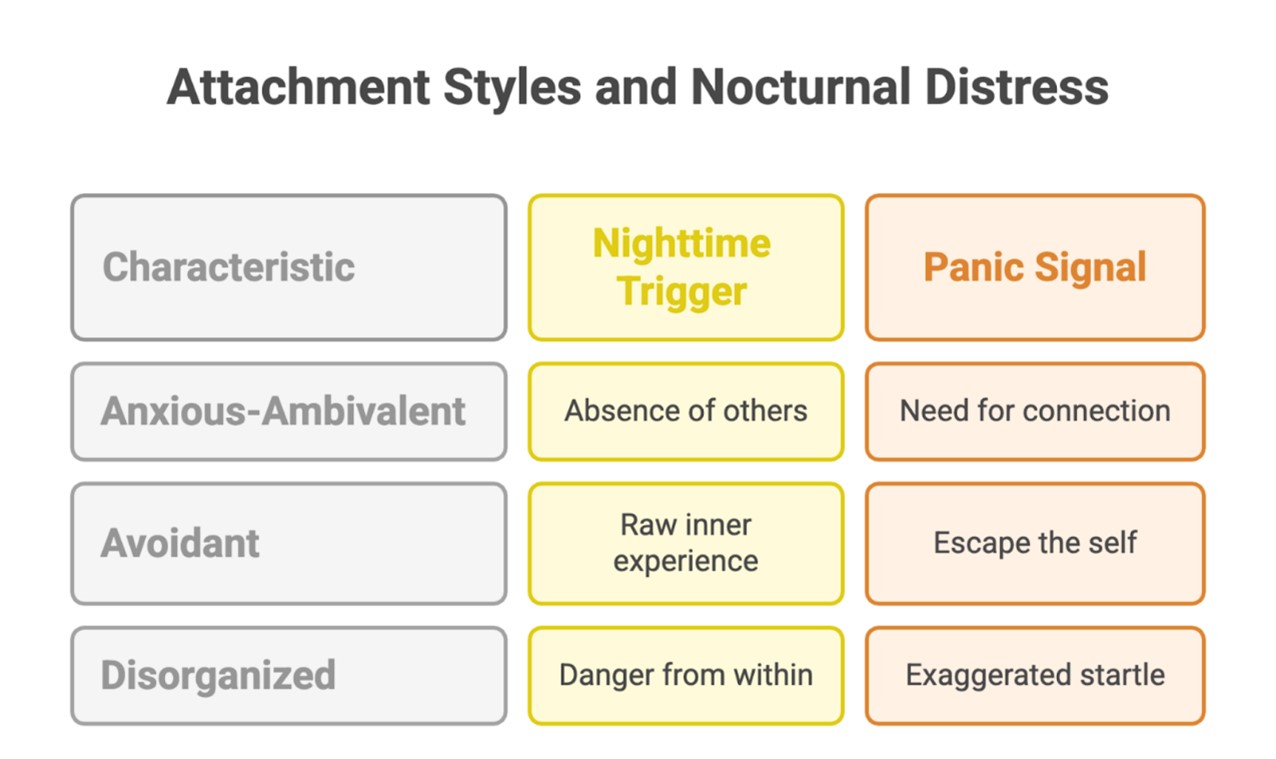
How Attachment Styles Trigger Nocturnal Distress
The panic response at night can be understood as the body's way of re-enacting an early unmet need, specifically related to the unavailability of a caregiver during a moment of distress.
- Anxious-Ambivalent Attachment
This style is characterized by a deep fear of abandonment and a constant need for external validation or reassurance.
- The Nighttime Trigger: The silence and physical absence of others (the partner, family, or social sphere) is unconsciously experienced as abandonment. The lack of immediate co-regulating nervous systems triggers intense separation anxiety.
- The Panic Signal: The nervous system yells: "I need someone where is my source of safety/soothing?" The panic attack becomes an urgent, somatic plea for connection and rescue, mirroring the experience of being left alone when threatened as a child.
- Avoidant Attachment
This style is marked by a deep discomfort with emotional closeness and vulnerability. The primary coping mechanism is to self-soothe by shutting down emotional and physical needs.
- The Nighttime Trigger: Avoidant individuals rely heavily on external distraction, work, or intellectualization to stay detached from internal discomfort. Night forces them into the confinement of their own raw inner experience. Being "stuck" with uncomfortable feelings (e.g., sadness, loneliness, or dependency) feels threatening and intolerable.
- The Panic Signal: The system panics when the defenses fail. The urge is to escape the self. The panic attack provides a physical, external focus (heart rate, breathing) that diverts attention away from the underlying emotional threat.
- Disorganized (Fearful-Avoidant) Attachment
This style involves an internal conflict where the person seeks proximity but fears it.
- The Nighttime Trigger: They may experience an overwhelming sense of danger coming from within the relational context (e.g., being in bed next to a partner can trigger unconscious fear). The body is hypervigilant but has no reliable strategy for soothing.
- The Panic Signal: This is often experienced as an exaggerated startle response or waking with a profound sense of being unheld or unsupported, even when physically safe.
The Reframing: An Attachment Wound Seeking Repair
When these old patterns are activated, the panic response signals three core deficits in the individual's capacity for emotional regulation:
- "I don’t know how to soothe myself." (A deficit in self-regulation.)
- "I don’t trust that I’m safe without external regulation." (A failure to internalize safety.)
- "My vital needs for safety are being ignored." (The attachment wound.)
Understanding this layer is therapeutically empowering. It helps clients shed the burden of shame and self-blame. Nighttime panic is not a moral failure of coping or a weakness; it is a profound, physiological manifestation of an attachment wound demanding attention and repair.
The Differential Diagnosis Checklist
When you’re waking up in panic at night, it’s natural to assume it must be “anxiety” or something emotional. But the truth is, several physiological conditions can look and feel almost identical to nocturnal panic, especially in the first disorienting seconds of waking. This is why, at Coach For Mind, we always remind our clients: Your symptoms are real, and they deserve a thorough, whole-body understanding, not assumptions.
Nocturnal panic is often a diagnosis of exclusion, which means we first rule out medical conditions that can mimic or directly trigger the same sensations: jolting awake, gasping for air, racing heart, chest tightness, or sudden fear. Many people spend years thinking something is “wrong with their anxiety,” when the real issue is undiagnosed sleep apnea, nighttime blood pressure spikes, low oxygen, or severe reflux.
Below are the most important medical conditions to rule out when nighttime anxiety becomes frequent, severe, or confusing. This is not about finding something “wrong” with you, it’s about making sure nothing important is being missed, and giving you the right path forward.
Sleep Apnea
One of the most important steps in understanding nocturnal panic is ruling out Obstructive Sleep Apnea (OSA). Unlike a psychological panic attack, OSA is a medical condition in which a person’s airway repeatedly collapses during sleep, causing breathing to stop or become dangerously shallow.
During an apneic episode, the airway closes, oxygen levels drop sharply, and the brain senses a threat of suffocation. To survive, it triggers a massive fight-or-flight response like a surge of adrenaline and cortisol, strong enough to jolt the person awake just enough to take a breath. This creates an experience that can feel indistinguishable from a panic attack, even though the root cause is entirely mechanical and oxygen-driven.
Nocturnal anxiety and OSA can feel similar when you wake up, but their internal triggers and body sensations differ. Primary nocturnal anxiety is usually driven by internal stress chemistry like cortisol spikes, emotional dreams, or racing thoughts and people often describe waking with dread, tension, or the fear of losing control.
OSA, on the other hand, is triggered by hypoxia or lack of oxygen. People tend to jolt awake gasping, choking, or feeling as if they were drowning or suffocating. Morning dry mouth, chronic fatigue, loud snoring, and witnessing/being told that you stop breathing during sleep are key differentiators. OSA episodes often happen in deeper sleep stages when the muscles relax and the airway collapses repeatedly throughout the night.
When to Seek Medical Help
If you notice (or a partner notices) symptoms like waking with a forceful gasp or choke, pauses in your breathing during sleep, unrefreshing sleep, or excessive daytime tiredness, it’s important to undergo a formal sleep study. OSA is not something that can be healed with anxiety techniques, grounding exercises, or talk therapy. It is a potentially life-threatening medical condition linked to hypertension, stroke, and heart disease and it must be treated by addressing the underlying breathing mechanism.
Anxiety and Nocturnal Hypertension
Research has established a strong link between anxiety disorders and significantly higher nocturnal and early morning blood pressure (BP).
If your anxiety is linked to nocturnal hypertension, you are experiencing a significant cardiovascular risk factor. If you frequently wake up with a pounding heart, monitor your blood pressure at night or upon waking to discuss a potential "riser-type" pattern with your doctor.
Gastroesophageal Reflux Disease (GERD)
Severe acid reflux (GERD) can trigger anxiety-like symptoms at night. When stomach acid backs up while lying down, it can irritate the vagus nerve (the main nerve regulating the calming parasympathetic system). This irritation causes symptoms that mimic a panic attack, including chest tightness and shortness of breath. If your anxiety is accompanied by a burning sensation, chronic cough, or sour taste,addressing GERD may alleviate nocturnal panic.
At Coach For Mind, we work collaboratively with medical professionals whenever needed, because nocturnal panic is often a mix of psychological and physiological factors. Our clinicians know when to treat, when to screen, and when to refer so nothing important gets missed.
What My Panic is Protecting Me From Feeling: An Internal Family Systems View
When you wake up in terror, it’s easy to think: “Something is wrong with my body. Why is it doing this to me?” But often, the panic isn’t a glitch, it’s your mind trying to protect you from feelings that once felt overwhelming.
Think of panic as a part of you that is doing whatever it can to keep you away from emotional pain you’ve had to carry for a long time. It’s not trying to harm you. It’s trying to shield you.
When deeper, more vulnerable feelings start to surface like loneliness, shame, grief, or the fear of not being good enough - this protective part steps in fast. It creates a physical crisis so you focus on your racing heart, your breathing, or the urge to run, instead of facing those painful emotions.
In other words:
- When you feel profound loneliness, your panic might rush in with shortness of breath or tightness in your chest.
- When you feel deep shame or unworthiness, your panic may whisper, “You’re having a heart attack,” because that fear feels easier to fight than the older emotional wound.
- When old grief or anger rises, panic might send a surge of adrenaline like something your body knows how to react to.
- When there are unmet needs for comfort or safety, panic might make you want to jump out of bed and escape.
The body chooses physical fear because it feels more manageable than emotional fear.
You can fight a racing heart. You can breathe through dizziness. But facing old emotional pain can feel much scarier, especially at night when everything is quiet.
So the panic steps in like a firefighter, pulling you away from the emotional flames. Not because you’re weak but because some part of you believes you’re not ready to feel what’s underneath. With the right support, you can slowly teach your system that those deeper feelings aren’t dangerous anymore and when that happens, this protective panic often softens on its own.
Immediate Action: The Post-Panic Recovery Protocol
When you wake up in a state of terror, your immediate goal is not to force sleep, but to rapidly down-regulate the nervous system and shift from the sympathetic (fight or flight) state back to the parasympathetic (rest and digest) state.
Rule of Thumb: If you wake up and cannot fall back asleep within 15–20 minutes, get out of bed. Your bed must be reserved for sleep and intimacy only.
- Grounding Techniques: Anchor Yourself in Reality
The amygdala, the brain's fear center, is highly active during a panic attack. Grounding techniques force the brain to focus on the present, physical reality rather than the intrusive, irrational thoughts.
The 5-4-3-2-1 Technique (Adapted for Darkness):
- 5 Things You Can Feel: Focus on the weight of the blanket, the texture of the sheets, and the coolness of the air on your skin.
- 4 Things You Can Hear: Focus intently on distant sounds, clock ticking, traffic, the hum of the refrigerator.
- 3 Things You Can See (in the dark): Notice the faint outlines of furniture, the sliver of light under the door.
- 2 Things You Can Smell: Focus on the scent of your pillow or lotion.
- 1 Thing You Can Taste: Take a sip of cold water.
- Vagus Nerve Stimulation for Rapid Calm
The Vagus Nerve is the highway of the parasympathetic nervous system. Stimulating it can override the panic response quickly.
- Controlled Breathing: Use the 4-7-8 method. Inhale deeply through the nose for 4 seconds,hold the breath for 7 seconds, and exhale slowly through the mouth for 8 seconds. Repeat 5–10 times.
- Cold Exposure: Splash cold water on your face, particularly around the eyes and temples.This triggers the mammalian dive reflex, which instantly lowers the heart rate.
- Humming or Gargling: The vagus nerve runs through the throat. Humming loudly or gargling vigorously stimulates the nerve, promoting a rapid return to a parasympathetic state.
- Cognitive Reappraisal in the Dark
When the irrational thoughts strike, practice cognitive reappraisal, validating the feeling without believing the thought.
- Acknowledge the physical state: "My amygdala is really working hard tonight. I feel panic."
- Challenge the thought: "This thought is extreme because it's 3 AM and my stress hormones are high. It is not a rational reflection of reality." *Repeat a mantra: "I am safe. This is a chemical reaction, and it will pass."
Long-Term Prevention
Preventing the 3 AM adrenaline dump requires managing your stress hormone profile throughout the day, especially in the evening. This structured approach targets the HPA axis hyperactivation that fuels nocturnal panic.
Evening Audit (6 PM to 8 PM)
The goal of this window is to ensure cortisol levels begin their necessary descent before bedtime.
| Time | Action | Rationale |
|---|---|---|
| 6:00 PM | Last Caffeine/High Sugar Intake. | Caffeine has a half-life of 5–6 hours. Consuming it too late prevents evening cortisol from dropping and promotes hyperarousal. |
| 7:00 PM | Stop Intense Exercise. | High-intensity exercise elevates cortisol and adrenaline. Switch to gentle movement (yoga, walking). |
| 8:00 PM | Last Meal/Snack. | Eating too close to bedtime, especially high-carb meals, increases the risk of nocturnal hypoglycemia. If you must snack, choose protein/fat (e.g., small handful of nuts). |
Pre-Bed Routine (9 PM to 10 PM)
This is the critical phase for signaling safety to the nervous system.
- Screen Blackout: Turn off all blue-light emitting devices. Artificial light convinces your internal clock that it is daytime, disrupting your circadian rhythm.
- Worry Dump: Dedicate 10 minutes to writing down every worry, fear, and to-do list item in a journal. This externalizes the worry, preventing racing thoughts in bed.
Sleep Hygiene Fundamentals
Consistency is key to regulating the HPA axis.
- Consistent Schedule: Go to bed and wake up at the same time every day, even on weekends.
- Optimize the Environment: Ensure the room is dark (use blackout curtains) and quiet.
Limit Fluids: Reduce fluid intake in the hour before bed to minimize nocturnal awakenings for bathroom trips, which can interrupt sleep cycles and trigger anxiety.
Seeking Help: Professional Treatment Pathways
Lifestyle changes can make a meaningful difference, but when nocturnal panic becomes chronic or overwhelming, therapy often becomes the missing piece. At Coach For Mind, we use an integrated, trauma-informed approach because nighttime anxiety almost always has both body and mind components. Below is a clear guide to the therapies that help most with 3 AM panic, and why they work.
- Cognitive Behavioral Therapy for Insomnia (CBT-I)
CBT-I is the gold-standard treatment for chronic sleep difficulties, especially when anxiety and sleep feed into each other. How CBT-I helps nighttime panic:
It focuses on retraining the brain to associate the bed with rest rather than fear or alertness. It also helps break the cycle of “anticipatory anxiety”, the dread that builds before sleep.
CBT-I typically includes:
- Stimulus Control: Rebuilding the bed as a safe space used only for sleep.
- Sleep Restriction: Temporarily tightening your sleep window to increase sleep pressure and reduce nighttime wakefulness.
- Cognitive Restructuring: Untangling the anxious thoughts (“What if it happens again?”) that make nights feel dangerous.
CBT-I is especially powerful when panic is driven by hyperarousal and nighttime dread.
- EMDR (Eye Movement Desensitization & Reprocessing)
Best for clients whose nighttime panic is tied to trauma, nightmares, or awakenings that feel “emotion-driven.”
Why EMDR helps: Nighttime panic often happens during REM sleep, the same stage that processes emotional memories. When unresolved experiences surface, the brain can jolt the body awake.
EMDR helps by:
- Clearing fear memories that get reactivated during sleep
- Reducing emotional intensity around old experiences
- Allowing the brain to complete the processing it attempts at night
Clients often report fewer nightmares and far fewer “mysterious terror awakenings” after EMDR.
- Somatic Experiencing (SE)
Best for sudden body-first panic, trauma-related dread, or waking frozen rather than activated.
Why it works for nocturnal panic: Sometimes the body wakes in panic because it’s carrying old survival energy (fight, flight, or freeze) that never got released. SE helps the nervous system slowly complete these unfinished responses so it no longer “ambushes” you at night.
SE is especially effective when awakenings feel like:
- dread or heaviness
- paralysis or numbness
- an “energetic jolt” with no thoughts attached
Nighttime is often when defenses lower, so stored survival energy tries to surface. SE teaches the body how to release it safely.
- Polyvagal-Informed Therapy
Best for clients who wake in panic without thoughts, are highly sensitive to body sensations, or have attachment-related nighttime distress.
This therapy teaches you how to recognize when your nervous system shifts between safety, fight, flight, and shutdown. Nocturnal panic often involves a sudden jump into fight-or-flight during a sleep-stage transition.
Tools include:
- vagal toning exercises
- breath pacing
- tiny micro-movements
- grounding strategies for nighttime
Clients learn how to keep their physiology anchored so normal shifts in heart rate or breathing don’t trigger panic.
- Sensorimotor Psychotherapy / Somatic CBT
Best for people whose panic is triggered by physical sensations — like tightness, shallow breathing, or muscle tension during sleep.
Many people tense their chest, clench their jaw, or restrict their breath while sleeping without realizing it. These physical cues can wake the body in alarm.
Sensorimotor work teaches clients how to:
- release nighttime bracing patterns
- breathe more freely
- soften chronic tension
- reduce “body-triggered” awakenings
It blends cognitive tools with body-awareness, making sleep more stable.
- Internal Family Systems (IFS)
Best for clients who feel their nighttime panic is symbolic or emotionally loaded like fear that comes “out of nowhere” or panic that feels like it stands in for something else.
IFS sees panic as a protective part of you, one that steps in dramatically when vulnerable emotions start to surface at night.
IFS helps by:
- soothing the panic part instead of fighting it
- gently exploring what the panic is protecting you from
- restoring safety internally so the panic doesn’t need to react so strongly
This approach is incredibly effective at night because emotional material naturally rises when the world is quiet and other distractions fade.
- Psychodynamic / Attachment-Focused Therapy
Best for repeated 3 AM awakenings linked to loneliness, abandonment fears, or a sense of being “unheld” at night.
Night amplifies old emotional patterns, especially those formed in childhood. Feelings of helplessness, separation, or self-criticism often echo into the darkness.
This therapy helps clients understand:
- what the panic protects them from feeling
- which attachment wounds get activated at night
- why the darkness and stillness feel threatening
- how to heal these patterns so the night feels safer
Instead of treating symptoms, it targets the root fear.
Pharmacological & Supplement Support
Sometimes medication or supplements can provide short-term relief while deeper therapeutic work unfolds. Medications that may help:
- SSRIs/SNRIs: Reduce overall anxiety and stabilize your baseline.
- Beta-blockers: Helpful when physical symptoms (pounding heart, surges) dominate.
Important: Always consult your physician before starting medication or supplements, especially if you’re already under treatment.
Conclusion: Reclaiming the Night
Waking up with anxiety in the middle of the night is a distressing signal that your body’s stress response system is overloaded. It is a terrifying experience, and the exhaustion it causes is profound.
But the challenge is manageable. By understanding the physiological mechanisms of the 3 AM cortisol spike, the HPA axis feedback loop, and the critical need to rule out conditions like Sleep Apnea and nocturnal hypertension, you gain the authority to seek the right solutions.
Start today by implementing the Cortisol Reset Protocol to stabilize your evening hormones. If the physical terror persists, prioritize a comprehensive medical evaluation. Taking control of your sleep environment and utilizing immediate nervous system regulation techniques, like Vagus Nerve stimulation, empowers you to break the cycle and finally reclaim the restorative peace you deserve.
If nocturnal panic has started to take over your nights, you don’t have to navigate it alone. At Coach For Mind, our trauma-informed clinicians specialize in nighttime anxiety and sleep-related panic, including those navigating social anxiety treatment. If your nighttime episodes involve sudden intense fear with physical symptoms, our panic attack treatment page explains exactly what's happening and how we treat it. You can begin with a gentle, 15-minute discovery call to understand what your system needs.
Why Choose CoachForMind for Your Healing Journey?
At CoachForMind, we understand the unique experiences and how exhausting panic attacks can be.
Experienced and Licensed Psychologists: We are a team of licensed RCI-registered (Rehabilitation Council of India) mental health counselors. Our team is well-experienced in various forms of therapies such as CBT, IFS, DBT, EMDR, Somatic and Narrative Therapy. Our expertise is verifiable, and our commitment to ongoing training ensures we deliver the most current and effective treatments.
Personalized, Client-Centered Approach
We are dedicated to treating our clients in the best-suited way, carefully curated as per the client's needs, and adhering to one-on-one, client-centered therapy. Every individual is different and every story is unique. We move beyond a one-size-fits-all model to create a safe, non-judgmental space where genuine healing can occur.
Scientific, Evidence-Based Techniques
Our treatment plans and therapeutic methods are based on highly researched scientific findings such as Cognitive Behaviour Therapy, Narrative Therapy, and Dialectical Behaviour Therapy. We believe in transparency and utilizing methods that have been proven effective in treating trauma. Our goal is to empower our clients, making them the authors of their own stories rather than passive recipients of a diagnosis.
Quality Service Grounded in Empathy
We at CoachForMind ensure quality services in our treatment regime and therapeutic approaches. Our clients hold most value to us, so we ground our techniques in empathy while maintaining the highest level of professionalism and confidentiality. We help you slow down the inner chaos so you can finally listen to what the masked trauma has been trying to tell you.
Begin with a free 15-minute discovery call For more information, please visit our website or contact us directly at [email protected]
Written by Ms Akshita: Psychotherapist at Coach For Mind
FAQs
What you’re experiencing is real, and it is not your fault. Many people feel embarrassed or confused by these episodes, especially when they don’t notice daytime stress. But nighttime panic is often the result of internal stress, not visible, “on the surface” stress.
During the 2–4 AM window, your body naturally goes through physiological shifts:
- Cortisol begins its pre-dawn rise. If your system is already overwhelmed, even quietly, this rise can become a surge.
- The emotional brain wakes faster than the rational brain. So fear hits before logic comes online.
- Sleep-stage transitions increase sensitivity to internal sensations like heart rate, temperature, or blood sugar changes.
You may feel completely “fine” during the day because the mind is busy and defended. At night, everything slows down, and the nervous system reveals what it has been holding.
How Coach For Mind helps:
Our therapists identify which “subtype” of nighttime panic you’re experiencing (biological, trauma-based, dream-induced, or attachment-related). We use CBT-I, Polyvagal Therapy, Somatic Experiencing, EMDR, and IFS to stabilize your physiology and help your system finally relax into nighttime safety.
Night magnifies fear not because you’re weak, but because the conditions of night remove your psychological armor:
- No distractions
- No co-regulation from others
- No external structure
- Lower prefrontal activity
- Higher emotional sensitivity
In the dark and quiet, the nervous system is left with what it suppressed all day. The fear feels worse because the system interprets isolation + darkness + reduced defenses as danger, even when you’re safe.
The dread builds because your body remembers previous nighttime terror and anticipates the next episode, this is called anticipatory anxiety. You can break this cycle, gently and systematically.
How Coach For Mind helps::
- CBT-I to reset your sleep–fear association
- Polyvagal grounding to make your body feel safe at night
- Psychodynamic & attachment therapy to understand why darkness triggers old emotional patterns
- Somatic therapy to help your body unlearn panic
- IFS to soothe the part of you that fears being unprotected at night
Therapy helps your nights feel less like a threat and more like a place of rest again.
Absolutely and this is more common than people realize. During sleep, especially REM, the brain tries to process emotional memories and unfinished feelings. When these memories are overwhelming, the brain may jolt you awake in panic, dread, or confusion.
This can look like:
- Panic during or after dreams
- Sudden fear with no dream recalled
- Waking in freeze or immobility
- Rising dread that feels “ancient” or symbolic
This is the nervous system saying: “The things I’ve held for years are surfacing. Please don’t ignore me.”
How Coach For Mind helps:
We specialize in trauma-focused approaches that directly address this:
- EMDR for unresolved memories that activate at night
- IFS to understand what the panic part is protecting you from
- Somatic Experiencing / Sensorimotor for freeze-based awakenings
- Nightmare rescripting for recurrent themes
- Attachment-focused therapy for abandonment or aloneness themes at night
You don’t need to relive trauma, you just need a therapist trained to guide you safely through how it shows up in your body at night.
Therapy costs at Coach For Mind vary depending on the therapist’s experience, specialization, and training, and typically range from ₹1500 to ₹4500 per session. We believe mental health care should feel accessible, not overwhelming, so we offer therapists across different pricing tiers, from early-career clinicians who are deeply trained and closely supervised, to senior therapists with advanced expertise in trauma, panic disorder, EMDR, and somatic therapies.
A higher fee doesn’t necessarily mean a “better” therapist, it just reflects different levels of experience and specialization. What matters most is fit, safety, and how understood you feel. Your needs, not your budget, define the match.
How Coach For Mind helps you choose
During your discovery call, we talk about your symptoms, history, goals, and preferences, and then match you with someone whose style, modalities, and training fit best. If you need EMDR, somatic therapy, or advanced trauma work, we pair you with a specialist. If you prefer a gentler, skills-focused approach, we have therapists for that too. The aim is simple: you get the right care, with the right therapist, at the right pace and price point for you.
It is overwhelming, however you can explain it like this: “My body goes into a survival reflex while I’m half asleep. It’s not a choice and not something I can control with willpower. It’s a biological stress response that feels terrifying even though I logically know I’m safe.”
Nighttime panic:
- Is physiological, not dramatic
- Happens before you’re fully conscious
- Is linked to trauma, sleep physiology, and cortisol rhythms
- Is often misunderstood by people who haven’t experienced it
Sometimes partners minimize because they don’t know the difference between “anxiety” and a nocturnal fight-or-flight surge.
How Coach For Mind helps:
If you want, our therapists can help you:
- find the right words to explain your experience,
- involve your partner in sessions if helpful,
- teach them how to respond supportively instead of dismissively,
- reduce the shame and misunderstanding around nighttime panic.
Lifestyle changes can absolutely make a meaningful difference, sometimes even reducing the intensity or frequency of nighttime panic. But they rarely reach the deeper nervous system patterns that keep panic looping. Adjusting your sleep routine, managing evening cortisol, stabilizing nighttime blood sugar, correcting reflux or breathing issues, and improving the sleep environment can all help your body feel safer. These changes support the physiology of sleep and help your system stay calmer as the night unfolds.
But nighttime panic is almost never only physiological. The emotional and relational layers, unprocessed feelings, trauma that resurfaces when defenses drop, attachment fears that get louder in the dark, catastrophic interpretations of body sensations, and the protective parts of you that trigger panic to avoid deeper pain - cannot be healed through lifestyle changes alone. This is the territory where therapy becomes essential. Therapy helps the body and mind relearn safety, process what rises at night, and gently shift the patterns that fuel the 3 AM alarm response. In other words: lifestyle changes are supportive, but therapy is transformational.
At Coach for Mind, we intentionally combine both. You receive a structured plan that supports your physiology: sleep hygiene, evening cortisol regulation, somatic calming techniques, while also engaging in trauma-informed therapy to work with the emotional roots of nighttime panic. Our clinicians integrate CBT-I, EMDR, IFS, somatic therapies, and polyvagal approaches to help you retrain your nervous system, release old patterns, and finally feel safe at night. You don’t have to choose between “body work” and “mind work.” You deserve a path that holds both with compassion, personalization, and clinical expertise—so your nights can become restful again, not something to fear.


