
Understand Codependency & How to Set Unshakeable Boundaries
Do you ever feel like you're constantly walking on eggshells around family, holding your breath, sacrificing your own needs just to keep a fragile peace, or perpetually managing someone else's swirling emotions? If so, please know this: you are absolutely not alone. For countless individuals, the intricate dance of family dynamics can feel less like a loving embrace and more like a subtle, suffocating trap, where, as many have voiced, "boundaries are tantamount to treason," and "everyone is required to accept unwanted help, advice, scrutiny, etc."
This isn't just a touch of family drama; it's the deeply, often invisibly, painful reality of codependency, a pervasive issue that leaves individuals feeling profoundly "stuck," sometimes "used as emotional punching bags, " and, perhaps most acutely, utterly drained to the bone.
But what if, just what if, you could truly break free?
For so many, the winding journey to understanding and healing from codependency begins with a quiet, yet profound, realization: "I've felt a stuckness my entire life, but at least now I know where it stems from." This guide, I hope, will serve as your compass, offering a comprehensive exploration of what codependency truly means, the absolutely vital role of healthy boundaries, and actionable, deeply human strategies to reclaim your precious autonomy. My heartfelt goal for you? To help you gently foster truly interdependent, healthy family relationships, and, crucially, to build a life where your well-being isn't just a fleeting option, but a deeply rooted, non-negotiable priority.
So, let's take a deep breath together and delve into the nuances of defining and enforcing these life-giving boundaries, thoughtfully navigating cultural complexities, and, most importantly, building the resilient, authentic self you so richly deserve.
Traditional definitions of codependency focus on behavioral symptoms like people-pleasing and poor boundaries, without addressing the underlying trauma that creates these adaptive responses. From a trauma-informed perspective, codependency is a relational pattern where self-worth becomes intertwined with others' approval, needs, and emotions, a survival strategy developed in response to early relational wounding.
Dr. Bessel van der Kolk's research in The Body Keeps the Score reveals that trauma fundamentally alters brain development, particularly affecting areas responsible for self-awareness and emotional regulation. This neurobiological understanding explains why survivors of childhood trauma often struggle to maintain a coherent sense of self separate from others' needs and emotions.
As van der Kolk notes, early relational trauma teaches us that "we have to suppress our own needs to survive", a pattern that becomes integrated into our relational blueprint and doesn't disappear with age.
What Codependency Really Looks Like
Codependency is a deeply learned behavioral pattern, often woven into dysfunctional family systems and passed down through generations. At its core, it involves an excessive focus on others' needs, feelings, and problems at the expense of one's own identity, well-being, and emotional health.
Professor Sandra C. Anderson describes it as "a pattern of painful dependence on compulsive behaviors and on approval from others in an attempt to find safety, self-worth, and identity." Individuals caught in this dynamic frequently derive their sense of worth from being desperately needed by others, particularly in "rescuer" or "fixer" roles.
Core Characteristics of Codependency
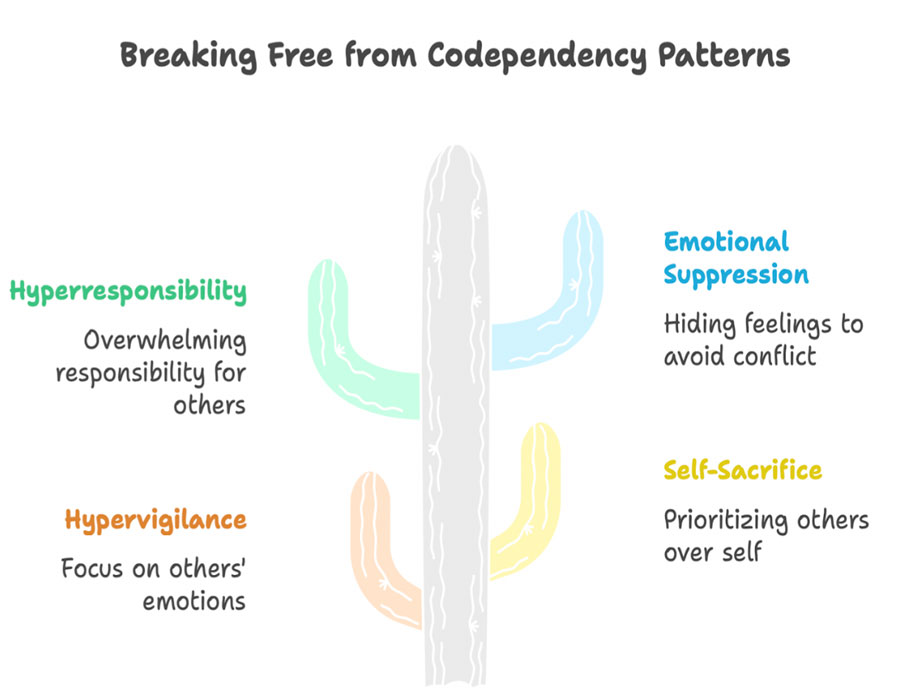
Research has identified four primary themes that define codependent behavior patterns:
- Hypervigilance: to others' emotional states to predict and prevent potential abandonment: One's attention remains fixated on other people's needs, feelings, and external activities rather than their own internal experience.
- Self-Sacrifice: Individuals consistently prioritize others' needs at the expense of their own, deriving self-worth from external approval and validation. This pattern often manifests as chronic people-pleasing and an inability to say "no" without guilt.
- Control and Hyperresponsibility: There's an overwhelming sense of responsibility for others' happiness and well-being. Codependent individuals often believe others are incapable of caring for themselves, leading them to take over responsibilities that aren't theirs.
- Emotional Suppression: Personal needs and feelings are consistently suppressed to avoid upsetting others. This emotional constraint creates internal resentment while maintaining external harmony.
Recognizing Codependent Patterns
In families, these patterns can be particularly insidious because they often masquerade as "love," "loyalty," or "duty." Common indicators include:
- Excessive People-Pleasing: You find yourself constantly chasing external validation and approval, often hearing yourself say "yes" when, deep down, you desperately want to scream "no", all to avoid conflict or the sting of disapproval. As one user so poignantly shared, "My mom plays 20 questions with me on the phone allllll the time and before I'd answer every single question because I felt like I had to."
- Difficulty Setting Boundaries: An almost paralyzing inability to define and maintain personal limits, leading inevitably to deep, simmering resentment and the feeling of being perpetually overwhelmed, like a ship adrift in a storm. Family members, sadly, may perceive your courageous attempts at boundaries as nothing less than "treason" or deeply personal attacks.
- Enmeshment: A disorienting blurring of personal boundaries where individual identities seem to merge, making it incredibly hard to distinguish one person's feelings, thoughts, and unique experiences from another's. This often manifests as an intense, almost suffocating, emotional over-involvement.
- Controlling or Rescuing Behaviors: You carry the heavy burden of feeling responsible for others' happiness, their choices, or their problems, and constantly, almost instinctively, attempt to "fix" them. As a community member wisely put it, "Codependency is a compulsion to control and rescue others by repairing their problems."
- Low Self-Esteem and Identity Loss: Your very self-worth feels like it's derived from others' opinions or needs, leading to a fragile, almost translucent, sense of self and a heartbreaking feeling of being utterly "lost" without a relationship to define your existence.
- Chronic Anger or Resentment: This is often a simmering byproduct of deeply unmet needs and long-suppressed emotions. Anger can silently build up from constantly giving, giving, giving, and so rarely, if ever, receiving. While some see anger as a sign of frustration, others identify chronic anger as a clear codependent trait in the "giver" role.
- Fear of Abandonment: An intense, gripping fear of being rejected or left utterly alone, driving the relentless need to maintain relationships at any cost, even when every fiber of your being knows they are profoundly unhealthy.
- Difficulty Expressing Needs and Feelings: A persistent tendency to suppress your own authentic emotions and desires, fueled by the belief that they are unimportant or, worse, that they will inevitably cause conflict.
- "Flying Monkeys": A vivid term borrowed from The Wizard of Oz, referring to those family members who, perhaps unknowingly, enable the primary codependent or dysfunctional person by carrying messages, enforcing unspoken rules, or otherwise subtly, or not so subtly, interfering with an individual's brave attempts at independence.
It's crucial, truly crucial, to grasp that "codependents subjugate themselves and their own needs, have weak boundaries, and tend to lose themselves in trying to fix or maintain a dysfunctional relationship. They enable the dysfunction." This profound, often painful, recognition is the very first, most powerful step toward courageously breaking the cycle.
AM I CODEPENDENT?
Self-Assessment and Recognition
Relational Patterns (Score: 0=Never, 1=Sometimes, 2=Often, 3=Always)
- I feel responsible for other people's emotions and happiness ___
- I have difficulty saying "no" without feeling guilty or anxious ___
- I prioritize others' needs even when my own are urgent ___
- I feel uncomfortable when I'm not helping or fixing someone ___
- I work hard to avoid conflict, even when it means sacrificing my needs ___
- I need approval from others to feel good about myself ___
- I feel lost or empty when not in a relationship ___
- I stay in unhealthy relationships because I fear abandonment ___
Internal Experience (Score: 0=Never, 1=Sometimes, 2=Often, 3=Always)
- I struggle to identify my own feelings and needs ___
- I feel anxious or guilty when doing something for myself ___
- I have difficulty making decisions without input from others ___
- I feel like I can't be my authentic self around others ___
- I suppress my emotions to keep others comfortable ___
- I doubt my perceptions and second-guess myself ___
- I feel unworthy of love unless I'm useful to others ___
- I experience chronic anxiety about relationships ___
Childhood and Family History (Score: 0=No, 1=Yes)
- I grew up in a family with addiction, mental illness, or dysfunction ___
- I felt responsible for managing family emotions or problems as a child ___
- I received inconsistent love or care from caregivers ___
- I was criticized, shamed, or rejected for expressing needs ___
Scoring:
- 0-20: Minimal codependent patterns
- 21-35: Moderate codependent tendencies
- 36-50: Significant codependent patterns
- 51+: Severe codependency requiring professional support
Understanding Your Results Through a Trauma-Informed Lens
High scores are not indicators of pathology, they reflect intelligent adaptations to difficult circumstances. If you scored high, recognize that:
- Your nervous system developed these strategies to keep you safe
- These patterns served important protective functions
- Healing involves honoring these parts while gently transforming their roles
- Recovery is possible with appropriate support and patience with the process
How Codependency Develops
Codependency typically originates from childhood environments characterized by chaos, unpredictability, or emotional unavailability. Children who grow up in families with addiction, mental health issues, or other dysfunctional behaviors develop codependent traits as survival mechanisms.
How Trauma Shapes Codependent Responses
- Unmet Developmental Needs: When children's physical and emotional needs go unmet, they internalize the belief that something is wrong with them rather than blaming their caregivers. This leads to seeking relief through caretaking behaviors that elicit praise and affection.
- Parentification: Many codependent adults were "parentified" as children, forced to take on adult responsibilities like managing family emotions or caring for siblings. This role reversal prevents normal identity development and creates adults who feel responsible for everyone's well-being.
- Attachment Disruption: Inconsistent or threatening caregiving creates insecure attachment patterns. Children learn that love must be earned through performance, sacrifice, or managing others' emotions.
Research consistently demonstrates the link between childhood trauma and adult codependency. Studies with nursing professionals found that those who experienced childhood abuse, including emotional neglect, emotional abuse, verbal abuse, physical abuse, and sexual abuse, scored significantly higher on measures of codependency as adults.
The Protective Function of Codependent Patterns
Every codependent behavior serves a protective function developed during childhood to ensure survival and connection. Understanding these functions helps reduce shame and supports compassionate healing:
- People-Pleasing: Originally developed to avoid caregiver rejection or anger, this behavior ensured safety in unpredictable emotional environments.
- Boundary Difficulties: When expressing needs or saying "no" historically led to abandonment or punishment, boundary-setting becomes associated with mortal threat.
- Emotional Responsibility: Taking responsibility for others' emotions provided a sense of control in chaotic family systems, creating the illusion of safety.
- Fear of Abandonment: This intense fear reflects accurate childhood assessment that rejection meant literal or emotional annihilation.
What's Happening in Your Brain When You're Codependent
Have you ever wondered why it feels so hard to break free from codependent patterns, even when you know they're hurting you? New brain research is revealing fascinating answers that help explain why codependency can feel so compulsive and difficult to change.
Your Brain on Codependency
Scientists have recently been able to peek inside the brains of people in codependent relationships using advanced brain imaging technology. What they found helps explain why breaking these patterns feels so challenging, and why you shouldn't blame yourself for struggling with them.
When Your Decision-Making Brain Goes Offline
In one groundbreaking study, researchers showed people images of their addicted loved ones while monitoring their brain activity. They discovered something remarkable: in family members with higher levels of codependent behaviors, a crucial part of the brain called the left dorsomedial prefrontal cortex showed much less activity.
Think of this brain region as your "wise advisor", it's the part that helps you make good decisions when emotions are running high, especially in relationships. It's what helps you step back and think clearly about what's really best for everyone involved, rather than just reacting from emotion.
When this area becomes less active, it's like having your internal wisdom counselor take a break right when you need them most. This explains why you might find yourself making choices you later regret, or feel like you "know better" but can't seem to act on that knowledge when you're with your loved one.
The Addiction-Like Pull of Caretaking
Perhaps even more eye-opening is what happens in your brain's reward system during codependent behaviors. Brain scans show that when codependent individuals focus on caring for their partners, the same reward centers that light up during drug addiction become highly active.
Here's what's happening: caretaking floods your brain with feel-good chemicals, dopamine (which drives motivation and craving) and oxytocin (often called the "bonding hormone"). This creates a genuine chemical reward cycle that makes being needed feel incredibly satisfying, even addictive.
This isn't a character flaw or weakness, it's your brain's natural reward system responding to behaviors that feel meaningful and connecting. The problem is that this same system can keep you hooked on unhealthy relationship patterns because they provide such a powerful neurochemical payoff.
Your Fear Center in Overdrive
At the same time, another part of your brain, the amygdala (your internal alarm system), goes into overdrive when there's any threat of conflict or disconnection in the relationship. This ancient part of your brain is designed to detect danger and motivate you to do whatever it takes to stay safe.
This ancient part of your brain is designed to detect danger and motivate you to do whatever it takes to stay safe. In codependent relationships, your amygdala interprets relationship conflict or your partner's distress as a genuine threat to your survival. This triggers an intense drive to fix, rescue, or maintain peace at almost any personal cost. It's like having a smoke alarm that's so sensitive it goes off every time, it's responding to normal relationship challenges.
How Trauma Rewires Your Brain for Codependency
Now you might be wondering: why do some people develop these brain patterns while others don't? The answer often lies in how early experiences literally reshape the developing brain.
Understanding this connection is crucial because it helps explain not just what's happening in your brain now, but how these patterns got established in the first place. Childhood trauma physically alters the growing brain in ways that can predispose someone to codependent relationships later in life.
When Your Executive Center Gets Disrupted
Prefrontal Cortex Problems: Under normal circumstances, this area develops throughout childhood and into early adulthood, gradually gaining the ability to regulate emotions, make thoughtful decisions, and maintain healthy boundaries.
But chronic childhood stress disrupts this development. It's like trying to build a house while the foundation keeps shifting. When a child's brain is constantly responding to stress, trauma, or unpredictable caregiving, the prefrontal cortex doesn't develop properly. This makes it incredibly difficult as an adult to recognize your own needs, maintain healthy boundaries, or make decisions that prioritize your wellbeing.
This explains why that "wise advisor" part of your brain goes offline around your loved one, it may never have developed the full capacity to stay online during emotional situations.
How Your Alarm System Gets Stuck on High Alert
Similarly, when children experience ongoing trauma or stress, their amygdala becomes chronically overactive. This survival mechanism helped you navigate dangerous or unpredictable situations as a child, but it creates adults who live in a constant state of vigilance for relational threats.
As an adult, you're always scanning for signs that someone might be upset, disappointed, or pulling away. This hypervigilance drives people-pleasing behaviors as a way to avoid perceived danger. Your brain learned early that relationship disruption could mean actual danger, so it developed hair-trigger responses to prevent that from happening.
When the Attachment System Goes Haywire
Early trauma also disrupts the normal development of the attachment system, the part of your brain that governs how you connect with others. When children experience inconsistent, frightening, or absent caregiving, their attachment system develops in ways that create adults who simultaneously crave and fear intimacy.
This creates the push-pull dynamics common in codependent relationships. You desperately want connection (because we're wired for it), but intimacy also feels dangerous (because early intimate relationships were unsafe). Codependent caretaking becomes a way to maintain connection while keeping emotional distance, you can be close through helping without being vulnerable through authentic intimacy.
When Your Stress Response System Gets Confused
Finally, chronic childhood stress dysregulates your body's main stress response system (called the HPA axis). This makes it difficult to distinguish between actual threats and perceived threats in relationships. Your brain might interpret your partner having a bad day as the same level of emergency as a genuine crisis.
This dysfunction keeps your nervous system in a constant state of reactivity, making it nearly impossible to respond to relationship challenges from a place of calm wisdom rather than fear-based urgency.
The Codependent Cycle: Understanding the Pattern That Keeps You Trapped
If you've ever found yourself caught in codependent relationships, you might recognize a frustrating pattern that seems to repeat itself over and over. You start with the best intentions, wanting to help and connect, but somehow end up feeling resentful, exhausted, and more disconnected than ever. Then, just when you think you might break free, you find yourself right back where you started.
This isn't a sign of weakness or failure. It's actually a predictable cycle that has deep psychological and neurobiological roots. Understanding this pattern can help you recognize where you are in the cycle and begin to make different choices.
Stage 1: Merging - Losing Yourself in Someone Else's World
What It Looks Like
The cycle typically begins with merging, a process where you gradually lose yourself in another person's needs, emotions, and problems. This might start subtly: you find yourself constantly thinking about your partner's mood, anticipating their needs, or feeling responsible for their happiness.
You might notice yourself:
- Constantly checking in on how they're feeling
- Changing your plans to accommodate their needs
- Feeling anxious when they're upset, even if it has nothing to do with you
- Making their problems your problems
- Losing touch with your own feelings, needs, and desires
Why It Feels So Good at First
Merging often feels wonderful initially because it activates those reward centers in your brain we discussed earlier. The dopamine and oxytocin flood makes you feel needed, important, and deeply connected. For many people, especially those with trauma histories, this intense focus on another person can feel like the deepest intimacy they've ever experienced.
There's also a sense of purpose and identity that comes from being someone's "rescuer" or primary support. When your own sense of self feels shaky or unclear (often due to early trauma), defining yourself through your role in someone else's life can feel stabilizing and meaningful.
The Hidden Cost
But merging comes with a hidden psychological cost. When you consistently prioritize someone else's internal world over your own, you begin to lose contact with your authentic self. Your own feelings get pushed aside, your needs become secondary, and your identity becomes increasingly dependent on the other person's state of being.
This isn't conscious, it happens gradually, like slowly turning down the volume on your own inner voice until you can barely hear it anymore.
Stage 2: Resentment - When Your True Self Fights Back
The Inevitable Build-Up
After a period of merging, something interesting happens: your authentic self begins to rebel. Deep down, part of you knows that constantly suppressing your own needs isn't sustainable or healthy. This creates an internal conflict between your people-pleasing behaviors and your genuine feelings and needs.
Resentment begins to build when:
- You realize you're always giving but rarely receiving
- You feel taken for granted despite all your efforts
- You notice the other person doesn't seem to consider your needs
- You feel exhausted from constantly managing someone else's emotions
- You start feeling angry but can't express it directly
Why You Can't Just Say What You Feel
Here's where the brain patterns we discussed earlier become crucial. Remember that overactive amygdala? It interprets any potential conflict as a genuine threat. So even though you're feeling resentful, your brain's alarm system warns you that expressing these feelings could lead to abandonment or rejection.
This creates a terrible bind: you're angry about constantly sacrificing yourself, but you're too scared of conflict to address it directly. So the resentment stays trapped inside, often manifesting as:
- Passive-aggressive comments
- Internal criticism of the other person
- Feeling like a martyr
- Physical symptoms like headaches or stomach problems
- Emotional numbness or depression
Stage 3: Collapse or Flip - When the False Self Can't Hold
The Breaking Point
As trauma expert Teal Swan notes, there comes a point when the false self, the people-pleasing, constantly-giving version of yourself, simply cannot hold any longer. The internal pressure of suppressed authenticity eventually reaches a breaking point.
This collapse or flip can take several forms:
Emotional Collapse
- Complete emotional shutdown or numbness
- Feeling overwhelmed and unable to function
- Depression or anxiety that seems to come out of nowhere
- Physical exhaustion that rest doesn't fix
Withdrawal and Avoidance
- Suddenly pulling away from the relationship
- Becoming distant or cold without explanation
- Avoiding conversations or interactions
- Feeling like you need space but not knowing how to ask for it
Rebellion and Anger
- Explosive anger that surprises even you
- Saying things you later regret
- Acting in ways that feel completely out of character
- Pushing the other person away through conflict
Why This Feels So Confusing
This stage often feels chaotic and confusing because it represents your authentic self finally breaking through the people-pleasing facade. Part of you feels relief at finally expressing your true feelings, but another part feels guilty and scared about disrupting the relationship.
The other person in the relationship is usually just as confused, because from their perspective, your behavior seems to come out of nowhere. They may not have realized how much you were sacrificing or how resentful you'd become.
Stage 4: Return to Pleasing - When Shame Drives You Back
The Power of Shame
After the collapse or flip, shame typically floods in. You might find yourself thinking:
- "I'm being selfish and unreasonable"
- "I hurt them and I'm a terrible person"
- "I'm asking for too much"
- "Maybe I don't deserve better treatment"
- "I should just be grateful for what I have"
This shame is often rooted in early messages about your worth and what kinds of behaviors are "acceptable." If you learned as a child that your needs were burdensome or that love was conditional on being "good," expressing authentic feelings can trigger deep shame.
The Return to Familiar Patterns
Driven by this shame and fear of losing the relationship, you typically return to pleasing behaviors, often with even more intensity than before. You might:
- Apologize excessively for your "unreasonable" behavior
- Overcompensate by being extra giving and accommodating
- Minimize your own needs even more than before
- Promise (to yourself and them) that you'll "do better"
- Convince yourself that you were wrong to want more
Why the Cycle Repeats
This return to pleasing temporarily reduces the anxiety and shame, but it doesn't address the underlying issues that created the resentment in the first place. In fact, it often makes things worse because now you're not only suppressing your needs, you're also carrying shame about having expressed them at all.
The neurochemical rewards of caretaking kick in again, your alarm system calms down because conflict has been avoided, and the cycle begins anew, often more intensely than before.
Why This Cycle Feels Addictive
As you mentioned, this cycle mirrors trauma bonds, where closeness feels intoxicating but separation feels annihilating. This happens because the cycle creates an intermittent reinforcement pattern, the most addictive type of reward system.
The intoxicating closeness comes during the merging phase, where you feel deeply needed and connected. The dopamine and oxytocin create genuine euphoria, especially after periods of distance or conflict.
The annihilating separation happens during the collapse/flip phase, where the threat of losing the relationship activates your deepest fears of abandonment. Your amygdala interprets this as a survival threat, creating panic-level anxiety.
The Chemical Roller Coaster
This creates a chemical roller coaster in your brain:
- High highs when you're needed and close
- Low lows when there's conflict or distance
- Relief flooding when you return to pleasing and closeness is restored
This pattern literally rewires your brain to crave the intensity of the cycle, even though it's ultimately harmful.
Codependency in Indian Families: When "Sanskaras" Become Survival Strategies
In Indian society, what we call codependency often masquerades as cherished cultural values, seva (selfless service), tyaag (sacrifice), and parivarik dharma (family duty). The joint family system, revered as our civilizational strength, can become a breeding ground for generational codependency patterns that get passed down as "good sanskaras" while slowly suffocating individual authenticity across generations.
The Cultural Camouflage of Codependency
Indian families excel at wrapping codependent patterns in the language of virtue. The daughter-in-law who loses herself serving everyone is praised as an "ideal bahu." The son who never questions family decisions is celebrated as "sanskari." The mother who sacrifices everything for her children is worshipped as "Mata." These roles, while containing genuine love, often mask deep patterns of enmeshment where individual identity becomes secondary to family harmony.
The joint family system, with its emphasis on collective decision-making and shared resources, creates fertile ground for codependent dynamics. Children learn early that love equals compliance, that questioning elders brings shame, and that individual needs are selfish luxuries. The cultural concept of "log kya kahenge" (what will people say) becomes a powerful tool for maintaining codependent patterns across generations.
Generational Transmission in Indian Context
The trauma roots of Indian family codependency often trace back to historical upheavals, Partition, colonization, economic hardship, or caste-based discrimination. Families that survived through collective sacrifice and rigid role adherence pass down these survival strategies as sacred traditions. The great-grandmother who endured poverty by suppressing her needs teaches her granddaughter that a woman's fulfillment comes through serving others.
Gender plays a crucial role in this transmission. Sons inherit the burden of family honor and financial responsibility, learning that their worth depends on providing for everyone. Daughters absorb the message that their value lies in maintaining relationships, managing family emotions, and ensuring everyone's comfort. These gendered codependent patterns get reinforced through religious stories, cultural celebrations, and family expectations.
The Sacred and the Suffocating
Indian spiritual traditions emphasize concepts like selfless service and "ahimsa" (non-violence), which can be misinterpreted to justify codependent behavior. The idea of "putting family first" becomes so sacred that questioning it feels like betraying centuries of wisdom. Yet true spiritual texts speak of "svadharma", following one's authentic path, which contradicts the self-abandonment that characterizes codependency.
The arranged marriage system often perpetuates codependent patterns by prioritizing family compatibility over individual compatibility. Couples learn to relate through their families rather than developing direct intimacy, creating marriages where emotional needs get mediated through parents and extended family members.
The Essential Role of Healthy Boundaries
If codependency represents the problem, then healthy boundaries are a crucial part of the solution. Boundaries are essential for emotional well-being, self-respect, and fostering functional, reciprocal relationships. Rather than walls that isolate, boundaries are clear lines that protect your physical, emotional, and mental space while preventing resentment and emotional exhaustion.
Understanding What Boundaries Really Are
Boundaries are fundamentally about self-assertion and self-respect, not about controlling or changing others. They are a clear, compassionate way of communicating what behaviors you find acceptable—and what crosses the line—allowing both you and the other person to maintain your distinct identities. Healthy boundaries help you honor your own needs and authenticity, while also signaling to others that you value the relationship enough to preserve it without sacrificing yourself. In essence, boundaries are a bridge: they protect your well-being while keeping your connections intact.
Types of Essential Boundaries
Physical Boundaries: Your personal space, comfort with touch, and right to physical privacy.
Emotional Boundaries: Protection from having your feelings dismissed, invalidated, or used as an "emotional punching bag." This includes not taking responsibility for others' feelings.
Mental/Intellectual Boundaries: Respect for your thoughts, opinions, and beliefs without allowing others to invalidate or dominate them.
Time/Energy Boundaries: Protection of your time and energy from being over-committed or drained by others' demands.
Material Boundaries: Your personal possessions and financial resources.
The Cost of Missing Boundaries
Without clear boundaries, individuals in codependent relationships often find themselves in situations like "managing my parent's anxiety [as] a full-time job that I didn't realize I had", a relentless task that leads to burnout and desire to avoid family altogether. Setting boundaries becomes an act of self-reclamation, allowing you to reclaim your energy and focus on your own life.
As this reddit user shared,
“I grew up without boundaries because the people who raised me had a really f-ed up idea of what love is. They hid behind the ideas of perfectionism and care... I had to learn to love myself first and set boundaries that honored my needs.”
Codependency vs. Healthy Relationships
Understanding the distinction between codependency and healthy interdependence is crucial for recovery. While both involve caring for others, the underlying motivations and patterns differ significantly.
| Healthy Interdependence | Codependent Patterns |
|---|---|
| Mutual Support: Both people give and receive emotional support, with a natural balance of dependence and independence | One-Sided Giving: One person does most emotional labor while receiving little in return |
| Individual Identity: Each person maintains their own sense of self, interests, and friendships outside the relationship | Identity Fusion: The codependent person's identity becomes wrapped up in the relationship, losing touch with their own needs |
| Healthy Boundaries: Partners respect each other's limits and communicate needs clearly without guilt or manipulation | Boundary Violations: Boundaries are non-existent or constantly violated, with guilt used as control |
This comparison reveals that healthy relationships involve mutual respect and individual autonomy, while codependent patterns create imbalance and loss of self. Recognizing these differences is the first step toward establishing healthier relationship dynamics.
The Boundary Blueprint: A Step-by-Step Guide to Reclaiming Your Family Relationships
Setting boundaries, especially with the intricate tapestry of family, can feel incredibly daunting, can't it? It's a common fear, knowing that family members often "don't take kindly to boundaries and get offended," and may even declare, with a dismissive wave, "they won't follow them." However, this blueprint is designed to be your practical, compassionate companion, offering actionable steps to navigate this challenging, yet utterly essential, process.
Step 1: Self-Awareness and Identifying Your Needs
Before you can even begin to draw those invisible lines, you must first understand, truly understand, what precious parts of yourself you need to protect. This requires a gentle, yet brave, journey of introspection and self-awareness.
- Journaling: Make it a practice to regularly write about those moments when you felt resentful, utterly drained, or deeply violated. What specifically happened? What did you wish, in that moment, you had done or said? Let your pen be your confidante.
- Identify Your "Non-Negotiables": What are those absolute, unwavering limits beyond which you simply cannot, must not, compromise your well-being? This could be about intrusive personal questions, the relentless stream of unsolicited advice, or specific, draining behaviors.
- Recognize Your Feelings: This is vital: validate your own emotions. Those persistent feelings of "stuckness," of being a "burden," or that constant hum of anxiety are not just fleeting moods; they are powerful, undeniable signals that your boundaries are being crossed, perhaps repeatedly.
Step 2: Defining Your Boundaries Clearly
Once you've tuned into your needs, the next step is to articulate your boundaries with precision and clarity. Remember, vague boundaries are like whispers in the wind, easily ignored and, sadly, easily crossed.
- Be Specific: Instead of the broad "Don't be so intrusive," try the clear and direct, "Please don't ask about my finances." Instead of "Stop giving unsolicited advice," try a more empathetic, yet firm, "I appreciate your concern, but I'm not looking for advice right now; I just need you to listen."
- Focus on Your Behavior, Not Theirs: This is a subtle but powerful shift. Frame your boundaries around what you will do or not do, rather than trying, fruitlessly, to control their actions. For example, "I will end the call if the conversation turns to my personal relationships" rather than "You need to stop asking about my relationships."
Step 3: Communicating Boundaries Assertively (The "I Statements" Approach)
Effective communication is absolutely critical here. Assertive communication is clear, respectful, and direct, using those powerful "I statements" to express your needs authentically, without resorting to blame.
- Use "I Statements": This simple structure can be incredibly empowering: "I feel [emotion] when [specific behavior] because [impact on you]. I need [your boundary/request]."
- Example: "Mom, I feel utterly overwhelmed when you ask me 20 questions about my day right after I come home. I really need some time to decompress before I can truly chat."
- Example: "I appreciate your concern, but I'm not going to discuss my career choices with you anymore. I need you to respect my decisions on this."
- Keep It Concise: As one community member wisely advised, "You don't need to explain the why. Just be firm. There’s no need to explain. Just be curt." Over-explaining, while tempting, often provides more unwelcome opportunities for debate or subtle manipulation.
- Prepare for Pushback: This is a tough but necessary truth. Family members, especially those deeply accustomed to codependent dynamics, may react with a storm of anger, a flood of guilt trips, or dramatic emotional outbursts. As one user shared, "My mother's response would be to become an emotional wreck her way of shutting me up." Remember, and this is crucial, their reaction is not, and never has been, your responsibility.
Step 4: Enforcing Boundaries with Consistent Consequences
Ah, this is often where many of us falter, isn't it? It's a crucial, often overlooked, piece of the puzzle. Stating a boundary is one thing; consistently, courageously enforcing it is another entirely. Consequences, crucially, are not punishments; they are the natural, protective outcome when a boundary is crossed, and they exist solely to safeguard your well-being.
- Follow Through: If you bravely state a boundary, you must follow through with the consequence if it's violated. Inconsistency, unfortunately, subtly teaches others that your boundaries are merely optional suggestions. As one community member wisely advised, "Be firm, consistent and discuss as little as possible. Remember that NO is a complete answer."
- Specific Scenarios and Consequences:
- Unsolicited Advice/Scrutiny: "If you continue to offer advice after I've said I don't need it, I will change the subject or, if necessary, end the conversation."
- Intrusive Questions: "If you ask about my personal life after I've asked you not to, I will gently say, 'That's not something I'm comfortable discussing,' and if it persists, I will politely excuse myself from the call/room."
- Emotional Punching Bag/Monologues: As one user candidly put it, "My person will go into scripts of monologues that I have already sat through numerous times so I am getting better at straight up interrupting them." You can bravely say, "I need to interrupt you here. I've heard this before, and I really need to move on." If it stubbornly persists, "I can't continue this conversation right now. I'm going to hang up/leave."
- Guilt Trips/Emotional Blackmail: "I understand you're upset, and I hear that. However, I'm not responsible for your feelings. I'm choosing to prioritize my well-being." If the behavior continues, gently disengage.
- Consistent Violations: For severe or repeated boundary violations, consider thoughtfully reducing contact (e.g., fewer visits, less frequent calls) or implementing a "gray rock" strategy (making yourself as uninteresting and unresponsive as possible to subtly avoid engagement).
- Boundaries are for You: Remember this deeply empowering truth: "Boundaries are about keeping you out of harmful situations as opposed to controlling or modifying someone else's behaviour." The consequence, therefore, is for your protection and peace, not to punish them.
Step 5: Navigating Emotional Backlash and Guilt
When you bravely begin setting boundaries, please, expect resistance. It's almost inevitable. Family members may become angry, deeply upset, or try to expertly guilt-trip you. This, while undeniably uncomfortable, is a normal, even expected, part of the process of shifting old patterns.
- Their Emotions Are Not Your Concern: This is a profound, liberating truth to internalize. As one community member wisely shared, "Learn to accept that people may cut you out, be angry with you, get upset. Their emotions are not your concern. Relationships will change. That's ok, it's part of the process." This, truly, is a crucial mindset shift that will set you free.
- Embrace the "Angry/Rude Stage": For some, an initial phase of being "short" or even "almost rude" can feel like a natural, albeit awkward, part of learning to assert new boundaries. As one person candidly admitted, "It's natural to go through an angry/rude stage when you are learning how to assert new boundaries... it may be necessary in order to grow a backbone." Please know, this is often a temporary phase as you courageously build your confidence and find your authentic voice.
- Self-Compassion: This entire process is incredibly, profoundly difficult. So, please, be exquisitely kind to yourself. You are unlearning a lifetime of deeply ingrained patterns, a Herculean task. Celebrate every small win, every tiny step forward, with the same warmth you'd offer a cherished friend.
Cultural Crossroads: Navigating Codependency & Boundaries in Diverse Family Systems
The already intricate challenge of setting boundaries is often compounded, sometimes dramatically, by cultural factors. Many vibrant cultures, such as Desi (South Asian), Asian, or various Christian communities, place an incredibly high value on family cohesion, deep respect for elders, and a strong collective identity. In these rich contexts, individual autonomy can, sadly, be perceived as selfish, and boundaries as deeply disrespectful or even, as we've heard, an act of "treason."
- Acknowledge Unique Pressures: In cultures where "the nuclear family dynamic can keep these patterns circulating," or where "the overarching theme is codependency and dysfunction" in multi-generational households, the pressure to conform can feel immense, almost crushing. The beautiful idea of "it takes a village" can sometimes, tragically, blur into unhealthy enmeshment.
- Indirect Communication and "Soft" Boundaries: In cultures where direct confrontation is highly, sometimes vehemently, discouraged, consider exploring more indirect or "soft" boundary-setting techniques. These can be incredibly effective and respectful:
- "I'm busy": Instead of a direct "no," stating you have other commitments or prior engagements can sometimes be a more culturally acceptable and gentler way to decline.
- "I'll think about it": This buys you precious time to thoughtfully consider a request and formulate a response that feels right for you, rather than an immediate, pressured "yes."
- Enlisting Allies: If possible, discreetly discuss your needs with a more understanding family member who might be able to subtly, yet effectively, support your boundaries within the family structure.
- Focus on "We" or "Family Well-being": Frame your boundaries not as your personal desire, but as something that will ultimately benefit the family's harmony or your ability to contribute effectively. For example, "I need to take care of myself so I can be fully present and truly contribute to the family later."
- Internal Work is Key: Regardless of external reactions, your internal commitment to your boundaries is paramount, your true north. While some community opinions suggest, "Don't be obsessing about boundaries, esp. in a gregarious Indian family system. It will lead to conflicts and walkouts," remember that prioritizing your mental health is a universal, undeniable need. It's about finding that delicate, yet powerful, balance that honors your heritage while fiercely protecting your own well-being.
Beyond Blood: Cultivating Your 'Chosen Family' for Codependency Recovery
One of the most isolating, heartbreaking aspects of codependency is that gnawing feeling that you're utterly alone in your struggle, especially if your family of origin is resistant to change, or perhaps even actively against it. The poignant question, "How should I stop being codependent when my family is against you and I don't have social life as well?" highlights a common, deeply painful reality for many. This, my friend, is precisely where cultivating a "chosen family", a vibrant, supportive network of healthy relationships outside your biological family, becomes not just helpful, but absolutely vital.
- Addressing Isolation: Codependency, like a shadowy vine, often thrives in isolation. Building a diverse, nurturing network of caring adults can beautifully "fill the gaps that even the best parents have," offering new perspectives and unconditional support.
- Seek Out Healthy Relationships: Consciously look for friends, partners, mentors, and community members who genuinely demonstrate:
- Mutual Respect: They truly value your opinions and choices, even when they differ from their own.
- Reciprocity: Giving and receiving flow in a healthy, balanced rhythm; it's never a draining, one-sided dynamic.
- Support for Autonomy: They celebrate your independence and actively encourage your personal growth, rather than stifling it.
- Clear Boundaries: They model healthy boundaries in their own lives, showing you what authentic self-respect looks like.
- Support Groups: Organizations like Codependents Anonymous (CoDA.org) offer invaluable support, a shared tapestry of experiences, and practical, real-world tools for recovery. These groups provide a safe, understanding space where you can truly be seen, heard, and validated, often for the very first time in your life.
- The Power of Interdependence: A healthy chosen family fosters a beautiful interdependence, where individuals are self-reliant and strong, but also deeply capable of forming profound, meaningful connections based on mutual respect and genuine support, rather than desperate need or controlling impulses. This contrasts sharply with the often-suffocating "nuclear family dynamic [that] can keep these patterns circulating."
The Six Principles of Trauma-Informed Codependency Recovery
Principle 1: Safety First
Physical and emotional safety form the foundation of all healing work. Before addressing codependent behaviors, establish:
Internal Safety Signals:
- Learn to recognize when your nervous system feels calm versus activated
- Practice grounding techniques: 5-4-3-2-1 sensory grounding, deep breathing, progressive muscle relaxation
- Develop a daily routine that supports nervous system regulation
External Safety Assessment:
- Evaluate current relationships for safety and respect
- Identify environments and people that feel genuinely safe
- Remove or limit exposure to unsafe situations when possible
Emotional Safety Practices:
Emotional Safety Practices:
- Create a judgment-free internal dialogue
- Practice self-compassion when noticing codependent patterns
- Remind yourself: "This behavior developed to protect me"
Principle 2: Trustworthiness and Transparency
Building trust with yourself and others requires consistent, reliable actions. Practice:
Self-Trust Building:
- Keep small promises to yourself (e.g., morning walk, bedtime routine)
- Honor your feelings without judgment
- Practice making decisions based on internal guidance rather than external approval
Transparent Communication:
- Use "I" statements to express feelings: "I feel overwhelmed when..."
- Share your needs clearly and directly
- Be honest about your limitations and boundaries
Principle 3: Peer Support and Mutual Self-Help
Healing happens in community. Connect with others who understand the codependency journey:
- Join Codependents Anonymous (CoDA) meetings
- Participate in trauma-informed therapy groups
- Find online communities focused on healthy recovery
- Seek relationships with people committed to their own healing
Principle 4: Collaboration and Choice
You are the expert in your own experience. Recovery involves:
- Choosing your own pace for healing
- Deciding which therapeutic approaches resonate
- Maintaining agency over your recovery process
- Collaborating with therapists rather than being "fixed" by them
Principle 5: Empowerment and Voice
Reclaiming your voice is central to codependency recovery:
- Practice expressing preferences in low-risk situations
- Use assertive communication techniques
- Set boundaries that honor your needs
- Trust your perceptions and internal guidance
Principle 6: Cultural, Historical, and Gender Considerations
Recognize how cultural and family patterns influence codependent behaviors:
- Explore family-of-origin dynamics and generational patterns
- Understand how gender roles may have shaped expectations
- Consider cultural factors that influence relationship patterns
- Honor your unique background while building healthier patterns
Daily Nervous System Regulation Practices
Morning Grounding Ritual (5-10 minutes):
- Place feet flat on floor, hands on heart
- Take 5 deep breaths, feeling your body's contact with chair/floor
- Ask: "What does my body need today?" Listen without judgment
- Set one small intention for self-care
Boundary Check-In (Throughout day):
- Before responding to requests, pause and breathe
- Ask: "What do I need right now?"
- Practice: "Let me think about that and get back to you"
- Notice body sensations when considering saying "no"
Evening Integration (10-15 minutes):
- Journal about moments you honored vs. abandoned yourself today
- Celebrate small wins (saying no, expressing a need, taking space)
- Send compassion to parts that felt scared or reactive
- Set intention for tomorrow's self-care
Weekly Exercises for Deeper Work
Exercise 1: Inner Child Dialogue
- Find a childhood photo of yourself or visualize yourself as a child
- Ask this younger part: "What did you need that you didn't receive?"
- Listen with compassion, without trying to fix or minimize
- Respond from your adult Self: "I see how hard you tried to stay safe"
- Ask: "What do you need from me now?"
- Make a commitment to meet one need this week
Exercise 2: Boundary Practice Scenarios
Start with low-risk situations and gradually build confidence
Week 1: Practice saying "no" to telemarketers or store offers
Week 2: Decline a social invitation you're not excited about
Week 3: Express a preference about where to eat or what movie to watch
Week 4: Set a limit with someone about time, communication, or behavior
After each practice:
- Notice physical sensations and emotions that arise
- Send compassion to anxious or guilty parts
- Celebrate the courage to practice self-advocacy
Exercise 3: Needs and Feelings Identification
Many codependent individuals struggle to identify internal experience
Daily Practice:
- When the alarm sounds, pause and ask:
- "What am I feeling right now?" (Use emotion wheel if needed)
- "What do I need right now?" (Rest, connection, space, food, movement)
Monthly Deeper Integration Work
Exercise 4: Family-of-Origin Exploration
Understanding the roots of codependent patterns
- Draw your family system, including extended family members who lived nearby
- For each person, note:
- Their emotional availability (scale 1-10)
- Their primary coping strategies when stressed
- The role you played in relation to them
- Reflect on patterns:
- Where did you learn that love required sacrifice?
- When did you learn to suppress your needs?
- What messages did you receive about your worth?
- Write a compassionate letter to your younger self acknowledging the difficulty of your situation
Exercise 5: Values Clarification
Reconnecting with authentic desires separate from others' expectations
- Complete a values card sort (available online) or list your top 10 values
- For each value, ask:
- Is this truly mine or something I learned I "should" value?
- How am I currently honoring/dishonoring this value?
- What would change if I fully embraced this value?
- Choose one value to focus on this month
- Take daily actions that align with this value, regardless of others' reactions
Trauma-Informed Therapeutic Approaches
While self-help strategies and supportive groups are invaluable, offering immense comfort and guidance, healing from deeply ingrained codependent patterns often, quite simply, requires professional guidance. Therapy provides a safe, confidential, and truly transformative space to gently explore the very roots of your codependency, to process any lingering trauma, and to lovingly learn new, healthier coping mechanisms.
Choosing the Right Therapist and Approach
The key, in this deeply personal journey, is finding a therapist who specializes in family systems, trauma, and, crucially, codependency, someone who truly gets it.
Therapeutic Modalities:
- Cognitive Behavioral Therapy (CBT): This helps you bravely identify and challenge those negative thought patterns and behaviors that have become so entwined with codependency.
- Dialectical Behavior Therapy (DBT): A powerful approach focusing on emotional regulation, distress tolerance, interpersonal effectiveness, and mindfulness, all absolutely crucial skills for setting boundaries and gently managing intense emotions.
- EMDR: EMDR therapy specifically targets traumatic memories that shaped codependent patterns:
- Target memories: Times when love was conditional on performance
- Transform beliefs: From "I'm only worthy when useful" to "I'm inherently valuable"
- Heal attachment wounds: Process experiences of emotional unavailability or rejection
- Regulate nervous system: Learn new responses to relational triggers
- Internal Family Systems (IFS) Therapy: IFS provides a non-pathologizing framework for understanding codependent patterns:
- Manager Parts: Protective parts that control situations to prevent pain
- Firefighter Parts: Reactive parts that use caretaking to distract from distress
- Exile Parts: Wounded parts carrying childhood pain and trauma
- Self-Leadership: Accessing core Self to provide internal healing and guidance
- Somatic Approaches: Since trauma is stored in the body, healing must include somatic work:
- Body awareness: Learning to recognize physical sensations and their meaning
- Nervous system regulation: Techniques to calm hypervigilance and anxiety
- Boundary embodiment: Feeling boundaries in the body, not just thinking about them
- Trauma release: Safe processing of stored traumatic activation
- Psychodynamic Psychotherapy: This explores how your past experiences and unconscious patterns subtly influence your current relationships and behaviors, offering profound insights.
- What to Look For: Seek a therapist who is deeply empathetic, genuinely validating, and truly empowering, and who wisely avoids judgmental or overly academic language. Look for someone who acknowledges the profound, deep-seated nature of family trauma and codependency, understanding the complex layers involved.
- What a Typical Therapeutic Journey Entails:
- Initial Assessment: A compassionate exploration of your history, family dynamics, and specific challenges.
- Psychoeducation: A gentle learning process about codependency, trauma, and the beautiful dance of healthy relationship dynamics.
- Skill Building: Developing practical, real-world tools for communication, emotional regulation, and, of course, boundary setting.
- Processing Trauma: Working through those past experiences that, perhaps unknowingly, contributed to your codependent patterns.
- Integration: Lovingly applying new insights and behaviors to your real-life situations, leading to lasting, profound change.
Remember, as we've noted, "healing from codependency requires a commitment to self-awareness, establishing and maintaining boundaries, and often involves professional therapeutic support." Please, don't hesitate to reach out for help if you ever feel overwhelmed, lost, or simply stuck. Your well-being is worth it.
As this reddit user shared,
“Therapy helped me identify my codependent behaviors and provided tools to set boundaries. It was a slow process, but it made a significant difference in my relationships.”
The Long-Term Transformation: Embracing Interdependence
Breaking free from codependency, you'll come to understand, is not a finite destination but a continuous, evolving journey, leading to profound, beautiful long-term transformations far beyond mere "emotional freedom." It's about gracefully moving from a state of suffocating enmeshment to one of healthy, vibrant interdependence, where you stand as a whole, autonomous individual, beautifully capable of forming deep, authentic connections rooted in genuine respect.
- Authentic Relationships: You'll find yourself, almost magically, attracting and nurturing relationships based on mutual respect, unwavering trust, and genuine connection, rather than desperate need or heavy obligation. Your existing relationships will either bravely transform or, sometimes, gently fall away, making sacred space for healthier, more life-giving dynamics.
- Enhanced Self-Worth and Identity: With your inner compass lovingly recalibrated, your self-worth will become intrinsic, an unshakeable truth, no longer dependent on the fickle winds of external validation. You'll simply know who you are and what you stand for, with quiet confidence.
- Emotional Resilience: You'll gracefully develop the profound capacity to manage your own emotions effectively, to navigate conflict constructively, and to recover from life's inevitable setbacks with newfound strength and wisdom.
- Breaking Generational Cycles: One of the most powerful, truly awe-inspiring outcomes is the ability to "break their family's multi-generational codependency trait," ensuring that healthier, more loving patterns are passed on to future generations. This, my friend, is a profound, enduring legacy of healing.
- Navigating Grief and Loss: This journey, inevitably, often involves grieving the loss of old relationship dynamics, and sometimes, the painful, yet necessary, loss of relationships themselves. It's a natural and deeply necessary part of the process of making space for something better. Allow yourself to feel this grief without judgment, understanding that it's part of making space for something healthier, more authentic.
- Supporting a Loved One: If you are a non-codependent partner or family member bravely trying to support a loved one overcoming codependency, please remember these gentle truths:
- Educate Yourself: Understand codependency deeply, but without enabling its patterns.
- Set Your Own Boundaries: Fiercely protect your own energy and wisely avoid slipping into a rescuer role.
- Encourage Professional Help: Gently support their journey to therapy or support groups, knowing it's their path.
- Practice Patience: Recovery is a long, often winding, non-linear process.
- Focus on Your Own Growth: Model healthy interdependence in your own life; it's the best lesson.
The transformation, truly, is profound: from feeling like a "burden" or an "emotional punching bag" to living a life brimming with self-respect, genuine joy, and authentic connection. It is a powerful testament to your incredible courage and unwavering commitment to a healthier, more authentic self.
The journey to untangle codependency and boundaries in families is, undeniably, a challenging one, often fraught with the sharp edges of frustration, the heavy cloak of guilt, and the very real fear of upsetting deeply ingrained dynamics. Yet, it is, simultaneously, a journey of immense liberation and profound self-discovery. By bravely understanding the insidious nature of codependency, by lovingly learning to define and enforce healthy boundaries, by thoughtfully navigating cultural complexities, and by courageously cultivating supportive relationships, you embark on a path toward a truly profound personal transformation.
Remember this, always: you are not alone in this struggle. The raw pain points shared by countless individuals, the relentless "20 questions," the exhausting "emotional wrecks," the gut-wrenching feeling that "boundaries are treason", are universal echoes of a shared human experience. Your unwavering commitment to self-awareness, your brave assertive communication, and your consistent follow-through are, in their purest form, an act of profound self-love. It's about breaking those generational cycles, reclaiming your precious identity, and ultimately, building a life of authentic connection and beautiful interdependence. Embrace this journey with courage and compassion; a healthier, more empowered you truly awaits.
Protecting Your Own Well-being
Avoid these common mistakes:
The Rescue Trap: Jumping in to solve their problems prevents them from developing their own coping skills
The Information Overload: Constantly sharing articles or advice about codependency can feel overwhelming and controlling
The Emotional Merger: Taking on their emotions as your own or feeling responsible for their progress
The Patience Pitfall: Waiting indefinitely for them to change while neglecting your own needs
Practical Dos and Don'ts
DO:
- Express your own needs clearly and directly
- Celebrate small steps toward healthier behavior
- Maintain your own friendships and interests
- Seek your own therapy or support if needed
- Trust their capacity for growth and healing
DON'T:
- Make decisions for them or take over their responsibilities
- Give unsolicited advice or constantly point out their patterns
- Threaten to leave unless they change (unless you mean it)
- Enable unhealthy behaviors by making excuses or cleaning up their messes
- Sacrifice your own well-being to accommodate their codependency
When to Seek Professional Guidance
Consider family or couples therapy if:
- The codependent patterns are significantly affecting your relationship
- You're struggling to maintain healthy boundaries
- There are children involved who may be affected
- You want to learn better communication and support strategies
Seek individual therapy if:
- You're developing your own codependent patterns in response
- You feel overwhelmed, resentful, or burned out from trying to help
- You're struggling with enabling behaviors you can't seem to stop
Special Considerations for Different Relationships
Supporting a partner:
- Balance patience with honest communication about your needs
- Consider couples therapy if both are committed to growth
- Maintain intimacy without taking responsibility for their emotional well-being
Supporting a family member:
- Respect cultural and family dynamics while maintaining boundaries
- Focus on long-term relationship health over short-term peace
- Model healthy behavior for other family members, especially children
Supporting a friend:
- Offer consistent, reliable friendship without trying to be their therapist
- Continue shared activities that don't revolve around their problems
- Be honest about your own limits and needs in the friendship
Remember: The most loving thing you can do is refuse to enable codependent behaviors while offering genuine support for their healing journey. Your own emotional health and well-being matter too, and taking care of yourself actually helps them more than sacrificing your needs does.
Why CoachForMind?
Experienced Psychologists: We are a team of licensed RCI-registered clinical psychologists. Our team is well-experienced in various forms of therapy such as CBT, DBT, EMDR therapy, and Narrative Therapy.
Personalized Approach: We are dedicated to treating our clients in the best-suited way, carefully curated as per the client's needs, and adhering to one-on-one, client-cantered therapy.
Scientific Techniques: Our treatment plans and therapeutic methods are based on highly researched scientific findings such as CBT, DBT, EMDR therapy and Narrative Therapy.
Quality service: We at CoachForMind ensure quality services in our treatment regime and therapeutic approaches. Our clients hold the most value to us, so we ground our techniques in empathy while maintaining professionalism.
Begin with a free 15-minute discovery call For more information, please visit our website or contact us directly at [email protected]
Written by Ms Tamana - Psychotherapist at Coach For Mind
FAQs About Codependency
Key signs you may be experiencing codependent patterns:
- External focus: Your attention remains primarily on others' needs, emotions, and problems rather than your own internal experience
- Self-sacrifice: You consistently prioritize others' needs while suppressing or ignoring your own
- Hyperresponsibility: You feel overwhelmingly responsible for others' happiness, problems, and emotional well-being
- People-pleasing: You have extreme difficulty saying "no" without guilt or anxiety
- Identity fusion: Your sense of self depends heavily on others' approval and validation
- Boundary difficulties: You struggle to know where you end and others begin
- Fear of abandonment: You'll sacrifice your needs to avoid real or perceived rejection
- Chronic stress, fatigue, or anxiety
- Digestive issues or headaches
- Feeling emotionally "numb" or disconnected from your body
- Stress-related health problems
Common cultural influences include:
Family-oriented cultures: May normalize excessive self-sacrifice and discourage individual needs or boundaries as "selfish"
Gender expectations: Cultural roles often reinforce codependent patterns, particularly for women who are expected to be primary caregivers and emotional managers
Religious or spiritual traditions: Some interpretations emphasize self-denial and serving others in ways that can reinforce unhealthy patterns
Collectivist societies: While interdependence is healthy, some cultural expressions may blur the line between cooperation and loss of individual identity
However, it's crucial to distinguish between:
- Healthy interdependence: Mutual support while maintaining individual identity and choice
- Cultural codependency: Loss of self and compulsive caretaking disguised as cultural virtue
Boundaries are NOT:
- Walls that shut people out
- Punishment or rejection of family
- Abandoning cultural values or responsibilities
- Selfish disregard for others' needs
- Clear communication about your limits and needs
- Taking responsibility for your own emotions and allowing others to do the same
- Honoring your well-being so you can genuinely care for others
- Creating safety for authentic connection to flourish
- "I love our family and want to contribute. I need to discuss how we can share responsibilities so everyone's needs are considered"
- "I care deeply about you and want our relationship to be healthy. When X happens, I feel Y and need Z"
- "I'm committed to our family's well-being, which includes taking care of my own health so I can be present for everyone"
Why families resist change:
- Your codependent behavior may have been serving others' unconscious needs
- Family systems naturally resist change to maintain homeostasis
- Others may fear they'll lose your caretaking or problem-solving
- Your healing may trigger others' own unhealed trauma
Focus on your own healing first: You cannot change others, but changing yourself inevitably shifts family dynamics
Expect and prepare for pushback: When you stop over-functioning, others may temporarily increase pressure to return to old patterns
Set loving but firm boundaries: "I love you and am no longer able to [specific behavior]. I'm happy to support you in [healthier alternative]"
Find external support: Work with trauma-informed therapists, join support groups, build relationships with others committed to growth
Practice patience: Family systems change slowly. Your consistent modeling of healthy behavior may inspire others over time
Protect your progress: Limit exposure to highly toxic family members during early recovery if necessary
Remember: You're not responsible for others' reactions to your healing. Your recovery benefits not just you but potentially future generations by breaking dysfunctional patterns.
Start Small and Build Gradually
Week 1-2: Internal boundaries
- Practice saying "let me think about that" instead of automatic "yes"
- Take 24-hour periods before responding to non-urgent requests
- Notice physical sensations when considering saying "no"
- Decline optional social invitations you don't genuinely want to attend
- Express preferences about small decisions (restaurant choices, movie selections)
- Set time limits on phone calls or visits when you're tired
- Communicate needs clearly: "I need some quiet time before family gatherings to be fully present"
- Set limits on advice-giving: "I care about you and trust your ability to handle this situation"
- Stop taking responsibility for others' emotions: "I can see you're upset. What support would be helpful?"
Instead of: "I won't do that anymore"
Try: "I want to find a way that works for both of us. Can we discuss some options?"
Instead of: "That's not my responsibility"
Try: "I care about you and believe you're capable of handling this. How can I support you without taking over?"
Instead of: "I need space from the family"
Try: "I love our family and want to be my best self when we're together. I'm going to take some time to recharge so I can be fully present"
Honor Cultural Values While Maintaining Boundaries
Acknowledge the relationship's importance: "Because I value our relationship, I want to be honest about my needs"
Frame boundaries as acts of love: "I'm setting this boundary because I want our relationship to be healthy and sustainable"
Offer alternatives: Instead of just saying no, suggest different ways to show care or support
Express gratitude: Acknowledge what you appreciate while still maintaining your limits
Understanding the Emotional Responses
Guilt often reflects:
- Old programming that equated self-care with selfishness
- Fear that others will be hurt or angry at your boundaries
- Internalized messages from childhood about being "good" or worthy
- Core beliefs about being "bad" for having needs
- Fear of being abandoned or rejected for authentic self-expression
- Internalized family or cultural messages about your role
Before Setting Boundaries:
- Ground yourself with 5-4-3-2-1 sensory technique
- Remind yourself: "I can care for others without sacrificing myself"
- Visualize setting the boundary with compassion for both yourself and the other person
- Breathe deeply and stay connected to your body
- Speak slowly and clearly
- Remember: "I'm being loving by being honest"
- Expect emotional reactions (yours and others') and prepare for them
- Journal about the experience without judgment
- Celebrate your courage in honoring your needs
- Reach out to supportive friends or therapist for validation
Instead of: "I'm being selfish"
Try: "I'm taking care of myself so I can genuinely care for others"
Instead of: "I'm hurting them"
Try: "I'm creating space for both of us to be authentic"
Instead of: "Good people don't have boundaries"
Try: "Healthy people have boundaries that honor everyone's dignity"
Long-term Guilt and Shame Healing
- Work with a trauma-informed therapist to process childhood messages about your worth
- Practice self-compassion meditation and exercises
- Join support groups where boundary-setting is normalized and celebrated
- Read and listen to recovery materials that validate your healing journey
Evidence-Based Approaches
EMDR (Eye Movement Desensitization and Reprocessing)
- Targets specific traumatic memories that shaped codependent patterns
- Transforms core beliefs like "I'm only worthy when useful"
- Heals attachment wounds from emotional unavailability or rejection
- Helps nervous system learn new responses to relational triggers
- Works with "parts" that drive codependent behaviors (managers, firefighters, exiles)
- Develops Self-leadership, responding from centered, compassionate core
- Non-pathologizing approach that honors protective strategies
- Builds internal harmony and authentic self-expression
- Address trauma stored in the body and nervous system
- Develop body awareness and internal safety signals
- Practice boundary-setting through embodied experience
- Regulate hypervigilance and chronic stress responses
- Teaches emotional regulation and distress tolerance
- Develops interpersonal effectiveness skills
- Particularly helpful for those who fear conflict or experience intense emotions
Cognitive Behavioral Therapy (CBT)
- Identifies and challenges automatic thoughts and beliefs
- Develops practical boundary-setting skills
- Helpful for anxiety and depression that often accompany codependency
- Focus on creating corrective relational experiences
- Heal early attachment wounds through therapeutic relationship
- Develop secure attachment patterns for future relationships
Codependents Anonymous (CoDA)
- 12-step program specifically designed for codependency recovery
- Provides peer support and structured recovery approach
- Available in-person and online worldwide
- Opportunity to practice new relational patterns in safe environment
- Learn from others with similar experiences
- Develop healthy connections with growth-oriented individuals
Questions to ask potential therapists:
- "How do you understand codependency from a trauma-informed perspective?"
- "What specific training do you have in treating attachment and relational trauma?"
- "How do you help clients develop internal safety and self-regulation?"
- "What is your approach to working with family-of-origin issues?"
- View codependent behaviors as intelligent adaptations rather than pathology
- Have specific training in trauma therapy
- Emphasize client choice and collaboration
- Understand nervous system regulation and somatic approaches
Realistic Timeline Expectations
First 3-6 Months: Safety and Stabilization
- Recognizing codependent patterns without shame
- Beginning basic boundary-setting practices
- Starting therapy and support groups
- Learning nervous system regulation techniques
- Common experiences: Initial anxiety about changes, guilt over self-care, relief at understanding patterns
- Working through childhood trauma and family-of-origin issues
- Developing stronger boundaries and communication skills
- Processing grief over unmet childhood needs
- Beginning to trust internal guidance over external approval
- Common experiences: Deeper emotional processing, some relationships changing or ending, increased self-awareness
- Building healthy, mutual relationships
- Developing secure sense of self independent of others' approval
- Integrating healing insights into daily life
- Common experiences: Greater emotional stability, authentic relationships, occasional regression during stress
- Continued refinement of relationship skills
- Supporting others in their healing when appropriate
- Deepening spiritual or personal growth practices
Accelerating factors:
- Consistent therapy with trauma-informed practitioner
- Active participation in support groups
- Strong commitment to self-care practices
- Supportive relationships with healthy individuals
- Willingness to feel difficult emotions rather than avoid them
- Severe childhood trauma or complex PTSD
- Current involvement in abusive relationships
- Lack of social support or understanding
- Cultural or family resistance to changes
- Untreated mental health conditions (depression, anxiety)
Early indicators (3-6 months):
- Less automatic "yes" responses to requests
- Increased awareness of your own feelings and needs
- Reduced anxiety about others' reactions to your boundaries
- Ability to set boundaries without excessive guilt
- Decreased need for others' approval to feel worthy
- More authentic relationships and conversations
- Strong sense of self independent of others' opinions
- Ability to support others without losing yourself
- Emotional stability during relationship conflicts
How Codependency Manifests in Romance
Early relationship stage:
- Intense attraction to partners who need "fixing" or saving
- Losing yourself quickly in new relationships
- Ignoring red flags because you want to be needed
- Confusing intensity with intimacy
- One-sided giving with little receiving
- Taking responsibility for partner's emotions and problems
- Difficulty expressing your own needs or preferences
- Staying in unhealthy relationships due to fear of abandonment
- Avoiding conflict at all costs, even when issues need addressing
- Apologizing for things that aren't your responsibility
- Feeling responsible for partner's reactions and emotions
- Using guilt or manipulation to control outcomes
Codependent Love:
- "I can't live without you" (fear-based attachment)
- Trying to change or fix your partner
- Losing your identity in the relationship
- Love feels desperate, anxious, or controlling
- "I choose to be with you" (conscious choice)
- Accepting partner as they are while maintaining your own growth
- Supporting each other's individual development
- Love feels peaceful, secure, and empowering
The Rescuer-Victim Dynamic: One partner consistently saves the other from consequences, preventing growth and creating resentment
The People-Pleaser Pattern: Sacrificing your needs to keep partner happy, leading to internal resentment and eventual relationship breakdown
The Emotional Merger: Losing boundaries between your emotions and your partner's, becoming anxious when they're upset
The Control Trap: Using caretaking, guilt, or manipulation to control partner's behavior when feeling insecure
Healing Romantic Codependency
Individual work (essential foundation):
- Develop relationship with yourself independent of romantic partner
- Work through childhood attachment wounds with therapist
- Practice self-care and emotional regulation
- Build identity and interests separate from relationship
- Practice expressing needs and preferences honestly
- Set boundaries about what you will and won't accept
- Stop taking responsibility for partner's emotions
- Support partner's growth without trying to control it
- Use "I" statements: "I feel..." instead of "You make me feel..."
- Ask for what you need directly rather than hoping partner will guess
- Address conflicts when they arise rather than avoiding them
- Express appreciation without trying to manage partner's emotions
Seek couples therapy if:
- Both partners are committed to growth but struggle with patterns
- Communication breaks down despite individual efforts
- There's a pattern of recurring conflicts without resolution
- There's any form of abuse in the relationship
- One partner is unwilling to examine their own patterns
- Addiction is present and affecting the relationship dynamic


