
Beyond Exhausted: Is It Stress, Fatigue, or Burnout? Your Path to Clarity & Reclaiming Your Life
Many of us can recall a time when our work or daily life felt energizing , when a sense of purpose fueled our motivation and gave structure to our days. Yet for some, that vitality doesn’t simply fade; it disappears. What remains is a persistent sense of heaviness, as though each day requires pushing against an invisible weight. Concentration falters, physical tension builds, and questions arise: Is this all there is?
This experience is far more common than many realize. Research indicates that 76% of employees report symptoms of workplace burnout, with rates disproportionately higher among marginalized communities and essential workers. Burnout is not merely a state of tiredness; it is a form of profound exhaustion that can erode motivation, diminish clarity, and create a sense of isolation.
The real question isn't if you're struggling, but what you're struggling with and why. Is it stress, fatigue, or something deeper? Moreover, critically, what can you actually do about it, especially when your environment feels like the problem?
For clients, recognizing these signs is an essential first step toward recovery. Distinguishing between ordinary stress, temporary fatigue, and burnout allows for more targeted and effective interventions. When the underlying causes include systemic pressures , such as workplace culture, inequitable demands, or lack of support , it can be difficult to know where to begin.
This guide cuts through the confusion. We'll empower you to pinpoint your exact state, expose the systemic forces often overlooked, and arm you with a clear, actionable roadmap to reclaim your energy, purpose, and life. Before that, let’s understand the differences between stress, burnout and fatigue.
Therapists at Coach For Mind offer structured guidance to help individuals clarify their current state, identify the root causes, and implement sustainable strategies for change. This guide will support you in differentiating between stress, fatigue, and burnout, understanding the broader context influencing your well-being, and taking practical steps toward restoring your energy, focus, and sense of purpose.
UNDERSTANDING YOUR SYSTEM THROUGH POLYVAGAL LENS
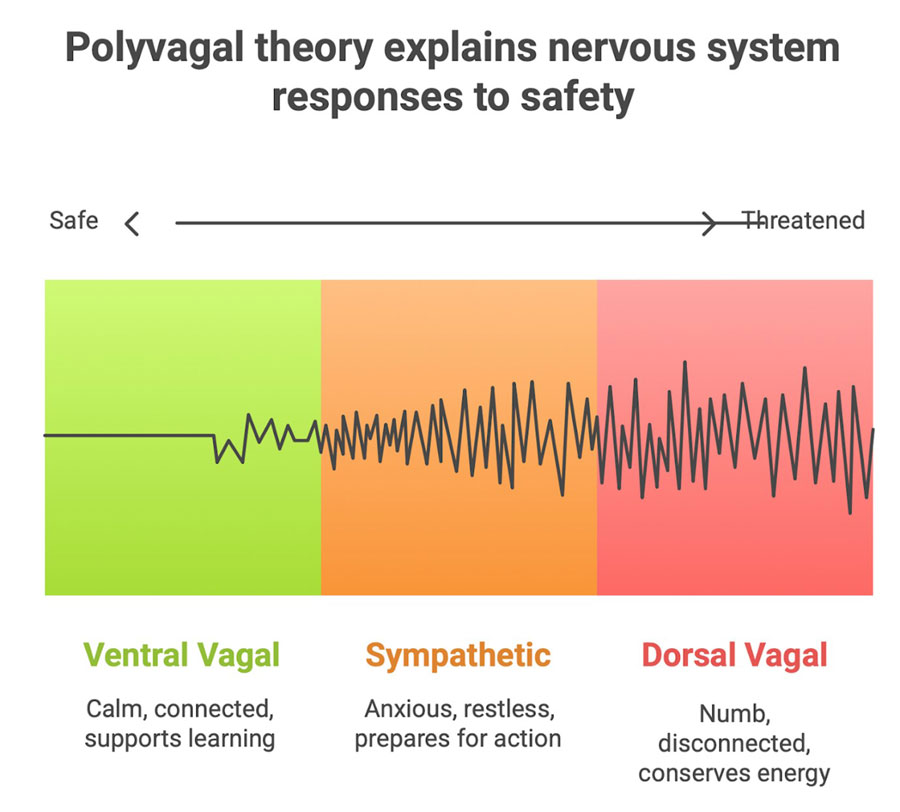
Developed by Dr. Stephen Porges, Polyvagal Theory revolutionizes how we understand our body's responses to stress, safety, and connection. Think of it as your nervous system's three-tier security system that automatically responds to whether you feel safe or threatened, often without you even realizing it.
The theory centers on the vagus nerve, a major communication highway between your brain and body that acts like your internal "smoke detector," constantly scanning for safety or danger.
Green zone: calm, connected, steady
Yellow zone: fight or flight, high alert
Red zone: shutdown, numbness, withdrawal
State 1: Safe and Social (Ventral Vagal)
This is your "green zone", when you feel calm, connected, and safe. Your heart rate and breathing is steady, you can think clearly, and you naturally want to connect with others. This state supports learning, creativity, and healthy relationships. It's like having your nervous system's "all clear" signal activated.
What it feels like: Relaxed but alert, able to make eye contact, feeling genuinely connected to others.
State 2: Fight or Flight (Sympathetic)
This is your "yellow zone", when your internal alarm system detects possible danger. Your heart rate increases , breathing quickens, and stress hormones flood your system. You become more alert, and your body prepares for action. This response evolved to help us escape predators. It's supposed to be temporary, but problems arise when you get stuck here.
What it feels like: Anxious, restless, irritable, difficulty concentrating, feeling "wired but tired."
State 3: Shutdown (Dorsal Vagal)
This is your "red zone", When the threat feels so overwhelming or inescapable, that it essentially hits the emergency brake. Your heart rate slows, you may feel numb or disconnected and exhausted, and your body conserves energy by shutting down non-essential functions. It's like your nervous system saying "this is too much time to go offline."
What it feels like: Exhausted, emotionally numb, hopeless, difficulty moving or thinking clearly.
Neuroception: Your Unconscious Safety Scanner
Neuroception is your nervous system's automatic threat detection system, it constantly evaluates whether you're safe or in danger without conscious awareness.
It evaluates facial expressions, vocal tones, body language, and environmental cues to determine whether you're safe or in danger, all without you being aware of it. This happens before conscious thought, which explains why you might suddenly feel anxious or calm without knowing exactly why.
When neuroception works well, you feel safe in safe situations and alert to real dangers. When it's faulty, often due to trauma or chronic stress, you might feel threatened even in safe environments.
The Core Distinction: Stress vs. Burnout vs. Fatigue
As a counselling psychologist in Gurgaon, I see these questions daily. Understanding the unique characteristics of stress, fatigue, and burnout is the first essential step toward meaningful recovery. While they can overlap, each has different origins, symptoms, and solutions.
What Is Stress?
Stress is the body and mind’s natural adaptive response to demands that are perceived as threatening, overwhelming, or beyond our current resources. It is not inherently harmful , in fact, it is designed to help us respond to challenges. However, when prolonged or unrelieved, stress can disrupt both mental and physical health.
Your personal appraisal of those demands, how threatening, urgent, or controllable they seem, largely determines whether a situation becomes stressful. This is why the same event can feel manageable to one person and overwhelming to another
Biopsychosocial perspective:
How intensely we experience stress , and how well we recover , depends on a complex interplay of biological, psychological, and social factors:
- Biological: Genetic predisposition, nervous system sensitivity, medical conditions, neurodiversity, and hormonal regulation.
- Psychological: Perceived control over the situation, learned coping strategies, personal beliefs, and trauma history.
- Social: Availability of supportive relationships, quality of the work environment, socioeconomic stability, and exposure to discrimination or oppression.
This model explains why two people can experience the same event differently , and why marginalized groups, people with complex trauma, or those in unsafe environments may be more vulnerable to chronic stress.
Physiology of Stress
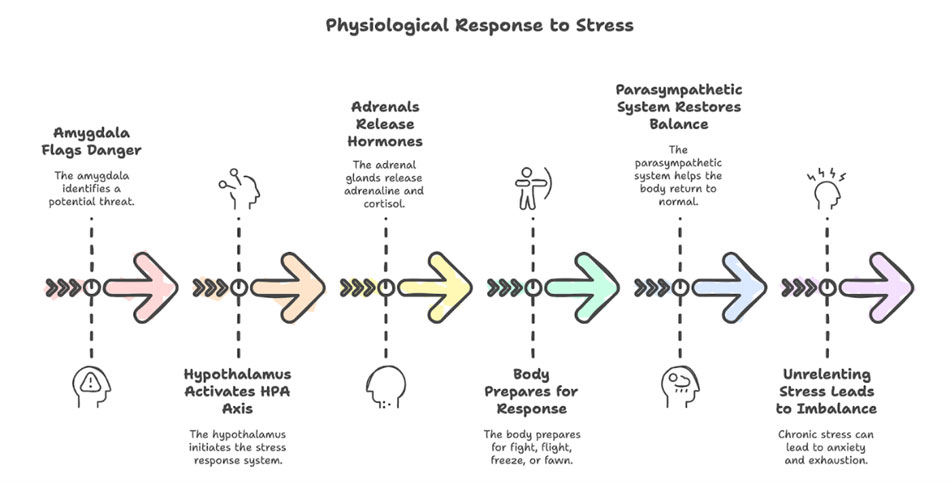
When you perceive a threat, your body engages a well-coordinated survival mechanism:
- Amygdala detects potential danger and sends an alarm.
- Hypothalamus activates the HPA axis (hypothalamic-pituitary-adrenal) aka your fight or flight response.
- Adrenal glands release stress hormones, cortisol and adrenaline.
- Your body prepares for fight, flight, freeze, or fawn:
- Heart rate, blood pressure, and muscle tension increase.
- Blood flow is redirected away from digestion and toward muscles.
- Higher brain functions for long-term planning slow down to prioritize immediate survival.
Once the stressor passes, the parasympathetic nervous system, particularly the vagus nerve, works to bring the body back into balance. If the stressor persists, this recovery phase may not occur, leading to nervous system dysregulation, inflammation, anxiety, and emotional exhaustion.
Acute Stress: Temporary Yellow Zone
- Acute Stress is:
- Short-term and immediate.
- Can heighten alertness, energy, and focus.
- Example: narrowly avoiding a car accident or preparing for a job interview.
- Recovery is typically quick once the challenge passes.
Acute stress happens when your sympathetic system activates temporarily but you can still return to the green zone once the challenge passes. You feel energized and alert, but you maintain hope and the ability to connect with supportive people. Your system activates to meet a challenge but maintains the ability to return to calm once the stressor resolves. It's like your nervous system saying "we can handle this."
- You can still connect with supportive people
- Recovery happens relatively quickly with rest
- Hope and sense of control remain intact
Chronic Stress: Stuck in Yellow Zone
Chronic stress occurs when your fight-or-flight system gets stuck "on" due to persistent demands or faulty threat detection. Your system loses its natural flexibility to move between states, becoming increasingly sensitive to threats while losing the ability to detect safety. It's like having a car alarm that won't turn off.
- Chronic Stress is:
- Long-term, ongoing exposure to stressors without adequate recovery.
- This creates a cycle where the nervous system becomes increasingly sensitive to threat cues while losing capacity for detecting safety signals.
- Examples: toxic workplace, caregiving under constant pressure, living in unsafe conditions, systemic discrimination.
- Can lead to immune suppression, cardiovascular strain, hormonal imbalance, digestive disorders, chronic pain, mood disorders, and burnout.
- May produce symptoms such as persistent fatigue, difficulty concentrating, emotional detachment, or a sense of hopelessness.
Common effects of chronic stress (gradual onset): immune suppression, digestive issues, sleep disruption, mood and anxiety symptoms, chronic inflammation/pain, hormonal shifts, skin flares, blood pressure changes, and burnout‑like exhaustion and detachment.
What stress feels like (common signs)
Physiological: fast heart rate, muscle tension, shallow breathing, headaches, GI upset, appetite changes, lowered immunity, tremors, dizziness, fatigue.
Psychological: anxiety, urgency or numbness, overwhelm, guilt/shame, irritability.
Cognitive: concentration lapses, indecision, intrusive worries, mental fog, second‑guessing.
Behavioral: withdrawal, procrastination, overworking, compulsions, emotional eating or suppression, substance use, impulsive spending, reduced breaks, crying spells.
(For chronic stress, these may persist and generalize beyond the original stressor.)
Stress isn’t always only “fight or flight”
- Appraisal matters: Stress intensifies when demands feel uncontrollable or unpredictable; it eases when you gain skills, support, or options.
- Perceived control & social support buffer stress: More autonomy at work and stronger support networks consistently predict better outcomes.
- Not everyone mobilizes: Some people, especially with complex trauma or certain neurodivergent profiles, experience freeze or shutdown, mental fog, slowed movement, or going blank, rather than urgency to act. Others may fawn/appease (people‑pleasing to defuse threat) or engage tend‑and‑befriend (seeking connection to regulate). These are legitimate stress responses, not personal flaws.
Stress Is Not Always About Action
For many people, stress initially creates urgency and mobilizes energy. However, this is not universal.
- Individuals with neurodivergence (e.g., ADHD, autism) or complex trauma may respond with shutdown, dissociation, or freeze rather than action.
- Others may engage in fawning , overcompliance and people-pleasing , as a survival strategy.
- Intergenerational stress patterns can also influence responses, with learned coping behaviors passed down within families.
Intergenerational Patterns (what runs in families)
Parental trauma and prenatal stress can influence offspring stress biology through environmental and possible epigenetic pathways; the science is advancing and complex. Findings (e.g., methylation changes in stress‑related genes) suggest mechanisms for how family stress histories may shape sensitivity, though not all effects are inherited biologically and context still matters.
Structures that amplify or protect
- Work design: High demands with low control (decision latitude) predict strain; improving control buffers harm. movingforwardnetwork.com
- Fairness & reciprocity: Sustained effort–reward imbalance (high effort, low reward/recognition/security) increases risk of poor health beyond either factor alone. PMC
- Minority stress: Chronic exposure to stigma/discrimination adds unique, cumulative stressors for marginalized groups and is linked to worse mental‑health outcomes. PMC
- Burnout is occupational: WHO classifies burnout as a syndrome due to chronic, unmanaged workplace stress, exhaustion, cynicism/mental distance, and reduced efficacy. Prevalence estimates vary; Gallup data show ~76% of employees report burnout at least “sometimes,” underscoring scale.
Why Understanding Stress Matters
Recognizing the type, cause, and personal pattern of stress allows for more targeted intervention. When we see stress as a natural but sometimes over-activated survival system , shaped by both our biology and environment , we can shift from self-blame toward self-understanding.
Through Coach For Mind, clients learn to:
- Identify whether their stress is acute or chronic.
- Recognize how personal history and systemic factors contribute.
- Develop regulation skills to calm the nervous system.
- Build structural supports , at home, at work, and in relationships , to protect against chronic overload.
Case Snapshot: When Chronic Stress Takes Over
Ayesha’s Story (Name Changed)
By Thursday, Ayesha’s chest feels tight. She’s glued to her laptop, eyes darting between urgent emails and looming deadlines. She’s trapped in a cycle of saying “yes” to every request—afraid that setting limits will make her look uncooperative or incapable. By Friday night she’s utterly spent, collapsing into bed and sleeping through most of the weekend. Monday morning arrives, and Ayesha is back at her desk, exhausted but compelled to keep going.
What’s Happening Behind the Scenes
Ayesha’s body and mind are locked in chronic stress, driven by two core imbalances:
- Low Perceived Control: She feels powerless to push back on extra work or define her own boundaries.
- Effort–Reward Imbalance: She pours in overtime and emotional energy yet receives little acknowledgment, appreciation, or progress in return.
This tug-of-war triggers her autonomic nervous system into a loop of:
- Overdrive (Yellow Zone): ramping up adrenaline and cortisol to meet demands.
- Crash (Red Zone): a protective collapse into exhaustion to recover.
Often, people in Ayesha’s position cope by prioritizing everyone else’s needs to avoid conflict. Unfortunately, appeasing others only deepens the loop: overcommitment leads to collapse, which erodes confidence and reinforces the need to over-please next week.
Breaking the Cycle
If Ayesha’s pattern sounds familiar, try these actionable steps:
- Increase Control
– Negotiate realistic deadlines or clarify what “good enough” looks like.
– Use conditional agreements: “Yes, if we can push the deadline to Friday afternoon.” - Boost Support
– Schedule a 15-minute check-in with a trusted colleague each week.
– Have one genuine conversation with a friend or family member to offload stress. - Prioritize Recovery
– After each intense task, pause for 2–4 minutes of slow exhale breathing (inhale 4 counts, exhale 6).
– Take a brief walk outdoors or follow a consistent bedtime routine. - Set Protective Boundaries
– Identify one task or request this week that you will decline—politely but firmly, especially if it triggers your automatic “yes.”
How Coach For Mind Can Help
Coach For Mind offers a structured yet flexible program built around two evidence-based frameworks, the Demand–Control–Support model and the Effort–Reward Balance model, to help you understand and transform your stress patterns. Here’s how it works:
- Mapping Your Stress Landscape
- Demand–Control–Support Checklist: You’ll rate your current workload demands, the degree of autonomy you feel, and the level of social support you experience. This snapshot reveals exactly where you feel most stuck—whether in overwhelming responsibilities, a lack of decision-making power, or isolation from colleagues and loved ones.
- Effort–Reward Balance Checklist: You’ll assess the ratio between the effort you expend (overtime hours, mental focus, emotional labor) and the rewards you receive (praise, recognition, promotions, personal satisfaction). This highlights critical imbalances fueling your exhaustion and demotivation.
- Uncovering Your Personal Triggers
- Identity-Based Triggers: Through guided reflection exercises, you’ll explore core beliefs—such as “I must always help others” or “I’m only valued when I’m performing at 110%.” Recognizing these self-definitions helps you understand why saying “no” feels impossible.
- Past-Trauma Triggers: If early experiences taught you that setting boundaries leads to rejection or punishment, Coach For Mind’s trauma-informed prompts will gently guide you to identify those patterns. Bringing these triggers into awareness is the first step toward interrupting the fawning or people-pleasing loop.
- Building Your Personalized Downshift Protocol
- Step-by-Step Routine: Drawing on your mapped stressors and triggers, you’ll create a short, daily “downshift” ritual—tailored to fit into your workday or home life. This could include a sequence such as:
a. One-minute breathwork to reset your nervous system
b. A two-minute guided visualization to reinforce your sense of safety and calm
c. A quick “body scan” to release tension from your shoulders, neck, or jaw
- Overdrive Exit Strategies: For moments when you’re mid-task and feeling overwhelmed, Coach For Mind offers micro-interventions—like tactical pauses or anchor phrases (“I am in control”)—to help you slip out of hyperarousal without losing momentum.
- Shutdown Exit Strategies: When you experience that post-crash exhaustion, you’ll use gentle reactivation techniques—such as brief, graded movement exercises or sensory stimuli (listening to uplifting music, stepping outside for fresh air)—to bring your system back online gradually and safely.
By guiding you through these stages, mapping, uncovering, and protocol building, therapists at Coach For Mind don't just alleviate symptoms; it empowers you with self-knowledge and practical skills to interrupt stress cycles before they escalate. Over time, you’ll learn to spot early warning signs, apply the exact strategies you need in the moment, and maintain a sustainable balance that supports both your productivity and your well-being.
What is Fatigue?
Fatigue is simply a state of extreme tiredness, often resulting from physical or mental exertion, lack of sleep, or underlying health conditions. It's your body's clear signal that it needs rest.
- Symptoms of Fatigue: Physical tiredness, lack of energy, drowsiness, and reduced physical and mental performance. Crucially, fatigue typically improves with rest, sleep, or a break from the activity causing it. As one community member shared:
"Exhaustion can be recovered from a few days off to relax, catch up on other adult duties and 'reset'."
Fatigue: Protective Red Zone
Fatigue through the Polyvagal lens represents your dorsal vagal system activating as protection from overwhelming demands. It is your body's protective response when active coping strategies aren't working. It's your system saying "conserve energy and withdraw from overwhelming demands". Unlike the energized feeling of stress, fatigue brings profound exhaustion that doesn't improve with rest, emotional numbness, brain fog, and social withdrawal. Your nervous system is essentially saying "we need to shut down to survive this."
Key signs include:
- Profound exhaustion that doesn't improve with rest
- Emotional numbness and disconnection
- Difficulty concentrating ("brain fog")
- Loss of motivation for previously enjoyed activities
- Reduced capacity for social connection
Causes of Fatigue: Prolonged physical activity, insufficient sleep, poor nutrition, illness, or even extended periods of stress.
P.S - Not all fatigue involves dorsal vagal shutdown:
- Post-exercise fatigue is physiological, not neurological
- Medication-induced fatigue has different mechanisms
- Sleep-deprivation fatigue involves circadian dysregulation
Burnout: Complex System Breakdown
Burnout a state of deep, persistent physical, emotional, and mental exhaustion caused by prolonged or chronic stress that has gone unmanaged. Burnout isn't just being tired from work, it's what happens when your body's stress response system gets so overwhelmed that it essentially malfunctions. Think of it like a car engine that's been running in the red zone for so long that it starts to break down, eventually sputtering and stalling out completely.
It is more than feeling “worn out” , it’s a depletion so profound that even extended rest doesn’t restore you. Motivation fades, performance suffers, and even your sense of self-worth can erode.
The World Health Organization (WHO) defines burnout as an occupational phenomenon resulting from chronic workplace stress that has not been successfully managed. While the research and formal definitions focus on work, lived experience , and emerging studies , show burnout can also occur in parenting, caregiving, community activism, social life, or even in relation to once-loved hobbies when demands consistently outweigh resources.
The Three-Stage Breakdown
Burnout involves a complicated pattern where your nervous system cycles between chronic yellow zone activation and red zone shutdown. Research from the Dresden Burnout Study shows that burnout involves your nervous system getting trapped in a destructive cycle between two extreme states: chronic high-alert mode and complete system shutdown. Unlike normal stress that comes and goes, burnout represents a fundamental breakdown in your body's ability to regulate itself.
Stage 1: Stuck in High Alert (Persistent Fight-or-Flight)
Your body's alarm system gets stuck in the "on" position. Even when there's no immediate threat, your system acts like you're constantly under attack. This stage can last months or even years before people realize what's happening.
What you experience:
- Hypervigilance: You're always scanning for problems, even during supposedly relaxing activities
- Sleep disruption: Your mind races at night because your internal alarm won't turn off
- Irritability: Small annoyances feel like major threats because your system is already maxed out
- Physical tension: Chronic headaches, muscle pain, and stomach issues from your body being constantly prepared for action
- Restless energy: You feel "wired but tired", exhausted but unable to truly rest
The hidden danger: Many people in this stage appear highly productive and dedicated, so both they and others miss the warning signs. You might even receive praise for your "dedication" while your system is slowly breaking down.
Stage 2: Loss of Flexibility between states
Your nervous system loses its ability to shift gears. It's like having a car stuck between drive and park, you can't fully engage with life, but you can't fully rest either.
What happens internally:
- Your body forgets how to calm down, even in genuinely safe situations
- You develop a persistent sense of threat, even when everything is objectively fine
- Your system's natural rhythm of activation and recovery disappears
- You become increasingly dependent on external things (caffeine, alcohol, medication) to function
What you experience:
- Difficulty relaxing even when safe: Even during vacations or weekends, you can't shake the feeling that something's wrong
- Emotional numbness: You start feeling disconnected from things that used to matter
- Decreased resilience: Minor setbacks feel catastrophic because you have no recovery reserves left
- Impaired relationships: You withdraw from people because social interaction feels like too much effort
Stage 3: System Shutdown (Complete Exhaustion)
When your body's stress system can no longer maintain high alert, it crashes into protective shutdown mode. This isn't the same as normal tiredness, it's your body's emergency protocol to prevent total system failure.
What you experience:
- Profound exhaustion: Sleep doesn't help because this isn't regular fatigue, it's cellular-level depletion
- Emotional detachment: You feel numb or disconnected from work, relationships, and activities you once cared about
- Cynicism: You develop a bitter, negative outlook as a psychological defense mechanism
- Loss of identity: You may feel like you've lost who you are outside of your responsibilities
- Physical symptoms intensify: Digestive issues, frequent illness, chronic pain, and brain fog become prominent
Studies specifically show that emotional exhaustion, the core of burnout, both predicts and results from reduced vagal function, creating a vicious cycle.
The Vicious Cycle at the Heart of Burnout
The Dresden Burnout Study made a crucial discovery: emotional exhaustion both causes and results from nervous system dysfunction. This creates a self-perpetuating cycle:
- Chronic stress damages your body's regulation system
- Poor regulation makes you more vulnerable to stress
- Increased stress vulnerability leads to deeper exhaustion
- Deeper exhaustion further impairs your regulation
- The cycle continues, getting worse over time
This explains why burnout feels so hard to escape and why simply "taking a vacation" doesn't fix it. You're not just tired, your body's fundamental stress-regulation system needs repair.
Why Emotional Exhaustion Is the Key
Research consistently shows that emotional exhaustion is the core component of burnout. It's not just one symptom among many, it's the central mechanism that drives the entire process.
Emotional exhaustion means:
- Your emotional processing system is overloaded and starts shutting down
- You lose the ability to care about things that should matter to you
- Your capacity for empathy, connection, and motivation becomes depleted
- Your body's stress-regulation system becomes increasingly impaired
This is why people in burnout often say things like "I just don't care anymore" or "I feel like I'm going through the motions." It's not a character flaw, it's a measurable dysfunction in how their nervous system processes emotional information.
The Physical Reality
Unlike simple tiredness or temporary stress, burnout creates measurable changes in your body:
- Heart rate patterns become irregular and less flexible
- Immune function decreases, making you more susceptible to illness
- Hormonal systems become dysregulated, affecting everything from sleep to metabolism
- Brain function changes, particularly in areas responsible for decision-making and emotional regulation
These aren't just psychological symptoms, they're biological changes that can be measured in laboratory settings.
Biopsychosocial Perspective on Burnout
- Biology: Prolonged stress disrupts hormonal balance (especially cortisol regulation), sleep cycles, and immune function, leading to persistent fatigue and vulnerability to illness. Neurodivergent individuals and those with trauma histories may reach burnout faster due to heightened nervous system sensitivity.
- Psychology: Burnout is more likely when there’s a mismatch between values and daily reality, chronic self-doubt, or perfectionistic standards that make “enough” feel unreachable.
- Social/Structural: Overwork, low control over tasks, poor social support, unfair treatment, identity-based discrimination, and misaligned values between you and your organization all increase burnout risk.
Core Symptoms of Burnout
- Exhaustion
- Physical: Persistent low energy, muscle aches, frequent illness.
- Emotional: Feeling drained, overwhelmed, unable to recover , even after rest or vacation.
- Cynicism / Emotional Detachment
- Growing negativity toward your work, responsibilities, or people you interact with.
- Feeling numb, resentful, or disconnected , sometimes as a defense to protect against further depletion.
- Reduced Efficacy & Cognitive Fog
- Decline in focus, memory, and decision-making.
- Feeling less capable, productive, or confident in your abilities.
- Struggling with basic tasks you once handled easily.
Causes of Burnout
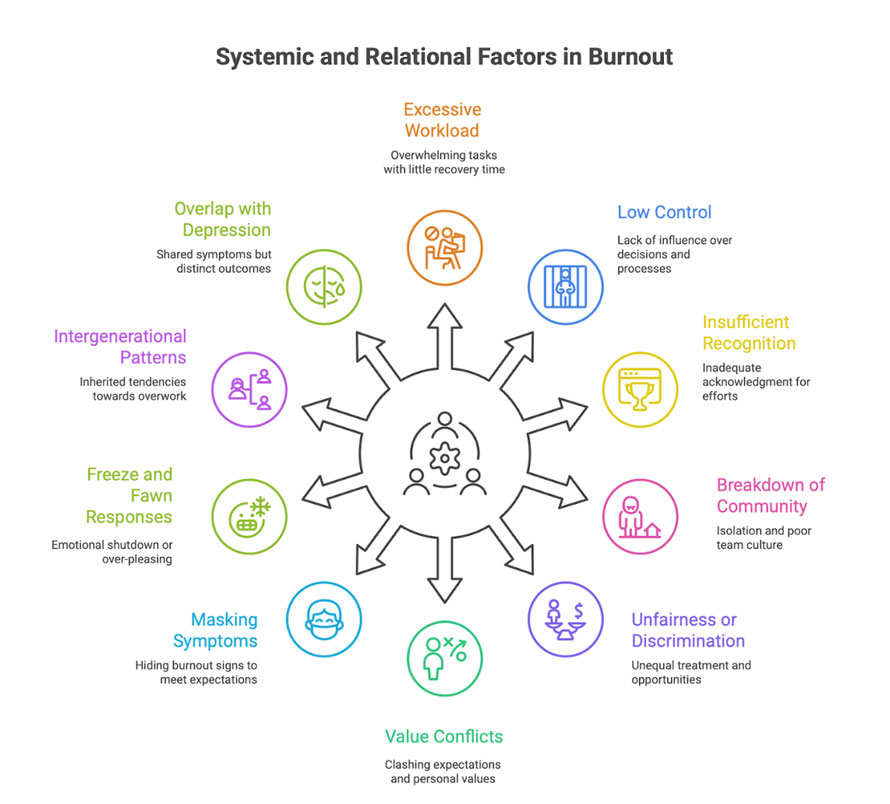
While personal coping style plays a role, most burnout is driven by systemic and relational factors, such as:
- Excessive workload with little opportunity for recovery.
- Low control over decisions, processes, or priorities.
- Insufficient recognition or reward for your efforts.
- Breakdown of community , isolation, poor team culture, lack of trust.
- Unfairness or discrimination in treatment, pay, or opportunity.
- Value conflicts , when what’s expected of you clashes with what matters most to you.
- Not always visible: People can “look fine” while experiencing severe burnout, masking symptoms to meet expectations.
- Freeze and fawn responses: Some burnout manifests as emotional shutdown (freeze) or over-pleasing to keep peace (fawn), not just irritability or withdrawal.
- Intergenerational patterns: If you grew up in environments that normalized overwork or self-sacrifice, you may be more vulnerable to burnout without realizing it.
- Overlap with depression: Burnout and depression can share symptoms, but burnout often improves when the stressor is addressed, while depression may persist regardless of work conditions.
As this reddit user shared,
“Burnout felt like permanent exhaustion, floaty, getting irate at simple things like VPNs crashing, short tempered, could not be arsed with anything, binge eating, feeling worse as type 2 diabetic. rinse and repeat.”
Case Snapshot:
Ravi, 38
"I used to love my work. Now I wake up with dread. Even after a long weekend, I feel the same , heavy, foggy, like my brain is wading through molasses. I snap at my team, zone out in meetings, and don’t feel proud of anything I do. Lately… I’m starting not to care."
What’s Going On:
Ravi is a senior marketing manager at a fast-paced tech firm. Over the past year, his responsibilities doubled. He once thrived on creative campaigns, but now he finds herself waking at 5 AM with a pit in his stomach. Weekends no longer replenish his energy, he spends them staring blankly at the ceiling or mindlessly scrolling through social media.
Ravi shows the three core signs of burnout:
- Unrelenting Exhaustion: “I feel like my batteries are at 10%. Coffee gives me a quick jolt, but I crash even harder.”
- Cynicism and Detachment: “I used to brainstorm with excitement. Now I endure meetings, roll my eyes when someone suggests a new idea, and dread collaborating.”
- Reduced Efficacy: “I can’t focus and decide. Simple decisions, choosing an image for a social post, take me an hour. I miss deadlines and feel embarrassed.”
Biopsychosocial markers of Burnout Ravi was experiencing:
- Biological:
Ravi’s nervous system is stuck in “overdrive.” Constant stress has kept her stress hormones, like adrenaline and cortisol, running high all the time. Physically, this means she: - Can’t sleep well, tossing and turning at night
- Wakes up with tight, achy muscles in her neck and shoulders
- Experiences brain fog and her memory feels unclear
- Psychological:
Ravi holds himself to impossibly high standards and fears letting anyone down. Ravi’s perfectionism and fear of disappointing her team intensify stress; he believes, “If I slow down or make a mistake, I’m worthless.” That mindset: - Fuels her anxiety about every task
- Makes her push harder, even when she’s exhausted
- Unable to say no or set boundaries with workload
- Leaves her feeling guilty or ashamed whenever she can’t keep up
- Social & Work Situation:
At work, Ravi faces constant deadlines, little recognition, and little control over his schedule or workload. He has: - Back-to-back meetings from morning until late afternoon
- No say in setting deadlines or priorities
- Few chances to get recognition or feedback
This “always on” culture means he never gets a break and without a pause, his stress snowballs.
What Helped Ravi:
Ravi needed more than weekend “self-care.” Real change meant:
- Regaining control over workload and deadlines.
- Rebuilding support inside and outside of work.
- Aligning daily tasks with personal values , or finding a role that does.
- Practicing brief downshift rituals (deep-breath breaks, walking outside) to help his system recover daily.
Therapeutic Interventions that helped Ravi:
- Establishing Safety and Regulation
- Paced Breathing Exercises: Ravi began each session with 5 minutes of 4-7-8 breathing to activate his ventral vagal system.
- Micro-break Scheduling: He committed to two 5-minute outdoor walks daily, using an alarm to ensure consistency.
- Cognitive and Relational Exploration
- A relational, psychodynamic-informed approach could help Ravi explore the deeper patterns keeping him in burnout , such as difficulty setting boundaries, perfectionism, or people-pleasing rooted in earlier experiences.
- Cognitive Restructuring: Together, Ravi and his therapist identified core beliefs. e.g., “I must be perfect to be valued” and test alternative perspectives: “My worth isn’t contingent on flawless performance.”
- Control-Mastery Tasks: In role-play, Ravi practices politely declining a nonessential project. In real life, he experimented by saying “no” to one extra meeting per week, then reflected on the outcome. Ravi tested and disproved old beliefs (“If I say no, I’ll lose my worth”) while creating space to practice new behaviors in a safe environment. This isn’t just symptom relief, it’s building a more sustainable way of working and living.
- Values and Job Crafting
- Values Clarification: Ravi listed his top work values: creativity, collaboration, autonomy.
- Job Crafting Plan: He negotiated with his manager to lead one new creative initiative monthly and reduce reporting duties by delegating to a junior associate.
- Building Resilience and Relapse Prevention
- Self-Compassion Practices: Guided imagery and journaling exercises help Ravi cultivate kindness towards himself when he falters.
- Support Network Activation: He commits to a weekly check-in with a coworker mentor and biweekly coffee dates with friends outside work.
With Coach For Mind
Structured tools like the Effort–Reward and Values Alignment checklists can pinpoint what’s draining Ravi and guide a plan for lasting change, both in his work and in how he supports his own energy.
This reddit user shared how therapy helped them with burnout,
“For me it was a lot of therapy and keeping up my self care and mental health routine. I'm finally at the place where I have been able to reframe my identity as it relates to work and how invested I am in the job. It pays my bills and that's all I care about now but I still do the best I can on the job. I have strict boundaries and don't work past 40 hours a week.”
Key Differences Between Stress and Burnout: A Comparative Overview
To help you definitively differentiate your experience, consider this comparative table:
|
Feature |
Stress |
Fatigue |
Burnout |
|
Primary Feeling |
Over-engagement, urgency, hyper-arousal |
Physical/mental tiredness, sleepiness |
Disengagement, hopelessness, exhaustion, cynicism, apathy |
|
Primary Cause |
Internal or external demands perceived as exceeding one’s capacity to cope. |
Overexertion, insufficient rest, illness, chronic stress, trauma, or systemic depletion of resources. |
Persistent stress without recovery, usually compounded by systemic/organizational or chronic relational demands. |
|
Emotional State |
Anxiety, worry, irritability |
Low energy, sluggishness |
Detachment, depression, loss of motivation, despair |
|
Energy Level |
High (initially), mobilized energy |
Low, depleted |
Profoundly depleted, even after rest |
|
Impact on Mood |
Agitation, reactivity |
Drowsiness, lack of focus |
Cynicism, negativity, irritability, emotional numbness |
|
Physical Impact |
Increased heart rate, muscle tension, sweating, shallow breathing, GI issues |
Physical aches, heavy limbs, impaired coordination, sleepiness, low stamina. |
Chronic fatigue, frequent illness, headaches, digestive issues |
|
Mental Impact |
Overwhelmed, racing thoughts, difficulty concentrating |
Reduced alertness, poor memory, impaired decision-making |
Diminished executive function, cognitive fog, difficulty concentrating, loss of creativity |
|
Motivation |
High, driven to overcome |
Low, desire to rest |
Absent, loss of interest, feeling "stuck" |
|
Outlook |
Hopeful (that if you work harder, things will improve) |
Desire for rest, expecting recovery with rest |
Hopeless, helpless, "what's the point?", "I can't find the spark again" |
|
Recovery |
Often resolves with stressor removal or coping |
Improves with rest, sleep, or a short break |
Requires significant time, systemic changes, and often professional intervention |
|
Core Problem |
Too many demands |
Lack of rest |
Too few resources, chronic unmanaged demands, values misalignment |
Self-Assessment Tool: Where Do You Stand?
Consider these questions honestly. If your answers lean heavily towards the latter symptoms, particularly the emotional detachment, cynicism, and profound exhaustion that doesn't resolve with rest, you are likely experiencing burnout.
- Do you feel exhausted even after a full night's sleep or a weekend off?
- Have you become cynical or negative about your work or responsibilities, even things you once enjoyed?
- Are you struggling with basic tasks, feeling like your "operating system crashes" when attempting work activities?
- Do you feel a persistent sense of dread or apathy when thinking about your daily tasks?
- Is your irritability a constant companion, affecting your relationships?
- Do you feel a loss of purpose or a sense that your efforts don't matter?
- Do you frequently get sick, or experience chronic physical symptoms like headaches or digestive issues?
- Do you feel trapped by your circumstances, unable to make changes due to financial or other pressures?
If you nod “yes” to a lot of these, it’s a sign your body and mind are waving a red flag. Burnout isn’t just about being tired, it’s your system telling you it can’t keep running like this without a change.
Beyond the Individual: Systemic Drivers of Burnout
While personal resilience is important, the overwhelming evidence and community sentiment point to burnout as primarily a systemic problem. As one user aptly stated:
"Burnout is mainly a systemic problem caused by systemic issues within organizations, not just individuals and their ability (or inability) to respond to stress."6
Many feel "constantly asked to do more and more with less and less," with a "lack of support from my manager or leadership." This shifts the narrative from individual failing to a critique of the system itself.
The "Always-On" Culture and Digital Overload
The pervasive expectation of constant availability, fueled by smartphones and remote work, blurs the lines between work and personal life. Digital overload contributes significantly to the erosion of personal space, making it difficult to truly disconnect and recover. This "hamster wheel" mentality means there's:
"no time for joy" because achievements are "simply one on an endless list of other goals to achieve."8
Lack of Autonomy and Recognition
Feeling like a cog in a machine, with little control over your work processes or decisions, is a major cause of burnout. When efforts go unrecognized or unrewarded, especially financially ("I will not make anymore money in my current position"), motivation plummets, leading to feelings of being undervalued and exploited.
Unrealistic Demands and Understaffing
Many individuals feel the burden of "being paid for a job while also being my own manager and our department ops manager as a result." Excessive workloads, coupled with insufficient resources or understaffing, create an unsustainable pace. This leads to chronic stress that, when unmanaged, inevitably progresses to burnout.
Toxic Workplace Dynamics
Micromanagement, lack of psychological safety, unfair treatment, and a: "constant 'we’re a family' talk while overworking everyone and ignoring actual burnout signs" are potent causes of burnout. These environments erode trust, foster cynicism, and make it impossible for employees to thrive.
The Vicious Cycle: How Burnout Exacerbates Stress
It's commonly understood that prolonged stress leads to burnout. However, a critical, often overlooked insight is that burnout itself can exacerbate stress, creating a vicious cycle. When you're burned out, your coping mechanisms are depleted, your executive function is impaired, and your emotional regulation is compromised. This means that even minor stressors can feel overwhelming, triggering intense stress responses that further drain your already limited resources.
For example, a burned-out individual might struggle with tasks they once found easy, leading to increased anxiety and self-doubt (stress). The lack of motivation inherent in burnout makes it harder to engage in stress-reducing activities, perpetuating the cycle. This "chicken-and-egg" dynamic means that addressing burnout requires not just reducing external stressors, but also rebuilding the internal capacity to cope.
The Burnout-Depression Conundrum: Are They the Same?
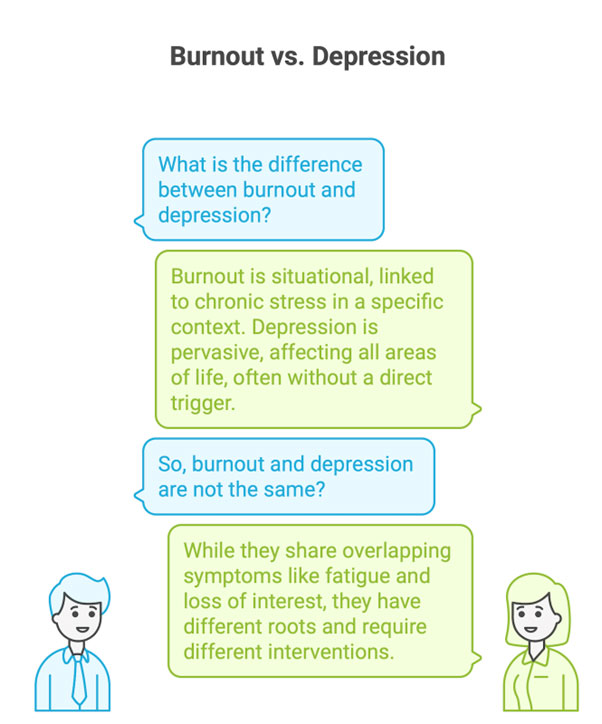
One of the most frequently asked questions is, "What is the difference between burnout and depression?" The confusion is understandable, as their symptoms often overlap, leading some to say:
"Clinically, we diagnose burnout and major depressive disorder all the same. The symptoms are all the same."11
However, while similar, they are distinct, though can co-exist.
Overlapping Symptoms, Different Roots
Both burnout and depression can manifest as profound fatigue, loss of interest, difficulty concentrating, irritability, and feelings of hopelessness. The key differentiator lies in their primary cause and context:
- Burnout is situational: It is directly linked to chronic, unmanaged stress, typically in a specific context like work, caregiving, or activism.
"Burnout is the result of cumulative stress, it can be directly attributed to external factors."12
When the external stressors are removed or significantly altered, burnout tends to improve. People with burnout often retain the capacity for joy or motivation in other areas of their life, or if the specific stressor is removed.
- Depression is pervasive: Major depressive disorder is a mood disorder that affects all areas of life, often without a direct external trigger.
"Depression is not directly affected by external factors, the depression continues despite external stuff (joyful activities, rest and relaxation, etc)."13
It's a clinical condition involving neurochemical imbalances and genetic predispositions, requiring specific clinical interventions.
While burnout can increase your vulnerability to depression, and someone with depression might experience burnout, they are not interchangeable. As one person eloquently put it:
"Burnout makes people explode! Depression makes people cry."14
This highlights the outward frustration often seen in burnout versus the inward despair of depression.
When to Suspect Depression
If your symptoms are pervasive, affecting all aspects of your life (not just the stressful context), persist despite significant breaks or changes in environment, or include feelings of worthlessness, suicidal ideation, or an inability to experience pleasure in anything, it's crucial to seek professional help for a clinical diagnosis. A mental health professional can differentiate between the two and recommend appropriate treatment.
Why Understanding This Matters
Different Problems Need Different Solutions
Since acute stress maintains nervous system flexibility, recovery involves returning to safety through rest, social support, and resolving the stressor. Your system remembers how to get back to green. Focus on returning to calm through rest and social support.
https://pmc.ncbi.nlm.nih.gov/articles/PMC9131189/
- Fatigue recovery:
This requires more intensive work to restore your system's ability to detect safety and move between states. You need approaches that specifically target resetting faulty threat detection patterns. Gentle re-activation that respects the protective shutdown.
Since shutdown is protective, recovery must be extremely gentle and respect why your system went offline. Pushing too hard too fast can send you back into shutdown. You need to slowly rebuild safety and capacity before expecting increased energy.
- Burnout recovery:
Complex restoration requires both individual healing and systemic changes.
This typically involves moving backwards through the hierarchy, from shutdown through fight-or-flight to eventually reaching safety again. It often requires both individual nervous system work and addressing the systemic factors that created the overwhelm.
The Power of Connection and Co-Regulation
Co-regulation means our nervous systems influence each other. When you're around someone who feels safe and calm, their regulated state can help shift your nervous system toward safety too.
This explains why healing happens best in relationships with others, not in isolation. Your nervous system literally borrows stability from others when your own system is struggling.
Recognizing Your Patterns
Understanding your nervous system's patterns helps you:
- Recognize early warning signs of overwhelm
- Choose appropriate interventions for your current state
- Be more compassionate with yourself during difficult periods
- Seek support when your system needs co-regulation
Reclaiming Your Spark: A Multi-Stage Recovery Roadmap
Recovering from deep burnout is not a quick fix or something curable by a simple vacation. It's a marathon, not a sprint, requiring a comprehensive, multi-stage approach that goes "beyond self-care" and addresses physical, mental, emotional, and even financial aspects.
Stage 1: Acknowledgment & Immediate Rest
The first step is validating your experience: "Am I truly sick, or just tired? Is my suffering valid?" Yes, it is. Acknowledge the severity of your exhaustion and the undeniable need for significant rest.
- Prioritize Radical Rest: This isn't just a weekend off. It might mean taking a "mental health day," a longer vacation, or even medical leave if possible.
"If you don't take one rest day, your body will force a rest week onto you."15
This initial phase is about stopping the bleeding and allowing your nervous system to calm down.
- Minimize Demands: Say "no" to non-essential commitments. Delegate tasks. Reduce screen time. Create a sanctuary where you can truly disconnect.
- Re-establish Basic Needs: Focus on consistent sleep, nourishing food, and gentle movement. These are the non-negotiable foundations your recovery will be built upon.
Stage 2: Re-evaluation & Boundary Setting
Once the initial acute exhaustion subsides, this stage focuses on understanding the root causes and implementing sustainable changes.
- Identify Your Core Values: What truly matters to you? What brings you joy and purpose outside of work? Burnout often arises from a misalignment between personal values and daily reality.
- Audit Your Commitments: Where are your boundaries being eroded? Identify the "suck it up" moments that are draining you.
- Set Firm Boundaries: This is crucial for preventing future burnout. Learn to say "no" without guilt. Protect your personal time and energy. This might involve setting specific "off-hours," declining extra projects, or limiting digital availability.
- Explore Low-Stakes Hobbies: Reconnect with activities that bring you joy, even if you feel "just bored" or lack motivation. Start small; the goal is to gently "reclaim your spark."
Stage 3: Rebuilding Resilience & Purpose
This is the long-term phase of sustained well-being, focusing on proactive strategies and relapse prevention.
- Cultivate Resilience: This goes beyond generic advice. Explore specific psychological techniques like mindfulness, cognitive behavioral therapy (CBT) principles to challenge negative thought patterns, or acceptance and commitment therapy (ACT) to align actions with values. Building resilience is about developing adaptive coping mechanisms, not just "sucking it up."
- Strengthen Social Support: Connect with friends, family, or support groups. Sharing your struggles can be incredibly validating and reduce feelings of isolation.
- Re-evaluate Career/Life Path: For many, burnout is a signal that fundamental changes are needed. This might involve exploring new career paths, negotiating for better work conditions, or even considering a career break. This is where the "golden handcuffs" often come into play, making this step challenging but necessary.
Practical Applications
Building Safety and Resilience:
- Deep breathing with longer exhales to activate your calm system
- Social connection with people who feel safe and supportive
- Mindfulness practices that improve your ability to notice internal states
- Gentle movement like yoga or walking in nature
- Vocal exercises like humming or singing to stimulate the vagus nerve
For Stress: Focus on returning to safety through rest, movement, and social connection.
For Fatigue: Honor the shutdown as protective. Slowly build safety and capacity with gentle practices like nature exposure, creative expression, and gradual social re-engagement.
For Burnout: Address both nervous system recovery and the environmental factors creating overwhelm. Expect this to be a gradual process moving through different states.
For Prevention: Build nervous system flexibility through practices that activate your social engagement system, meaningful connections, breathwork, singing, and activities that bring joy and safety.
When You're Stuck in High Alert:
- Box Breathing: Four counts in, four counts held, four counts out, four counts held. This specific rhythm sends your nervous system the signal that the emergency is over.
- Progressive Muscle Release: Tense your shoulders for five seconds, then let them drop completely. Your body discharges the energy it mobilised for action.
When You're Stuck in Shutdown:
- Vocal Activation: Humming, singing, or making sustained "ahh" sounds creates vibration that gently activates your vagus nerve and brings you back online.
- Temperature Contrast: Cold water on your face or wrists provides just enough stimulation to shift you out of protective numbness without triggering high alert.
Universal Nervous System Support:
- Micro-movements: Two minutes of gentle movement helps your body recognise that you're safe and capable of response.
- Social Connection: Even brief eye contact or physical touch with someone you trust activates your bonding systems.
- Morning Light: Natural light in your eyes within the first hour of waking helps regulate the circadian rhythms that stabilize your entire nervous system.
Navigating the System: Advocating for Change and Professional Help
Feeling financially trapped or facing unsupportive management are major barriers to recovery. This section provides practical, empathetic guidance for navigating these complex realities.
Communicating with Your Employer
This can be daunting, especially with a "lack of support from my manager or leadership."16
- Document Everything: Keep a clear record of your workload, hours, and specific issues.
- Focus on Impact, Not Blame: Instead of saying "I'm burned out because you overwork me," frame it as: "My current workload is impacting my ability to perform at my best, leading to diminished executive function and reduced efficacy. I'd like to discuss solutions to ensure I can continue contributing effectively."
- Propose Solutions: Come with specific, actionable suggestions, such as workload redistribution, adjusted deadlines, or access to resources like an Employee Assistance Program (EAP).
- Know Your Rights: Research your company's policies on mental health leave, accommodations, or EAP services. In some regions, FMLA or state-specific paid leave programs (like FAMLI) might apply.
Leveraging Benefits and Resources
Many workplaces offer resources that go underutilized.
- Employee Assistance Programs (EAPs): These often provide free, confidential counseling sessions, legal advice, and financial guidance.
- Health Insurance: Understand your mental health coverage for therapy, coaching, or medication.
- HR Department: While sometimes perceived negatively, HR can be a resource for understanding policies, mediation, or accommodations.
When and How to Seek Professional Support
For severe burnout, professional intervention is crucial.
- Therapy/Counseling: A therapist can help you process emotions, develop coping strategies, identify underlying patterns, and address issues like "moral injury" (when you're asked to do things that violate your moral compass) or "compassion fatigue" (common in caregiving professions). Cognitive Behavioral Therapy (CBT), Dialectical Behavior Therapy (DBT), Internal Family Systems (IFS), and EMDR are often effective.
- Coaching: A specialized burnout coach can help with career re-evaluation, goal setting, and accountability for implementing changes.
- Medical Doctor: Rule out any underlying physical health conditions contributing to your fatigue. They can also discuss medication options if depression or severe anxiety are co-occurring.
- Specialized Assessments: Tools like the Maslach Burnout Inventory (MBI) or Copenhagen Burnout Inventory (CBI) can provide a structured assessment of your burnout levels, which can be useful for both self-understanding and discussions with professionals.
The Financial Realities: Strategies When You Can't Quit
"So what? Don't got the time to get help or take a break. This post basically means nothing to the people who need it most."17
This sentiment is valid and highlights the immense pressure of "golden handcuffs." If quitting isn't an option right now, here are strategies:
- Strategic Job Searching While Employed: Even if you can't quit immediately, start exploring alternatives. Update your resume, network, and apply for jobs that align better with your values and offer a healthier environment.
- Budgeting and Debt Management: If financial stress is a major contributor, seek advice on managing debt or creating a budget that allows for even small savings towards a potential future break or career change.
- Leverage Existing Benefits: Explore any paid time off, sick leave, or short-term disability options your employer or state might offer.
- Side Hustles (Cautiously): If additional income is critical, consider low-stress side hustles that don't exacerbate your burnout. This might mean leveraging existing skills in a less demanding way, rather than taking on more high-pressure work.
Preventing Future Burnout: Building Sustainable Well-being
Prevention is about creating a lifestyle and work environment that supports your well-being, rather than constantly pushing you to the brink.
Cultivating Resilience
This isn't about being tougher; it's about being more adaptive.
- Mindfulness and Stress Reduction Techniques: Regular meditation, deep breathing exercises, or yoga can help regulate your nervous system and build your capacity to handle stress.
- Emotional Regulation Skills: Learn to identify and process your emotions rather than suppressing them. Journaling, talking to a trusted friend, or therapy can help.
- Physical Well-being: Consistent exercise, balanced nutrition, and adequate sleep are non-negotiable foundations for resilience.
"Mentally tired? Workout. Physically tired? Rest."18
Continuous Self-Assessment
Regularly check in with yourself using the self-assessment questions from earlier. Don't wait until you're in a crisis. Recognize early warning signs of stress or fatigue before they escalate into burnout.
Advocating for Systemic Change
While individual actions are important, true long-term prevention of widespread burnout requires systemic change. Support initiatives for better work-life balance, fair compensation, increased autonomy, and supportive leadership in your workplace and beyond. Remember:
"Most of the time, burnout stems from a series of workplace problems that one person cannot solve alone."19
Special Considerations: Neurodivergence and Burnout
Individuals who are gifted, have ADHD, or are on the autism spectrum often experience burnout differently and may be more susceptible to it. Their unique brain wiring can lead to:
- Sensory Overload: Heightened sensitivity to environmental stimuli can be incredibly draining in typical work environments.
- Executive Dysfunction: Challenges with planning, organizing, and initiating tasks can lead to constant overwhelm and a feeling of "diminished executive function."
- Intense Interests & Hyperfocus: While a strength, this can lead to neglecting self-care and pushing past natural limits.
- Social Masking: The effort to conform to neurotypical social expectations can be exhausting.
For neurodivergent individuals, tailored strategies are crucial:
- Sensory Management: Creating a low-stimulus workspace, using noise-canceling headphones, or taking frequent sensory breaks.
- Structured Routines: Implementing highly structured routines and external organizational tools to compensate for executive dysfunction.
- Advocacy for Accommodations: Requesting specific workplace adjustments (e.g., flexible hours, remote work options, quiet spaces) that support their unique needs.
- Specialized Therapy: Therapists familiar with neurodivergence can offer tailored coping mechanisms and strategies for managing burnout within this context.
This journey from profound exhaustion to reclaiming your vibrant self isn't a simple fix; it's a courageous act of self-reclamation. By finally understanding the critical distinctions between stress, fatigue, and burnout, by acknowledging the systemic forces that often trap us, and by committing to a multi-faceted roadmap, you're not just recovering – you're rebuilding.
Your suffering is valid. Your exhaustion is real. And you are absolutely not alone. It's time to stop just surviving and start thriving again, as the whole, human being you were always meant to be.
Ready to take the first step?
Which aspect of this guide resonated most deeply with you? What's one small action you can take today to begin your path to clarity and healing? Share your thoughts in the comments below, or reach out if you're ready to explore personalized support. Your journey back to yourself starts now.
The Role of a Therapist in Recovery
Whether you are experiencing stress, fatigue, or burnout, professional guidance can help you untangle what’s happening and build a recovery plan that works in real life. A best psychologist in Gurgaon doesn’t just give coping tips, they help you understand your unique nervous system patterns, your personal history with stress, and the systemic factors keeping you stuck.
At Coach For Mind, therapy sessions often focus on:
- Mapping your stress and energy patterns
- Identifying beliefs and behaviours that keep you in overwork or shutdown
- Creating practical, daily “downshift” routines to restore nervous system balance
- Addressing workplace or relationship boundaries
- Reconnecting you to values and activities that bring meaning
If you are unsure whether you’re dealing with stress, fatigue, or burnout, talking to a professional can help you find clarity faster and avoid further depletion. Whether you work with a counselling psychologist in Gurgaon or the best psychologist in Gurgaon for your needs, what matters most is having a safe, non-judgmental space to understand what’s really going on and take steps towards change.
The right therapist helps you shift from self-blame to self-understanding, which is where healing truly begins.
Why CoachForMind?
Experienced Psychologists: We are a team of licensed RCI-registered clinical psychologists. Our team is well-experienced in various forms of therapy such as CBT, IFS, DBT, EMDR, and Narrative Therapy.
Personalized Approach: We are dedicated to treating our clients in the best-suited way, carefully curated as per the client's needs, and adhering to one-on-one, client-centered therapy.
Scientific Techniques: Our treatment plans and therapeutic methods are based on highly researched scientific findings such as CBT, DBT, EMDR and Narrative Therapy.
Quality service: We at CoachForMind ensure quality services in our treatment regime and therapeutic approaches. Our clients hold the most value to us, so we ground our techniques in empathy while maintaining professionalism.
Begin with a free 15-minute discovery call For more information, please visit our website or contact us directly at [email protected]
Written by the therapists at Coach For Mind
FAQs: Burnout, Stress and Mental Wellbeing
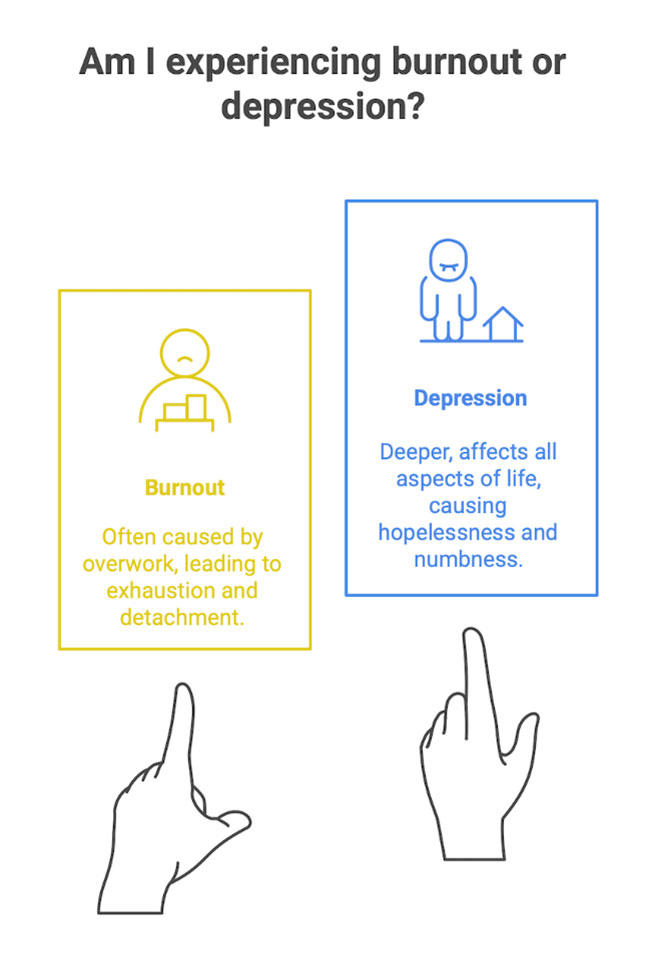
Burnout usually shows up when you've been under a lot of pressure or doing too much for too long, especially in work or caregiving roles. You start feeling drained, detached, irritated, and like nothing you do is good enough. Your energy is gone. You're not sad all the time, but you just don't feel like yourself anymore.
Depression, on the other hand, doesn't always have a clear "cause" like overwork. It sinks deeper. You may feel numb, hopeless, worthless, or like there's no point to anything, even things you once enjoyed. It affects every part of your life like sleep, appetite, self-worth, relationships, and not just work or tasks.
Exhaustion is when you're tired after a long day or week. Rest, sleep, a good meal, or a weekend away can bring your energy back.
Burnout doesn't go away with a good night's sleep. Even after resting, you might feel like you're still running on empty. You dread doing the same tasks again. You feel emotionally detached, cynical, or hopeless about the work or role that's burning you out.
So if exhaustion is like a low battery that charges overnight, burnout is like a broken charger that no matter how long you plug in, you don't fully recharge.
If the low energy, detachment, or irritation is mainly tied to your work, caregiving, or specific roles, it's likely burnout.
If your low mood is spread across everything in life, and even things you usually enjoy feel meaningless, it's more likely depression. Depression tends to come with feelings of worthlessness, deep sadness, guilt, or thoughts of hopelessness which go beyond burnout.
Take small steps to manage and balance the stress like:
Move your body (walks, stretching, dancing), rest it (sleep, slow mornings), fuel it (eat regularly).
Give your mind space (journaling, breathing, quiet time), feed it well (limit doom-scrolling or gossip), and talk to people who 'get' you.
Say no to things that drain you, protect your peace, and don't try to fix everything for everyone.
Stress isn't just in your head, it lives in your body, your emotions, and your thought patterns. The goal is not to "get rid" of stress but to move it through your system before it gets stuck and turns toxic. This means engaging both your mind and body.
Move the Stress Out of Your Body
Stress is physical energy, if you don't release it, it lingers as muscle tension, headaches, or fatigue.
Try: dancing in your living room, running, boxing, swimming, gardening, vigorous cleaning, or yoga.
CBT integration: notice how your mood shifts after movement; track the connection between activity and energy.
Anchor to a Clear Purpose
A stressful task feels lighter when you can see why it matters.
Try: writing down the bigger goal you're serving, whether it's supporting your family, finishing a project you care about, or building a skill.
IFS integration: identify which "part" of you feels the pressure and which part holds the deeper purpose; help them collaborate rather than fight.
Use Strategic Breaks
Your brain can't process constant demands without a pause. Breaks help metabolize stress instead of storing it.
Try: 5–10 minutes away from screens every 90 minutes, stepping outside, or stretching.
DBT skill: PLEASE (treat Physical illness, balance Eating, avoid mood-altering substances, balance Sleep, get Exercise) to maintain emotional regulation.
Shift State with Humor and Music
Laughter and rhythm reset your nervous system, lowering cortisol and lifting mood.
Try: a comedy clip, a light-hearted podcast, or a playlist that matches, then gradually lifts, your current mood.
CBT & eclectic approach: intentionally use mood-shifting activities to challenge negative predictions like, "Nothing will make me feel better."
How Therapy Approaches Can Help You Harness Stress
Cognitive Behavioral Therapy (CBT): Helps you identify unhelpful thought patterns ("This is impossible") and replace them with balanced, motivating thoughts ("This is tough, but I've managed before"). You also learn to schedule energizing activities to balance demands.
Internal Family Systems (IFS): Helps you understand the different "parts" of you that react to stress (the task-driven part, the avoidant part, the perfectionist part) and get them working together toward your goals.
Dialectical Behavior Therapy (DBT): Offers concrete skills for emotion regulation, distress tolerance, and mindfulness so you can stay grounded while under pressure.
Eclectic Approach: Combines movement, cognitive restructuring, somatic techniques, and value-based planning to give you a personalized stress-to-energy toolkit.
Coach For Mind therapists integrate these approaches so you can:
Spot early stress signs in both mind and body.
Develop movement and mindfulness routines that work in real life, not just on paper.
Reframe challenges as manageable and aligned with your values.
Build a recovery plan that keeps stress as a source of momentum rather than burnout.
First, name it: Simply admitting 'I'm burnt out' can be a huge relief.
Pull back where you can: Take a break, say no, delegate, or pause tasks that aren't urgent.
Add small joys: A walk, calling a friend, listening to your favourite song can help you find some relief.
Therapy helps: Especially if the burnout is long-term or tied to toxic patterns.
Sleep and eat: You can't heal burnout on an empty tank. Nourish yourself both physically and emotionally.
Keeping a check on your emotions and your body regularly helps tracking when you start feeling the stress get intense. Setting emotional boundaries with people who do not deserve our energy. Prioritising breaks and rests as much as goals and achievements. Indulging in activities to have fun and not just because they're productive. Getting support from friends, family, and a professional that understands your struggles goes a long way.
Tiredness is a signal, not a moral failing. Avoidance is also a signal—usually of overload, fear, or misalignment. The goal isn't to "be tough"; it's to choose what actually restores you or moves you forward.
1) Two‑Minute Triage
Do this first.
Body red flags: fever, pain, illness, <5–6 hours sleep last night, migraine, injury.
If yes → Rest (medical care if needed). Your body is already choosing.
Burnout flags: exhaustion that doesn't improve with sleep, emotional flatness/cynicism, sharp drop in effectiveness.
If yes → lean toward structured recovery today and adjust workload.
2) Clarify What You're Feeling
Name the load; the plan follows the load.
Physical fatigue: heavy limbs, droopy eyes, slow reaction time.
Mental overload: foggy focus, task-switching fatigue, reading the same line repeatedly.
Emotional exhaustion: dread, irritability, numbness, quick tears.
"Tired‑but‑wired": keyed up, racing thoughts, restless body (often stress physiology).
3) Four Questions That Cut Through the Noise
Answer honestly—out loud or on paper.
If I rest today, how will I likely feel tomorrow—calmer or more anxious?
After resting, will I return to the task—or keep dodging it?
Am I mainly physically tired, mentally overloaded, or emotionally spent?
Is this task important to me (values, livelihood, integrity) or mainly imposed?
If you're still unsure, run the 10‑minute test below.
4) The 10‑Minute Test (Activation Without Pressure)
Set a timer for 10 minutes. Do the smallest possible step of the task (open the file, write three bullet points, outline one slide).
If you feel better or more focused: it was likely avoidance/anxiety. Continue in short bouts (10–25 minutes) with brief breaks.
If you feel the same: choose one more 10‑minute bout or switch to a low‑effort task.
If you feel worse (spike in dread, panic, shutdown): your system needs rest/regulation today.
5) Decide by "Energy Return on Investment"
Ask: Which option gives me more usable energy by tomorrow—rest or a small action?
Choose Rest when there's illness, sleep debt, emotional crash, or repeated "worse" responses to the 10‑minute test.
Choose Action‑Lite when anxiety is the main barrier and the task is values‑important.
6) If You Choose Rest, Make It Deliberate
Rest works when it's intentional, not accidental.
Name it: "I'm taking a recovery day to repay sleep debt and calm my system."
Contain it: set a stop time (e.g., 7 pm today).
Choose nourishing rest: nap, slow walk, breathwork, stretches, warm meal, sunlight, gentle connection—not doom‑scrolling.
Plan re‑entry: write tomorrow's first micro‑task (e.g., "10 minutes to outline the email at 10:30 am").
7) If You Choose Action, Reduce the Friction
Make doing the thing easier than avoiding it.
Define 'good enough': one clear outcome for today (e.g., "draft two paragraphs," not "finish the report").
Time‑box: 25 minutes on, 5 off; repeat up to three rounds.
Start warm: two minutes of slow exhale breathing or a short walk to settle your nervous system.
Make it visible: open the document, full screen, notifications off, water nearby.
Use "Yes, if...": "Yes, I can do this, if the deadline moves to tomorrow noon."
8) Watch for Avoidance Tells
You're likely to avoid it when you feel an instant relief after deciding to skip, followed by guilt, rumination, or numbing behaviors (scrolling, snacking, busywork). Treat this as information, not a character flaw. Return to the 10‑minute test or ask for help/boundaries.
9) Special Notes for Neurodiversity & Trauma
Freeze/shutdown can masquerade as laziness. If you go blank or heavy, start with body‑first regulation (cold water on wrists, paced breathing, movement) before deciding.
Task initiation issues (ADHD): externalize structure—co‑working body double, timers, one‑screen rule, verbalizing the first step.
Perfectionism/people‑pleasing: set a deliberately "B‑minus" first pass. Done is kinder than perfect.
Quick Decision Guide
Illness or severe sleep debt? Rest.
Emotional crash or burnout signs? Structured recovery + limits on workload.
Anxiety about values‑important task? 10‑minute start; continue if easier.
Task not aligned with your values and fully optional? Consider saying no.
A Coach For Mind therapist will help you:
Map your pattern: differentiate physical fatigue, mental overload, and anxiety‑driven avoidance; spot burnout early.
Test core beliefs (Control‑Mastery): e.g., "If I rest, I'm failing," or "If I say no, I'll be punished," and replace them with workable alternatives.
Build a regulation toolkit: breathing protocols, grounding, movement, and micro‑rest that actually reset your system.
Design a values‑based plan: clarify what truly matters, set boundaries, and create "yes, if..." agreements that give you control.
Create a re‑entry script: exact times, first micro‑steps, and supports so tomorrow isn't another avoid‑and‑panic loop.
Burnout isn't confined to the workplace. While the World Health Organization defines it as an "occupational phenomenon," the same underlying process (chronic, unmanaged stress that depletes your emotional, mental, and physical reserves) can happen anywhere.
You can burn out from constantly managing the emotional climate at home—always trying to keep the peace, smoothing over conflicts, or anticipating someone's moods to prevent an outburst. It can happen when you're the one carrying the bulk of household responsibilities, caring for a chronically ill or aging family member, or absorbing other people's crises. Over time, you may feel drained, resentful, detached, or numb.
Burnout can also show up in relationships and friendships, especially when there's a constant imbalance of emotional labor, where you're the "strong one," the listener, the fixer, without space to support yourself.
How a Coach For Mind therapist can help:
A therapist trained in relational and psychodynamic approaches can help you:
Identify hidden burnout patterns in family and social relationships, including people-pleasing, over-functioning, and emotional caretaking.
Understand the deeper roots of why you take on these roles, often linked to early family dynamics or learned survival strategies.
Set and maintain healthy boundaries without guilt, and learn to tolerate the discomfort that may come when others push back.
Rebuild your energy and self-trust through recovery practices tailored to your life, not just generic "self-care."
Shift relationship dynamics by communicating needs clearly and allowing others to take more responsibility for their own emotions and actions.
Therapists at Coach For Mind draw on several evidence-based and relational approaches to address burnout in personal and family contexts:
Relational Psychodynamic Therapy: Explores the deeper patterns behind your caregiving role, often rooted in early family dynamics, and how these shape your boundaries and sense of self-worth today.
Control-Mastery Theory: Helps you uncover and challenge unconscious beliefs such as "If I stop helping, I'll lose love" or "My needs aren't as important as theirs". In therapy, you can "test" these beliefs in a safe space and discover new ways of relating.
Systems Therapy: Looks at family or relationship structures to identify role imbalances, enabling you to step out of over-functioning patterns without destabilizing the system.
Somatic and Nervous System Regulation Practices: Teaches tools like grounding, paced breathing, and body scans to help you recover from emotional overload and shift your body out of chronic stress states.
Boundary and Communication Skills: Equips you with language and strategies to say "no" or delegate responsibility without guilt, and to manage any pushback with confidence.
Burnout, whether from work, home, or social life, is a signal, not a weakness. It's your mind and body asking for change. With the right support, you can respond in ways that protect your well-being while keeping your important connections intact.


