
Grief Changes Everything: Your Compassionate Guide to Navigating Loss, Healing, and Finding Your Way Forward

That hollow ache. The suffocating weight. The feeling that your world has fundamentally shifted, leaving you adrift. In the aftermath of any life-shattering event — whether a loved one's final breath, a marriage that dissolves, a career that ends, or a diagnosis that rewrites the future — you may find yourself asking the same desperate questions:
Am I doing this right? Why hasn't the pain eased? How do I rebuild when the map of my life just tore in half?
This guide is designed as a lifeline. It will help you understand what grief genuinely is and why it defies neat timelines, recognize the many forms loss can take (including losses society tends to overlook), navigate the jagged emotional terrain without losing your sense of self, support others whose grief is invisible or complicated, and integrate loss into a life story that still holds meaning, connection, and possibility.
What Is Grief?
Grief is your body and mind's natural, multifaceted response to losing someone or something irreplaceable — whether that's a loved one, a relationship, a dream, or even our identity or a part of ourselves. While death remains the most recognized trigger, grief can follow any event that tears a hole in the fabric of your identity or future:
- The end of a significant relationship
- A job loss or career change
- A serious or chronic health diagnosis
- Relocation away from "home" or immigration to a new culture
- Infertility, miscarriage, or adoption plans that collapse
- Dreams that didn't come to pass
- The slow erosion of personal abilities through aging or disability
- Even the profound sorrow of losing a beloved pet
Because grief disrupts so many systems at once, it shows up on multiple levels:
- Emotional — Profound sadness, anger, fear, guilt, relief, and emptiness
- Physical — Crushing fatigue, restless sleep, appetite changes, persistent headaches, digestive issues, and increased susceptibility to illness
- Cognitive — Decision-making difficulties, memory disruption, social withdrawal, and existential questioning
- Behavioral — Social withdrawal, restlessness, irritability, unexpected crying spells, and significant changes in daily routines
It's vital to remember: these are normal responses to an abnormal situation. Forget the idea of "getting over it." Grief is not a staircase you climb and then exit; it is a lifelong companion whose voice eventually softens.
The Many Faces of Loss: Types of Grief
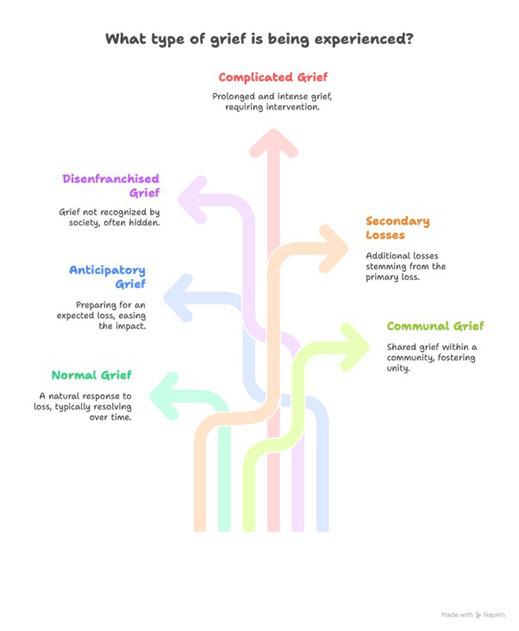
Grief wears many masks, each one unique, each one challenging. Understanding these distinctions can help validate your experience and guide you toward the right support.
- Normal Grief: The expected, typical emotional and physical response to loss. While its intensity gradually lessens, waves of sadness may resurface.
- Anticipatory Grief: The grieving process sometimes begins before an actual loss occurs — such as with a terminal illness or the looming end of a major life chapter.
- Disenfranchised Grief: The silent, often isolating grief that isn't openly acknowledged, publicly mourned, or socially supported — the pain of a miscarriage, the death of an ex-spouse, or the profound loss of a beloved pet.
- Complicated Grief (Prolonged Grief Disorder): When grief's intensity doesn't diminish over time, significantly impairing daily functioning for more than 6-12 months. This affects 10-20% of bereaved individuals and includes chronic, delayed, exaggerated, and masked grief.
- Secondary Losses: Beyond the primary loss, grief often triggers a cascade of other losses — financial security, social identity, daily routines, future plans, and a fundamental sense of self.
- Communal Grief: The collective sorrow experienced by a group, community, or nation in response to a shared tragedy.
The Journey Through Grief: A Non-Linear Map
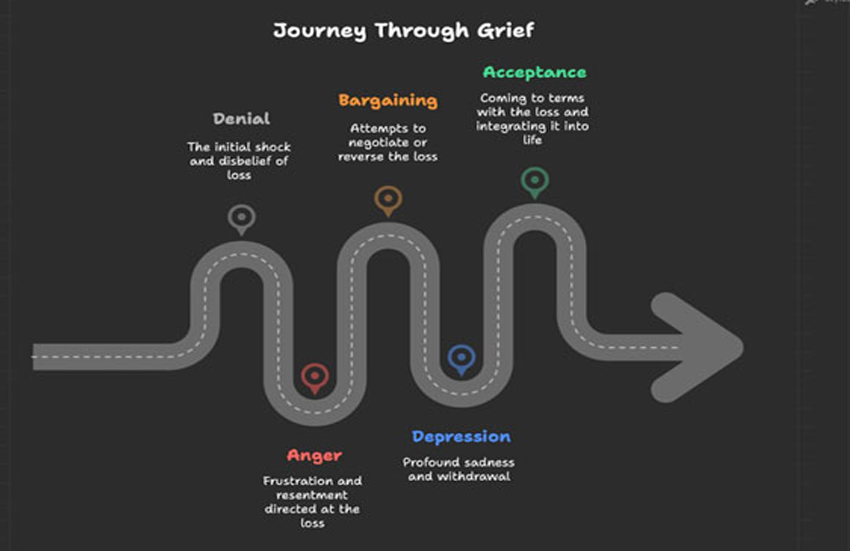
While grief is anything but linear, the Kübler-Ross model of the "five stages of grief" offers a widely recognized framework for understanding some common emotional responses. These aren't rigid steps you tick off, but fluid experiences you might move in and out of, or even feel simultaneously:
- Denial: Your mind's temporary shock absorber — "This can't be happening."
- Anger: Frustration, rage, and resentment — "Why me? It's not fair!"
- Bargaining: Trying to negotiate to reverse or postpone the loss — "If only I had..."
- Depression: A profound sadness and withdrawal as the full weight of the loss sinks in.
- Acceptance: Coming to terms with the reality of the loss and finding a way to live with it.
Identity Grief: When the Person You Lose Is You
Beyond the traditional understanding of grief as mourning the death of a loved one lies another profound form of loss — the grief that accompanies the death of parts of ourselves. This type of grief occurs when we experience fundamental changes to our identity, capabilities, roles, or sense of self, leaving us to mourn who we used to be while struggling to understand who we are becoming.
Identity grief represents the profound sadness and disorientation that accompanies the loss of aspects of ourselves that once felt central to our identity. Unlike traditional bereavement, this form of grief is often invisible to others and may be dismissed or minimized by society, making it particularly isolating for those experiencing it.
Identity grief differs from other forms of loss because the "deceased" part of yourself may feel simultaneously gone forever and intimately present. This creates what researchers call ambiguous loss — grief that remains unclear and unresolved because there's no clear endpoint or closure.
Common Triggers for Identity Grief
- Chronic Illness and Disability: The diagnosis of a chronic illness or acquisition of a disability often precipitates profound identity grief — mourning the pre-illness self, lost physical capabilities, and the future you had envisioned.
- Trauma and Post-Traumatic Stress: Traumatic experiences can shatter fundamental assumptions about yourself, others, and the world, leading to identity confusion or feeling that "a part of oneself has died."
- Career Transitions and Professional Identity Loss: For many people, professional roles become so central to identity that career changes — whether voluntary or involuntary — trigger profound grief. You simultaneously lose status, daily structure and purpose, professional relationships, financial security, and future plans.
- Life Stage Transitions: Major life transitions often involve grieving aspects of identity that no longer apply — menopause, retirement, children leaving home — while struggling to embrace emerging aspects of self.
- Parenting Transitions: Parents often experience identity grief during major transitions in their children's lives, particularly when children leave home (empty nest syndrome).
Case Spotlight
Consider Sanya, a professional dancer who suffered a severe knee injury at age 28 that ended her career permanently. Though she's physically alive and healthy in other ways, she grieves the death of her dancer identity — mourning the loss of the stage lights, the euphoria of perfect performances, the community of fellow dancers, and the future she had envisioned.
Her friends suggest, "You can still teach," but the suggestion feels like salt on an open wound because Sanya is not just losing a job; she is losing who she is.
Cultural Perspectives and Individual Variations
Grief expressions vary dramatically across cultures, influenced by religious beliefs, social norms, and historical traditions. Western cultures often emphasize individual processing with expectations to "move on," while many Eastern and Indigenous cultures view grief as inherently communal with extended mourning periods and continuing bonds practices.
Individual differences in grief response reflect personal meaning-making systems, identity centrality, attachment patterns, cultural background, and available resources. What makes loss "irreplaceable" isn't objective characteristics but the unique attachment bonds and personal significance invested in what was lost.
Why Grief Feels So Different from One Person to the Next
| Core Factor | How It Shapes "Irreplaceability" | Impact on the Grief Curve |
| 1. Personal meaning-making system | A loss that punches a hole in your core life narrative feels catastrophic. The more central that narrative, the more irreplaceable the loss. | Greater need to make sense of the loss; higher risk of complicated grief if no meaning can be found. |
| 2. Identity Centrality | The more a loss undermines a central identity pillar (intellect, productivity, caregiving), the more "who-am-I?" anxiety it triggers. | Acute identity shock; heightened risk of shame and self-criticism; recovery hinges on schema revision. |
| 3. Attachment pattern | Secure attachment trusts support is available elsewhere; anxious attachment experiences separation as abandonment; avoidant attachment numbs out. | Secure: intense pain but steady recovery. Anxious: prolonged yearning. Avoidant: delayed or masked grief. |
| 4. Cultural background | Culture dictates how and when emotions may be shown, who provides support, and what rituals help re-knit the social fabric. | Collective mourning distributes emotional burden; cultural stigma can intensify shame. |
| 5. Available resources | Internal (emotional regulation, coping experience) and external (income, friends, therapy) resources determine whether someone can process grief or becomes overwhelmed. | Adequate resources act as shock absorbers; scarcity prolongs grief and increases health risks. |
Beyond Coping: Integrating Grief into Life's Fabric
The outdated idea of "moving on" from grief is finally giving way to a more compassionate and realistic concept: integrating grief. This perspective acknowledges that loss doesn't disappear; it becomes a permanent part of your life story. The goal isn't to forget or erase the pain, but to learn to live alongside it.
Practical Tools for Emotional Flexibility:
- Mindfulness & Self-Compassion: Practice being present with your emotions without judgment. Acknowledge your pain with the same kindness you'd offer a dear friend.
- The Dual Process Model: Healthy grieving involves oscillating between "loss-oriented" activities (focusing on pain and memories) and "restoration-oriented" activities (engaging with life, adapting to changes).
- Creative Expression: Art, writing, music, or journaling can provide a vital non-verbal outlet for complex emotions.
- Rituals & Remembrances: Creating new rituals or continuing old ones that honor what was lost can offer immense comfort and a sense of ongoing connection.
Modern Contexts: Grief in the Digital Age and Beyond
Grief today unfolds within increasingly complex social and technological landscapes. In the workplace, employers can cultivate a grief-sensitive culture through flexible leave policies and Employee Assistance Programs. In academic settings, universities and schools have a responsibility to provide accessible counselling services and academic accommodations.
Technology is also opening up new avenues for grief support — digital memorials, grief support apps, and online communities. These can provide accessible support, especially for those geographically dispersed.
Supporting Others: When Grief Goes Unseen
Some individuals exhibit "inhibited" or "masked" grief, where outward expressions of sorrow are suppressed or channeled into physical symptoms or relentless busyness. They might appear "fine" on the surface.
- Look for Subtle Cues: Notice changes in behavior, increased irritability, social withdrawal, or unexplained physical ailments.
- Avoid Assumptions: Never assume someone isn't grieving just because they aren't crying or talking about it openly.
- Offer Direct, Gentle Inquiry: A simple "How are you really doing?" or "I'm here if you ever want to talk" can be the compassionate invitation they need.
Effective Support Strategies
- Listen Actively, Without Judgment: Offer a safe, non-judgmental space. Resist the urge to fix or minimize. Simple phrases like "I'm so sorry. I'm here for you" are often enough.
- Offer Practical, Specific Help: Instead of "Let me know if you need anything," offer concrete assistance: "Can I bring you a meal on Tuesday?"
- Avoid rushing the process: Resist pressure to help them "move on" before they're ready.
- Validate Their Experience: Acknowledge their pain directly: "It sounds incredibly difficult," or "It's okay to feel whatever you're feeling right now."
- Be Patient and Persistent: Grief has no timeline. Continue to check in over weeks and months.
- Gently Encourage Professional Help: If you observe signs of complicated grief or severe distress, gently suggest seeking professional support. Frame it as a strength, not a weakness.
When to Seek Professional Help for Grief
While grief is a normal, albeit painful, human process, sometimes it becomes overwhelming or prolonged, requiring professional intervention. Knowing when to reach out for help is a crucial act of self-compassion.
Distinguishing Grief from Clinical Depression:
| Indicator | Normal Grief | Major Depression |
| Mood variation | Waves of sadness with moments of relief | Persistently low mood nearly every day |
| Self-esteem | Generally intact | Feelings of worthlessness |
| Focus of thought | Preoccupation with the loss | Global hopelessness about life |
| Suicidal ideas | Desire for reunion with deceased | Desire to end personal pain |
| Duration | Gradual improvement | 2+ weeks of pervasive impairment |
Processing the Emotional Reality
Grieving requires becoming an ally to your past self rather than a critic. This involves directing compassion toward the parts of you that were deprived of safety, care, or authentic expression. Working with a therapist can provide crucial support in learning to receive care and acceptance, which enables directing those same qualities inward.
The goal isn't to eliminate painful emotions but to experience them without becoming overwhelmed or stuck.
Therapeutic Approaches
Various therapeutic modalities can provide invaluable support as you navigate complicated grief or profound distress:
- Grief Counselling/Therapy: A safe, confidential space to process emotions, develop personalised coping strategies, and explore the evolving meaning of your loss. Sessions involve discussing your loss story, examining its impact on daily life, and exploring evolving meanings. Research shows it can significantly decrease symptoms of complicated grief, with many people reporting improved emotional regulation after 12-16 sessions.
- Cognitive Behavioral Therapy (CBT): A structured, evidence-based therapy that targets the interplay between thoughts, feelings, and behaviors. CBT helps identify and gently challenge unhelpful thought patterns — such as "I'm a complete failure because I lost my job" — and replace them with more balanced perspectives. Studies indicate CBT can decrease complicated grief symptoms by 40-60% in 8-12 sessions.
- Acceptance and Commitment Therapy (ACT): ACT emphasises psychological flexibility, teaching you to accept painful emotions as natural rather than fighting them, while aligning actions with your deepest values. Through mindfulness exercises and value clarification, ACT promotes post-traumatic growth by redirecting energy toward meaningful living.
- Somatic Experiencing: Grief often gets stored in our bodies as tension, tightness, or restlessness. Somatic Experiencing helps you notice these bodily sensations and gently work with them so that stuck energy can flow and release. Techniques include grounding, pendulation, and titration — taking in small bits of grief at a time.
- Sensorimotor Psychotherapy: Combines talking and body-based work to help you notice grief held in how you move and hold yourself — a hunched back, clenched fists, or shallow breathing. Guided movements help unlock buried grief and bring a sense of relief.
- Polyvagal-Informed Therapy: Uses science-backed exercises to shift you back into your "safe and social" mode so you can face loss without feeling frozen or overwhelmed. Simple practices like slow breathing, soft humming, and gentle rocking regulate your body's stress response.
- Internal Family Systems (IFS): Inside each of us are different "parts" with their own feelings and roles. IFS teaches you to step into your own calm, compassionate center (the Self) and kindly listen to each part's needs — reducing inner conflict like guilt versus relief, and cultivating self-kindness.
- EMDR for Traumatic Grief: When grief comes with shocking or graphic memories that replay over and over, EMDR offers a way to gently reprocess those memories so they lose their painful charge. Using guided side-to-side eye movements or taps, your brain is helped to store the memory in a calmer way.
- Trauma-Informed Narrative Therapy: Grief can scramble our life story, making it hard to see how loss fits into who we are. This therapy provides a structured, safe way to rebuild your personal narrative — mapping out meaningful events, highlighting moments of strength, and reshaping your story to include hope, resilience, and the lasting impact of your loved one.
- Mindfulness & Compassion-Focused Therapy: Teaches you to mindfully notice waves of sadness without judging them, then respond with kindness. Simple practices like breathing exercises and compassionate imagery build a caring inner voice that soothes shame and guilt.
Support Groups
While not formal therapy, support groups provide peer-based healing through shared experiences. Connecting with others who have experienced similar losses can profoundly reduce isolation, offering a powerful sense of shared understanding, validation, and community. Participants often report reduced shame and increased hope, with studies showing group support can decrease depression symptoms by 20-30%.
Grief is not a wound that simply "heals" and disappears. It's a profound testament to your capacity for love, a journey that reshapes you, and a part of your story that can, over time, be integrated into a life lived with renewed purpose and profound resilience.
Why CoachForMind?
Experienced Psychologists: We are a team of licensed RCI-registered clinical psychologists experienced in grief counselling, CBT, DBT, EMDR, and Narrative Therapy.
Personalised Approach: We are dedicated to treating each client in the best-suited way, carefully curated to individual needs, adhering to one-on-one, client-centered therapy.
Scientific Techniques: Our treatment plans and therapeutic methods are based on highly researched scientific findings.
Begin with a free 15-minute discovery call. For more information, please visit our website or contact us at [email protected]
Written by Dr. Kudrat — Clinical Psychologist at Coach For Mind
FAQs About Grief and Loss
Grief is not just sadness — it's an earthquake that shakes the foundations of life. It is your body and mind's natural, multifaceted response to losing someone or something irreplaceable. While we often associate it with death, grief casts a much wider net: a broken relationship, job loss, health decline, relocation, or even the loss of a beloved pet. It's not a single emotion you "get over," but a dynamic process that ripples through every part of you — emotionally, physically, cognitively, and behaviorally. Ultimately, the pain of grief is a testament to your capacity for connection and love.
There's no fixed timeline. Some people may start to feel better in months, while for others grief can resurface for years, especially around anniversaries or reminders. The key is that grief eventually lessens in intensity rather than disappearing entirely.
Yes, the widely known Kübler-Ross model includes five stages: Denial ("This can't be happening"), Anger ("Why me?"), Bargaining ("If only I had..."), Depression (profound sadness as the weight of the loss sinks in), and Acceptance (coming to terms with reality and integrating it into your life's narrative). These are not rigid steps — they are fluid experiences you may move in and out of, or feel simultaneously.
Grief isn't just an emotional experience — it profoundly impacts your entire physical and mental well-being. Emotionally you may feel deep sadness, anger, guilt, anxiety, loneliness, and numbness. Physically, your body may react with fatigue, sleep disruption, appetite changes, headaches, digestive issues, and increased susceptibility to illness. Cognitively you may experience difficulty concentrating, memory problems, and a constant preoccupation with the loss. These are normal responses to an abnormal situation — but if symptoms become debilitating or persist for an extended period, professional support can be incredibly beneficial.
No. While we often associate grief with losing a loved one to death, we can grieve many types of losses: the end of a significant relationship, a job loss or career change, moving away from a cherished home, a diagnosis that changes your future, and dreams that didn't come to pass.
Yes. Common physical symptoms include crushing fatigue, restless sleep, dramatic appetite changes, persistent headaches, digestive issues, unexplained muscle aches, and even an increased susceptibility to illness. Your body's stress response goes into overdrive, impacting your immune system.
Listen actively without fixing or judging. Offer practical, specific help ("Can I bring you a meal on Tuesday?"). Avoid rushing the process or pressuring them to "move on." Validate their experience: "It sounds incredibly difficult." Be patient and persistent — grief has no timeline. And gently encourage professional help if you observe signs of complicated grief or severe distress.
Seek therapy if you notice: persistent inability to function at work or home, intense yearning beyond a year, self-harm thoughts or substance dependence, or extreme guilt or worthlessness. Grief-informed therapists at Coach For Mind use approaches such as grief counselling, CBT, and EMDR to help you process loss without erasing love.
They overlap but are distinct. In grief, you'll typically find waves of sadness interspersed with moments of relief, pain focused on the specific loss, intact self-esteem, and thoughts of death often about reunion with the deceased. In clinical depression, you'll typically experience a persistent low mood for most of the day for at least two weeks, pervasive loss of pleasure in almost all activities, feelings of worthlessness or excessive guilt, and suicidal ideation not focused on reunion. If your symptoms are severe, persistent, or significantly impair daily functioning, please seek professional support — it's a sign of strength.
Healing often involves allowing yourself to feel, expressing emotions, leaning on support systems, practicing self-care, and sometimes working with a therapist at Coach For Mind to integrate the loss into your life. Remember: the goal isn't to "get over" grief but to carry it with strength, compassion, and a deeper understanding of yourself.


