
Guarded Hearts, Silent Mouths: Why Indian Men Struggle to Say Yes to Couples Therapy
Couples therapy has become increasingly accessible and socially acceptable in urban India's evolving relationship landscape. However, a noteworthy pattern emerged that showed that although women are often willing to seek professional help for relationship struggles, many men are still reluctant or categorically refuse to do so. This resistance is often mistaken for pride or stubbornness. But the truth is, it is deeply rooted in trauma responses shaped by cultural conditioning, societal expectations, and intergenerational patterns of emotional suppression.
Aditya (names anonymised due to confidentiality), a 36 year old engineer from Gurgaon, was referred to couples therapy by his wife, Shreya. They had been married for six years and Shreya described Aditya as "emotionally unavailable," “defensive,” and “distant.” Shreya explained that Aman shut down during conflicts, didn't engage in repair and as a result, she felt alone and isolated in their marriage.
Let’s have a closer, kinder look at Aditya to better understand this resistance.
Peeking behind the curtain
To better understand why men resist couples therapy, it is imperative we first understand that that resistance is often a trauma response. We often chalk this resistance up to narcissistic, difficult or willful obstinacy. However what might appear as defensive and difficult behaviours, are actually protective mechanisms designed to cope with overwhelming experiences or trauma they experienced in childhood.
In many Indian households, trauma often shows up as:
- Chronic emotional invalidation
- Pressure to suppress vulnerability
- Cultural messaging that says emotional expression is a sign of weakness
- Not witnessing healthy resolution models after domestic conflict

When someone goes through these experiences, they develop a protective mechanism of “emotional numbing” where they disconnect from their emotions to avoid pain. This results in difficulty in communication and intimacy.
We can see this play out in Aditya’s immediate response to Shreya suggesting couple’s therapy.
"I don’t understand how talking about our problems with a stranger is going to help us. I work, I provide, I don’t hit anyone. What more do you want?"
While Shreya hoped for intimacy and connection, Aditya was reluctant and only agreed to start couples therapy to “keep the peace”. During the first session, he sat with a tense silence and his arms crossed looking out for the first sign of emotional exposure.
The Cost of Performing Masculinity
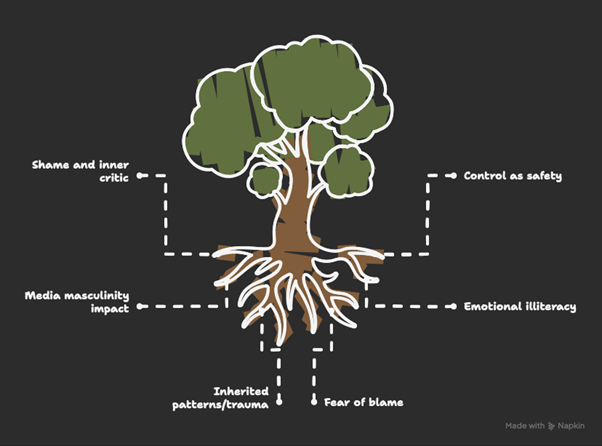
SHAME AND INNER CRITIC
One of the most powerful emotions that drives resistance towards couples therapy is Shame. Many Indian men experience intense shame at the thought of needing therapy. They associate the need for therapy with them being an inadequate partner and their capacity to live up to masculine standards. This shame tells them that they are not enough or that they are wrong.
This shame is often voiced in the form of a relentless inner critic that constantly tells them that:
- needing help means they're weak or a failure
- real men should be able to handle relationship problems independently
- seeking therapy will expose them as inadequate or weak
This shame has deep roots in Indian cultural messages that equate independence as strength and needing help as weakness. Even just acknowledging that they can’t solve their relationship problems on their own can feel like a fundamental failure of masculinity.
Most men grow up in an environment where problems were often handled privately, and seeking outside help was considered weak or as acting like a victim. It can feel like a betrayal of family values and cultural expectations to discuss intimate relationship details with a complete stranger, even if they are a trained professional.
Aditya’s resistance and discomfort was shame, not apathy towards his marriage. Every time Shreya expressed sadness over the lack of connection in their marriage, Aditya’s inner critic would speak loudly, "You’re failing. You’re a bad husband. You’re inadequate."
As a result, he would get flooded with shame. To protect himself from this overwhelming shame, he’d get desensive, make a sarcastic comment or withdraw emotionally.
He shared that he knows he is messing up but he doesn't know how to stop and fix it without feeling humiliated and emasculated. “Where do I begin?” His resistance was self protection.
CONTROL AS SAFETY
Aditya learned at an early age that control meant feeling safe. He had an emotionally distant father who valued discipline over empathy and a mother who modeled silence and sacrifice. The message he received was that emotions are unsafe.
As a result, he developed a high achieving, perfectionistic and pragmatic personality who’d suppress and reject the vulnerable parts of himself.
Hence control ended up being a defensive strategy against shame. As a result, therapy felt like a direct threat to this defensive tactic because of its emphasis on relinquishing control and exploring his emotions and becoming vulnerable.
IMPACT OF MEDIA ON MASCULINITY
Male rage, emotional shutdown and control in relationships are glorified in movies such as Animal and Kabir Singh, portraying these traits as strong and masculine ideals.
Most Indian men grow up with the ideas that portray vulnerability as weak and soft. Vulnerability is often mocked and reserved only for women and “weak” people. “Real men don’t cry.” They are strong, stoic problem solvers and fixers. This script strips men off of their emotions except anger.
The media also teaches men that their worth is tied to their success and performance. Needing therapy can feel like a failure in their most important role as a husband and partner. If men fail to play the role of protector and provider, their worth collapses and their sense of self dismantles. This can be incredibly distressing hence they avoid therapy.
EMOTIONAL ILLITERACY
Aditya often went blank or got angry whenever Shreya cried or expressed hurt. Aditya had no roadmap for emotional communication. This was emotional illiteracy, not indifference. He didn’t know a safe way to process what he or Shreya was feeling.
Once Aditya learned to name his emotions, he realised that he is scared to disappoint Shreya.
INHERITED PATTERNS AND CHILDHOOD TRAUMA
Therapy enabled Aditya to recognise his anger and reconnect with his suppressed vulnerable younger part of himself that felt rejected, confused and desperate for emotional safety. That vulnerable part of him learned early on that if you feel too much, you’ll fall apart and that vulnerability is dangerous. This part had grown up in a household where love was conditional, strength meant silence, and emotional expression was either ignored or punished.
These beliefs weren't born in a vacuum. They were passed down through generations from an emotionally absent father that never said, “I love you”, a grandfather that believed silence as strength and a mother who taught emotional suppression because ”men don’t cry”. As a result, when their partner wants to connect, empathise or be vulnerable, they feel lost, pressured or inadequate, not because they don’t want to, but because no one taught them how to.
Intergenerational legacies of silence, emotional suppression and patriarchal control shaped his inner world. Therapy became a journey about understanding himself, not just Shreya.
FEAR OF BEING BLAMED OR BEING THE VILLAIN
Most Indian men avoid therapy because they’re worried that therapy is a covert intervention where they’ll be ambushed, blamed or attacked. Some forms of therapy can unintentionally reinforce this fear.
Therapy is supposed to feel like a healing space, not a courtroom. If it doesn’t, it can activate defense mechanisms involving shutting down, walking out, deflecting or lashing out just to escape feeling shame.
Aditya had similar apprehensions of being labeled as “the problem” and reframing what therapy is, helped create safety in the room.
"I was worried about being blamed."
COMMON FEARS MEN BRING TO COUPLES THERAPY
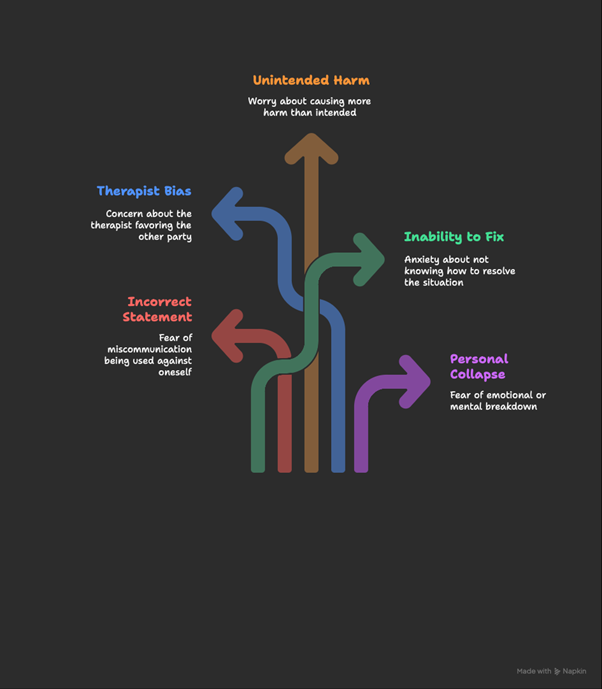
There are genuine worries that remain hidden behind the sarcasm and silence, such as:
- "What if I say something incorrectly and she later turns it against me?"
- "What if the therapist takes her side?"
- "What if I turn out to have hurt her more than I initially believed?"
- "What if I have no idea how to fix it?"
- "What if I collapse?"
These are serious concerns. These are memories encoded with trauma, burdens men bear from early life, from unimaginable family situations, and from a society that seldom accepts male weakness.
WHAT COUPLES THERAPY ACTUALLY OFFERS
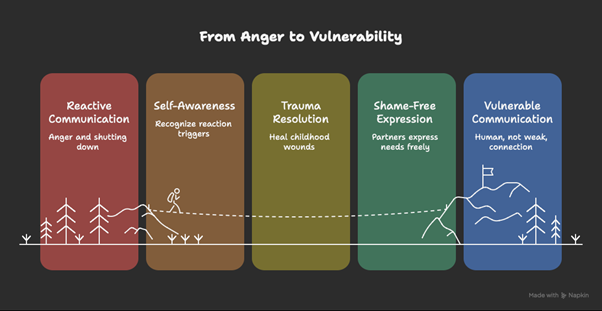
Many men are surprised to discover what couples therapy actually involves. It is not about assigning blame or establishing who is correct. When done effectively, particularly by trauma-informed therapists, it becomes a place to:
- Develop the ability to communicate without shutting down or having an anger outburst.
- Recognise the reasons behind your reactions in a conflict.
- Resolve childhood traumas that resurface in adult relationships.
- Provide a space where both partners can freely express their needs without feeling shame.
- Discover that being vulnerable makes you human, not weak.
How Partners can Support the Process
Shreya’s patience was key. She began to recognise minor changes and ceased advocating for change. She noticed when Aditya tried to show up, even if he did so imperfectly. This gradually strengthened his courage and lessened his shame. Partners may:
- Validate the effort, not just the outcome
- regulate their own emotions in stressful situations.
- To prevent burnout, get individualised support.
Aditya's story is not the only one. It's the story of thousands of Indian men navigating relationships with a nervous system wired for self-protection.
He didn't undergo a dramatic change. It was hard-won, slow, and delicate. But, it was genuine. He began to view therapy as a mirror he dared to look into rather than as an indictment.
If you can relate to Aditya's journey, be aware of this:
You're not weak. You are wired for survival. However, recovery is achievable.
You don’t have to work alone. Explore our couples therapy in India services whenever you’re ready to take that first step.FAQ’s
Not at all. This belief is one of the biggest reasons many couples delay getting the support they need. That is a prevalent misconception in Indian society, where therapy is frequently viewed as a last resort, something you do only when everything is falling apart or divorce is on the table. However, therapy is actually a preventative and proactive measure.
Couples therapy isn't just for relationships in crisis, just as going to the gym isn't just for people with health problems. It's a place to explore each other's emotional worlds, improve communication skills, strengthen emotional bonds, and identify hidden patterns that could be causing conflict or distance.
Therapy provides a safe, nonjudgmental space for many couples to express feelings that might otherwise cause miscommunications or arguments. It fosters the development of relational skills that can prevent problems from escalating in the future, such as empathy, active listening, emotional control, and constructive conflict resolution.
Early intervention can improve intimacy, fortify a relationship's foundation, and even reveal unresolved personal issues that might be impacting the relationship. The objective is to establish a more sensitive, courteous, and emotionally secure relationship for both parties, not to "fix" either one.
Therefore, therapy isn't limited to "broken" relationships. It is intended for inquisitive, growth-oriented couples who wish to better understand one another and create a more wholesome relationship—together.
Couples therapy is often thought to be reserved for relationships that are in crisis, such as those involving serious dysfunction, abuse, or affairs. Therefore, your husband may sincerely think that your relationship is not eligible for assistance when he says, "We don't need therapy—I'm not abusive or cheating." His statement is frequently a reflection of how society defines "real" relationship problems, particularly for men, and is not necessarily an act of resistance.
You could politely reply with something like:
"Resolving serious problems isn't the only goal of therapy. It's about strengthening our bond, improving our understanding of one another, and learning how to communicate through challenging emotions without becoming defensive or fighting. We deserve more than merely surviving; I don't think we're broken."
This approach works because he may be using the absence of hurt as a yardstick for relationship success—"I don't cheat, I don't hit you, I work hard." However, relationships require more than just survival; they require intimacy, communication, emotional safety, and repair. Reframing therapy as a workshop for relationship growth rather than a punishment may reduce his resistance over time.
Couples therapy can feel like a confrontation for many Indian men, rather than just a conversation. From an early age, many are taught that real men are independent, in control, and emotionless. They are congratulated for being "tough," "strong," and "problem-solvers." Showing vulnerability—such as crying, asking for support, or admitting difficulty—is often met with embarrassment or silence.
This cultural conditioning means that therapy, which requires openness and vulnerability, can trigger a deep nervous system response—a feeling of threat rather than mere discomfort. It calls into question their identity and challenges the belief that emotional control equals strength.
Moreover, many men carry an internal critic formed by childhood experiences of emotional neglect or hyper-criticism, so the therapeutic process may inadvertently trigger shame or feelings of failure. Therapy encourages cooperation, vulnerability, and shared responsibility, which can feel like a loss of power for those raised to equate authority with emotional detachment.
Often, what appears as stubborn resistance or defensiveness is actually a trauma response. Many men have learned to suppress vulnerability due to factors such as chronic emotional invalidation, pressure to hide their true feelings, and cultural messaging that deems emotional expression as weak.
When faced with emotionally charged situations, their protective mechanisms may trigger an "emotional numbing" response as a survival tactic. This shutdown helps them avoid overwhelming pain, but it also hinders communication and intimacy. Understanding this pattern as a trauma response can help both partners approach therapy with more compassion and patience.
Yes, often. Especially for those who have rarely felt safe expressing vulnerability. The discomfort is frequently an indication that something significant is being uncovered. It isn’t a sign that therapy is failing; rather, it’s part of the process of addressing long-held emotional wounds.
When facing resistance, partners can consider the following approaches:
- Try to understand the resistance with compassion.
- Focus on creating a safe, non-judgmental space for dialogue.
- Validate their fears, even if you don’t share them.
- Avoid blaming or shaming them.
- Recognize and appreciate small efforts rather than only outcomes.
- Regulate your own emotions during stressful situations.
- Ensure you have individualized support so you don’t self-abandon.
Yes, and it's usually the best place to begin. For many Indian men, the concept of couples therapy can be intimidating due to the pressure of "opening up" in front of their partner. Individual therapy provides a private space to build emotional trust and literacy.
The goal of individual sessions is to help the person:
- Recognize their feelings without the burden of shame.
- Understand their protective traits, such as emotional shutdown, anger, or avoidance.
- Examine underlying cultural or childhood conditioning that has taught them that emotions are unsafe.
- Develop a new emotional vocabulary at their own pace.
Once they feel less judged and more secure, they are more likely to be receptive to the relational work of couples therapy.
Internal Family Systems Therapy (IFS) can be especially beneficial for men who feel resistant to therapy because their resistance often stems from emotional overload, fear, or shame. Many men have never been taught to explore their inner world; instead, they've learned to “man up” and suppress emotions.
IFS works by inviting individuals—without judgment—to explore their internal “parts” or subpersonalities. This approach validates previously adopted coping mechanisms while gently guiding them toward understanding, healing, and integration. Over time, this method helps in reducing emotional resistance and opens the door to deeper relational work.
Not necessarily. A partner shutting down during emotional conversations is often a trauma response rather than a sign of indifference. Many men have been conditioned to see emotional expression as a vulnerability or weakness. Their automatic withdrawal is more about not knowing how to cope with overwhelming feelings than about neglect.
With support and gradual exposure, these patterns can be changed, leading to better communication and emotional intimacy.
Many Indian men worry that therapy might feel like they will be ambushed, blamed, or attacked. It is important to remember that therapy is designed to be a healing space—not a courtroom. A skilled therapist will work to create an environment that fosters connection rather than confrontation.
By ensuring that the therapeutic process emphasizes shared responsibility and mutual growth, partners can move past the fear of being singled out and use therapy as a tool for real connection and healing.