
TL;DR
- Founder judgment under pressure is a major business risk; stress directly affects decision quality, hiring, strategy, and execution.
- Chronic cognitive overload reduces prefrontal functioning → more reactivity, avoidance, overcontrol, and delayed decisions.
- Therapy for founders isn’t just emotional support; it’s leadership infrastructure that protects clarity, bandwidth, and judgment.
- Better cognitive bandwidth = faster, cleaner decisions, stronger teams, and higher-leverage use of founder time (Decision ROI).
- Psychological Capital (self-efficacy, hope, resilience, optimism) acts as internal infrastructure that buffers pressure and improves performance.
- Common founder traps include identity fusion, control paralysis, recognition gap, and fraud tax.
- “Always-on” hustle culture narrows thinking and distorts decisions more than it boosts performance.
- Costly patterns under pressure: avoidance, ego defensiveness, overcontrol, people-pleasing, and decision fatigue.
- Therapy shortens the lag between recognizing a problem and acting on it → reduces hidden financial risk.
- High-stakes moments (fundraises, pivots, exits) require cognitive clarity; therapy helps maintain it.
- Many founders have ADHD or high-intensity cognitive styles; therapy helps optimize these strengths sustainably.
- Coaching improves external systems; therapy addresses internal drivers. Together, they strengthen leadership.
- Therapy is a strategic investment that protects judgment, improves decision quality, and supports long-term company scalability.
The Founder's Cognitive Edge: Why Therapy Is a Strategic Investment
It’s 3:00 AM. You’re not awake because of caffeine. You’re awake because of projections. Burn rate. Hiring risk. Runway math. The quiet sense that one wrong decision could compound faster than ten good ones.
In most companies, risk sits in the market, the product, or the team. In founder-led companies, the biggest risk often sits somewhere else: the founder’s judgment under pressure.
As one founder put it, “when the company dips, it doesn’t feel like a normal business fluctuation. It feels personal.” That overlap between identity and company performance isn’t just emotional, it affects real decisions. It changes how fast you pivot, how clearly you hire, how decisively you let someone go, and how accurately you read what’s actually happening.
Startup culture has long rewarded endurance. Lack of sleep gets framed as dedication. Constant pressure gets framed as ambition. But the data is clear: entrepreneurs report much higher levels of stress, burnout, and cognitive overload than the general population. When stress becomes constant, the brain’s decision-making systems don’t work at full capacity. They slow down.
If your servers started lagging under heavy load, you wouldn’t just push them harder. You’d optimize them. Fix bottlenecks. Increase capacity. Remove technical debt. Leadership works the same way.
Therapy in this context isn’t about emotional relief. It’s about keeping your thinking clear, your bandwidth intact, and your judgment reliable when decisions carry real weight.
At scale, therapy functions less like wellness and more like infrastructure maintenance. It protects cognitive bandwidth, improves decision quality, and reduces costly leadership mistakes. For founder-led companies, that makes it one of the highest-leverage investments available.
At Coach for Mind, we work with entrepreneurs using this exact lens. Therapy for entrepreneurs here is structured, strategic, and performance-oriented: a confidential space to audit patterns, reduce cognitive drag, and strengthen decision clarity under sustained pressure.
The ROI of Clarity: Judgment as a Core Business Asset
Many founders still treat therapy as time taken away from execution. The implicit assumption is that strong leaders should be able to “handle it.” This is the Stoic Leader fallacy: the belief that resilience is measured by suppression and that strong leadership requires emotional impermeability.
In reality, leadership under sustained uncertainty imposes a cognitive tax.
When stress remains elevated, the prefrontal cortex, responsible for planning, prioritization, impulse control, and strategy, becomes less efficient. The shift is gradual and easy to miss:
- Decisions become reactive instead of deliberate.
- Hard conversations get postponed.
- Over-analysis replaces movement.
- Control tightens.
- Irritability increases.
These are not flaws. They are predictable consequences of operating at sustained cognitive overload.
- Hiring decisions take longer.
- Underperformers remain longer than they should.
- Conflict simmers instead of resolving.
- Strategic pivots get postponed until they become forced.
- Decision fatigue becomes the baseline.

An hour spent restoring cognitive bandwidth is not an hour lost to the P&L. It is an hour protecting the quality of decisions that shape the P&L. In founder-led companies, judgment is not a soft variable. It is a core asset.
Cognitive Bandwidth and the Decision ROI
Every strategic move you make draws from a finite internal resource: Cognitive Bandwidth. This resource is constantly drained by unresolved tension, sleep disruption, and the sheer emotional load of being "the one with the answers."
When your bandwidth is compromised, your brain takes shortcuts. You rely on defensive heuristics, short-term relief, and "safe" decisions that eventually stall growth. Therapy functions like system defragmentation for leadership cognition. It reduces internal noise and increases pattern awareness. You begin to see when:
- Fear is masquerading as caution.
- Ego is shaping a hiring decision.
- Avoidance is being framed as patience.
- People-pleasing is a distorting strategy.
When clarity increases, leverage compounds:
- Cleaner Decisions lead to stronger, high-trust teams.
- Stronger Teams reduce the founder’s day-to-day load.
- Reduced Load preserves your bandwidth for high-leverage strategy,
This is Decision ROI in action.
Building Your Psychological Capital
Mental resilience is not a personality trait. It is infrastructure. High-performing founders actively build Psychological Capital, a reserve that buffers pressure and preserves clarity. The four pillars that matter the most:
- Pivot Reflex (Hope): The cognitive flexibility to generate three new pathways when your primary strategy hits a wall.
- Strategic Optimism: The ability to see success as a result of your competence, while viewing failures as objective data points to be fixed rather than personal indictments.
- The Bounce-Back (Resilience): The capacity to process a failed launch or a lost key hire without losing the team’s trust or your own momentum.
- Unshakeable Agency (Self-Efficacy): The quiet, technical confidence to execute your vision even when the market is screaming for a retreat.
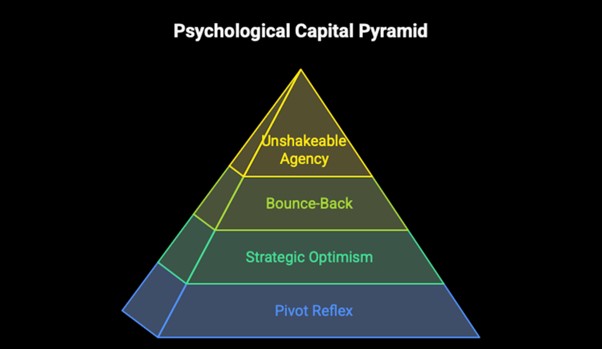
According to research, psychological capital acts as a primary mediator for entrepreneurial success. Founders who invest in this "internal infrastructure" don't just survive the journey; they maintain the clarity required to scale at a level their competitors simply cannot sustain.
In "hustle culture," therapy was dismissed as a weakness. Today’s top-tier founders view it as Leadership Optimization. If you are the ultimate bottleneck of your organization, then unresolved personal "bugs" lead to hiring mistakes, toxic cultures, and strategic errors.
| PsyCap Pillar | The Business Impact | How Therapy Develops It |
| Self-Efficacy | The confidence to execute pivots. | Dismantling Imposter Syndrome. |
| Hope | Generating multiple pathways to goals. | Reducing "Decision Fatigue" via mental clarity. |
| Resilience | Bouncing back from VC rejection. | Processing founder-specific stress patterns and high-pressure identity strain |
| Optimism | Maintaining vision during volatility. | Regulating emotions and building emotional awareness. |
The Four Cognitive Traps of the Founder Journey
Leadership isolation is not merely a cliché; it is a structural feature of the role. As a founder, you operate in a vacuum. You cannot fully process pressure with employees without leaking anxiety into the culture. You cannot be entirely transparent with investors without risking their confidence. Often, you cannot even bring the full weight of the boardroom home without straining your personal sanctuary.
Without a private, structured environment to process this load, it accumulates internally and begins to distort your external judgment. This isolation gives rise to four predictable cognitive traps that carry measurable business risks.
- Identity Fusion
Many founders don’t just run companies; they experience them as extensions of themselves. Recent research confirms founders don't just "work" at their companies, they view the business as a second identity. While this intensity fuels early-stage survival, it eventually creates Identity Fusion. When your personal worth is tied to your MRR, metrics cease to be data points - they become verdicts on your value as a human.
- The Business Risk: This fusion creates strategic rigidity. You become slower to abandon failing ideas because doing so feels like self-abandonment. Feedback feels like a threat rather than information, and pivots feel like an identity crisis rather than an evolution.
- The Strategic Fix: Therapy introduces "Identity Decoupling." This doesn't reduce your commitment; it reduces your distortion. When you stop experiencing every downturn as a personal indictment, you gain the Emotional Distance required to evaluate reality cleanly. You can kill failing projects faster and tolerate short-term losses without defensive decision-making.
- Control Paralysis
In the early days, direct oversight was a survival mechanism. But as you scale, that same need for certainty becomes a bottleneck. Therapy for entrepreneurs who cannot tolerate the "messy middle" of growth often struggle with Control Paralysis, over-involving themselves in execution under the guise of "maintaining high standards."
- The Business Risk: Execution slows to the speed of your personal bandwidth. Senior hires feel constrained and eventually disengage. You become the ultimate limiting factor in your organization's velocity.
- The Strategic Fix: Therapy addresses the internal triggers of overcontrol - usually a response to an underlying fear of chaos. By moving from Control to Context, you learn to set clear expectations and trust the execution. The result isn't just a healthier mind; it’s an organization that gains velocity because it no longer requires your permission to move.
- The Recognition Gap
One of the most expensive patterns in leadership is Avoidance disguised as "strategic patience." You delay a hard firing decision because you "need more data." You postpone a co-founder confrontation because the "timing isn't perfect."
- The Business Risk: This becomes the Slack Death-Spiral. Avoidance accumulates "interest" quietly: toxic hires erode culture, failing strategies consume runway, and co-founder friction deepens until it becomes explosive. By the time you act, your options have narrowed and the cost has tripled.
- The Strategic Fix: Therapy shortens that recognition gap - the time between the first signal of a problem and the moment you act. It helps you identify when irritability, insomnia, or a "death-grip" on Slack are signals of overload rather than background noise. With earlier recognition comes earlier intervention.
- The Fraud Tax
Imposter syndrome is often framed as a lack of confidence, but in high-stakes leadership, it functions as a Performance Tax. Founders who fear being "found out" often wear a "Mask of Strength," performing the role of the leader who is always "crushing it" while they are internally crumbling.
- The Business Risk: This leads to overpromising to the Board, pursuing unsustainable growth to prove legitimacy, and an inability to set boundaries. Strategy becomes driven by short-term validation rather than long-term viability.
- The Strategic Fix: By dismantling the internal narrative of the "fraud," you convert wasted energy into Unshakeable Agency. You no longer need to prove yourself through unrealistic commitments. This steadier, more authentic posture improves your credibility with investors and builds a culture where your team feels safe enough to be honest about their own challenges.
The Cost of the "Always-On" Culture
When founders operate in constant high-alert mode, it doesn’t just affect energy levels. It changes how decisions are made, how teams are led, and how value compounds over time.
The difference between white-knuckling leadership and optimized leadership is measurable.
| Feature | The "Hustle" Approach (Always-On Mode) | The Optimized Approach (Therapy-Led) |
|---|---|---|
| Decision Quality | Reactive, urgency-driven, influenced by anxiety and fatigue | Proactive, deliberate, strategically clear |
| Leadership Style | Micromanagement, overcontrol, approval-seeking | Context-setting, empowered delegation, high-trust leadership |
| Hiring Accuracy | Ego-driven or rushed decisions; tolerance for misalignment | Pattern-aware hiring; clearer judgment under pressure |
| Conflict Handling | Avoided, delayed, or handled defensively | Addressed early, directly, and without escalation |
| Burnout Risk | High and cumulative; decision fatigue becomes baseline | Managed and monitored; cognitive bandwidth preserved |
| Long-Term ROI | Diminishing returns as founder becomes bottleneck | Compounding growth as clarity and leverage increase |
Most founders assume that mental strain shows up as exhaustion.
In reality, it shows up as distorted decision-making - and that distortion has a measurable financial cost.
From a therapist’s perspective, the patterns we see most often in founders are not dramatic breakdowns. They are quieter, more expensive dynamics: avoidance, overcontrol, ego defensiveness, and people-pleasing. Each one drains cognitive bandwidth and quietly erodes revenue.
Not because founders lack capability, but because sustained pressure narrows perception. When cognitive load stays high for too long, leaders default to familiar patterns that feel stabilizing in the moment but destabilizing over time.
- Avoidance
Avoidance rarely looks like inaction. It looks like postponement framed as prudence:
- “Let’s revisit next quarter.”
- “We need more data.”
- “Now isn’t the right time.”
From the inside, avoidance often reflects decision fatigue. When cognitive bandwidth is depleted, the brain defers conflict and uncertainty to preserve short-term stability.
From the outside, the cost compounds quickly.
A delayed termination extends salary burn and team friction.
A postponed pivot consumes the runway.
An unaddressed co-founder tension slows execution across departments.
In therapy, we often see founders who know the correct decision weeks before they make it. What delays action is not lack of intelligence, it’s depleted psychological capacity to absorb the fallout. Restoring clarity and bandwidth reduces that lag time. Faster decisions rarely come from more pressure; they come from less internal noise.
At Coach for Mind, much of our work with founders centers on shortening that lag time, identifying where avoidance, ego, or overcontrol are silently increasing financial risk.
- Ego Defensiveness
Ego in founders is not simply arrogance. It is often a protective response to constant evaluation. When identity and performance are tightly linked, feedback can feel like a threat rather than data. Under pressure, leaders may double down on failing strategies, dismiss dissent, or surround themselves with agreement to preserve momentum.
This has predictable operational consequences. Teams become cautious about challenging directions. Board conversations lose candor. Strategic corrections happen later than they should.
From a therapist’s lens, this is less about personality and more about cognitive threat response. When leaders feel internally destabilized, they prioritize certainty over accuracy. Therapy helps widen that tolerance window. As defensiveness decreases, leaders can take in information without experiencing it as destabilizing. This improves hiring accuracy, strengthens executive teams, and allows course correction before costs escalate.
- Overcontrol
Overcontrol is often born from early-stage necessity. When resources were limited, direct oversight ensured survival. As companies scale, the same pattern reduces leverage.
Leaders who struggle to delegate often do so because uncertainty feels risky. Letting go of control can feel like risking relevance or quality. The result is a familiar pattern: the founder becomes the bottleneck. Senior hires slow down waiting for approvals. Decision cycles lengthen. High-autonomy talent exits.
From a business standpoint, this reduces execution speed and increases hiring churn. From a therapist’s standpoint, overcontrol usually signals a nervous system trying to maintain predictability under pressure. When founders learn to tolerate uncertainty without tightening control, organizations regain velocity. Delegation improves not because leaders learn a new framework, but because they feel less internally threatened by letting others lead.
- People-Pleasing
People-pleasing founders rarely look like passivity. It looks like over-accommodation. Agreeing to investor demands that don’t align with strategy. Retaining underperforming hires to avoid discomfort. Over-promising timelines to maintain confidence.
The short-term benefit is relational stability. The long-term cost is strategic drift.
When leaders prioritize approval over clarity, they accept misaligned hires, tolerate weak performance, and commit to goals that dilute focus. Over time, this erodes culture and margins simultaneously.
In therapy, this pattern often reflects a learned association between approval and safety. Under high scrutiny, that association intensifies. Strengthening psychological resilience allows leaders to tolerate temporary disapproval in service of long-term alignment. As that tolerance grows, hiring becomes sharper, expectations clearer, and execution more consistent.
- Burnout and Decision Fatigue
Burnout in founders rarely presents as collapse. It presents as narrowed thinking. Reduced patience. Shorter time horizons. Lower tolerance for ambiguity. Decision fatigue becomes the background state, and with it, the quality of decisions gradually declines.
From a financial perspective, this is not an emotional issue. It is a performance issue. When cognitive bandwidth is depleted, leaders default to familiar patterns rather than adaptive ones. Hiring decisions become reactive. Conflict resolution becomes avoidant or abrupt. Strategic thinking becomes short-term.
Therapy restores bandwidth by creating a structured space to process pressure before it accumulates into distortion. This is not about venting. It is about maintaining the clarity required to make clean decisions repeatedly over time.
The Founder's Mental Playbook: High-Pressure Moments
Founder stress isn’t constant. It spikes around fundraises, pivots, exits, and major transitions, the exact moments when decision quality matters most. In these windows, cognitive bandwidth narrows and reactivity rises. High-performing founders don’t rely on willpower alone. They use simple protocols to protect clarity with Therapy for entrepreneurs
During a fundraise or high-stakes pitch
Before an investor meeting, the nervous system often shifts into threat mode: faster thinking, tighter attention, a tendency to overtalk or overpromise. A brief reset before the room helps restore cognitive flexibility. Slow the breath for a few cycles and mentally reframe the interaction: this is a partnership conversation, not a personal evaluation. The aim isn’t to feel calm - it’s to stay clear enough to think and respond deliberately.
After a failed pivot or down round
When strategy falters, identity can fuse with outcome. If self-worth is tied to company performance, leaders either become defensive or reactive. A simple separation exercise helps: list roles or qualities unrelated to the company. Not for motivation, but for perspective. When identity isn’t fully tied to results, founders can evaluate what happened more objectively and decide faster.
After an exit or liquidity event
Exits remove structure as much as they deliver relief. Without the daily urgency of building, some founders move too quickly into the next commitment. A short period of structured reflection prevents impulsive decisions and helps rebuild direction outside the company context. The goal isn’t introspection for its own sake. It’s ensuring the next move is deliberate rather than reactive.
Neurodivergence and Founder Performance
A large number of founders operate with ADHD traits, high-intensity focus, or non-linear thinking styles. These patterns often drive success: rapid ideation, risk tolerance, deep focus in bursts, and high energy under pressure.
The challenge is sustainability. The same traits that fuel growth can also increase decision fatigue, impulsive pivots, inconsistent prioritization, and burnout when unmanaged. Under pressure, attention becomes harder to regulate and switching costs rise. That affects hiring judgment, sequencing of strategy, and follow-through on key initiatives.
In this context, specialized therapy isn’t about reducing these traits. It’s about optimizing them. Founders learn how to structure their environment for focus, manage energy cycles, and reduce decision overload. When managed well, these cognitive styles become performance advantages rather than hidden liabilities.
The goal is simple: preserve the strengths while removing the friction that slows execution.
Therapy and Coaching: Different Layers of the Stack
Coaching and therapy often get mixed up, but they work at different layers.
Coaching focuses on what you do:
- delegation systems
- communication tools
- performance frameworks
It’s forward-looking and execution-oriented.
Therapy focuses on why you respond the way you do:
- how you handle pressure
- how you interpret feedback
- fears around control, failure, or relevance
For example, a founder who struggles to delegate might learn time-management and org-design tools in coaching. But if the real issue is “If I let go, I’ll become irrelevant,” those tactics won’t stick. Therapy helps shift that underlying fear. Once the internal pattern changes, the external behavior becomes easier and more sustainable.
A startup founder came to Coach for Mind saying, “I know I should delegate, but I end up redoing everything.” Coaching had given him systems, but he still micromanaged. In therapy, we uncovered a deeper belief: If the company succeeds without me being everywhere, I lose my value. Under stress, this made him overcontrol.
We worked on noticing that trigger, separating identity from output, and tolerating the discomfort of letting others take ownership. Over a few months, delegation improved, not because of a new framework, but because the fear underneath softened. The same tools he’d learned in coaching finally started working.
While coaching optimizes external execution, therapy optimizes internal clarity. Together, they build more resilient leadership.
Why This Matters for Valuation
Investors often assess risk in terms of market conditions, product viability, and competition. Increasingly, they also assess founder stability. A leader who maintains clarity under pressure, acts decisively, and adjusts quickly is a lower-risk asset than one operating under chronic cognitive strain.
Unaddressed psychological patterns function like technical debt. They don’t crash the system immediately. They accumulate quietly until they begin to slow execution, distort hiring, and reduce strategic accuracy. By the time they are visible externally, the cost is already embedded in culture and performance.
Addressing these patterns does not make leadership softer. It makes it more precise. When founders reduce avoidance, regulate defensiveness, loosen overcontrol, and act from clarity rather than fatigue, decision quality improves. When decision quality improves, everything downstream like hiring, retention, strategy, and revenue stabilizes.
From a clinical perspective, the goal is not emotional comfort. It is sustained cognitive clarity under pressure. For founder-led companies, that clarity is one of the most valuable assets on the balance sheet.
The Bottom Line: Don't Wait for a System Failure
Most leaders seek support only after a visible crisis: burnout, co-founder conflict, team attrition, or strategic collapse. By that point, options are narrower and recovery more complex. Preventative maintenance is less dramatic but far more effective.
High-performance systems require regular optimization. No organization would run its core infrastructure at maximum load for years without upgrades. Expecting the human system at the center of a company to do so is unrealistic.
The most practical question is not whether therapy is necessary. It is what it costs to delay it. When decision quality declines, when avoidance increases, when control tightens, and when cognitive bandwidth shrinks, the impact shows up in hiring, retention, culture, and strategy. These costs accumulate quietly until they become visible in financial outcomes.
Leaders who treat their internal clarity as part of the job protect not only their own capacity but the trajectory of the companies they lead. Therapy, in this context, is not an indulgence. It is a strategic investment in sustained judgment, cleaner decisions, and long-term scalability.
The companies that endure are not just those with strong products or strong funding. They are those led by founders whose internal systems are as well maintained as their external ones.
Why Choose CoachForMind for Your Healing Journey?
At CoachForMind, we understand the unique experiences that you go through as you consider and start your journey with therapy.
Experienced and Licensed Psychologists: We are a team of licensed RCI-registered (Rehabilitation Council of India) mental health therapists in Gurgaon. Our team is well-experienced in various forms of therapies such as CBT, IFS, DBT, EMDR, Somatic and Narrative Therapy. Our expertise is verifiable, and our commitment to ongoing training ensures we deliver the most current and effective treatments. We also offer offline mental health sessions in gurgaon
Personalized, Client-Centered Approach
We are dedicated to treating our clients in the best-suited way, carefully curated as per the client's needs, and adhering to one-on-one, client-centered therapy. Every individual is different and every story is unique. We move beyond a one-size-fits-all model to create a safe, non-judgmental space where genuine healing can occur.
Scientific, Evidence-Based Techniques
Our treatment plans and therapeutic methods are based on highly researched scientific findings such as Cognitive Behaviour Therapy, Narrative Therapy, and Dialectical Behaviour Therapy. We believe in transparency and utilizing methods that have been proven effective in treating trauma. Our goal is to empower our clients, making them the authors of their own stories rather than passive recipients of a diagnosis.
Quality Service Grounded in Empathy
We at CoachForMind ensure quality services in our treatment regime and therapeutic approaches. Our clients hold most value to us, so we ground our techniques in empathy while maintaining the highest level of professionalism and confidentiality. We help you slow down the inner chaos so you can finally listen to what the masked trauma has been trying to tell you.
Begin with a free 15-minute discovery call For more information, please visit our website or contact us directly at [email protected]
Written by Lekh: Founder and Clinical Psychologist at Coach For Mind
FAQs
Yes, and often especially then. Many founders who begin therapy are not in visible distress. Revenue is increasing, fundraising is progressing, and the team appears aligned. Yet internally, they notice subtle but important shifts: decisions taking longer than they should, difficult conversations lingering unresolved, increased irritability, or sleep disruption during high-stakes periods. These are not signs of weakness; they are early indicators of sustained cognitive load. High performers are particularly vulnerable to normalization of pressure, they adapt so well to stress that they stop recognizing its cumulative impact.
Therapy, in this context, is not about fixing dysfunction. It is about protecting clarity before distortion becomes visible in hiring errors, delayed pivots, or leadership bottlenecks. At Coach for Mind, we approach therapy as preventative leadership infrastructure. When performance is already strong, the work focuses on preserving and refining judgment so growth does not outpace psychological capacity.
Business performance is downstream of thousands of micro-decisions. Under chronic stress, the brain gradually shifts from reflective processing toward reactivity. Threat sensitivity increases. Ambiguity tolerance decreases. Cognitive bandwidth narrows. This affects everything from hiring and delegation to board communication and strategic pivots.
Therapy improves business performance by restoring internal regulation. As anxiety decreases and identity becomes less fused with company outcomes, founders gain greater emotional distance from data. They respond rather than react. They act earlier rather than postponing. They tolerate disagreement without escalating.
At Coach for Mind, we focus on reducing cognitive drag, the invisible friction created by unresolved stress, ego defensiveness, and avoidance patterns. When clarity improves, decisions become cleaner. When decisions become cleaner, execution accelerates. Over time, that compounding clarity produces measurable performance impact. This is not soft benefit; it is structural leverage.
Executive coaching and therapy operate at different layers of leadership development. Coaching focuses on behavior and systems: delegation frameworks, communication strategies, performance metrics, time management. It answers the question, “What should I do differently?” Therapy focuses on internal drivers: fear of irrelevance, identity fusion, approval-seeking, intolerance of uncertainty. It asks, “Why do I tighten control under pressure?” or “Why does feedback feel destabilizing?”
A founder may intellectually understand how to delegate, yet still micromanage because letting go activates a fear of becoming unnecessary. In that case, coaching tools alone will not sustain change. Therapy addresses the emotional architecture beneath the behavior. Once internal triggers soften, external tools begin to stick.
At Coach for Mind, we often see coaching and therapy complement each other. Coaching refines execution. Therapy stabilizes the internal system that makes execution sustainable.
In today’s landscape, increasingly the opposite is true. Sophisticated investors understand that founder judgment is a core asset. A founder who can regulate emotions under pressure, adapt strategy quickly, and tolerate uncertainty without destabilizing the organization represents lower operational risk. Therapy is not a signal of fragility; it is a signal of proactive self-regulation. Confidentiality remains strict and legally protected, so the content of therapy remains private. What becomes visible externally is improved steadiness: clearer board communication, faster course corrections, less reactive conflict handling. Emotional suppression may appear strong in the short term, but suppressed stress eventually leaks into decision-making. Regulated clarity builds investor confidence. Therapy strengthens that regulation.
Burnout is often the final stage of prolonged overload. Long before exhaustion becomes visible, more subtle distortions emerge. Avoidance masquerades as patience. Overcontrol is justified as maintaining standards. People-pleasing is reframed as diplomacy. Decision fatigue becomes the background state. By the time burnout is evident, strategic costs have often accumulated.
Therapy is far more effective when used preventatively. At Coach for Mind, many founders begin therapy not because they are depleted, but because they notice early warning signs - cognitive heaviness, narrowing perspective, decreased tolerance for friction. The goal is to maintain performance sustainability, not merely recover from collapse. High-performance systems require maintenance before failure. Leadership is no different.
Therapy does not provide business answers. It refines the decision-making instrument, the founder’s mind. Under pressure, fear can disguise itself as caution, ego as conviction, fatigue as prudence. Therapy increases awareness of these distortions. As internal noise decreases, founders can evaluate information more objectively and separate emotional triggers from strategic reasoning. They recognize when they are postponing because they are overloaded rather than because timing is truly wrong. They identify when a hiring preference is driven by comfort rather than competence. The result is not perfection but cleaner judgment. Decisions become faster because internal resistance decreases. Earlier action reduces downstream cost. Improved decision quality compounds across quarters and years.
Yes, often in subtle but measurable ways. Hiring errors frequently stem from psychological triggers rather than lack of skill. Founders may hire for familiarity to reduce uncertainty, tolerate underperformance to avoid confrontation, or overcommit to investor expectations to preserve approval.
These are human responses to pressure. When therapy reduces people-pleasing, loosens overcontrol, and strengthens tolerance for discomfort, hiring sharpens. Leaders become more decisive about misalignment. Performance conversations happen earlier. Delegation increases because internal anxiety decreases.
At Coach for Mind, we often observe that once founders address underlying triggers, executive teams stabilize and decision velocity increases. Leadership outcomes improve not because strategy changed dramatically, but because internal clarity did.
Conflict at the founder level is rarely purely operational. Board disagreements, co-founder friction, or executive misalignment often activate deeper psychological themes - fear of abandonment, fear of replacement, authority sensitivity, recognition needs. When these remain unexamined, they amplify conflict intensity and delay resolution. Therapy helps founders expand their emotional tolerance so disagreement does not automatically register as a threat. They learn to separate identity from position and strategy from ego. As regulation improves, difficult conversations happen earlier and with less escalation. Conflict shifts from something to avoid or dominate to something to process constructively. This protects both culture and strategic direction.
Founders commonly present with identity fusion - where company performance feels synonymous with personal worth. Imposter syndrome, chronic overcontrol, avoidance of difficult conversations, decision fatigue, and anxiety around fundraisers are frequent themes. Co-founder tension and post-exit loss of meaning also arise. Many founders operate with ADHD traits or high-intensity cognitive styles that drive innovation but create sustainability challenges. Therapy at Coach for Mind does not pathologize these traits. Instead, we help founders preserve their strengths while reducing the friction that accumulates under sustained pressure. The work is not about reducing ambition; it is about stabilizing the internal system that supports it.
Yes. Confidentiality is strict and legally protected. Therapy remains separate from coaching, advisory relationships, and investor communication. This separation is critical because founders require a space where doubts, fears, frustration, and vulnerability can be explored without strategic consequences.
Without psychological safety, stress remains internalized and continues to distort judgment. Confidential therapy provides a contained environment to process pressure before it accumulates into reactive behavior. The privacy of the work is what enables its strategic value.
You might benefit if decisions feel heavier than they once did, if you delay actions you intellectually know are correct, or if reactivity has increased during high-pressure cycles. You may notice that delegation tightens as stakes rise, or that identity feels increasingly entangled with metrics and valuation. Perhaps you are performing well externally but feel cognitively saturated internally. Therapy is not about whether you are coping. It is about whether your internal clarity is optimized for the scale you are building toward. At Coach for Mind, we treat founder judgment as core infrastructure. Protecting it is not indulgence. It is strategic maintenance for long-term scalability and sustained performance.
Therapy costs at Coach For Mind vary depending on the therapist’s experience, specialization, and training, and typically range from ₹1500 to ₹4500 per session. We believe mental health care should feel accessible, not overwhelming, so we offer therapists across different pricing tiers, from early-career clinicians who are deeply trained and closely supervised, to senior therapists with advanced expertise in trauma, panic disorder, EMDR, and somatic therapies.
A higher fee doesn’t necessarily mean a “better” therapist - it just reflects different levels of experience and specialization. What matters most is fit, safety, and how understood you feel. Some clients thrive with a warm, structured therapist who works at ₹1500, while others feel supported by a trauma specialist who works at a higher rate. Your needs, not your budget, define the match.
How Coach For Mind helps you choose
During your discovery call, we talk about your symptoms, history, goals, and preferences, and then match you with someone whose style, modalities, and training fit best. If you need EMDR, somatic therapy, or advanced trauma work, we pair you with a specialist. If you prefer a gentler, skills-focused approach, we have therapists for that too.
We also value flexibility, if at any point you feel you need a different approach, we help you transition easily without judgment. The aim is simple: you get the right care, with the right therapist, at the right pace and price point for you.


