

Trapped by Panic? Your Roadmap to Breaking Free, Reclaiming Life, and Thriving
That sudden, gut-wrenching dread. The feeling your heart is about to explode, your breath is stolen, and your mind races with the terrifying thought: Am I dying? Am I going crazy?
If you've ever been caught in the grip of a panic attack, felt this visceral, overwhelming surge of fear, you know it’s not “just nerves”. It's a terrifying internal alarm blaring at full volume, often without a clear external threat, leaving you feeling utterly helpless, exhausted, and like your own body has betrayed you, depriving you of your free will.
Yet, millions of people in India and across the globe live with this fear every day, avoiding situations, relationships, and even dreams to escape the next episode.
Panic attacks can shrink your world, stealing your potential and leaving you with a profound sense of emptiness and sadness, a “shell of a life”. Here's the truth though: it doesn't have to be this way.
This isn't just a guide; it's your empathetic blueprint to understanding what's happening, equipping you with powerful coping strategies, and ultimately, helping you reclaim a life defined by freedom, not fear. Whether you're grappling with panic yourself or supporting a loved one through it, this journey is for you.
Understanding Panic Attacks: More Than Just “Nerves”
They are not a sign of weakness, nor are they something you can simply "snap out of." Instead, panic is your brain's ancient alarm system, the "fight or flight" response, misfiring. Understanding its "why" is the first step to rewiring it for calm.
What is a Panic Attack?
Panic attacks are a sudden episode of intense fear or discomfort that occur without warning or apparent cause and peak within minutes and are often accompanied by severe physical sensations. These experiences are not indicative of personal weakness, nor can they be simply dismissed or overcome through willpower alone. Instead, panic attacks result from your brain's ancient alarm system, the fight-or-flight response, misfiring in situations that pose no actual threat. While terrifying, it's crucial to understand that panic attacks are not physically dangerous. Your body is simply reacting to a perceived threat, even if that threat is entirely internal. Though intensely distressing, panic attacks serve as the body’s ultimate attempt to protect itself from perceived danger. When these attacks are recurrent and unexpected, leading to persistent worry about future attacks or significant changes in behavior to avoid them, it may indicate panic disorder.
The Terrifying Symphony of Symptoms
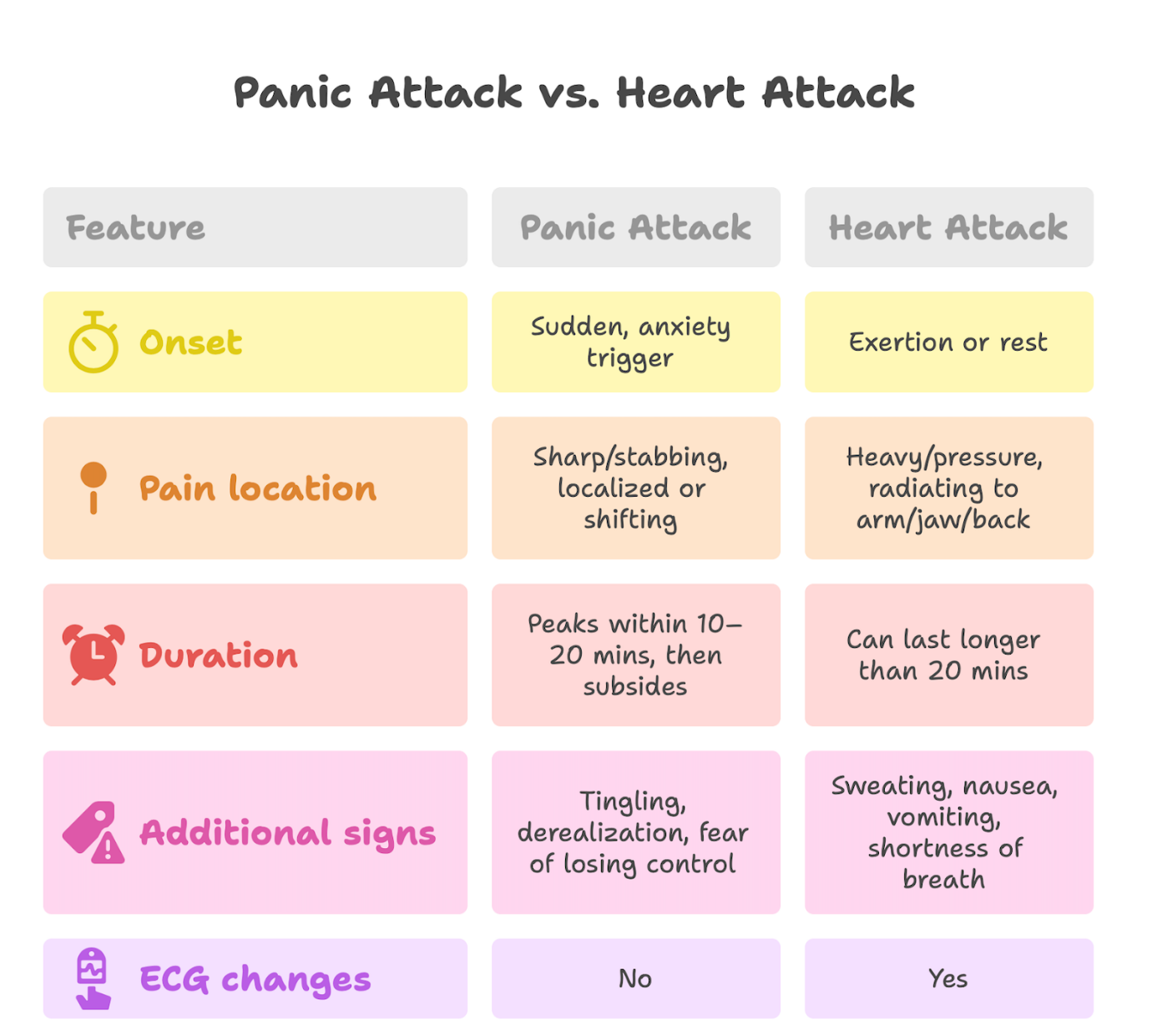
The symptoms of a panic attack are intensely physical and often mimic those of a heart attack or other medical emergency, leading to significant health anxiety. These can include:
- Cardiovascular: These can feel like pounding or racing heart, increased heart rate, increased blood pressure, discomfort in the chest and feeling faint. People often report a panic attack feeling like a mini “heart attack”.
- Respiratory: These signs include difficulty in breathing or breathing in through short, quick gasps and sensation of choking.
- Neurological: Neurological signs involve dizziness, trembling, lightheadedness, tingling or numbness in hands, feet or face, pupils dilating like the surroundings seem too bright, inability to think clearly or focus, trembling or shaking, inability to remember things properly.
- Gastrointestinal: Panic in the body can cause physiological signs like nausea, diarrhea, abdominal distress, loss of appetite or excessive eating even, digestive issues and hyperacidity.
- Psychological: The feelings that come up with panic include immense terror, unexplained anxiety, intense fear of dying, losing control over self and emotional reactions, or ‘going crazy’, feeling overwhelmed, feeling like running away or withdrawing in a shell, aggressive emotions, feeling helplessness, speechlessness over being unable to put the feelings into words, nightmares and flashbacks, lethargy due to loss of energy, feelings of unreality (derealization), or being detached from oneself (depersonalization), lack of interest in pleasurable activities, extreme emotional shifts, low self-esteem and more.
- Other: Some other signs include muscle tension, pale skin, sweating, chills or hot flashes, cold hands or feet, bodily aches.
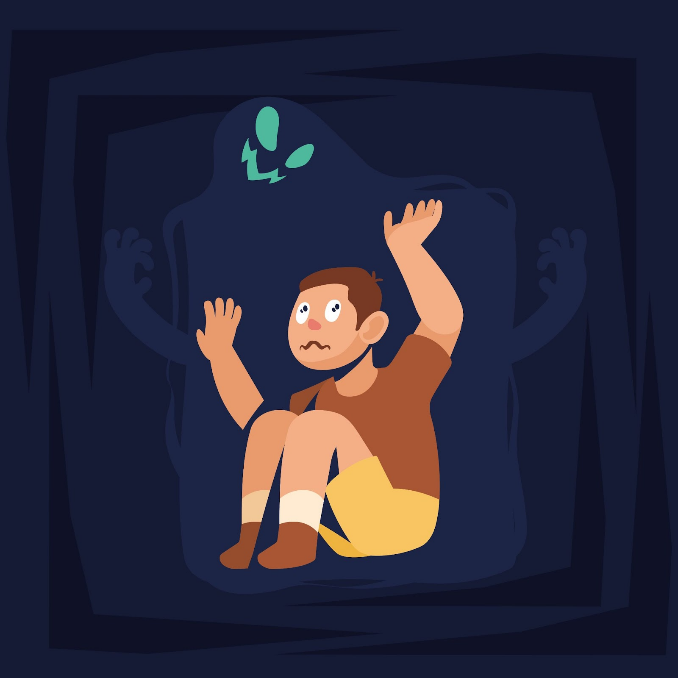
These symptoms peak within ten minutes and can persist for up to half an hour, leaving individuals exhausted, shaken, and often fearful of recurrence.
You might even describe the visual effect during an attack as "horrifying and unmistakable," amplifying the distress. The terrifying thought, "I won't make it until help arrives," is a common and valid concern, highlighting the extreme physical sensations you endure.
A reddit user described their experience as, “My panic attacks are my heart beating really fast, light headed from holding my breath. I’m afraid to move and also feeling claustrophobic. Feeling like I’m going to have a heart attack, mind racing then I feel like I want to throw up.”
What Really Happens During a Panic Attack?
Panic attacks can feel like they come out of nowhere, leaving you wondering "Why is this happening to me?" The truth is, they result from a complex mix of factors involving your brain, body, past experiences, thoughts, and environment. Understanding these underlying causes can help demystify panic attacks and point toward effective ways to manage them.
The Protective Nature of Panic
When you face danger, your nervous system doesn't stop to think, it immediately springs into action with one of four survival strategies:
- Fight: You try to defend yourself by fighting the tiger.
- Flight: You try to escape the danger by running away from the tiger as fast as you can.
- Freeze: You might freeze completely, hoping that the tiger won't notice you if you stay still and quiet.
- Fawn: You try to calm down the tiger, offer it food or act really nice to avoid getting hurt. You try befriending the tiger and appease them, in the hopes that it won’t attack you.
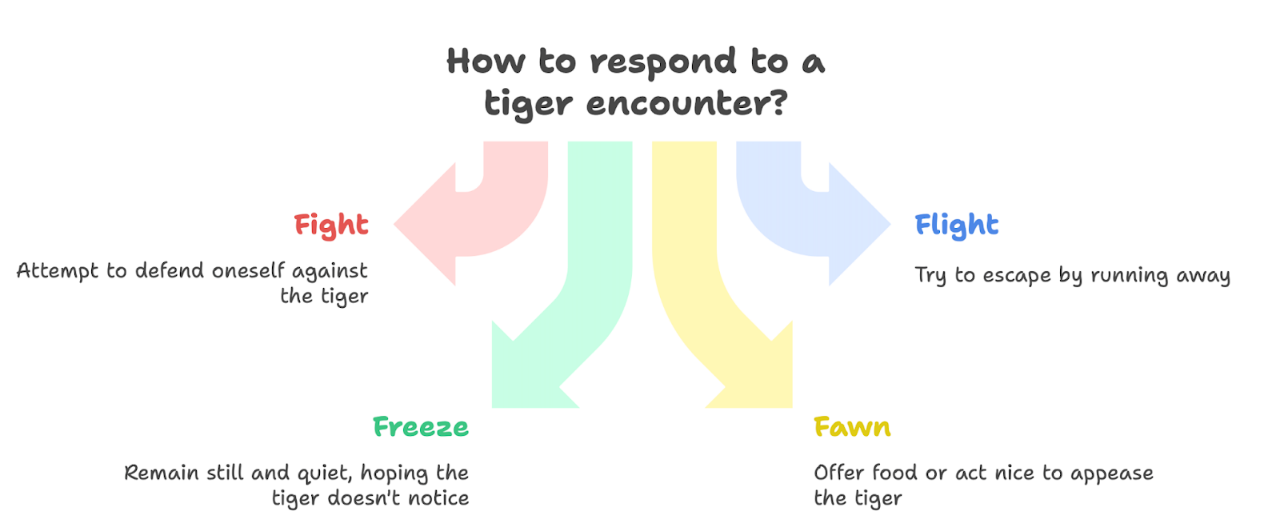
This involves:
- Surge of stress hormones (adrenaline, cortisol)
- Rapid heart rate, muscle tension, shallow breathing
These responses happen automatically, below the level of conscious thought. They're ancient, hardwired programs designed to keep you alive.
If you've ever watched nature documentaries, you might have noticed something interesting: after a gazelle escapes from a lion, it doesn't just walk away. It literally shakes and trembles for a few minutes, then returns to grazing peacefully. This physical discharge is crucial, it's how the animal's nervous system completes the survival sequence and returns to normal.
However, humans often skip this crucial step, making us sick.
Why Humans Get Stuck?
Unlike animals, we humans have a highly developed thinking brain (the neocortex) that often overrides our natural instincts. When something overwhelming happens, our instinct might be to shake, cry, or even curl up in a ball. But our thinking brain steps in with messages like:
- "Be strong"
- "Don't make a scene"
- "Pull yourself together"
- "Others have it worse"
We've been socialized to suppress these natural physical responses, thinking they're signs of weakness rather than necessary biological processes.
The Energy Has to Go Somewhere
When your body prepares for fight, flight, freeze or fawn, it generates enormous amounts of energy, stress hormones flood your system, muscles tense, heart rate spikes. If you can't physically discharge this energy through natural movement and expression, it gets trapped in your nervous system. It can lie dormant in your system for years, like a program running in the background of a computer. You might not even be aware it's there until something triggers it, a sound, smell, physical sensation, or even just a racing heartbeat from climbing stairs.
When triggered, your nervous system suddenly thinks: "Oh right! We were in the middle of escaping/fighting/protecting ourselves!" It tries to pick up where it left off, flooding your body with the same survival energy from years ago.
But here's the problem: there's no actual danger present for you to fight or flee from. All that intense energy, the racing heart, rushing adrenaline, muscle tension, has nowhere to go. This overwhelming flood of activation with no outlet is often what we experience as a panic attack.
Think of it like a pressure cooker with a stuck valve. The pressure keeps building with nowhere to go until eventually something has to give, often in the form of panic attacks, as your body's desperate attempt to finally release that stored energy.
Panic as a “False Alarm”
From this perspective, a panic attack isn't a random malfunction, it's your body's urgent misfired attempt to finish a survival sequence that never got to complete:
- Trigger (sometimes obvious, sometimes subtle, even internal sensations) reminds the body of the original trauma.
- The amygdala (threat detector) activates as if the threat is happening now.
- The nervous system launches the same adrenaline-fueled reaction, rapid heartbeat, chest tightness, shaking, shortness of breath, as if preparing to fight or flight.
- Since the threat is not actually present, there’s no physical completion (no running, fighting, or safe shaking). The body floods with energy but has nowhere for it to go → panic spirals.
Think of it as your nervous system saying:
"Remember that time we needed to run/fight/escape but couldn't? Well, we're going to finish that now!"
This explains the classic symptoms:
- Adrenaline surge – Your body mobilizing for action
- Racing heart and rapid breathing – Preparing to fight or flee
- Trembling and muscle tension – Getting ready to move
- Sense of impending doom – Your brain interpreting all this activation as danger
- Feeling trapped or overwhelmed – Having intense energy with nowhere to direct it
This is why panic attacks often feel like they come "out of nowhere." From your conscious mind's perspective, you're just sitting in a meeting or driving to work. But from your body's perspective, it's finally trying to complete an urgent survival task that's been waiting in the queue.
Why Some People Get Stuck While Others Don't
How Trauma Rewires Your Brain and Body
People with unresolved trauma have nervous systems that are essentially more sensitive and reactive. Bessel van der Kolk, author of "The Body Keeps the Score," explains how traumatic experiences literally change your brain's wiring. When overwhelming things happen, especially during childhood when your brain is still developing, key areas get altered:
- The amygdala (your alarm system) becomes hyperactive. Think of your amygdala as your brain's security guard, it's constantly scanning for danger to keep you safe. In people prone to panic attacks, this security guard becomes hypervigilant, treating harmless situations like major threats. Your heart beating a little faster after climbing stairs? The overactive amygdala might interpret this as a heart attack warning and sound the alarm. When this alarm goes off, your body floods with stress hormones like adrenaline, triggering the classic "fight-or-flight" response: racing heart, rapid breathing, sweating, and muscle tension.
- The hippocampus (which processes memories) can shrink. You have trouble distinguishing between past and present, so old dangers feel like they're happening right now.
- The prefrontal cortex (which helps you think rationally) gets less blood flow during stress.
- Your body has a sophisticated stress management system called the HPA axis (think of it as your internal stress control center). When you're under chronic stress or have experienced trauma, this system can get thrown off balance, producing too much of the stress hormone cortisol. High cortisol levels make your brain's alarm system even more sensitive while weakening your ability to think clearly and calm yourself down. It's like having a smoke detector that goes off every time you toast bread, the sensitivity is cranked way too high.
- Mixed signals → fight/flight energy + freeze response = feeling both wired and paralyzed. During panic attacks, something strange happens: your body activates both the "fight-or-flight" response (get ready for action!) and the "freeze" response (play dead!) at the same time. This creates confusing sensations, you might feel simultaneously energized yet frozen, detached yet overwhelmed. These mixed signals amplify the panic because your body literally doesn't know what it's supposed to be doing.
- Heightened Interoception: Some people naturally pay more attention to what's happening inside their bodies, their heartbeat, breathing, muscle tension, and other internal sensations. While this can be helpful, it becomes problematic when normal bodily changes get misinterpreted as danger signals. That slight increase in heart rate from drinking coffee? Instead of thinking "I had caffeine," the mind jumps to "Something's wrong with my heart!"
These changes happen because your brain is trying to protect you, but they can leave you with an alarm system that's way too sensitive.
Even tiny triggers, a certain tone of voice, a smell, the way light hits a wall, can reactivate the unfinished survival response. To your rational mind, these triggers seem completely harmless. But to your nervous system, they're urgent calls to action.
When Your Body Becomes the Enemy
Van der Kolk discovered that people with trauma histories often develop a fear of their own physical sensations. Normal bodily experiences, like your heart beating faster when you exercise, can feel threatening because they remind your body of past overwhelming moments.
This creates a cruel irony: the very sensations that are part of being alive and healthy become sources of terror. Your body, which should feel like home, starts feeling like a dangerous place you can't escape.
Your Body Remembers What Your Mind Forgets
Perhaps most importantly, van der Kolk showed that trauma lives in the body, not just in thoughts and memories. Your muscles, nervous system, and organs hold the imprint of overwhelming experiences. Even when you can't consciously remember what happened, your body remembers and can react as if the trauma is happening right now.
This is why panic attacks can feel so confusing, you might be sitting in a safe place doing something ordinary when suddenly your body launches into crisis mode, seemingly for no reason.
Becoming a Danger Detective
When you're prone to panic, your attention naturally gravitates toward anything that might be threatening, both in your body and your environment. You might find yourself constantly checking your pulse, scanning for exits, or monitoring how you feel.
While this hypervigilance is meant to keep you safe, it actually keeps your nervous system in a state of high alert, making panic more likely.
Avoiding Discomfort Makes It Worse
Many people try to prevent panic by avoiding situations or sensations that make them uncomfortable. You might stop exercising because it makes your heart race, or avoid social situations where you felt anxious before.
Unfortunately, avoidance prevents you from learning that these sensations and situations are actually safe. It's like never touching a friendly dog because you're afraid of being bitten, you never get the chance to discover the dog is harmless.
Why Some People and Not Others?
There are specific factors that make some people more vulnerable:
- The Severity and Timing of Overwhelming Experiences
- Research has suggested that childhood trauma has the biggest impact because it happens when your brain and nervous system are still forming
- Repeated trauma is more damaging than single incidents
- Early life experiences literally shape how your stress response system develops
- Your Early Relationships
If your caregivers were consistently attuned, responsive, and safe, you likely developed good emotional regulation skills. But if your early relationships were unpredictable, frightening, or emotionally unavailable, you might have learned that the world is dangerous and your body's signals can't be trusted.
- Your Natural Sensitivity
Some people are simply born with more sensitive nervous systems, they notice sounds, lights, textures, and internal sensations more intensely. This isn't a flaw, but it can make you more reactive to stress and more likely to develop panic attacks if you don't have good coping tools.
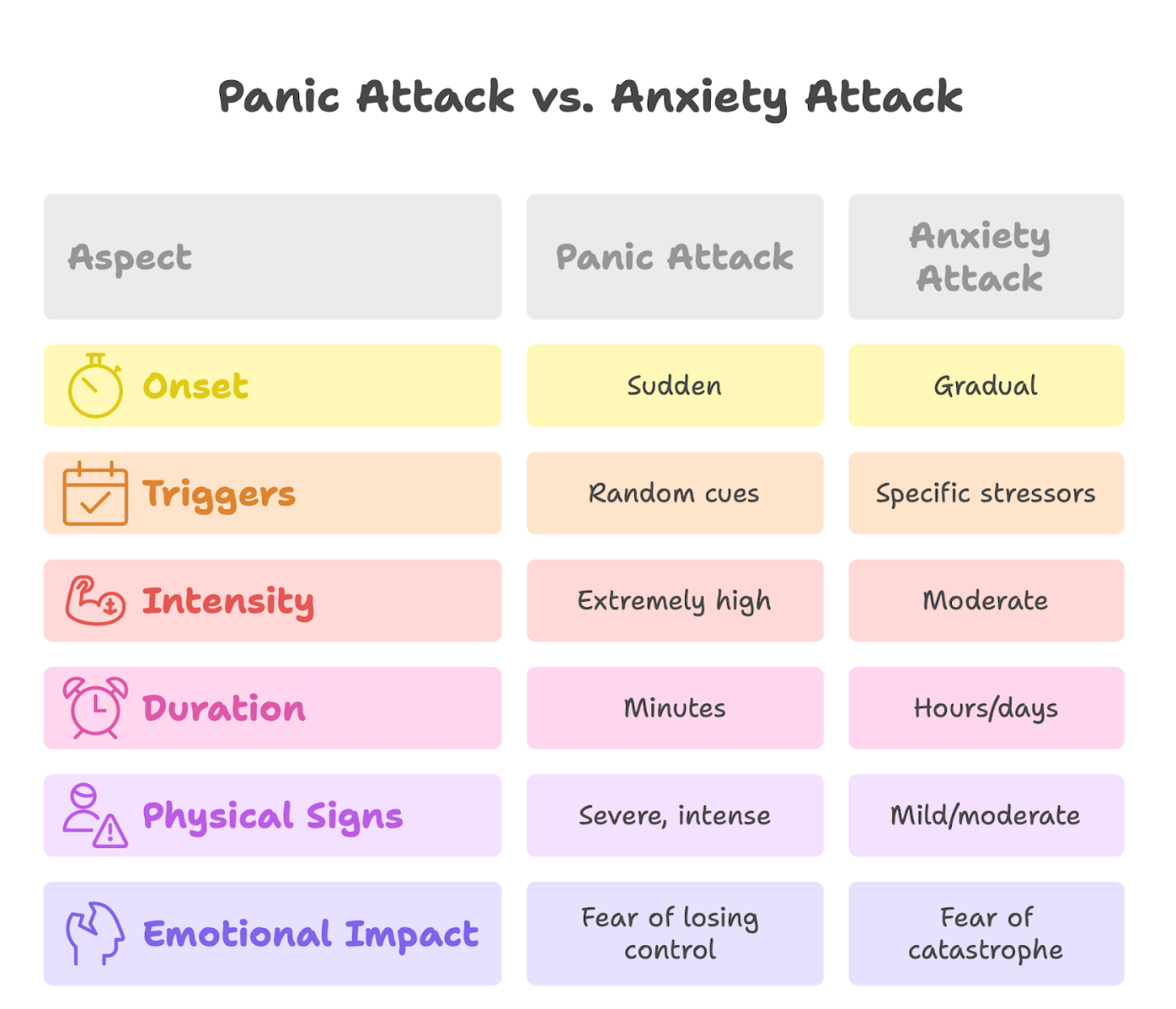
- Panic Attack vs. Anxiety Attack: Clearing the Confusion
The terms "panic attack" and "anxiety attack" are often used interchangeably, but there's a crucial distinction. While both involve intense fear and physical symptoms, a panic attack has a clinical meaning and is specifically described in medical literature, such as the Diagnostic and Statistical Manual of Mental Disorders (DSM). It's a sudden, intense surge of fear that peaks rapidly.
Conversely, "anxiety attack" does not have an actual medical definition; it's a term in common use. It typically refers to a period of heightened anxiety that builds more gradually and is often a reaction to a specific stressor. While an "anxiety attack" might leave you feeling stunned and overwhelmed, a panic attack often triggers a desperate, acute "fight or flight" response, forcing you into action or paralysis. Think of panic as a much more unpredictable and physical, intense manifestation of anxiety, peaking rapidly and often unexpectedly. Understanding this difference can help you articulate your experience more accurately and seek appropriate support.
- Panic Attack vs. Heart Attack
Common Triggers and Risk Factors
While panic attacks can strike unexpectedly, certain factors increase their likelihood:
- Genetics and Brain Chemistry: A family history of panic disorder or other anxiety disorders can increase susceptibility. The sensitivity of the amygdala is linked to the levels of neurotransmitters like serotonin. Low serotonin levels can make the fear system hyperactive, increasing the likelihood of fight, flight or freeze responses to threat. The amygdala activates the hypothalamus which is in control of releasing the stress hormones cortisol and adrenaline from the adrenal glands.
- Stress and Trauma: Panic attacks can be triggered by general stress factors as well. Major life stressors like job loss, job changes, graduation, death of a close one, divorce, chronic stress, or past traumatic experiences are common triggers. Trauma causes actual physiological changes in the brain's alarm system and stress hormone activity leading to flashbacks and reliving of the trauma. It can be so distressing that it can trigger panic attacks at any time.
- Substance Use: Some individuals resort to alcohol, caffeine, nicotine, and recreational drugs which can induce or aggravate panic symptoms.
- Medical Conditions: Certain physical conditions, like thyroid problems or heart arrhythmias, can present with symptoms similar to panic attacks, emphasizing the importance of medical evaluation.
- Learned Associations: The amygdala forms and stores emotional memories through associations. So a previously neutral sound, sight, smell or sensation might become a trigger if it’s experienced around the same time as the threatening event. For example, the sound of brakes can trigger fear and panic after a car accident.
The Deep Connection: Panic Attacks and Mental Health
Panic attacks and mental health are inextricably linked. While panic disorder is a specific anxiety disorder, panic attacks frequently co-occur with, or are symptoms of, other mental health conditions.
Beyond Panic Disorder: Comorbidity with Other Conditions
It's rare for panic disorder to exist in isolation. Many individuals experiencing panic attacks also struggle with other mental health challenges:
- Generalized Anxiety Disorder (GAD): Anxiety, generally, is a common natural response to any aspect of life. People with GAD are constantly preoccupied by excessive worry about all sorts of events in their daily life. Over time the body and mind is unable to bear the weight of this worry and is flooded with panic. That’s why sometimes people say that it came ‘out of nowhere’ but it had been building underneath all this time.
- Social Anxiety Disorder: This is a common type of anxiety often involving a fear of being scrutinized or judged by others. People with this fear embarrassment, criticism, or awkwardness. The fear builds up before social situations like presentations, dates, or even phone calls. When they imagine being judged or making a mistake, their body kicks into fight-or-flight. In such moments, the fear builds up so intensely, it’s no more anxiety but panic. So the next time, people might go out of their way to avoid stepping into such circumstances.
- Specific Phobias: Phobias are characterized by an irrational, overwhelming fear of a specific object or situation. People may feel an intense urge to flee but are often paralysed. For example, Nidhi is terrified of needles. So whenever she is near any kinds of needles or has to get vaccines, panic hits her hard. She starts choking, sweating and wants to run in such moments.
- Depression: A significant number of people with panic disorder also experience depression, often as a result of the limitations and despair caused by chronic panic. This can manifest as a ‘vast sense of emptiness and sadness’ after prolonged avoidance but sometimes also as sudden emotional surges. Thoughts of helplessness and fear of being trapped can turn into panic attacks.
- Obsessive-Compulsive Disorder (OCD): In OCD, people engage in repetitive distressing thoughts and behaviors that can sound like ‘What if I hurt someone?’ or ‘What if I didn’t lock the door and someone dies?’ If someone tries to resist these thoughts, it can create intense anxiety leading to a panic attack. They feel not in control of themselves, helpless and trapped.
- Post-Traumatic Stress Disorder (PTSD): Panic attacks can be a prominent symptom of PTSD, triggered by reminders of a traumatic event. A loud sound, a smell, or even a tone of voice can trigger a traumatic memory. The body responds instinctively to this through the pounding heart, dizziness, feeling unsafe. This is panic.
The interplay between these conditions can be complex, often requiring a comprehensive and integrated treatment approach.
Impact on Daily Life and Identity
The profound fear and unpredictability of panic attacks can have a devastating impact on various aspects of life, leading to a gradual erosion of your sense of self and capabilities.
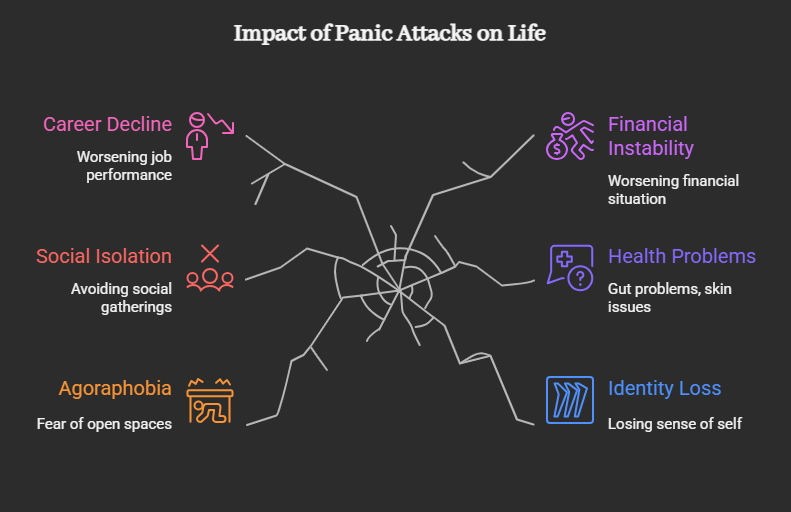
- Avoidance and Agoraphobia: The fear of having another attack, especially in public or inescapable situations, often leads to avoidance behaviors. This can escalate to agoraphobia, where individuals become housebound, terrified of leaving their safe spaces. This avoidance can suck your potential away, limiting career opportunities, academic pursuits, and social engagements.
- Social Isolation: The thought ‘What if I have a panic attack in front of others?’ makes people pull away from friends, family gatherings, dates, public transport. They avoid crowded places, restaurants, and long conversations which lead to shame and loneliness.
- Career and Academic Performance: To avoid panic triggers, people start skipping class or work, avoid deadlines, or miss important exams or presentations. Their concentration also gets impaired because when the brain is busy being on the lookout for triggers and trying to be in control, it cannot focus on working or learning. The school or work performance takes a hit and progress gets impeded.
- Financial Stability: People might turn down interviews, client calls, or job offers because the thought of handling pressure or travel is too much. Panic also sometimes leads to quitting suddenly or working short-term roles with less responsibility. Health expenses also add up like repeated hospital visits for chest pain or breathlessness.
- Physical Health: The hormonal surges leave the body drained even when no physical work was done. Nausea, gut problems, stomach cramps, skin problems also give rise due to the chronic stress from anxiety and panic.
Loss of Identity: Many report feeling a ‘grieving’ for their former selves, the person they were before panic took hold. Things they used to enjoy like travelling, solo errands or parties feel out of reach due to fear of panic attacks. Reclaiming your life isn't just about managing symptoms; it's about rebuilding this lost sense of identity and freedom.
- DBT (Dialectical Behavior Therapy): The goal of this therapy is to manage overwhelming emotions and reduce panic-driven behaviours through skills. DBT helps people learn how to self-soothe and regulate distress arousal. It focuses on emotional regulation, distress tolerance, and mindfulness. Chain analysis in DBT is a powerful tool used to help individuals understand the full sequence of events that lead up to a panic attack that feels out of control. It helps figure out the internal and external triggers, thoughts, feelings, urges that showed up before and after the panic attack to spot the areas where prevention is possible.
- ACT (Acceptance and Commitment Therapy): ACT helps to reduce the struggle with panic. This therapy is of the notion that trying to rid oneself of the panic makes it worse. It focuses on acceptance of internal experiences like difficult thoughts, feelings and experiences like fear or racing heart and committing to actions aligned with your values. Many have seen combining exposure therapy with ACT has been the key.
- EMDR (Eye Movement Desensitization and Reprocessing): EMDR aims to resolve past experiences that may trigger panic in the present. EMDR helps identify the root memory or emotional wound connected to the panic like a childhood illness, bullying, or emotional neglect. This bilateral stimulation helps engage both sides of the brain, grounding you in the present moment, reducing distress, and making it easier to process overwhelming emotions or memories. Slowly the body learns that it’s no longer in danger so our system can calm down.
- IFS (Internal Family Systems): IFS helps individuals understand and integrate different ‘parts’ of themselves that trigger or fear panic. IFS views panic not as a problem, but as a protective part trying to help. Often, a “panic part” is trying to alert you to emotional danger. Another part might be terrified of being judged or trapped. These parts carry old beliefs like ‘I’m unsafe’ that IFS heals. IFS reduces panic by healing the inner conflict and giving all parts what they actually need.
- Brainspotting: A newer therapy that uses specific eye positions to process trauma and emotional distress. Brainspotting accesses the panic stored in the body, not through talking, but through where you look. The therapist helps you find an eye position, “brainspot”, where you feel the panic more strongly. Holding that spot, your brain starts to process and release what’s stuck, memories, fear, frozen emotions. Brainspotting helps people process panic on a deep, somatic level, especially when panic has no clear source.
- Tracking Sensations – Noticing small, tolerable bodily sensations without being overwhelmed.
- Pendulation – Moving attention between distressing and calming sensations to widen the window of tolerance.
- Titration – Working with small doses of traumatic activation instead of re-experiencing it all at once.
- Completion Movements – Sometimes, the body may spontaneously want to push, kick, shake, or run in micro-movements, which completes the unfinished motor sequence.
- Integration – Once energy is discharged, the nervous system shifts into parasympathetic rest-and-digest, reducing panic likelihood.
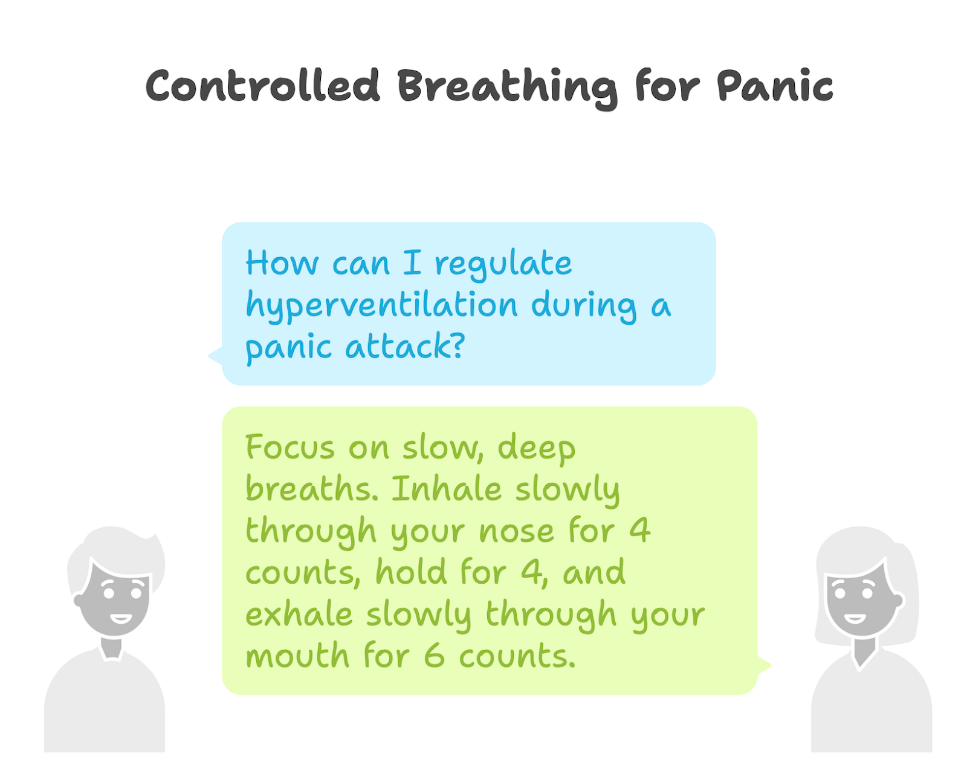
- Controlled Breathing: Focus on slow, deep breaths. Inhale slowly through your nose for 4 counts, hold for 4, and exhale slowly through your mouth for 6 counts. This helps regulate the hyperventilation that often accompanies panic.
- Butterfly tapping: Butterfly tapping is a gentle self-soothing technique often used in trauma therapy and EMDR (Eye Movement Desensitization and Reprocessing) to help regulate emotions and calm the nervous system. Sitting comfortably, you cross your arms over your chest so your hands rest on your upper arms or shoulders, like giving yourself a hug, and then alternately tap each side in a slow, rhythmic pattern, mimicking the flutter of butterfly wings. This bilateral stimulation helps engage both sides of the brain, grounding you in the present moment, reducing distress, and making it easier to process overwhelming emotions or memories.
- 5-4-3-2-1 Sensory Exercise: Identify 5 things you can see, 4 things you can touch, 3 things you can hear, 2 things you can smell, and 1 thing you can taste. This redirects your focus away from internal sensations.
- Cold Water Immersion: Splashing cold water on your face or holding an ice pack can activate the "diving reflex," which slows heart rate and calms the nervous system.
- Engage Your Senses: Chew strong gum, listen to music, or hold a textured object.
- Positive Self-Talk: Remind yourself, "This is a panic attack, it will pass," and "I am safe."
- Balanced Diet: A well-rounded diet helps regulate blood sugar, stabilise energy, and support neurotransmitters (like serotonin and GABA) that keep panic in check. When we skip meals or rely on junk food, our blood sugar crashes, our nervous system becomes reactive, and even tiny triggers can set off alarm bells in the body. Focusing on complex carbs like oats, brown rice, sweet potatoes, healthy fats like avocados, nuts, seeds and leafy greens for magnesium and other nutrients helps our nervous system prevent sudden dips in blood sugar levels.
- Probiotics and Prebiotics: Natural probiotic sources include curd/yogurt, fermented carrot or beet drink, kimchi or sauerkraut along with prebiotic-rich foods like green bananas, garlic onions, leeks, asparagus, whole grains like barley and oats to support a healthy gut microbiome.
- Limit Stimulants: Reducing caffeine, alcohol, nicotine and even high-sugar energy drinks as they can exacerbate anxiety and trigger panic. Instead you can try caffeine-free herbal teas like chamomile, lemon balm, tulsi and warm water with mint or fennel as replacements.
- Hydration: Stay well-hydrated. Drinking water might seem so bleak and lame, right? But dehydration can cause dizziness, heart palpitations and brain fog as well. You can infuse water with tulsi, cucumber, or fruit to make it more inviting for you.
- Mindfulness and Meditation: Regular practice can train your brain to observe thoughts and sensations without judgment, reducing reactivity to panic symptoms. Mindfulness creates a small distance between a person and their thoughts. Instead of “I’m going to die”, the thought becomes “I’m having the thought that I might die”. That space helps reduce panic’s grip.
- Regular Exercise: Physical activity is a potent stress reliever and can reduce anxiety symptoms. Exercise encourages the body to shift from fight-or-flight mode into rest-and-digest. It helps balance the body. Physical activity teaches the brain that an increased heart rate, like during panic, doesn’t always mean danger. Even a brisk walk can make a difference.
- Quality Sleep: Sleep deprivation can heighten anxiety and make you more vulnerable to panic attacks. Deep sleep helps the brain process emotions from the day and lowers emotional reactivity the next day. Prioritize a consistent sleep schedule and create a calming bedtime routine. Avoid screens and heavy meals at least one hour before bed.
- Identify Early Warning Signs: Learn to recognize the subtle physical or mental shifts that precede an attack. This could be a specific feeling in your stomach, a racing thought, or a sense of unease. Noticing these "indicators" allows you to intervene early.
- Structured Routine: A predictable daily routine can provide a sense of control and reduce anxiety.
- Stress Management Techniques: Incorporate stress-reducing activities like yoga, journaling, or creative hobbies into your daily life.
- Mindful Consumption: Be aware of news and social media consumption, as constant exposure to negative information can heighten anxiety.
- Stay Calm: Your calm presence can be incredibly reassuring.
- Reassure and Validate: Say, "I know this is terrifying, but you are safe, and it will pass." Remind them to breathe slowly.
- Help Them Ground: Guide them through breathing exercises or sensory grounding techniques (e.g., "Tell me five things you see").
- Ask What They Need: Don't assume. Ask, "What can I do to help you right now?" They might need quiet, a glass of water, or simply your presence.
- Don't Force Them: If they want to be alone or need to move, respect their wishes as long as they are safe.
- After the Attack: They might be exhausted or emotionally drained. Offer comfort and quiet support.
- Educate Yourself: Learn about panic disorder, its triggers, and effective coping strategies.
- Encourage Professional Help: Support their journey to find the right therapist or doctor. Offer to help research options or drive them to appointments.
- Respect Their Boundaries: Understand that avoidance is a symptom, not a choice. Gently encourage gradual exposure, but don't push them into situations they're not ready for.
- Communicate Openly: Maintain open dialogue about their experiences and your role in supporting them.
- Take Care of Yourself: Supporting someone with a mental health condition can be taxing. Ensure you have your own support system and practice self-care.
- Setting Small, Achievable Goals: If leaving the house is difficult, start with a short walk around the block.
- Celebrating Small Victories: Acknowledge every step forward, no matter how minor it seems.
- Building a Support Network: Connect with others who understand, whether through support groups or trusted friends and family.
- Acceptance: Learning to accept that anxiety is a normal human emotion, and that panic attacks, while terrifying, are temporary and survivable.
- Self-Compassion: Being kind to yourself during setbacks and acknowledging the immense courage it takes to face these challenges.
- Finding Purpose: Reconnecting with hobbies, passions, and relationships that bring joy and meaning to your life.
Seeking Help: Diagnosis and Professional Treatment
Recognizing that panic attacks are a legitimate medical condition, not a personal failing, is the first step toward recovery. Seeking professional help is a sign of strength, not weakness.
When to Seek Professional Help
If you experience recurrent, unexpected panic attacks, or if the fear of future attacks significantly impacts your daily life, it's time to consult a healthcare professional. It's especially important to seek immediate medical attention if you're unsure whether your symptoms are due to a panic attack or a more serious physical condition, as some symptoms overlap. A medical doctor can rule out underlying physical causes.
Navigating the Diagnostic Process
Diagnosis typically involves a thorough physical examination to rule out other conditions, followed by a psychological evaluation. Your doctor or mental health professional will ask about your symptoms, medical history, and any stressors you may be experiencing. Be open and honest about your experiences, however terrifying they may seem.
Therapeutic Approaches: Finding Your Path
Psychotherapy is a cornerstone of treatment for panic attacks and panic disorder, often proving highly effective.
Cognitive Behavioral Therapy (CBT) and Exposure Therapy
CBT is widely regarded as one of the most effective treatments. Its goal is to identify and modify illogical or unhealthy thinking patterns that contribute to or worsen anxiety and depression. This process is known as cognitive restructuring. Strategies include disrupting negative thoughts with evidence, ignoring them, or replacing them with coping thoughts. For example, replacing ‘I can't handle this’ with ‘This isn't easy, but I will get through it’. Thought stopping (telling oneself "Stop!") followed by replacing the thought is also used in CBT.
Exposure therapy involves exposing individuals to feared situations or objects. The core component is to allow the anxiety response to rise and then subside without escaping the situation. This process teaches the amygdala to associate the previously feared situation with safety, providing ‘corrective information’. Many individuals report life-changing results with exposure therapy.
For panic attacks, interoceptive exposure is specifically mentioned. This involves simulating physical sensations like vigorous activity, intentional hyperventilation, head spinning to help individuals become more accustomed to the bodily symptoms of anxiety. In such exposures, one must not leave the situation while fear is still high, as this reinforces the amygdala's belief that escape is necessary. Staying until anxiety decreases, preferably by half, is key.
Beyond CBT, other therapeutic modalities offer unique benefits:
Somatic Experiencing: Peter Levine’s approach focuses on allowing the body to gently complete what it couldn’t finish during the original event:
The effectiveness of therapy is highly individualized; what works for one person may not work for another. It's a journey of finding the right fit, and sometimes, coping skills alone are not enough, requiring deeper therapeutic work.
Medication:
Medication can be a valuable component of a comprehensive treatment plan, especially for managing acute symptoms or reducing overall anxiety levels.
SSRIs and SNRIs
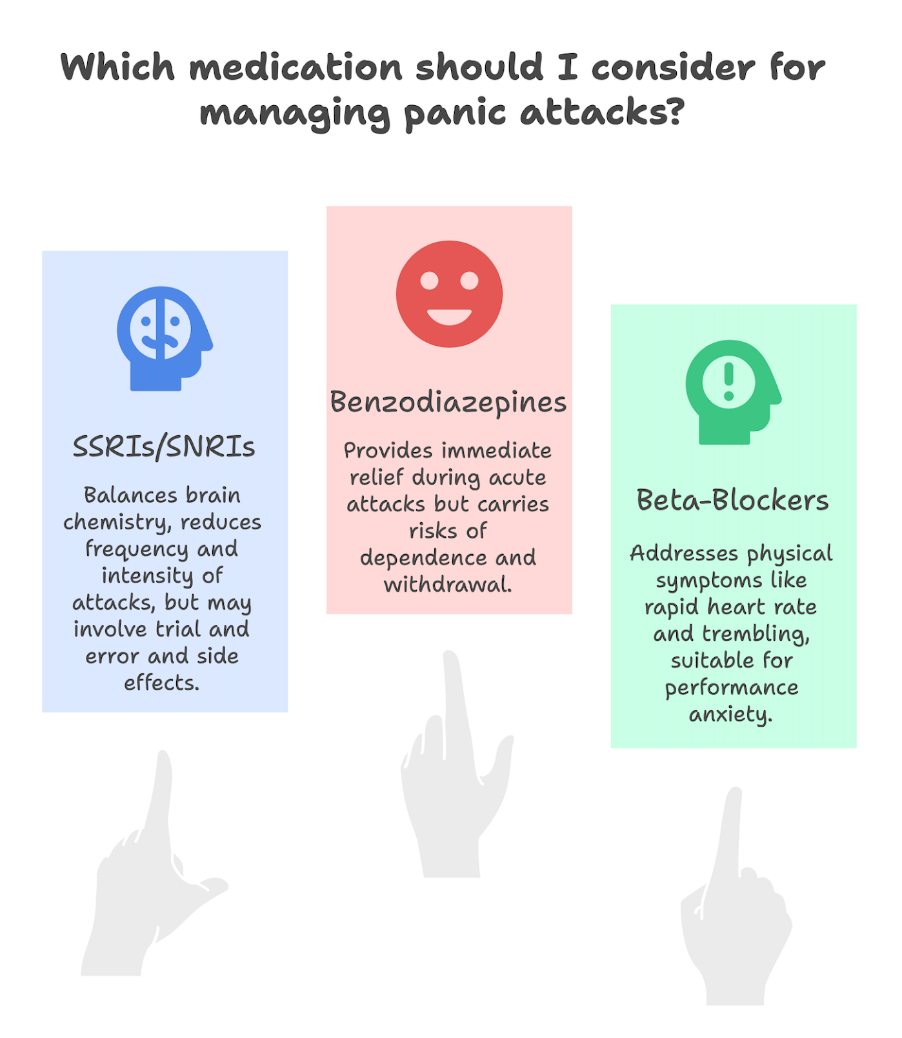
Selective Serotonin Reuptake Inhibitors (SSRIs) and Serotonin-Norepinephrine Reuptake Inhibitors (SNRIs) are commonly prescribed antidepressants that can significantly reduce the frequency and intensity of panic attacks by balancing brain chemistry. Many report immense relief from medications like Zoloft. However, finding the right medication and dosage can involve trial and error, and some individuals may experience side effects or find certain medications ineffective.
Benzodiazepines
These are fast-acting sedatives (e.g., Ativan, Xanax) that can provide immediate relief during an acute panic attack. While effective for short-term use, they carry risks of dependence and withdrawal, making them "scary drugs" for some and typically reserved for acute situations or short-term management.
Beta-Blockers
Beta-blockers (e.g., Propranolol) primarily address the physical symptoms of anxiety by blocking the effects of adrenaline, such as a rapid heart rate and trembling. They can be particularly helpful for performance anxiety or situations known to trigger physical panic symptoms.
It's crucial to work closely with a psychiatrist or doctor to determine the most appropriate medication, dosage, and to manage any potential side effects.
Empowering Yourself: Coping Strategies for Managing Panic Attacks
Beyond professional treatment, a powerful arsenal of self-help and coping strategies can significantly improve your ability to manage panic attacks and reduce their impact.
Immediate Grounding Techniques for an Attack
When a panic attack strikes, grounding techniques can help you regain a sense of control and bring you back to the present moment:
Long-Term Self-Care and Lifestyle Adjustments
Beyond immediate coping, consistent self-care builds resilience and can reduce the frequency and intensity of attacks.
The Gut-Brain Connection and Nutrition
Emerging research highlights the profound connection between gut health and mental well-being, including anxiety and panic. Your gut microbiome produces neurotransmitters, including serotonin, which influence mood and stress response.
While not a standalone cure, supporting your gut health can be a powerful, often overlooked tool in your panic management arsenal.
Mindfulness, Exercise, and Sleep
These foundational lifestyle elements are crucial for long-term mental health:
Prevention Strategies: Beyond the Basics
Nuanced prevention goes beyond general advice:
The "Silent" Panic Attack: Recognizing Internal Distress
Not all panic attacks present with overt, dramatic symptoms. For many, a "silent" panic attack is a significant experience where symptoms are primarily internal. You might not hyperventilate visibly or scream, but internally, you're experiencing the same terrifying surge of fear, depersonalization, derealization, and intense physical sensations, just without the outward expression. Your "silent" panic is valid: Recognizing and validating these internal symptoms, even without outward signs, is crucial for effective coping and seeking help. It can feel incredibly isolating because others may not perceive your distress, making it harder to receive understanding and support.
Supporting Loved Ones: A Guide for Family and Friends
If someone you care about experiences panic attacks, your role is invaluable. Supporting someone with panic isn't about "fixing" them, but about empowering them through understanding, practical presence, and fostering their independence.
Understanding Their Experience: What Not to Say
Avoid minimizing their symptoms or suggesting quick fixes. Phrases like "just relax," "it's all in your head," or "there's nothing to be afraid of" can be incredibly invalidating and damaging. Remember, they are not choosing to feel this way. The fear is real, even if the perceived danger isn't.
Practical Ways to Offer Support During an Attack
Fostering Long-Term Resilience Together
Navigating the Healthcare Landscape: Telehealth and Beyond
Accessing mental healthcare has evolved, with new avenues offering greater flexibility and reach.
The Rise of Telehealth for Mental Health
Telehealth and online therapy options have become increasingly prevalent, offering convenient and accessible mental health support. This can be particularly beneficial for individuals with panic disorder or agoraphobia who may find it challenging to leave their homes for in-person appointments. Many therapists and psychiatrists now offer virtual sessions, making consistent care more attainable. When choosing an online provider, ensure they are licensed and reputable.
Cultural Considerations and Stigma
The impact of stigma on seeking help for panic attacks varies significantly across diverse communities. In some cultures, mental health issues are misunderstood, dismissed, or seen as a sign of weakness, leading to reluctance in seeking professional help. This stigma can exacerbate feelings of isolation and shame. It's crucial for healthcare providers and support systems to be culturally sensitive, offering understanding and resources that respect diverse beliefs and values, and actively working to dismantle barriers to care.
A Journey of Resilience and Hope
Living with panic attacks can feel like a constant battle, but recovery isn't a destination, but a journey of building resilience. Every small step in managing panic builds lasting freedom and a richer life.
From Avoidance to Engagement
The path to recovery often involves gradually reversing the cycle of avoidance. This doesn't mean forcing yourself into terrifying situations, but rather taking small, manageable steps to re-engage with life. This might involve:
Building a Life Beyond Panic
Ultimately, managing panic attacks is about building a fulfilling life that isn't defined by fear. This involves:
Remember, reclaiming your life from panic is a journey, not a destination. It's about building resilience, finding your unique path to healing, and understanding that every small step forward is a monumental victory. You are not alone in this. Millions understand the silent battles you face, and with the right tools, support, and unwavering self-compassion, a life of freedom and well-being isn't just a dream – it's within your reach.
What's one small step you're ready to take today towards reclaiming your peace? Share your thoughts or questions in the comments below, or reach out to a trusted professional to begin your journey.
How a CFM Therapist Can Help
At Coach For Mind, we don’t just give you generic coping tools; we help you understand the mechanics of your anxiety, the emotional roots beneath it, and how to rewire your relationship to both your thoughts and body.
Here’s how we approach this specific pattern of health anxiety and panic:
- Mapping the Anxiety Loop
We start by collaboratively mapping your unique panic-anxiety cycle:
- What bodily sensations trigger alarm?
- What meaning do you assign to them?
- What early memories or beliefs may be shaping those reactions?
This helps you see your symptoms as patterns, not mysteries.
- Somatic Regulation
Many clients with health anxiety have a hypersensitive interoceptive system, meaning their bodies pick up on tiny internal shifts and interpret them as threats. We help you:
- Learn the difference between sensations of fear vs. signs of medical danger.
- Practice grounding techniques that restore a felt sense of safety in your body.
- Train your nervous system to downregulate more easily after activation.
- Parts Work (IFS-Informed)
Often, there’s a part of you that panics, and another part that panics about the panic. We help you:
- Meet these inner parts with compassion.
- Understand what they’re protecting you from.
- Build a curious, steady inner observer who isn’t swept up in alarm.
This takes you out of reactivity and into self-leadership.
- Cognitive Reappraisal with Depth
Yes, we help you challenge distorted thoughts , but not superficially. We dig into:
- What deeper beliefs are driving the fear? (“If I get sick, no one will help me.”)
- Whose voice is it? (A critical parent, a dismissive doctor?)
- What would it mean to trust your body again?
This gives the work emotional weight, not just logic.
- Corrective Experiences
We guide you through graduated exposure , not just to bodily sensations, but to the underlying fear of loss of control, of dependency, or of being “too much.” Panic often masks existential fears. We help you face them gently, with support.
Yes, absolutely. Health anxiety and panic attacks often feed into each other. When you're constantly scanning your body for symptoms like a racing heart, dizziness, or tight chest, it’s easy to misinterpret normal sensations as dangerous. This fear can then set off a full-blown panic attack. For example, a slight ache might make you think of something serious like a heart attack, and before you know it, your body goes into survival mode. Panic attacks can feel like confirmation that something is wrong physically, even though it’s anxiety fuelling the sensations. Over time, this creates a cycle: fear of illness leads to panic, and panic makes you more fearful of illness. Breaking this cycle often involves therapy, body education, and learning to gently challenge those scary thoughts.
- Will I ever wake up one day and not think about anxiety?
ay, you might notice your morning felt smooth, that you moved through your routine with ease, and anxiety wasn’t the first thing on your mind.
At first, these moments of ease may last only minutes. Then hours. Eventually, whole days. Anxiety may still show up , because it’s part of how the brain tries to protect us , but it will lose its volume and authority. You’ll recognize it, know what helps, and move forward without letting it dictate your choices.
Therapy Approaches That Support This Shift
- CBT: Helps you challenge catastrophic thinking and replace it with balanced, reality-based thoughts.
- IFS: Allows you to meet the “anxious part” of you with curiosity rather than fear, so it doesn’t need to shout to be heard.
- DBT: Equips you with grounding and self-soothing tools so anxiety passes more quickly when it spikes.
- Somatic regulation: Trains your body to shift from high alert back into calm until this response becomes second nature.
How Coach For Mind Can Help
At Coach For Mind, therapists integrate these approaches into a personalized plan that fits your unique needs and lifestyle. Together, you’ll:
- Map your unique anxiety triggers and patterns.
- Build a calm toolkit you can use anywhere, at work, at home, or on the go , with tools that work for you.
- Practice real-life scenarios so you can respond differently to anxious thoughts and sensations.
- Reconnect with activities, people, and goals that make life feel bigger than anxiety.
- Understand your “parts” better , the protective parts, the fearful parts, and the confident ones , so they can work together instead of against you.
Healing isn’t about eliminating anxiety forever. It’s about knowing you’re bigger than it, and building a life where anxiety no longer calls the shots.
- Is it normal for panic to affect the gut?
Yes, and not just “a little.” The gut and brain are in constant conversation through what’s called the gut–brain axis, linked by your nervous system, hormones, immune pathways, and the vagus nerve. When panic or intense anxiety hits, your body flips into survival mode, and digestion is one of the first systems to shift.
What actually happens in your body:
- Your brain detects a threat → amygdala sends the alarm.
- The sympathetic nervous system and HPA axis flood your body with adrenaline and cortisol.
- Blood flow is redirected away from digestion toward your muscles and heart.
- Gut motility can speed up (urgency, diarrhea) or slow down (constipation), and your intestines can become more sensitive to even normal sensations (bloating, cramps).
- Appetite may vanish, or you may feel full after just a few bites.
This is why many people with panic attacks also notice IBS-like symptoms — the brain–gut loop is overreactive. And it’s not “all in your head”; these are real physiological changes that happen when your body is on high alert.
The role of somatic work: Somatic therapy focuses on helping your nervous system complete the stress cycle so those gut reactions don’t stay “stuck” in fight/flight mode. This might mean:
- Grounding through breath: slow, extended exhales to stimulate the vagus nerve and signal safety to your gut.
- Orienting exercises: gently noticing your environment to bring your brain out of tunnel vision.
- Micro-movement releases: stretching, shaking, or pacing to discharge excess stress energy from the body.
- Gut-directed relaxation: abdominal breathing or gentle touch to soften chronic tension in your digestive system.
Over time, these practices teach your body that not every sensation in your gut is a danger signal — reducing both panic intensity and digestive discomfort. At Coach For Mind, therapists integrate CBT, somatic regulation, and psychoeducation to address both sides of the gut–brain loop.
Why CoachForMind?
Experienced Psychologists: We are a team of licensed RCI-registered clinical psychologists. Our team is well-experienced in various forms of therapy such as CBT, DBT, EMDR, and Narrative Therapy.
Personalized Approach: We are dedicated to treating our clients in the best-suited way, carefully curated as per the client's needs, and adhering to one-on-one, client-centered therapy.
Scientific Techniques: Our treatment plans and therapeutic methods are based on highly researched scientific findings such as CBT, DBT, IFS, EMDR and Narrative Therapy.
Quality service: We at CoachForMind ensure quality services in our treatment regime and therapeutic approaches. Our clients hold the most value to us, so we ground our techniques in empathy while maintaining professionalism.
Begin with a free 15-minute discovery call For more information, please visit our website or contact us directly at [email protected]
FAQ's
Anxiety attacks usually build gradually, often in response to ongoing stress, worry, or a triggering situation. The symptoms can last hours or even days, and might include:
- Feeling on edge, restless, or keyed-up
- Muscle tension and tightness in the body
- Racing thoughts or constant "what if" thinking
- Trouble sleeping or focusing
It's like your nervous system is driving a car in high gear for a long time - uncomfortable, but not overwhelming in one sudden wave.
Panic attacks, in contrast, are sudden and intense. They often feel like they come "out of nowhere," even if a subtle trigger is present. Within minutes, your body can shift into full fight-or-flight mode:
- Rapid heartbeat or chest tightness
- Shortness of breath or feeling like you can't breathe
- Dizziness, shaking, or numbness
- A strong fear of losing control, fainting, or dying
Panic peaks quickly - usually within 10–15 minutes and then gradually fades. The fear feels disproportionate to the actual situation, which is why it can be so unsettling.
In therapy, we focus on helping you spot the early signs of both, understand your nervous system's role, and develop grounding and regulation skills so neither type of episode controls your life.
A panic attack is an intense surge of fear or discomfort that comes on quickly, often within minutes, and can feel overwhelming both physically and mentally. Many people describe it as "being hijacked" by their own body.
Physically, you might feel:
- A racing or pounding heartbeat
- Tightness or pain in the chest
- Shortness of breath, as if you can't get a full breath
- Sweating, trembling, or shaking
- Lightheadedness or dizziness
- Nausea or stomach distress
- Chills or sudden heat
- Numbness or tingling in the hands, feet, or face
Mentally and emotionally, it can feel like:
- A sudden, intense fear of losing control or "going crazy"
- A sense that something terrible is about to happen
- Feeling detached from yourself or your surroundings (derealization or depersonalization)
- An overwhelming urge to escape the situation you're in
What makes panic attacks so frightening is the speed and intensity - they can happen without warning and peak within 5–10 minutes. The symptoms are real, driven by your body's fight-or-flight system, which floods you with adrenaline and changes your breathing, heart rate, and muscle tension in seconds.
Even though they feel dangerous, panic attacks themselves aren't harmful. Your body can return to normal. In therapy at Coach For Mind, we work on helping you understand what's happening physiologically, reduce the fear of the sensations, and build tools like breath regulation, grounding techniques, and gradual exposure so that when a panic attack starts, you know exactly how to ride it out without feeling powerless.
Panic and anxiety can create sensations such as racing heart, chest pressure, dizziness, shortness of breath that feel identical to medical emergencies. That's because your body's "fight-or-flight" system is wired to prepare you for danger, and it does that by activating the same cardiovascular and respiratory changes you'd see in an actual crisis.
The difference is in the pattern. Anxiety symptoms tend to come in waves, peaking quickly and then fading, often without medical intervention. Serious medical issues usually have a steadier, worsening course and don't resolve on their own. But here's the important part: it's never "wrong" to get checked if you're unsure - in fact, ruling out medical causes can be a relief and make therapy work more effectively.
Therapy sessions at Coach for Mind together, we'd focus on helping you recognize your body's unique anxiety signature, understand the difference between stress-driven sensations and warning signs, and build confidence in how to respond when those feelings arise. Over time, that fear of "what if this is something serious?" starts to lose its grip.
Here's what people often feel during a panic attack:
- Heart pounding or racing
- Sweating or chills
- Shaking or trembling
- Shortness of breath
- Tight chest or choking feeling
- Dizziness or lightheadedness
- Nausea or upset stomach
- Tingling in hands or feet
- Feeling detached from reality (like watching yourself from outside)
- A strong fear of going crazy, losing control, or dying
These symptoms usually appear suddenly and feel overwhelming, even if nothing dangerous is happening.
When generalised anxiety disorder (GAD) isn't treated, it slowly starts taking over your everyday life. You constantly worry about your job, health, loved ones, the future, even if everything seems fine.
- Chronic fatigue and burnout from living in a hyper-aroused state
- Insomnia or disrupted sleep such as racing thoughts that won't let you rest
- Physical symptoms like tight muscles, IBS, high blood pressure, tension headaches
- Relationship strain due to irritability, withdrawal, or constant seeking of reassurance
- Low confidence and indecisiveness, especially in work or life goals
- Avoidance behaviors that shrink your world over time
- Missed opportunities because fear feels more powerful than desire
- Depression, as the psyche collapses under chronic pressure
Early support can prevent all this from accelerating.
While you can't always stop a panic attack from happening, you can reduce how often they show up and how strongly they hit. Here's how:
- Therapy: Cognitive Behavioural Therapy (CBT), EMDR, and other trauma-focused therapies help identify and heal the root causes.
- Grounding techniques: Learn ways to bring your mind back to the present (like feeling textures, smelling essential oils, or breathing exercises).
- Lifestyle changes: Regular sleep, balanced meals, and less caffeine or sugar help keep your nervous system calm.
- Understanding your triggers: Awareness helps you prepare for or avoid certain situations.
- Medication: Some people find relief through short-term or long-term meds. This can be discussed with a psychiatrist.
- Routine and self-compassion: Structure and kindness towards yourself reduce the emotional load.
Over time, panic lessens when your mind and body learn that you're safe.
The best thing you can offer is co-regulation: your calm, grounded presence becomes the external cue that helps their body reorient to safety.
1. Stay Present
Your presence is powerful. Don't crowd them, but don't disappear. Just being there - quietly, steadily - can be the anchor they need.
Say: "I'm right here with you. You don't have to go through this alone."
2. Don't Argue With the Fear
Trying to talk them out of it - "It's just anxiety," "You're fine" - often feels dismissive. Instead, validate the experience even if the fear is irrational.
3. Breathe With, Not At, Them
Rather than instructing them to "breathe," just slow your own breath down. Let them follow you - humans are wired for this.
4. Use the 5-4-3-2-1 Grounding Tool
This pulls attention out of the spinning internal world and back into the senses:
- 5 things you can see
- 4 things you can touch
- 3 things you can hear
- 2 things you can smell
- 1 thing you can taste
This isn't about distraction - it's about reanchoring the nervous system in the present.
5. Respect Their Autonomy
If they want space, give it gently. But don't disappear entirely unless they explicitly ask. Panic attacks often involve a fear of abandonment or helplessness.
6. Afterward, Let Them Recover
Don't rush into analysis or problem-solving. Panic attacks are metabolically exhausting. Give their body time to settle.
7. Later - Encourage Support
Once calm has returned, gently open the door to professional help. The panic is real - but also treatable.
At Coach For Mind, we prepare you before the panic hits again - and equip those close to you with the tools to respond supportively, not reactively.
For Clients:
- We help you map your panic cycle: what triggers it, what fuels it, what calms it.
- You'll learn your personal "panic profile" - including how early relational experiences may shape your fear of losing control, being alone, or feeling trapped.
- We co-create a "panic action plan" - breathing tools, grounding techniques, and parts-based self-dialogue you can access when panic strikes.
For Loved Ones:
- We offer psychoeducation for partners, parents, and friends - helping them become co-regulators, not fixers.
- We rehearse scenarios with you and your support system, so they know what to say (and what not to).
- We explore the relational roots: what does it mean for you to let others care for you? What stops you from asking for help?
Later, encourage them to seek professional help. Panic attacks are treatable, they don't have to suffer in silence.
Yes, absolutely. Health anxiety and panic attacks often feed into each other. When you're constantly scanning your body for symptoms like a racing heart, dizziness, or tight chest, it's easy to misinterpret normal sensations as dangerous. This fear can then set off a full-blown panic attack.
Health anxiety isn't just about worrying that something might be wrong. It's a complex pattern of hypervigilance, catastrophic thinking, and often a deep-rooted fear of helplessness or abandonment in the face of illness.
When you feel a tightness in your chest or a lump in your throat, your mind - trained by past experiences - may jump to conclusions:
- Is this a heart attack?
- A brain tumor?
- Am I about to die?
That panic is your nervous system reacting to perceived danger - even if the danger is a misinterpreted signal. The body responds as if you're truly under attack.
This reinforces the fear and increases symptom monitoring, creating a feedback loop where the fear of the symptom becomes more distressing than the symptom itself.
However, this loop can be interrupted with Therapy.


